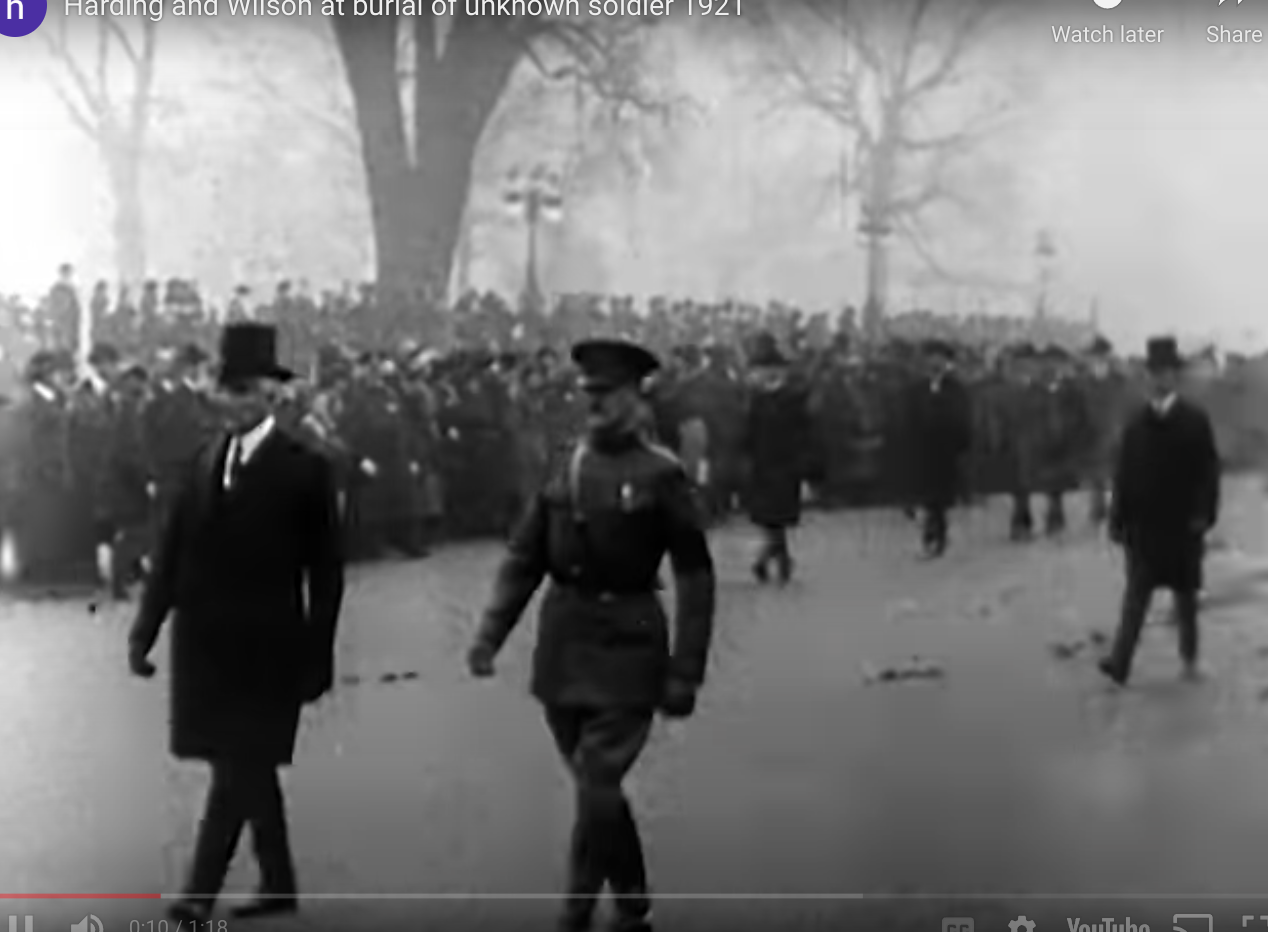
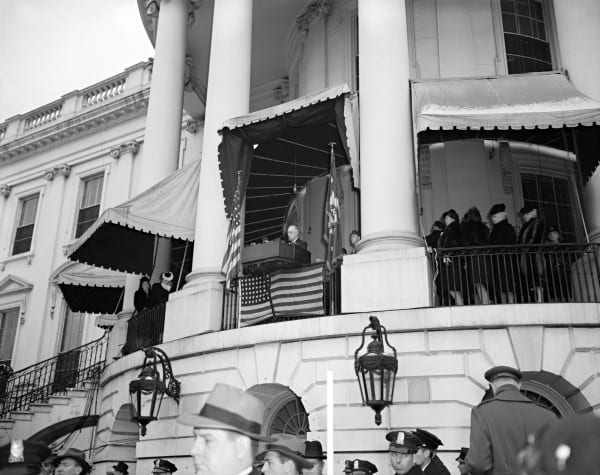
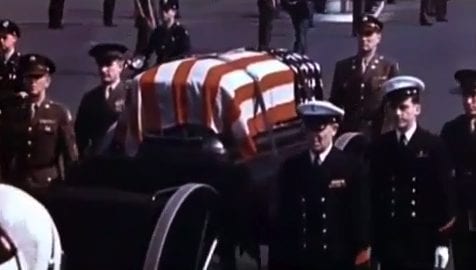
Here’s a video I came across on YouTube of the old president and recently inaugurated one attending the burial ceremony of the Unknown Soldier. President Wilson was instrumental in honoring those “unknown but to God” by having them interred in the Tomb of the Unknowns at Arlington National Cemetery.
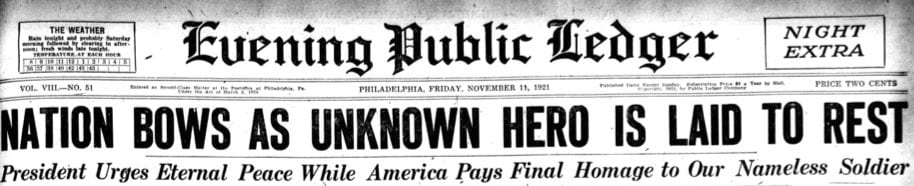
The ceremony made all the national and local evening papers that day. Below is Philadelphia’s Evening Public Ledger (for only 2 cents) from November 11th, 1921.
Evening Public Ledger – Friday, November 11th, 1921
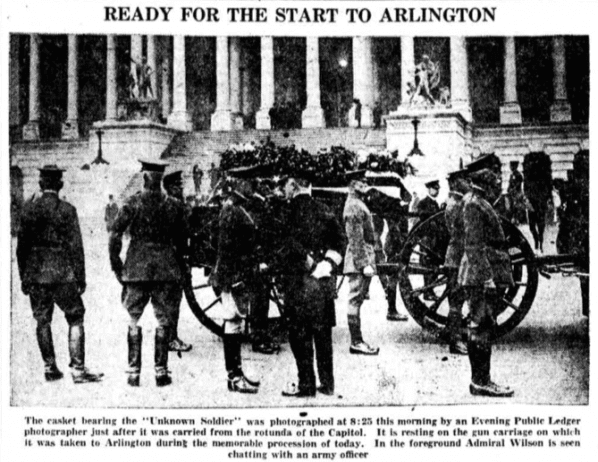
Below is the photo on the front page of the paper (sorry for the slow download – it’s slightly higher resolution). The photo was taken by the Public Ledger’s photographer as it was being removed from the Capitol, getting ready for the slow march to Arlington National Cemetery.
Ready for the start to Arlington – Unknown Soldier
On his last official day in office, March 4, 1921, Woodrow Wilson also set into motion another of our Veterans Day traditions, the honoring of those fallen in battle “unknown but to God.” As Wilson arrived at the Capitol for the inauguration of his successor, Warren G. Harding, he went to the President’s Room in the Senate and signed the legislation that designated the interment of the remains of an Unknown Soldier at Arlington Cemetery. Later that day, Wilson moved to his new home at 2340 S Street in Washington, which is now the Woodrow Wilson House. On November 11, 1921, former President Wilson attended the ceremonies in the Rotunda of the Capitol for the Unknown Soldier and later that day he returned to his home to greet the crowd that had gathered there.
Little known fact: Woodrow Wilson is the only president buried in Washington, D.C. He is buried in Washington National Cathedral.
UPDATE: I was just made aware of the Woodrow Wilson House blog. You should check it out and check out the house.
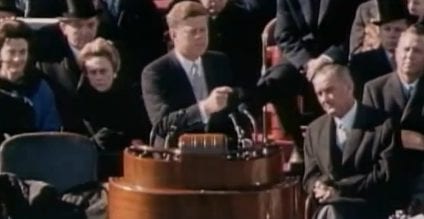
An in-depth look at one of the most powerful and important inaugural addresses of all time. Read the text or watch the full speech to see why this is something worth watching in its entirety. Includes a famous quote, start watching at 13:45.
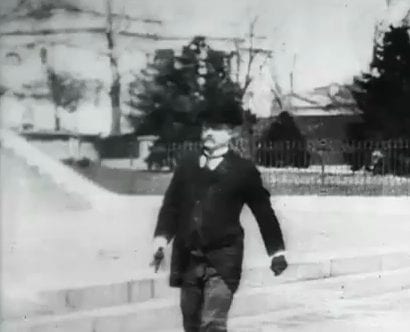
Mark this down as something you’ll never see today. The President is just walking out of the White House grounds … alone. Let’s be honest, any guy that takes a bullet in his chest and STILL gives a speech can kick anyone’s ass. He casually strolls south onto what appears to be E St.
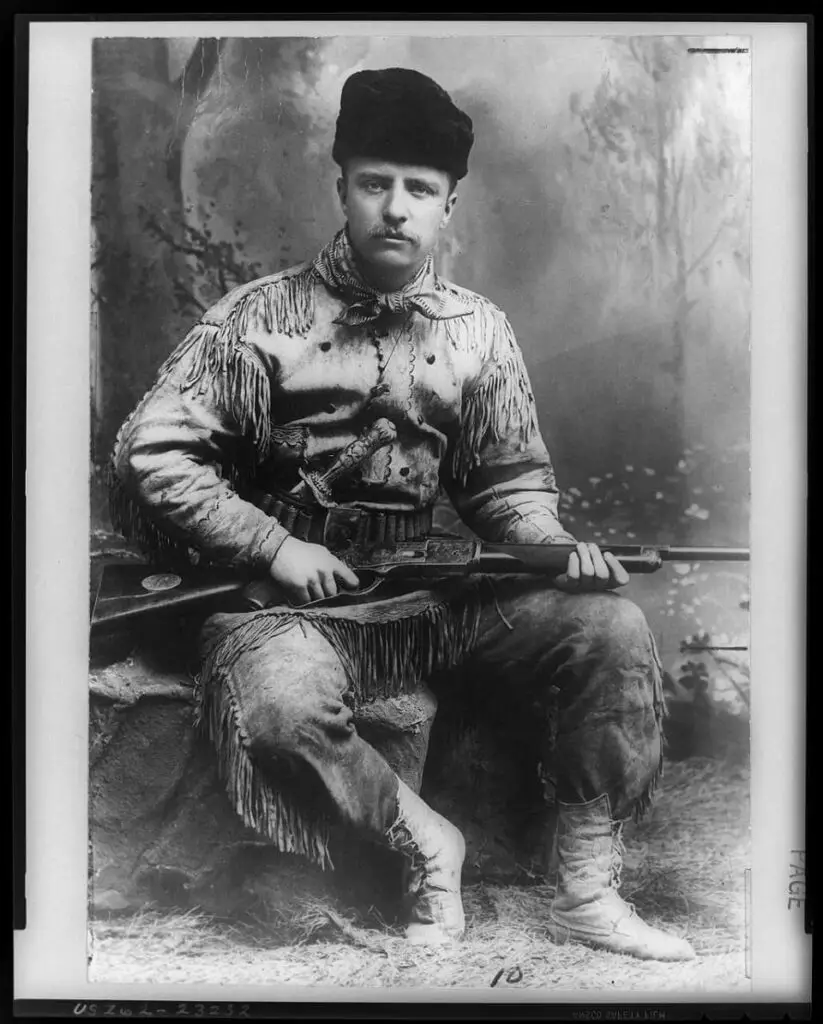
Here’s another photo of the 26th President of the United States. It was taken in 1885, ironically, in New York City.
Teddy Roosevelt poses for photo
The one below is probably the most iconic image of Teddy. This is his official White House portrait done by John Singer Sargent, which hangs in the East Room of the Executive Mansion.
Teddy Roosevelt official White House portrait (1903)
Roosevelt was a regular at the Five of Hearts salon at the Hay-Adams houses across Lafayette Square, the Richardson townhouses that came down in 1927 to make way for the hotel.
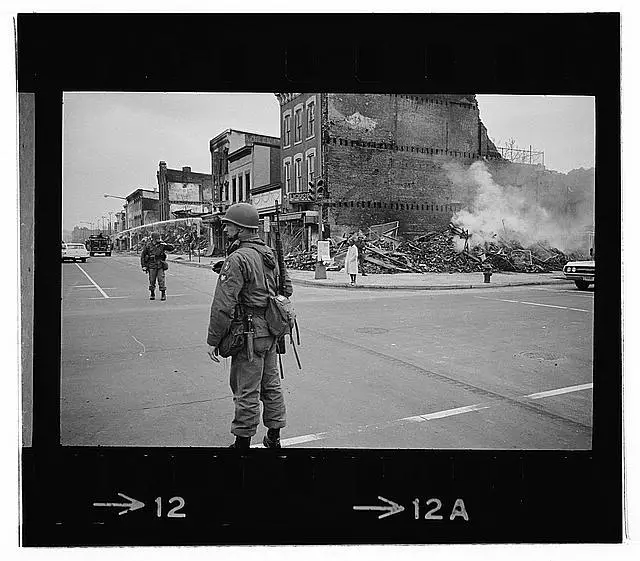
There’s a strong element of sadness watching this video. A burning city, military occupation … what essentially was complete chaos in the city from April 4th to April 8th, 1968, following the assassination of Martin Luther King, Jr. Economically it seriously devastated the corridors of 14th St NW, 7th St NW and H St NW. It has only been in the last decade that these neighborhoods have seen a significant resurgence. The damage to 14th Street NW in particular created the conditions for what became DC’s red-light district through the 1970s and 80s.
Here are a couple more photos of the riots.
Soldiers on guard in D.C.
Soldiers in the streets of D.C. (7th and N St NW)
Also check out these riot aftermath photos on Flickr.
When Theodore Roosevelt put his hand on the Bible at the East Portico of the Capitol on March 4, 1905, he was wearing a ring almost no one could see.
It contained a strand of Abraham Lincoln’s hair.
John Hay sent it over to the White House the night before. Hay had been one of Lincoln’s private secretaries in 1865 and was now Roosevelt’s Secretary of State. He had paid $100 for a few hairs clipped from Lincoln’s head after the assassination and had a jeweler mount one of them under a thin oval of glass and set it in gold.
Hay’s note to Roosevelt was three sentences. “Please wear it tomorrow,” he wrote. “You are one of the men who most thoroughly understand and appreciate Lincoln.”
Roosevelt wrote back that night. “Surely no other President, on the eve of his inauguration, has ever received such a gift from such a friend. I am wearing the ring now; I shall think of it and you as I take the oath tomorrow.”
Roosevelt had already been president for three and a half years by then. He had taken the oath for the first time on September 14, 1901, in a Buffalo parlor, hours after William McKinley finally died from the gunshot wound a self-described anarchist named Leon Czolgosz had given him eight days earlier.
Roosevelt was forty-two. He had been hiking on Mount Marcy in the Adirondacks when the news arrived, and when he came down the mountain he had to borrow a frock coat and four-in-hand tie to be sworn in. He inherited the office. He did not win it.
That gnawed at him.
In 1904 he ran in his own right against Alton B. Parker, a colorless New York judge the Democrats had nominated specifically to be the opposite of Roosevelt. The country chose Roosevelt by the largest popular plurality any candidate had taken to that point, more than two and a half million votes.
The night the returns came in he could not contain himself. “Tomorrow I shall come into office in my own right,” he told a friend the night before the inauguration. “Then watch out for me.”
Inauguration day was that day.
The morning of March 4
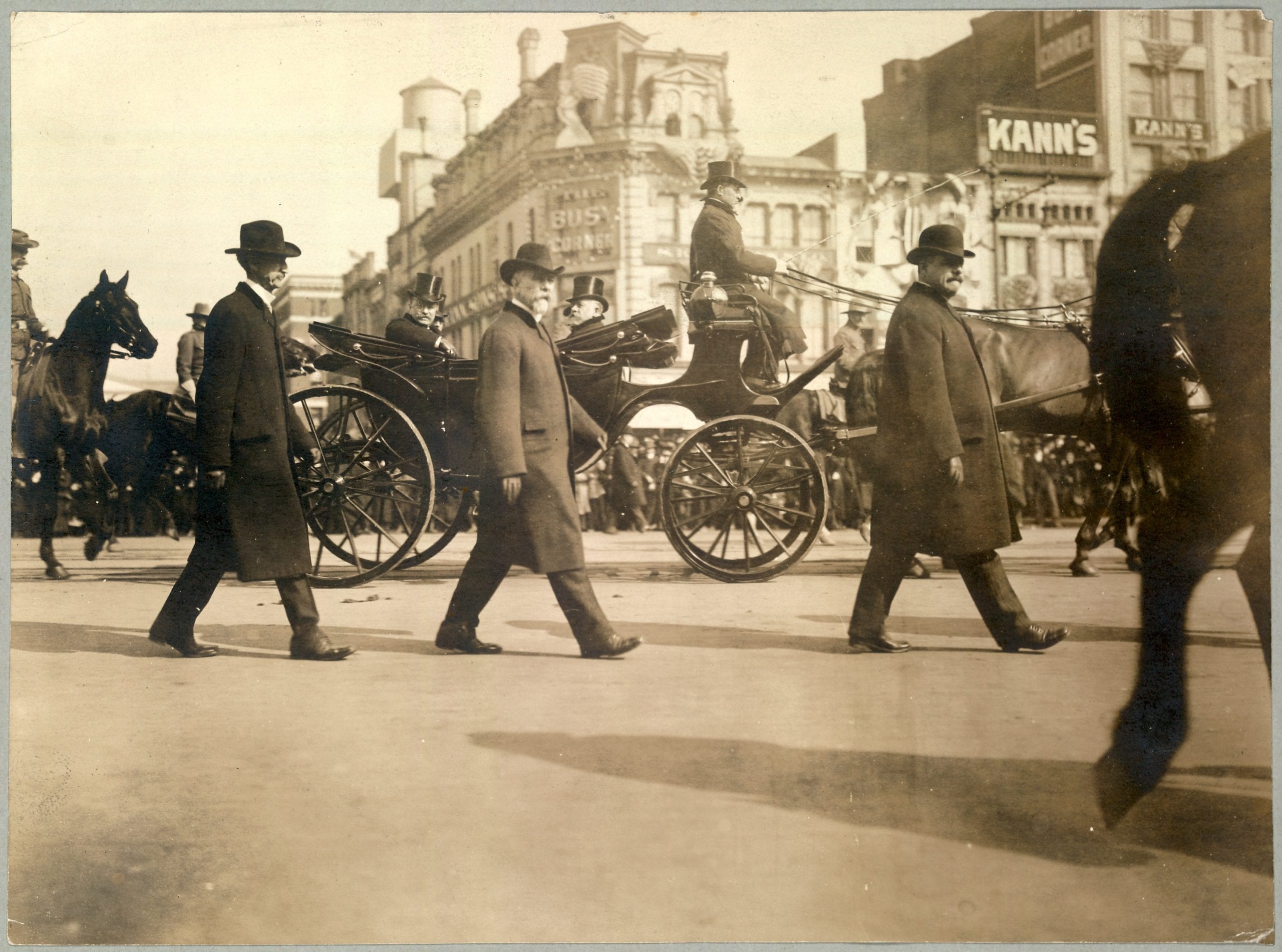
Roosevelt left the White House late in the morning in an open landau. The weather was cold and clear, the kind of bright early March day that flatters Washington when it does not turn ugly.
President Roosevelt in carriage en route to the Capitol, March 4, 1905. Library of Congress.
He rode up Fifteenth Street toward the Capitol with Senator John C. Spooner of Wisconsin beside him. Spooner chaired the Joint Committee on Inaugural Ceremonies and was largely responsible for the spectacle about to unfold. Senator Henry Cabot Lodge and Representative John Dalzell sat opposite.
Mounted Rough Riders escorted the carriage. Secret Service men walked on either side. Roosevelt tipped his hat to the crowds packed along the curb.
Edith Roosevelt rode in a separate carriage with the children. Theodore Jr. was seventeen. Kermit was fifteen. Ethel was thirteen. Archie was ten. Quentin was seven and would be photographed climbing all over the inaugural stand.
They would all be at the East Portico by the time the carriage pulled up. The Roosevelt children had spent the previous three years turning the White House into the most chaotic American household most reporters had ever seen, and they were not about to stop on inauguration day.
The route turned east along Pennsylvania Avenue at the Treasury and ran straight to the Capitol. Along the way Roosevelt waved at the West Point cadets and Annapolis midshipmen who were already lined up in their dress uniforms below the inaugural platform. The platform itself was decorated with potted plants and garlands. A large banner with the American eagle hung from the center of the railing.
Roosevelt stepped up to it just before noon.
The oath and the address
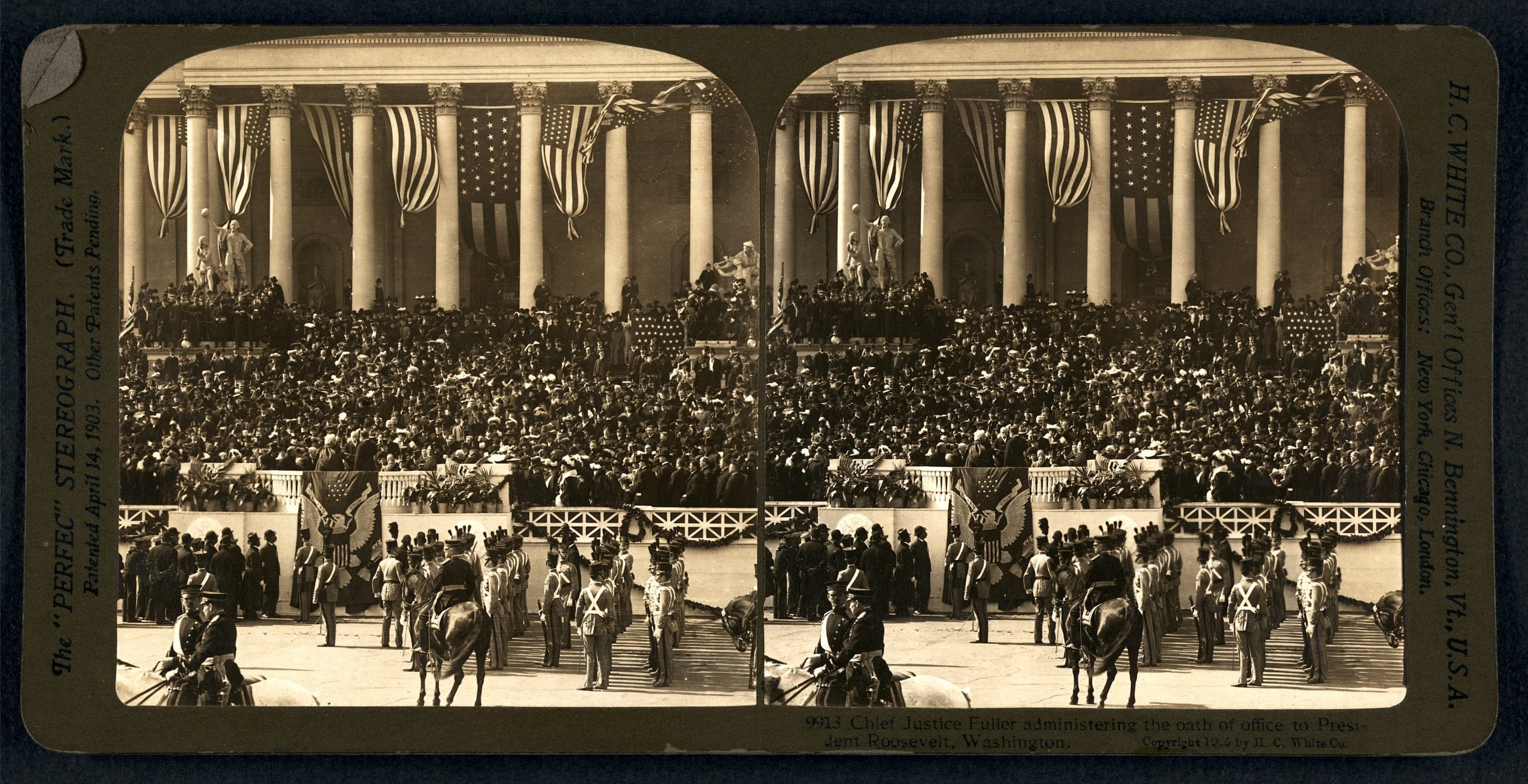
Chief Justice Melville Weston Fuller administered the oath. Fuller was seventy-one and had been on the bench since Grover Cleveland appointed him in 1888. He would hold the chief justiceship until 1910. James H. McKenney, Chief Clerk of the Supreme Court, held the Bible. Roosevelt placed his left hand on it. The Lincoln hair was on his right.
Chief Justice Melville Fuller administers the oath of office to Theodore Roosevelt on the East Portico of the Capitol, March 4, 1905. Library of Congress.
Then he gave the speech. It is short by inaugural standards, only about a thousand words, and it is almost entirely about what the United States now owed the rest of the world. Roosevelt opened with a kind of grace.
No people on earth have more cause to be thankful than ours, and this is said reverently, in no spirit of boastfulness in our own strength, but with gratitude to the Giver of Good who has blessed us with the conditions which have enabled us to achieve so large a measure of well-being and of happiness.
Then he turned to power. The country had become “a great nation, forced by the fact of its greatness into relations with the other nations of the earth.” It had to act like one.
We wish peace, but we wish the peace of justice, the peace of righteousness. We wish it because we think it is right and not because we are afraid. No weak nation that acts manfully and justly should ever have cause to fear us, and no strong power should ever be able to single us out as a subject for insolent aggression.
The crowd cheered hardest at “no strong power should ever be able to single us out.”
Roosevelt closed by tying the present to the founders and to Lincoln. He had been doing this all winter. He would do it again at lunch. The hair on his finger was the visible proof.
A few weeks later he signed a photograph of himself delivering the address with what would become the keystone of his second term in his own hand at the bottom: “In a Republic such as ours the only safety is to stand neither for nor against any man because he is rich or because he is poor… We must treat each man only on his worth as a man. We must see that each is given a square deal.”
The parade
Then came the part everyone had been waiting for.
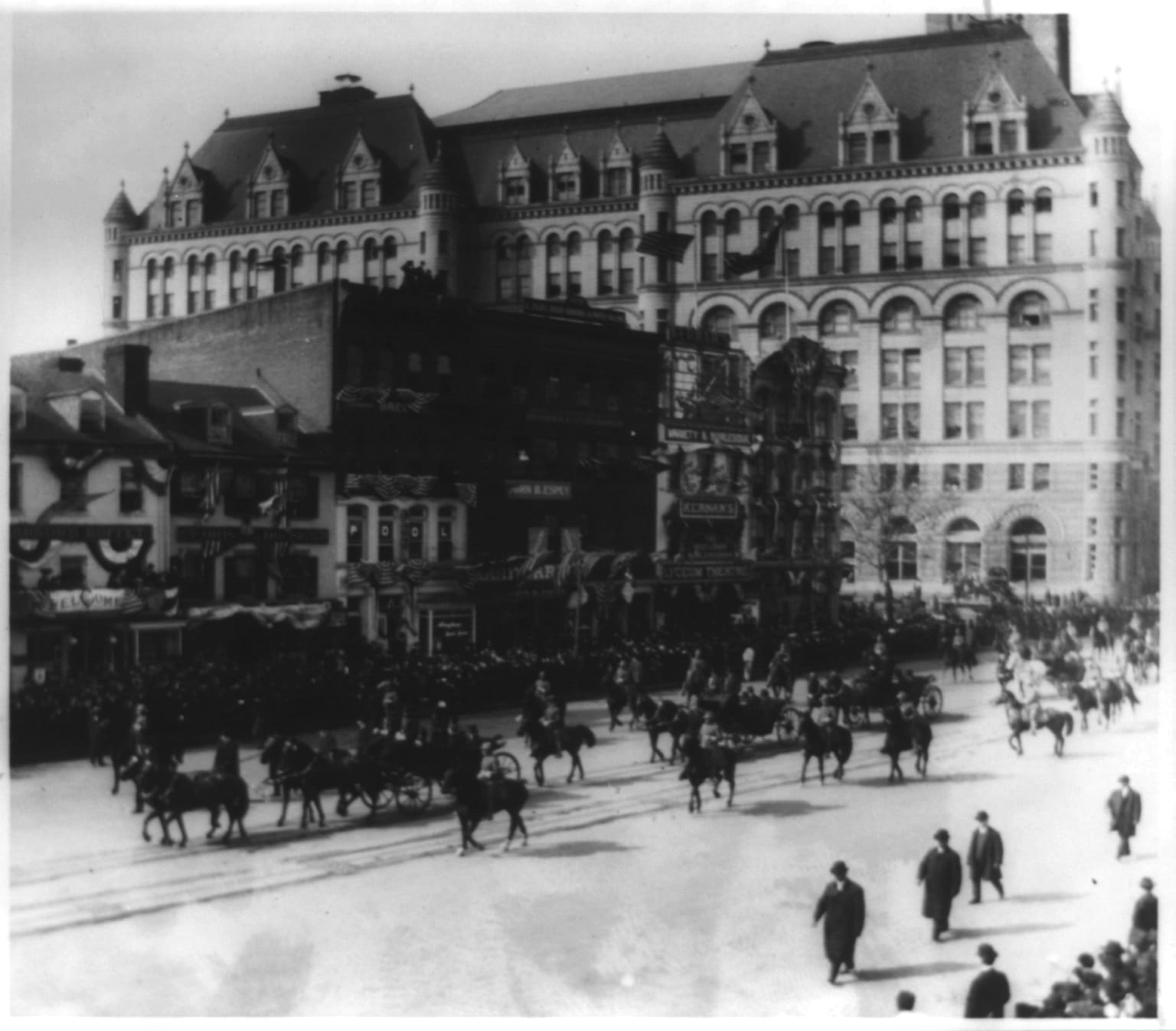
Contemporary press accounts put the parade at about 35,000 marchers. It was one of the longest in the city’s history to that point and possibly the most varied. He wanted it that way.
President Theodore Roosevelt passing 10th Street and Pennsylvania Avenue in the inaugural parade on the way to the Capitol. Library of Congress.
Squadrons of cavalry and infantry regiments came first. West Point cadets and Annapolis midshipmen marched in step behind them. The famed 7th Cavalry, Custer’s old regiment, rode the avenue, followed by Coast Artillery, state militia from every quadrant of the country, governors, mayors, Spanish American War veterans, fraternal lodges, college bands, fire companies, and Roosevelt’s own Rough Riders.
Black soldiers from the regular Army’s segregated regiments marched as well, including units from the 9th and 10th Cavalry, the Buffalo Soldier regiments that had served on the Cuban front in 1898 alongside Roosevelt’s Rough Riders.
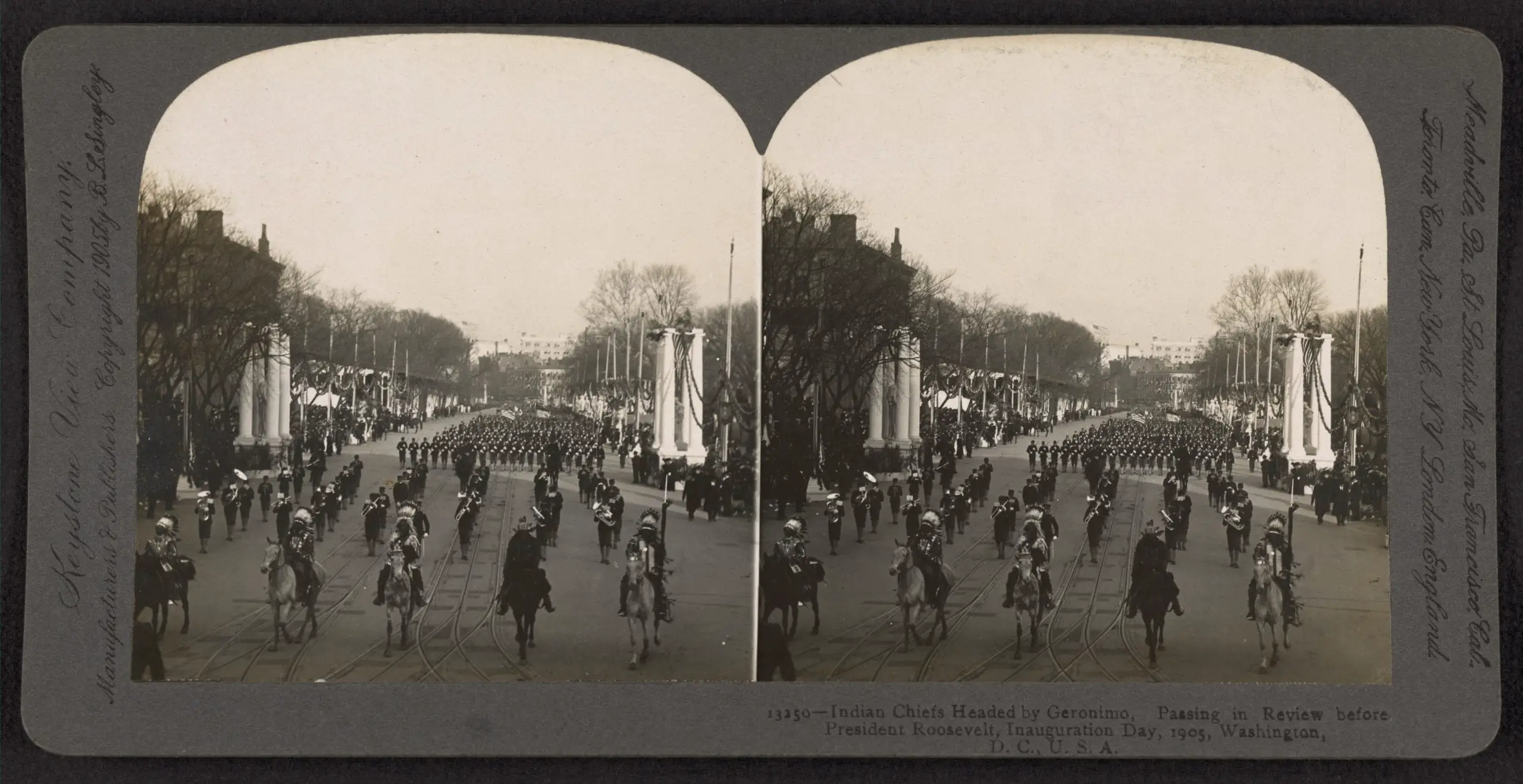
And then there were the cowboys, and Geronimo.
A detachment of Western cowboys, many of them Rough Riders alumni, rode the avenue in chaps and bandannas. Coal miners came in a marching block. Puerto Ricans came in another. The Carlisle Indian Industrial School sent 350 cadets, scrubbed and uniformed and marching in step, who got barely a mention in the papers because what came behind them stopped the parade cold.
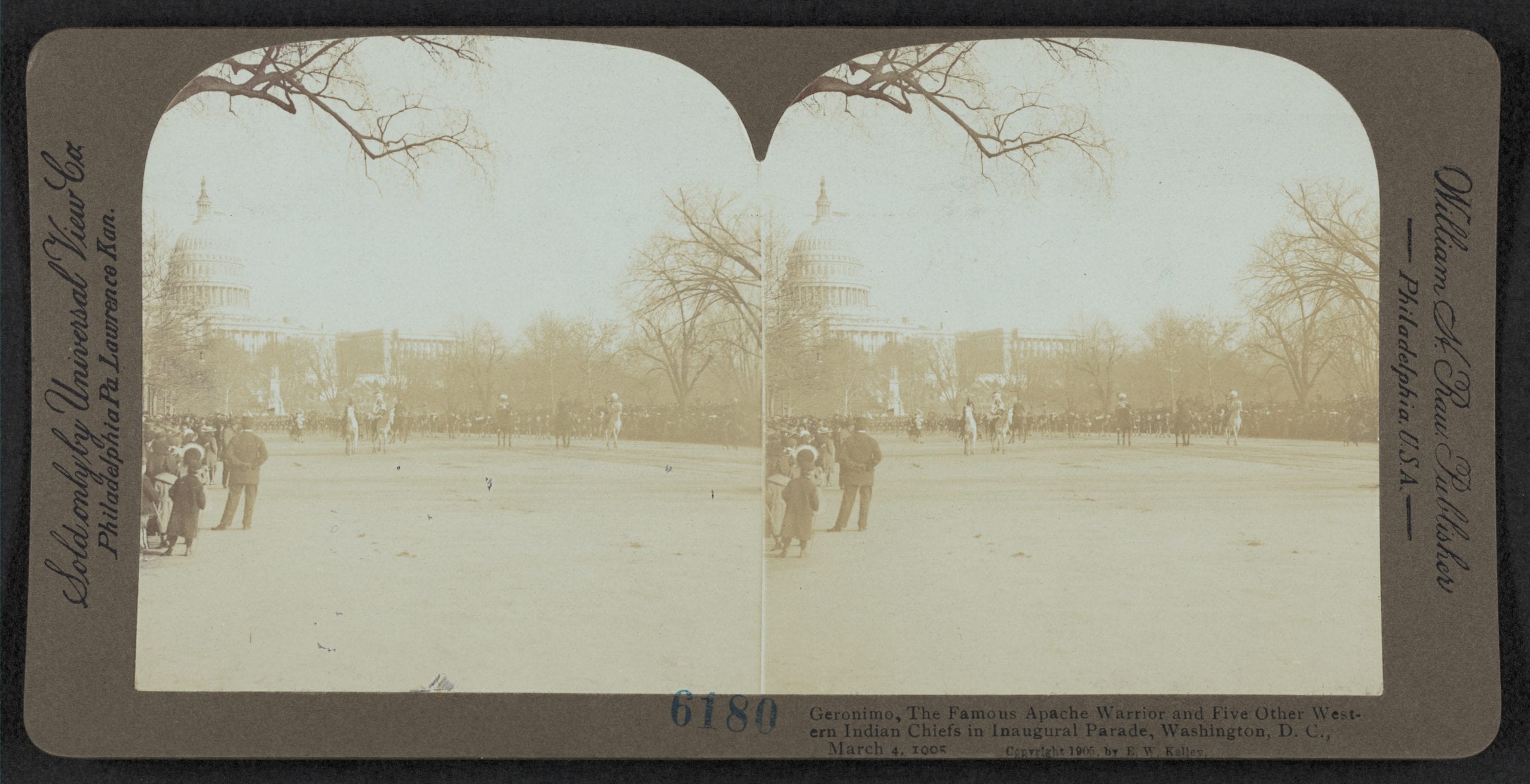
Six Native chiefs rode in single file, in full regalia, in headdresses, with face paint. Buckskin Charley of the Ute, American Horse of the Oglala Lakota, Quanah Parker of the Comanche, Geronimo of the Chiricahua Apache, Hollow Horn Bear of the Brulé Lakota, and Little Plume of the Piegan Blackfeet. Geronimo was seventy-five and had been a prisoner of war since 1886. He rode tall.
Geronimo and five other Western Indian chiefs in the inaugural parade, Washington, D.C., March 4, 1905. Library of Congress.
Woodworth Clum, a member of the inaugural committee whose father had captured Geronimo years earlier, asked Roosevelt directly why he had agreed to put the old Apache in the parade. The exchange got reported in newspapers across the country.
“Why did you select Geronimo to march in your parade, Mr. President? He is the greatest single-handed murderer in American history.”
“I wanted to give the people a good show,” Roosevelt replied.
That was true. It was also incomplete.
Later that week Geronimo went to the White House and asked Roosevelt through an interpreter to let him die in his own country. According to accounts of the meeting, he said: “Great Father, my hands are tied as with a rope. My heart is no longer bad. Let me die in my own country, an old man who has been punished long enough and is free.”
Roosevelt refused. He told Geronimo there would be too much trouble in Arizona if he went home. Geronimo died at Fort Sill in 1909, still a prisoner.
Indian chiefs headed by Geronimo, passing in review before President Roosevelt, Inauguration Day, 1905. Library of Congress.
The Keystone View Company and the Philadelphia publisher William H. Rau both put stereograph crews on the avenue and copyrighted images of the chiefs that spring. The H.C. White Company covered the swearing-in from the East Portico.
Their plates and prints went to the Library of Congress and most are still there. The pictures are the reason most people who know anything about the 1905 inauguration know about it at all.
The ball at the Pension Building
The parade ran into the early evening. Roosevelt and his party went back to the White House at dusk.
That night the inaugural ball was held at the Pension Building at 4th and F Streets NW. It was the great red brick hulk Montgomery C. Meigs had designed in the 1880s as a memorial to Civil War veterans and a working office for the clerks who processed their pensions.
Today it is the National Building Museum. In 1905 it was the largest interior space in the city, and inaugural committees had been using it for balls since Cleveland.
The Great Hall was banked in flags and bunting. Eight enormous columns rose out of the dance floor. Roosevelt and Edith made the rounds of the President’s box.
Newspapers reported the ball as “a scene of great splendor and brilliancy.” The next morning the city let the orphans of Washington in to see what was left of the decorations before they came down.
Then the new term began. Roosevelt would spend the next four years brokering peace between Russia and Japan, sending the Great White Fleet around the world, pushing the Panama Canal forward, busting trusts, and signing the Antiquities Act.
He would also become the first sitting American president to win the Nobel Peace Prize. By the time he handed the office to William Howard Taft on March 4, 1909, the country was a different one than the country he had inherited from McKinley.
The ring went home with him to Oyster Bay. The cowboys went back west. Geronimo went back to Fort Sill.
Watch as Franklin Roosevelt, the 32nd President of the United States, starts his fourth term at the White House during WWII. See the impressive video and photos, and learn more about this unique and muted event.
April 12th, 1945 was a sad day for our nation. Our president, who had led us through the depths of the Depression and was a force for good during World War II, died at 3:35 pm. He had just been inaugurated for a record fourth term and was guiding our country through the closing months of the greatest war the planet had ever seen.
This is a somber video of his funeral procession through the nation’s capital. The only other recent presidents to have a funeral on this scale were Kennedy and Reagan.
Below is a beautiful shot of the procession heading down Pennsylvania Avenue.
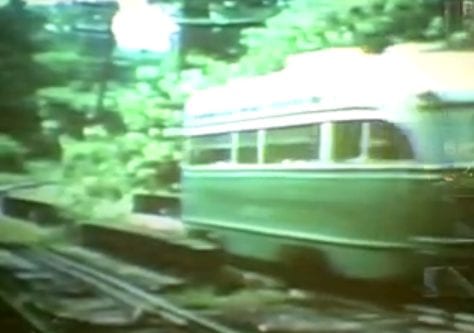
Here’s another cool old streetcar video. This is the The Washington & Great Falls Electric Railway line (“Cabin John Trolley”) from Georgetown. Disclaimer: the music is horribly cheesy, so you might want to mute it.
Here’s a little about it from Wikipedia:
Incorporated in 1892 and opened in 1895, The Washington & Great Falls Electric Railway began in Georgetown at 36th and Prospect Streets and ran in a private right-of-way along the lands of the Washington Aqueduct to Glen Echo and from there along the old tracks of the Glen Echo Railroad to Cabin John. Because the railroad never reached Great Falls, but instead terminated at Cabin John, it was often referred to as the “Cabin John Trolley”. It was acquired in 1902 by the Washington Railway and Electric Company. The railway was dismantled in the 1960s, but the former roadbed is still discernible in The Palisades and in Montgomery County, Maryland
The country was in mourning, having just lost our President a few weeks earlier in Dallas. This is a pretty somber, powerful and moving video of the Kennedy family leaving the White House and moving into their new Georgetown home at 3038 N St NW. There’s another shot of Jackie visiting JFK’s grave in Arlington Cemetery.