
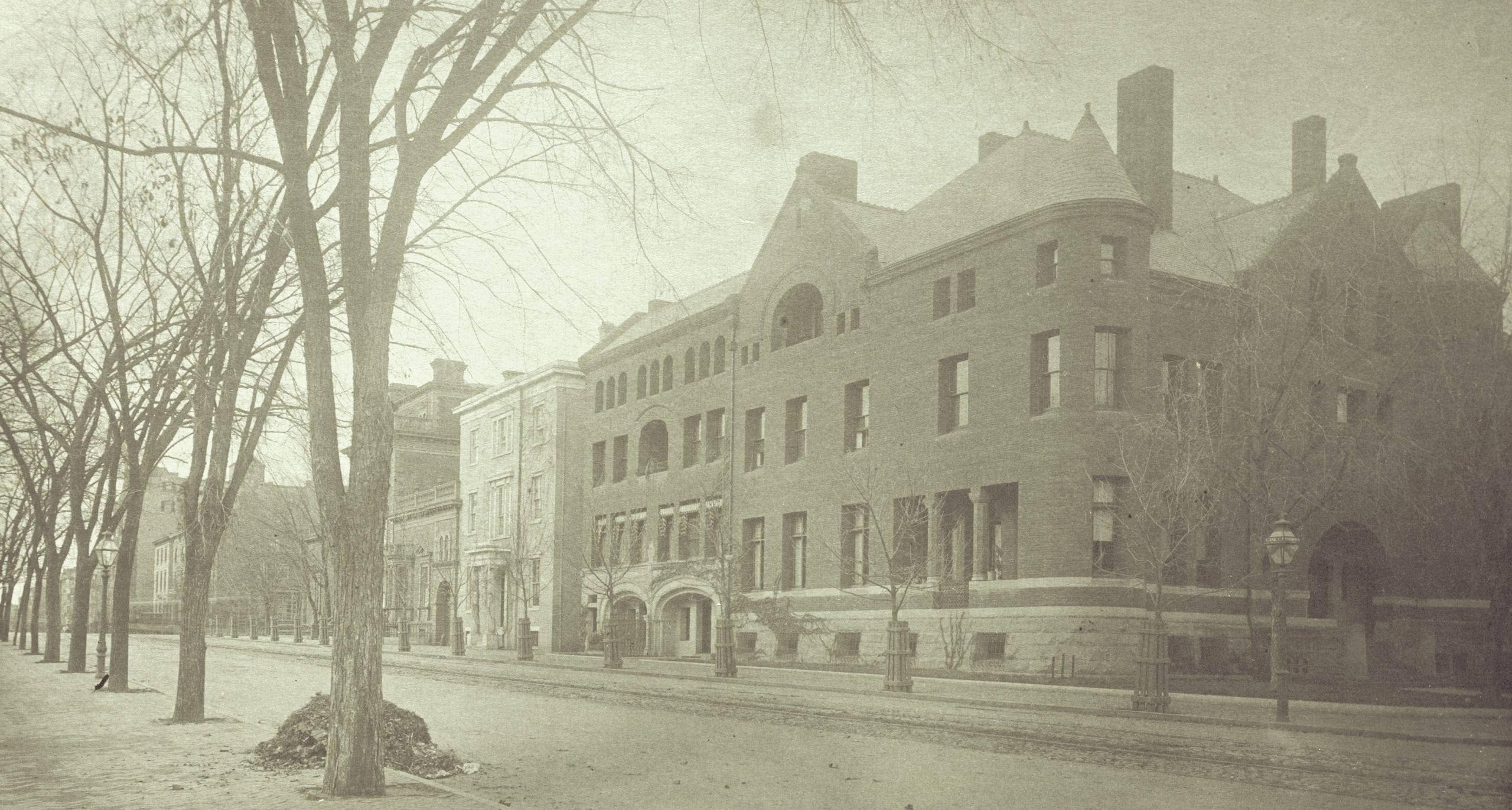
You can stand on the sidewalk at 16th and H Streets NW today, look up at the Italian Renaissance façade of the Hay-Adams, and miss the fact that you’re standing on the most consequential corner of Gilded Age Washington. Two friends built side-by-side mansions here in 1884. A statesman and a historian. Their salon hosted Theodore Roosevelt, Mark Twain, Henry James, and Augustus Saint-Gaudens. One of them buried his wife in Rock Creek Cemetery in December 1885, and she has supposedly never left the address.
The Hay-Adams Hotel opened in 1928 on the rubble of that story. This is how it got here.
The Five of Hearts arrive on Lafayette Square
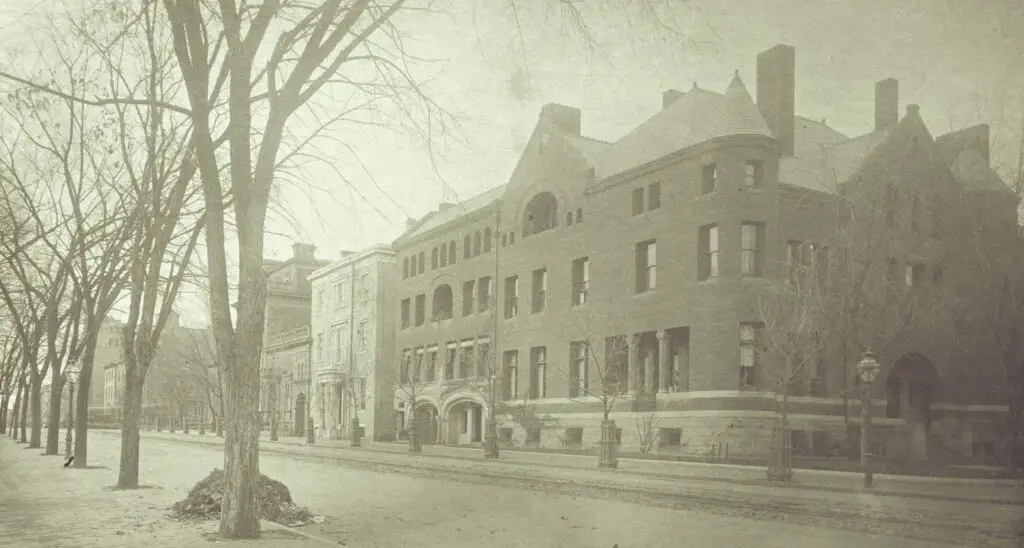
John Hay and Henry Adams were both born in 1838. Hay grew up in Indiana, went to Brown, and at twenty-two became Abraham Lincoln’s personal secretary in the White House through the Civil War. Adams was the great-grandson of John Adams and the grandson of John Quincy Adams, taught medieval history at Harvard for seven years, and by 1877 had moved to Washington with his wife Marian, who everyone called Clover. The two couples were already close. Add the geologist Clarence King to the table and you have what they jokingly named the Five of Hearts, an exclusive circle of five friends that ran one of the most influential salons in the city through the 1880s.
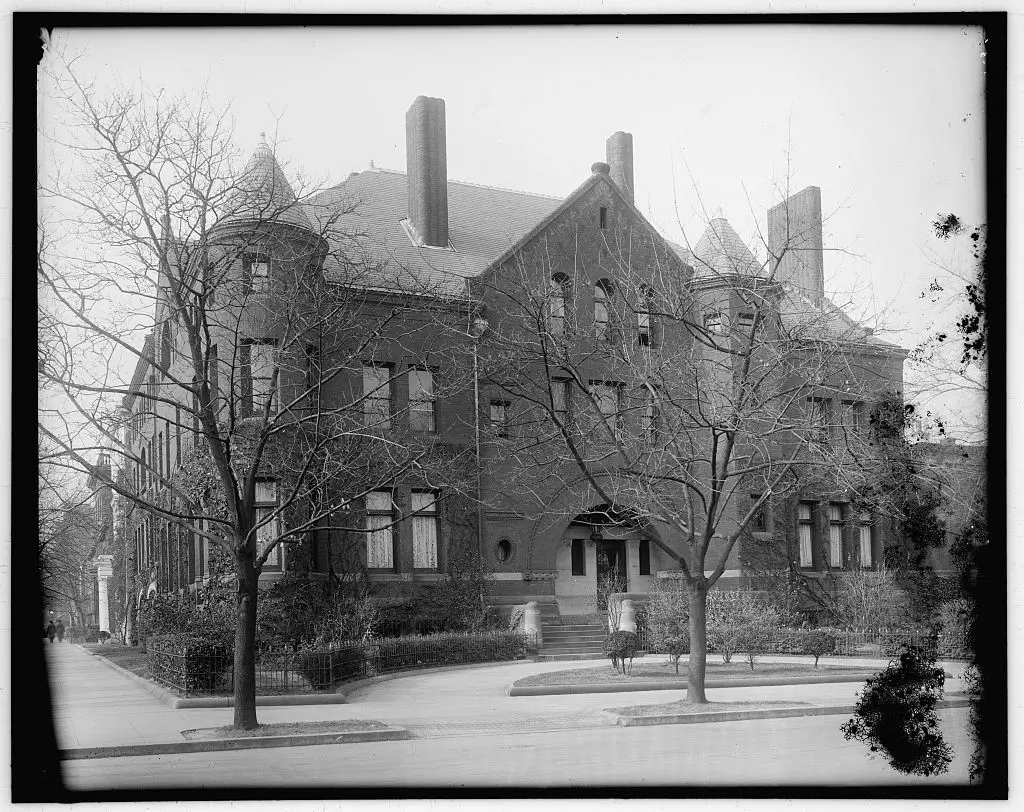
By 1884 the Hays and the Adamses had decided to live next door to each other on Lafayette Square. They hired Henry Hobson Richardson, the Louisiana-born architect already famous for Trinity Church in Boston and the Marshall Field’s Wholesale Store in Chicago, to design two attached Romanesque Revival townhouses sharing a façade at the northwest corner of 16th and H Streets NW. The Adams house, as Patricia O’Toole writes in her group portrait of the circle, was Clover’s project. Henry described what she wanted as “a Spartan little box.” The Hay house next door was larger, formal, and elegant.
Richardson designed only four houses in Washington, and these two were among them. Today just one survives: the Warder Mansion, which was moved stone by stone to 16th Street to escape demolition.
The houses were under construction through 1884 and into 1886. The friends rented a house nearby on H Street while they waited. Clover documented the construction with her camera.
Clover Adams, December 6, 1885
Clover Adams was forty-two years old in 1885, a Boston Brahmin who had reinvented herself in Washington as a hostess so sharp the novelist Henry James called her “a perfect Voltaire in petticoats.” She had taken up photography in 1883, taught herself the chemistry, and was one of the earliest American women working seriously in portrait photography.
Her father, the physician Robert William Hooper, died on April 13, 1885. Clover wrote to him weekly through her entire marriage. He was the only person to whom she signed her letters “Lovingly, Clover.” After his death she sank into a depression that Natalie Dykstra, in Clover Adams: A Gilded and Heartbreaking Life, describes as immobilizing.
On Sunday morning, December 6, 1885, while alone in the rented H Street house, Clover swallowed potassium cyanide, the chemical she used to develop her photographs. Henry found her on the bedroom floor. He ran two blocks down H Street to fetch the family doctor, C. E. Hagner. They returned to find her dead.
The morning papers protected her reputation. The Washington Post of December 7, 1885 ran the headline “Death’s Sudden Summons: Mrs. Henry Adams Stricken by Heart Disease.” The Evening Star of the same day reported “Sudden Death of Mrs. Henry Adams.” The cause given in both was “paralysis of the heart.” The New York Times of December 7 ran “Mrs. Henry Adams’s Sudden Death” on page one.
Is it any consolation to remember her as she was? That bright, intrepid spirit, that keen, fine intellect, that lofty scorn for all that was mean, that social charm which made your house such a one as Washington never knew before and made hundreds of people love her as much as they admired her.
John Hay, in a letter to Henry Adams after Clover’s death
Henry James wrote, more characteristically Jamesian, “poor Mrs. Adams found, the other day, the solution of the knottiness of existence.”
Henry Adams burned every letter Clover had ever written to him. He never spoke of her in public again. When he wrote his autobiography decades later, The Education of Henry Adams, his wife of twelve years does not appear on a single page.
The book won the Pulitzer Prize for Biography in 1919, the year after he died.
The houses Theodore Roosevelt walked into
The Hay-Adams houses were finished in 1886. The Adams house was at the corner of 16th and H, and the Hay house at 800 16th Street NW, where the hotel sits today. For the next forty years the two homes functioned as one of the most important addresses in American intellectual life.
The Hay-Adams Hotel’s own historical timeline records that the houses hosted “stimulating discussions about literature, art, science, and politics,” with guests including Theodore Roosevelt, Mark Twain, Henry James, and the sculptor Augustus Saint-Gaudens.
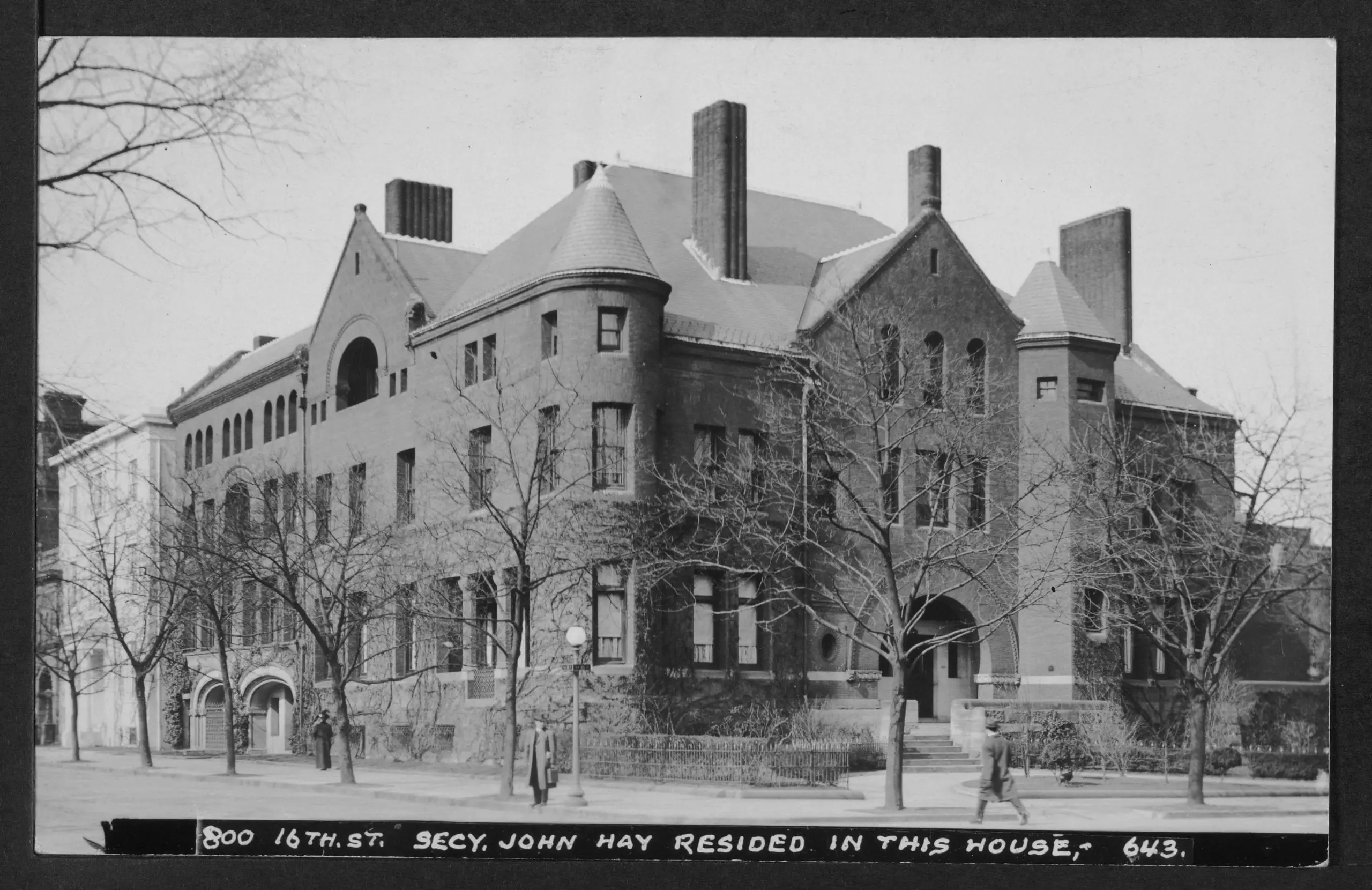
John Hay’s career kept climbing. President William McKinley named him Ambassador to the United Kingdom in 1897. After the United States won the Spanish-American War the following year, Hay became Secretary of State. He kept the job after McKinley’s assassination, serving under Roosevelt, and he negotiated the Hay-Pauncefote Treaty, the Open Door policy with China, and the Hay-Bunau-Varilla Treaty that secured U.S. rights to build the Panama Canal. He died in office on July 1, 1905.
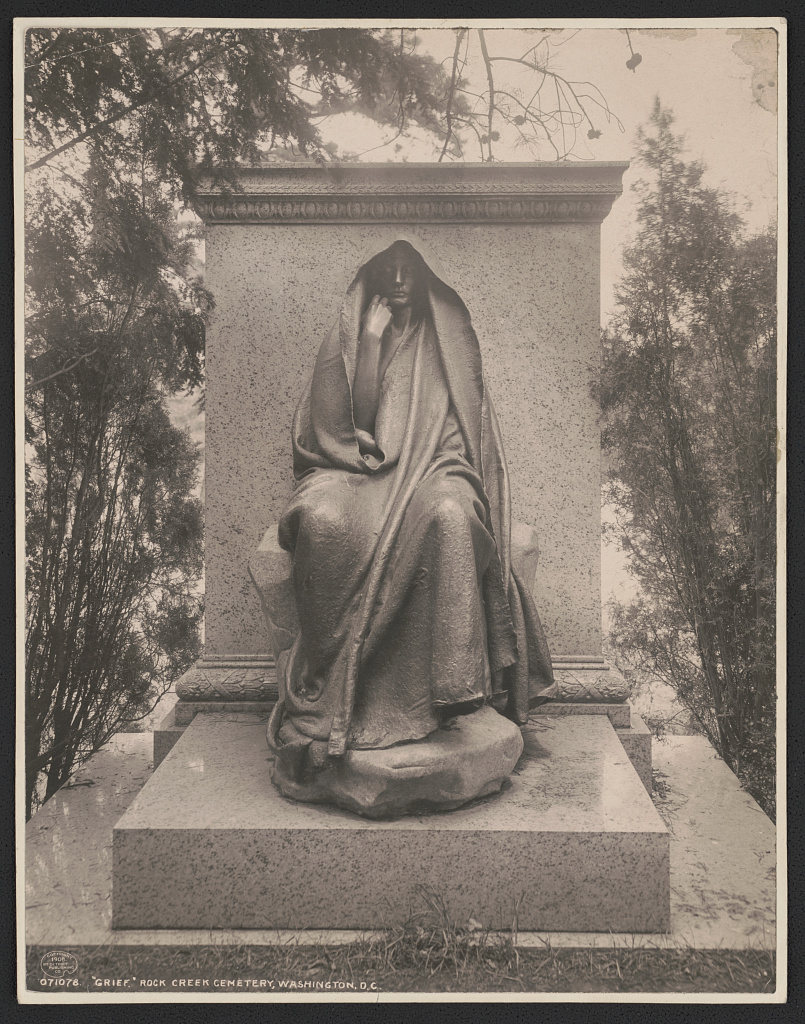
Henry Adams stayed in the house for another thirteen years, increasingly reclusive. He died on March 27, 1918. After Clover’s death, he had commissioned Augustus Saint-Gaudens to sculpt her grave marker in Rock Creek Cemetery, with architect Stanford White designing the setting. The result, a shrouded bronze figure that the newspapers immediately and against Saint-Gaudens’s wishes nicknamed “Grief,” sits in Section E of the cemetery to this day. It is generally considered Saint-Gaudens’s finest work. Henry Adams is buried beside Clover, unmarked.
After Henry Adams’s death the ownership of the two houses passed to John and Clara Hay’s daughter Alice and her husband Senator James Wadsworth, who leased the corner property to the Brazilian Embassy.
Harry Wardman tears them down
In 1927, the houses had a problem. Lafayette Square real estate was now worth more than the buildings on it. The Washington developer Harry Wardman, who built somewhere north of 5,000 buildings across the District in his career, bought the property from the Wadsworths and announced that the Hay and Adams houses would come down to make way for a 138-room apartment-hotel.
Wardman commissioned Mihran Mesrobian, the Armenian-born architect who had already designed the Carlton Hotel a block away, to draw the new building. James Goode’s Capital Losses, the standard reference on Washington’s demolished architecture, lists the Hay and Adams houses among the most significant losses of the period.
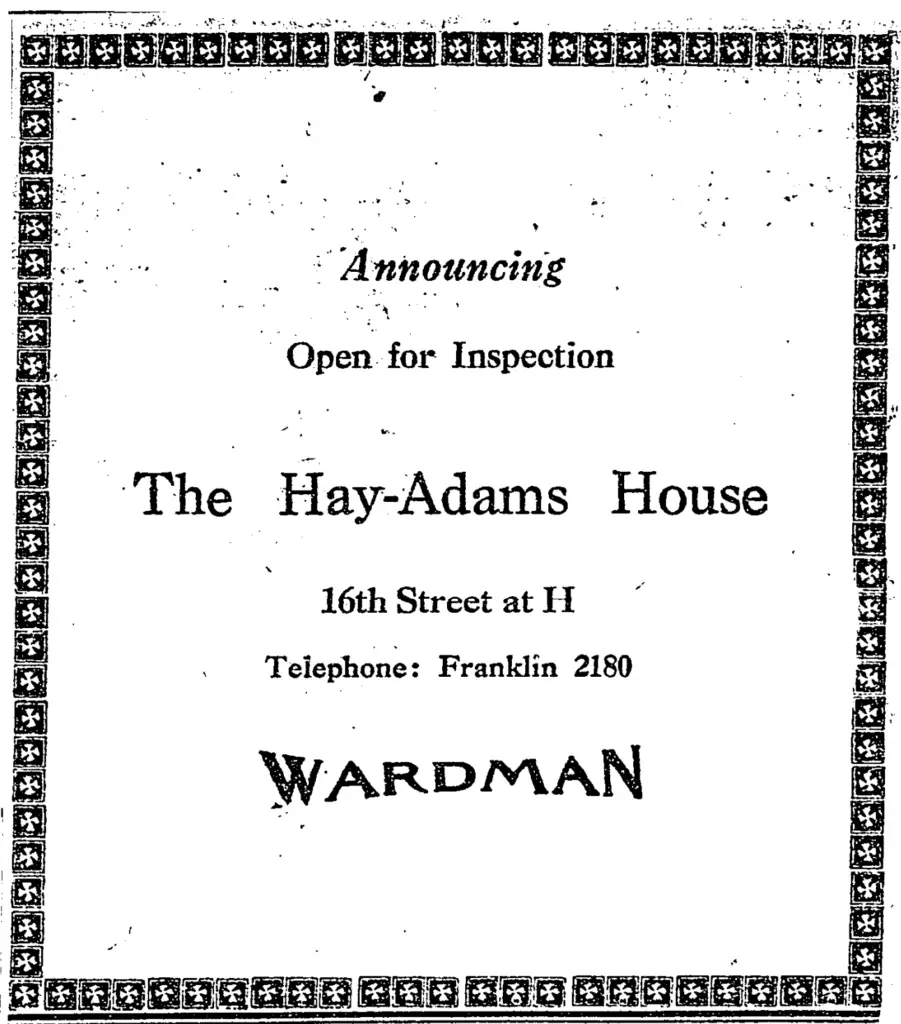
Craftsmen pulled what they could from the doomed houses before demolition began. Wood paneling and carved mantelpieces from the original Hay residence were repurposed into what is now called the Hay-Adams Room inside the hotel. Other architectural fragments were salvaged for two houses built in the Woodland-Normanstone neighborhood.
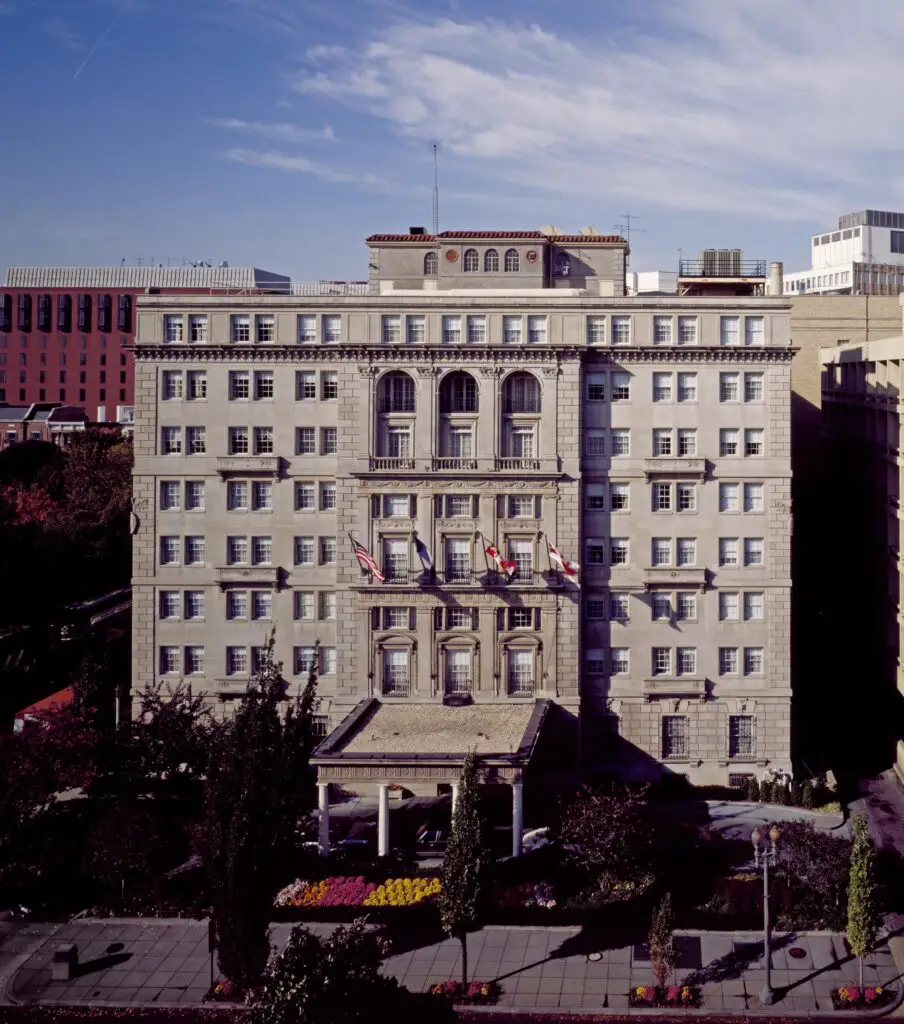
The Hay-Adams House opened in 1928. The $900,000 building was Italian Renaissance in style, with what the period descriptions called “walnut wainscoting and intricate ceiling treatments featuring Elizabethan and Tudor motifs.” The Doric, Ionic, and Corinthian orders all appeared in the lobby. The hotel’s marketing took aim straight at the political class: rooms came with kitchens, large suites, elevators, steam heat, circulating ice water, and starting at three dollars a night.
The early guest list, per the hotel’s own records, included Charles Lindbergh, Amelia Earhart, Sinclair Lewis, and Ethel Barrymore. In 1930 the Hay-Adams installed Washington’s first air-conditioned dining room.
The Depression nearly killed it
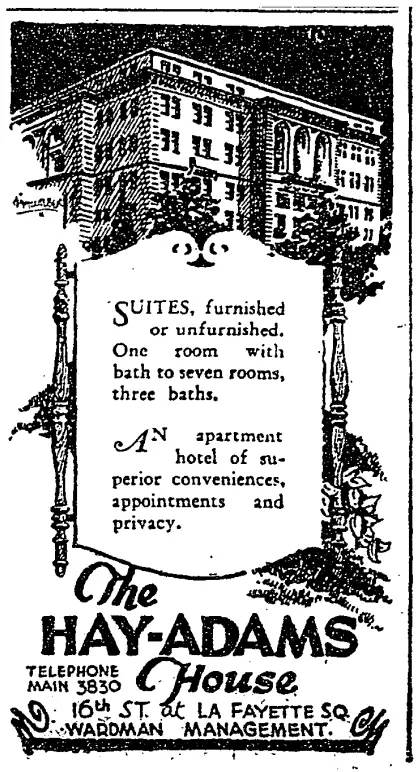
Harry Wardman’s empire collapsed in the Great Depression. He lost most of his hotel and apartment holdings in August 1930 and held onto the Hay-Adams House for two more years before defaulting on its loans. In 1932 the hotel went to public auction and was acquired by the Washington Loan and Trust Company, then quickly sold to the hotelier Julius Manger, who renamed it the Manger Hay-Adams Hotel and converted it from residential apartment-hotel to transient hotel. Manger added central air-conditioning and lived in the hotel until his death in March 1937. He was at the time the largest independent hotel operator in the United States.
The hotel changed hands several more times in the second half of the twentieth century, ending up under the B.F. Saul Company in 2006. A $20 million renovation in 2001 to 2002, led by the Washington designer Thomas Pheasant, kept the Italian Renaissance bones and added the Off the Record bar in the basement, which the hotel’s bartenders have spent the last two decades making the most reliably indiscreet room in Washington.
A presidents-elect address
The Hay-Adams sits across Lafayette Square from the White House. The hotel’s own slogan, coined in a Condé Nast press release in 2006, is “Where nothing is overlooked but the White House.” Presidents-elect have used it as a staging post when the Blair House across Pennsylvania Avenue is occupied. The Hay-Adams was a latecomer to a city whose 19th-century hotel scene was centered down on Pennsylvania Avenue, where the National, Brown’s Indian Queen, and the Southern had been demolished by the 1940s. President-elect Barack Obama and his family lived at the Hay-Adams for two weeks in January 2009 because the Blair House was booked. The fictional Frank Underwood, on House of Cards, took the same suite.
And Clover
Every December, near the anniversary of her death, hotel guests and housekeepers report the smell of bitter almonds in the fourth-floor hallways. Potassium cyanide smells like almonds.
Locked doors in unoccupied suites open. Radios click on by themselves. A woman’s voice has been reported in empty rooms, sometimes whispering housekeepers’ names, sometimes asking what they want. A few staff have described an invisible embrace.
The hotel is now in its tenth decade. Clover Adams has been the Hay-Adams’s most loyal guest for nearly fourteen.
Some of our stories are researched and written with help from AI, and checked by a person before they run. Here’s how we use AI.