It was a few minutes before 3 a.m. on November 11, 1984, when the dancers assembled on stage at Benny’s Home of the Porno Stars for their final number.
As an X-rated movie flickered unnoticed on a screen in the back, the dancers stopped periodically to hug one another, pose for snapshots, and lean over customers to have one last dollar bill tucked inside a black lace garter already bulging with cash. Benny’s, which billed its topless, bottomless show as “the most explicit on the East Coast,” was bumping and grinding its way to a halt.
By daybreak, developer Jeffrey Cohen was outside pulling down the awning.
If you walk down that stretch of 14th Street NW today, you know it as restaurant row. Doi Moi, Le Diplomate, Barcelona. Cocktails on rooftops. Brunch lines on Sunday mornings. It is basically unrecognizable from what stood there forty years ago. And the story of how it got from one to the other is one of the stranger chapters in Washington’s history.
Before the Riots
The 800 block of 14th Street NW wasn’t always Washington’s red-light district. According to Thomas Lodge, a neighborhood resident since 1952, the top entertainers in the country performed on that block in the 1950s. High-class entertainment, legitimate clubs, a real commercial corridor.
As the Vietnam era dragged on, the character of the strip started shifting. Lodge described it as evolving from high-class entertainment into “a kind of a place for soldiers on leave.”
As late as November 1969, the Washington Post’s late-night dining guide was still listing the Californian Steak House at 1522 K Street NW as a legitimate restaurant serving “steaks, chops, Italian food and seafood.” Benny’s Rebel Room, same block, was advertising “honky-tonk piano and ragtime tunes.”
Fine dining and ragtime piano. Hard to picture.
The Riots Changed Everything
April 1968. Martin Luther King Jr. is assassinated in Memphis, and Washington burns. The riots ripped through the commercial corridors on 14th Street, H Street, and 7th Street. Businesses closed. Property values cratered. Landlords stopped investing.
The result was cheap rent in a part of the city that had lost most of its legitimate commercial tenants. That vacancy didn’t stay empty for long.
By the early 1970s, sex businesses were filling the storefronts. Peep shows. Adult bookstores. Massage parlors. Strip clubs. The Casino Royal Adult Theatre anchored the corner of 14th and H streets NW. The block between H and I streets became what residents and police started calling the “combat zone.”
My father took me to the 1988 Washington Auto Show at the old convention center. We parked a few blocks away, next to an X-rated bookstore. I was a kid. I knew it wasn’t good.
What the Strip Looked Like
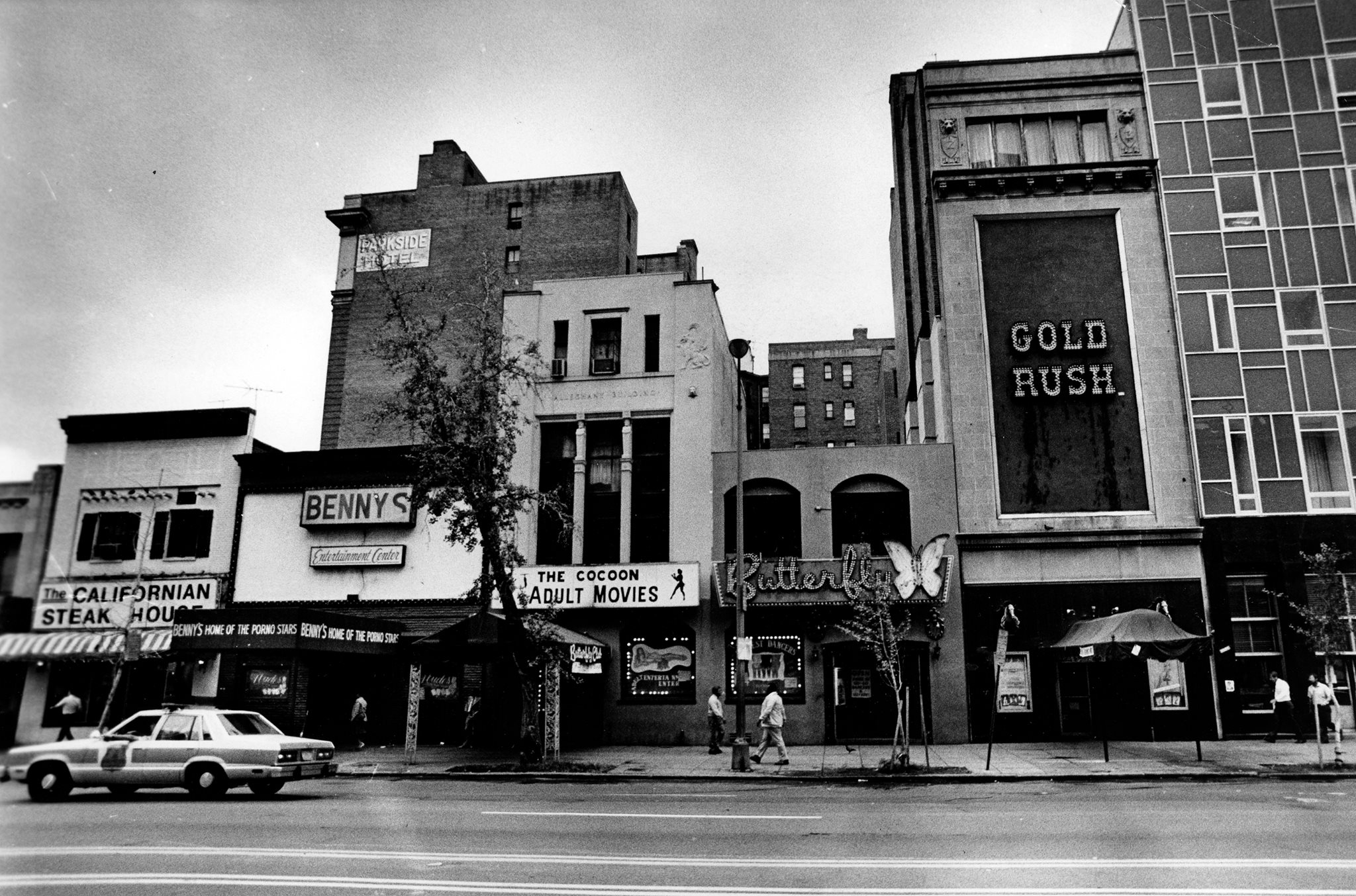
By 1982, the stretch running north from H Street was DC’s undeniable red-light district. Benny’s had rebranded from Rebel Room to Home of the Porno Stars. The Californian Steak House had ditched the steaks and installed a stage for topless dancing. The Cocoon, The Butterfly Club, the Gold Rush bar. All operating in roughly the same blocks.
In October 1983, the Washington Post described the strip as “as much a monument to free enterprise as a testament to free thinking.”
One of the strip’s owners summed up the situation pretty clearly. Sitting in a cramped office at the Gold Rush, dressed in a three-piece suit, he leaned back in his chair and smiled: “A half-million dollars. It would take a half-million dollars to buy me out.”
He wasn’t far off about the price. He was wrong about whether anyone would pay it.
The Law That Nobody Used
D.C. had actually passed zoning regulations in 1977 prohibiting sexually oriented businesses from operating in most of the city. Under the rules, adult shops and massage parlors couldn’t open within 300 feet of each other, or within 600 feet of a church, public building, or apartment building.
No permits for new establishments were ever granted after 1977. Existing businesses were grandfathered in but couldn’t expand.
The 1978 Washington Post described the political calculation:
The rising tide of development in downtown Washington is about to break over a barrier to business for nearly a decade—the red light district along 14th Street N.W. Today 14th Street’s sleezy sex shops, running north from H Street NW, are considered the most obvious roadblock to the spread of redevelopment eastward into the old downtown. But optimistic developers contend economics will eventually accomplish what law enforcement has failed to do—drive out the peep shows, “book stores” and other fronts for the sale of sex material.
The city’s approach was what planners called “the Detroit approach” rather than a “combat zone” approach. Instead of designating a specific area for sex businesses, the goal was dispersal. Don’t concentrate them; spread them out until they disappear.
For years, the city mostly ignored the 1977 rules. The strip was contained. Nobody wanted to figure out where everything would go if they actually enforced anything.
Then the real estate developers showed up, and suddenly the law was very useful.
The Developer Who Bought the Block
Jeffrey Cohen was 21 when he bought his first property in 1971 for $24,000 and flipped it six weeks later for $36,000. By the early 1980s, he was one of Washington’s most aggressive developers.
Starting in 1978, Cohen quietly started buying properties along the strip. The Parkside Hotel on I Street. The buildings housing Benny’s. The Californian Steak House. The Cocoon. The Butterfly Club. The Gold Rush. By 1985, he controlled what would become a $12.5 million deal.
His timing was almost too good. The Franklin Square area was booming. The new Convention Center had opened blocks away. Metro Center station sat two blocks south. An estimated 1 million square feet of office space had been leased in the area in 1982 alone.
One thing stood in the way: the strip.
In 1981, major downtown developers formed the Franklin Square Association with an $80,000 budget funded mainly by real estate interests. Their stated mission was to clean up the area’s image. Their actual mission was to clear valuable land.
The Legal Siege
The campaign started in earnest in January 1984 when the Franklin Square Association challenged liquor licenses for The Butterfly at 823 14th Street and This Is It? at 813 14th Street. They hired private investigators. They submitted 34 letters from businesses claiming their employees were being harassed by club barkers on the sidewalks.
The clubs fought back. Samuel Intrater, representing The Butterfly, argued that while the shows were sexually explicit, they weren’t “patently offensive” under community standards.
The real breakthrough came through the Californian Steak House.
Cohen, who owned the building, complained to zoning officials that the Californian violated the 1977 regulations. The restaurant had converted to topless dancing while still operating under a restaurant certificate. The owners’ lawyer argued that unclothed dancers weren’t sexually arousing unless they touched patrons.
The D.C. Board of Zoning Adjustment was not convinced. In a “graphically worded 14-page ruling” issued November 22, 1983, the board concluded that “the positions assumed by the women and the manner in which the women displayed themselves are clearly designed to stimulate or arouse patrons.”
On December 2, 1983, officials physically shut down the Californian. The first time the city had ever taken such action. Police escorted Department of Consumer and Regulatory Affairs officials as they revoked the certificate of occupancy.
Once the precedent was set, it moved fast.
The Cascade
On July 18, 1984, the Alcoholic Beverage Control Board denied This Is It?’s liquor license renewal, ruling the club didn’t operate as a bona fide restaurant. First time a topless club lost its license based primarily on sexual content.
The Butterfly Club and The Cocoon faced federal forfeiture after their owners, Abraham and Isidore Zaiderman of Potomac, pleaded guilty to using the premises as fronts for prostitution.
El Ceazar’s Palace at 1016 14th Street closed when the landlord razed the building. The Golden Eagle at 1411 I Street voluntarily converted to a restaurant.
By November 1984, only Benny’s remained.
Benny’s Last Night
Owner Roger “Roddy” Simkins Jr. stood by the bar, shaking hands with regulars who had stopped in to offer condolences. “This strip, for all intents and purposes, is already gone,” he said.
Then the dancers assembled on stage for the last time.
The next morning, Cohen was outside pulling down the awning. Fifty volunteers from the Franklin Square Association arrived to clear broken bottles from the curbside and paint a billboard reading: “Franklin Square: Washington’s Next Great Neighborhood.”
Demolition
On April 2, 1985, the Washington Post announced that Trammell Crow Co., one of the nation’s largest developers, had purchased Cohen’s properties in a $12 million joint venture. The deal included the hotel, the boarded-up nightclubs, and plans for a major office building.
“This is significant because it represents Trammell Crow’s entry into the hottest real estate in the area,” said Arthur Schultz, the Franklin Square Association’s executive director. “They will bring an end to 14th Street as we know it.”
By April 1986, Benny’s, the Californian, The Cocoon, and The Butterfly had been reduced to twisted steel and shattered bricks. Lt. Robert Poggi of the city’s prostitution task force described the impact: “Our experience has been that sexually oriented businesses are fronts or contact places for prostitution. Without a concentration of adult clubs, potential customers won’t have the incentive to drive downtown.”
He also noted that traffic jams had decreased, along with drug sales and assaults associated with the area. But he stopped short of claiming the activity had been eliminated. Dispersed is the word he used.
Cohen, who spent years as the crusading landlord fighting to evict his own tenants for moral violations, had already cashed out, pocketing millions on the same properties he’d cleaned up. His 1985 Washington Post profile quoted him saying: “If I can do something good and help bring that area back… that’s what I’m turned on about doing.”
He was also turned on about the money.
Roddy Simkins, the last man standing at Benny’s, had the final word: “I think that certainly there were people who got their start there, one way or another. But I don’t think the city has lost anything.”
By then the strip was already rubble.
What’s There Now
The block where Benny’s, the Californian, The Butterfly, and the Gold Rush once operated is now office towers, a hotel, and the kind of restaurants where you make a reservation two weeks out.
The upper stretch of 14th Street, running north from U Street, is a different story. That’s the one you know from weekend nights, from brunch, from all those rooftop bars. We’ve documented what the corridor looked like right after the 1968 riots, which is about as far from today as you can get.
The whole episode is one of those Washington stories where moral and economic interests lined up perfectly, and nobody had to pretend they were in conflict. The Franklin Square Association cared about quality of life. The developers cared about property values. The city cared about tax revenue. Everybody got what they wanted.
Except maybe Roddy Simkins. But he seemed at peace with it.
If you want another slice of old 14th Street before it went corporate, the Pearl Dive building has its own strange history that goes back well before the oyster bar moved in.
At 14th and Mass, cars with Pennsylvania and Delaware plates would circle for hours, negotiating deals with the ladies. Thank goodness it’s all indoors at massage parlors now.
I prefer it.
Sure, it may have been “unwanted” to some, but it never would’ve survived in that area if they had no customers.
The late 70s were a time of transition for downtowns…it wasn’t just here in DC. White flight, civil unrest, no historic preservation to speak of, and cities with no budget for clean-up, etc. only pushed this sort of business environment. Also, remember, the VCR was still a few years away so if you wanted porn you went to a movie theatre or a book store.
I’ll take today’s 14th St over that one anyday.
I don’t know, if they can manage to keep a little of old Chinatown in Chinatown, they should keep a little of the porn district on 14th Street. It’s unfortunate that the powers that be get to decide which parts of history are remembered, and which parts are swept under the rug.
White flight was starting to wind down in the 1970s. That was when middle class African-American flight to the suburbs started ramping up, culminating in the crack epidemic and Murder Capital status in 1990.
I remember those times as there were red-light pockets throughout the city.
>14th and H Streets, NW a few blocks from the White House.
>9th and F Streets, NW across the street and few blocks from the FBI building
>8th Street and Pennsylvania Avenues few blocks from the US Capitol
Does anyone remember Chesty Morgan?
“If you lived in or visited Washington in the 1970s or 80s you probably remember how nasty this city was.” What an over-broad dumb generalization.
Yeh, I remember her. Here she is today in her 70s.
http://www.tampabay.com/features/humaninterest/chesty-morgan-a-life-more-than-skin-deep/1058097
If you go back in history you will see that DC has has a strong red light district even in the 20s 30’s and 40s maybe even earlier.
I helped build th
e 14th Street strip. My stepfather owned all of it.I worked there as a teenager. I managed Adam and Eve bookstore .And worked on the construction of the Casino Royale theater. Even run the movies there.worked the strip bars and massage parlors . It was one hell of a ride .
From 1970 to 1973 I was a DC police officer, the 800 block of 14th St NW was part of my beat, needless to say the area has changed quite a bit, I would say for the better.