
Smithsonian
Since James Smithson’s bequest established the Smithsonian Institution in 1846, the organization has grown from a single building on the Mall to a complex of museums that defines how the world experiences American history and culture. These posts explore the history of the Smithsonian’s buildings, collections, and the stories behind the institution itself.

A photograph from the Smithsonian Institution Archives, taken from the Castle around 1900, shows the National Mall as a working industrial yard: the old Botanic Garden greenhouses in the foreground, Baltimore and Potomac Railroad tracks cutting across the grass, the Capitol on the horizon. Within a few years the McMillan Plan would erase all of it.
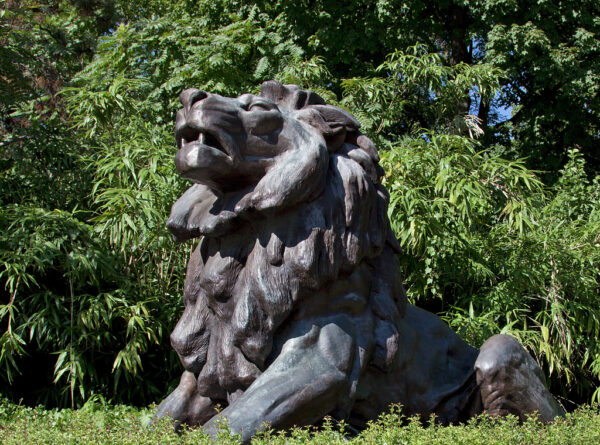
Margaret Davis King was found dead in the National Zoo’s lion exhibit in March 1995. Reporting on her final days revealed her request for help with an apparent custody dispute and questions officials could not resolve.

William Hornaday penned live bison behind the Smithsonian Castle in 1886 to save the species. The Mall menagerie became the National Zoo by 1889.
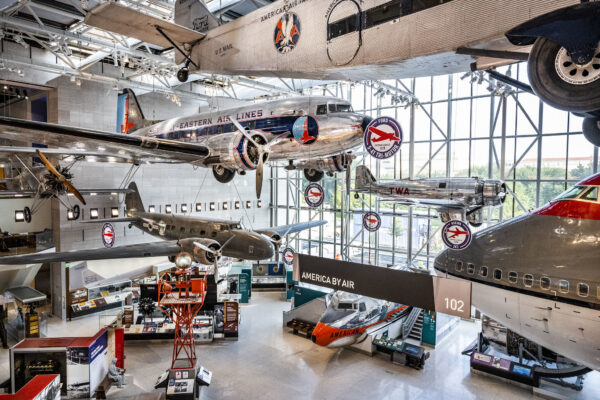
Plans, funding delays and design revisions preceded the National Air and Space Museum’s opening on the Mall in July 1976.

A photograph of the Smithsonian Castle taken around 1867, just two years after the Civil War ended. The red sandstone building was barely a decade old.
Lost Washington stories, in your inbox.
The newest story, plus a few from the archive.

Did you know our greatest museum was funded by and named for an Englishman who never set foot in the United States? Read up on the origins of the Smithsonian and how it was born in our nation’s capital.
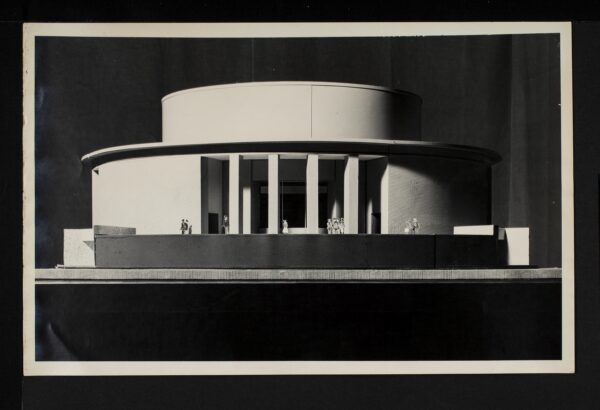
The Smithsonian’s Air and Space Museum opened on the Mall on July 1, 1976, after 18 years and dozens of rejected designs.
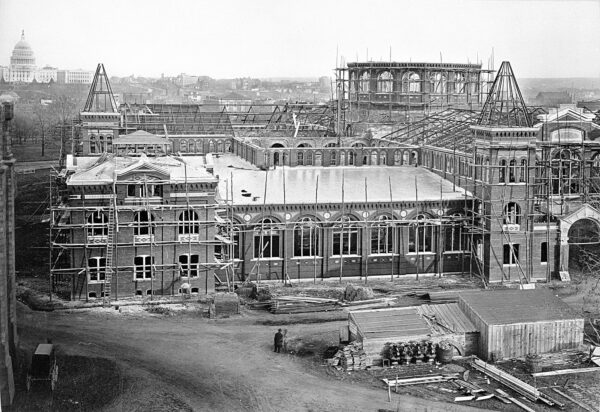
An 1878 rendering, an 1879 construction photograph and a finished view show the Arts and Industries Building taking shape.

An 1856 photograph records the Smithsonian Castle early in its history.

In 1846, an open design competition could have given Washington a very different Smithsonian Castle. One rejected design became a church. The church became a parking lot.

An 1863 view east up B Street, now Independence Ave, shows the Smithsonian Castle before a January 1865 fire destroyed its central roof and tower caps.

An early 20th-century photograph looks across the Mall from the Smithsonian.
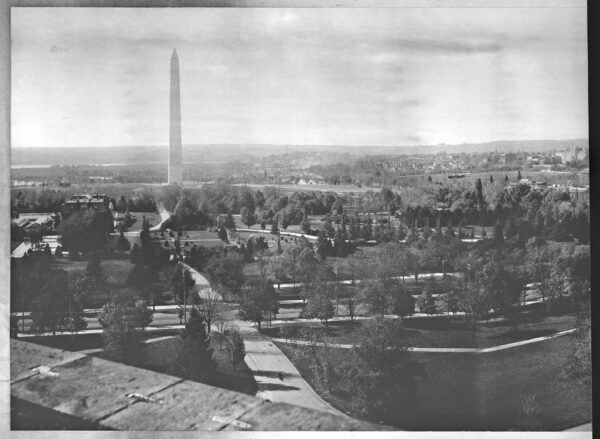
Four panoramic photos William Henry Jackson took in 1886 from a Smithsonian tower, showing the Ellipse, Center Market, the Pension Bureau and the Capitol.

One of the earliest known photographs of Washington, taken in 1857, shows the Smithsonian Castle in the distance and an unpaved Mall.

Garnet Jex painted the Smithsonian from an aerial perspective in 1936.

The Smithsonian and Washington Canal appear in this overhead depiction of the city.

A view from the Washington Monument shows temporary buildings on the site later occupied by the National Museum of American History.

A photograph shared by Shorpy shows the Smithsonian Castle between 1860 and 1865.

This bird’s-eye view of Washington, D.C. was drawn in 1867, two years after the Civil War ended. The Washington Monument sits unfinished at the center of the image. The full caption from the Library of Congress is included below.

A 1924 photograph of the old U.S. Patent Office building in Washington, D.C. The building now houses the Smithsonian’s National Portrait Gallery.