
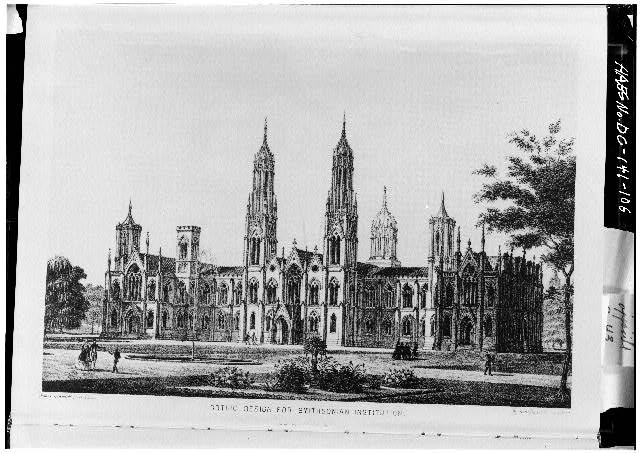
On December 23rd, 1846, a Philadelphia architect named John Notman submitted the drawing above to the Smithsonian’s building committee. It is a Gothic design with three stories, a central tower and cupola, crenellated battlements, and strictly symmetrical wings.
The committee rejected it. That decision is why the Smithsonian Castle looks the way it does today.
The Castle has been closed since February 2023 for its first major renovation in more than fifty years. It reopens May 22nd, 2026, as part of the Semiquincentennial celebrations. Before you walk in, it is worth knowing how close the building came to looking completely different.
Notman was one of the most accomplished architects in America by 1846. Born in Edinburgh in 1810 and trained under William Henry Playfair, he had emigrated to Philadelphia in 1831. In 1836 he won the commission to design Laurel Hill Cemetery, beating out established names including William Strickland and Thomas Ustick Walter. He was a founding member of the American Institute of Architects. His Gothic Revival churches and country houses across the Mid-Atlantic were serious, well-executed work.
The Smithsonian Institution had been chartered by Congress just months earlier, in August 1846, using the bequest of British scientist James Smithson to create an institution “for the increase and diffusion of knowledge.” The Board of Regents immediately needed a building. They organized an open national competition and invited the country’s leading architects to submit proposals.
Notman submitted his Gothic design. The Board turned it down, along with every other submission, and chose instead the proposal of a 27-year-old architect who had exactly one major commission to his name: James Renwick Jr., who had just finished Grace Church on Broadway in New York City.
The vote was unanimous.
The Norman Castle That Won
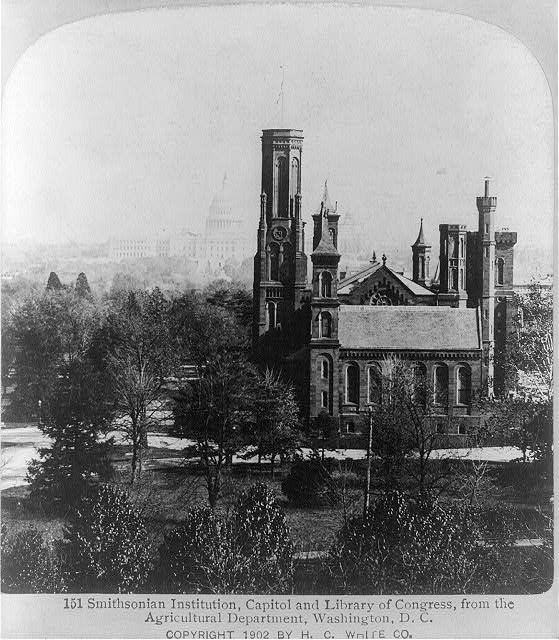
Renwick’s winning design was not Gothic. The Board of Regents had requested a Norman or Romanesque style, and Renwick gave them a hybrid: pointed arches and crenellated towers drawn from medieval English architecture, set in a Norman rather than Gothic idiom. The building’s nine towers and asymmetrical plan were chosen specifically to allow for future expansion at either end, something a symmetrical Gothic design like Notman’s could not easily accommodate.
The choice of stone took longer than the choice of architect. The building was initially planned in white marble, then redesigned in yellow sandstone, before the committee finally settled on Seneca red sandstone from Montgomery County, Maryland. It was substantially cheaper than marble or granite, and Renwick confirmed it hardened satisfactorily on exposure to the elements. The principal south tower stands 91 feet tall. The taller north tower rises to 145 feet.
Gilbert Cameron was selected as general contractor. Construction began in 1847. A partial structural collapse in 1850 raised questions of workmanship and led to a shift to more fireproof construction methods. Renwick’s exterior was completed in 1852, at which point he withdrew from the project. Cameron finished the interior work in 1855. The entire building was funded from accrued interest on the Smithson bequest. Not a dollar of federal appropriation built it. You can see what it looked like just a dozen years after completion in our 1867 look at the Castle.
Notman went back to Philadelphia and kept building. He designed Hollywood Cemetery in Richmond in 1849, Prospect House at Princeton in 1851, and a series of well-regarded Gothic churches across Pennsylvania, Maryland, and New Jersey. He died in Philadelphia on March 3rd, 1865, and was buried at Laurel Hill Cemetery, the one he had designed thirty years earlier. His Smithsonian proposal went into the Smithsonian’s own archives, where it has been ever since.
Renwick’s Other Design Became a Church, Then a Parking Lot
Here is the part that most people do not know. Renwick had submitted two designs to the Smithsonian competition. His winning entry was the Norman building that became the Castle. His second submission was in a high Gothic style, similar in character to Notman’s rejected proposal. The committee turned that one down as well.
That discarded Gothic design did not stay discarded for long.
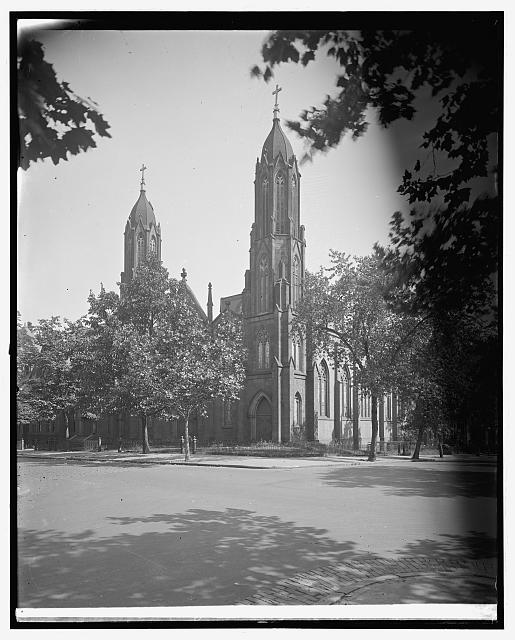
William Wilson Corcoran, the wealthy Washington banker and art patron who was an enthusiastic supporter of Renwick’s work, was at the same time helping Trinity Episcopal Church raise funds for a new building. The congregation had been worshipping at a modest structure on Fifth Street NW since 1831. Corcoran helped them acquire a new lot at 3rd and C Streets NW, in the Judiciary Square neighborhood. It appears Corcoran was the one who suggested Renwick’s rejected Smithsonian entry as the basis for the new church.
The cornerstone of Trinity was laid on April 2nd, 1850. The church was built primarily of Seneca red sandstone, the same stone being quarried at the same moment for the Smithsonian Castle less than two miles away on the Mall. The first service was held in May 1851.
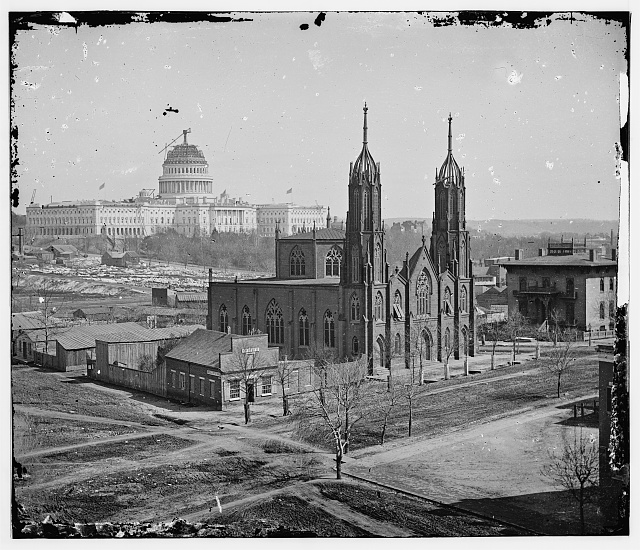
Trinity became one of the most fashionable congregations in the city. The church’s earlier building on Fifth Street had been attended by John Quincy Adams, Daniel Webster, Henry Clay, and John C. Calhoun. The new Renwick structure, with its elaborate Gothic tracery, twin towers, and unusual octagonal nave, drew Washington’s civic elite and became known informally as “the church of the mayors.” One newspaper commentator was less impressed, observing that the building’s towers, with their wooden openwork spires, looked “like a stump-tailed steamboat.”
During the Civil War the Army commandeered the building in 1862 and laid wooden planks across the tops of the pews to create platforms for hospital cots. The marks of the nails and screws stayed visible in the woodwork for decades. President Lincoln may have visited the wounded soldiers inside.
The neighborhood began its decline after the war, as wealthy congregants moved to newer residential areas to the northwest. The congregation was formally dissolved in 1922. In 1936, facing mounting debt, the diocese agreed to raze the buildings and lease the land to the Auto City Parking Company for $43,000 in rent. The stained glass, pews, Seneca sandstone blocks, and roof slates were sold off in a salvage auction. A Washington Post article called the demolition “sacrilege, heartless and commercial.” With no historic preservation laws in place, there was nothing to be done.
The Frances Perkins Building, headquarters of the Department of Labor, stands on the site today. It was not the last time a Smithsonian building would be decided by design competition. See the rejected designs for the Air and Space Museum for another round of what almost was.
So: the design that almost became the Smithsonian Castle is gone, held only in the Smithsonian’s own archives. Renwick’s rejected Gothic alternative was built as a church, served as a Civil War hospital, and was torn down for a parking lot in 1936. What survived is the one the committee chose unanimously in 1846 over everything else submitted, including Notman’s Gothic proposal and Renwick’s own second entry.
You can walk in starting May 22nd.
Dear Ghosts,
One of James Renwicks’ alternative designs for the Smithsonian Castle was actually built as Trinity Episcopal Church, at 3rd and C Streets, N.W. It was built in 1860-1861 and demolished in 1936.
https://www.washingtonpost.com/local/james-renwicks-trinity-episcopal-church-was-a-striking-place-of-worship/2014/01/04/7dbc07c2-73c1-11e3-9389-09ef9944065e_story.html?utm_term=.efcef6052cb4