
For most of the 19th century, the ground the Lincoln Memorial sits on did not exist.
It was a tidal mudflat. Half river, half mosquito country. The Potomac slid in and out of it twice a day. When the city upriver flooded, which was often, the flats took the runoff. People threw dead animals there. Most maps did not bother to mark a shoreline.
Then in August 1882, the Army Corps of Engineers, under Maj. Peter Conover Hains, started dredging the channel and dumping the spoils on the flats. They kept doing that for about thirty years. By 1911 there was new ground out past where the Potomac used to be.
That new ground is what the memorial sits on. The whole thing, including the building’s secret three-story foundation, is built on river bottom that was a swamp inside living memory. Henry Bacon’s design accounts for it. So does the basement most people will never see.
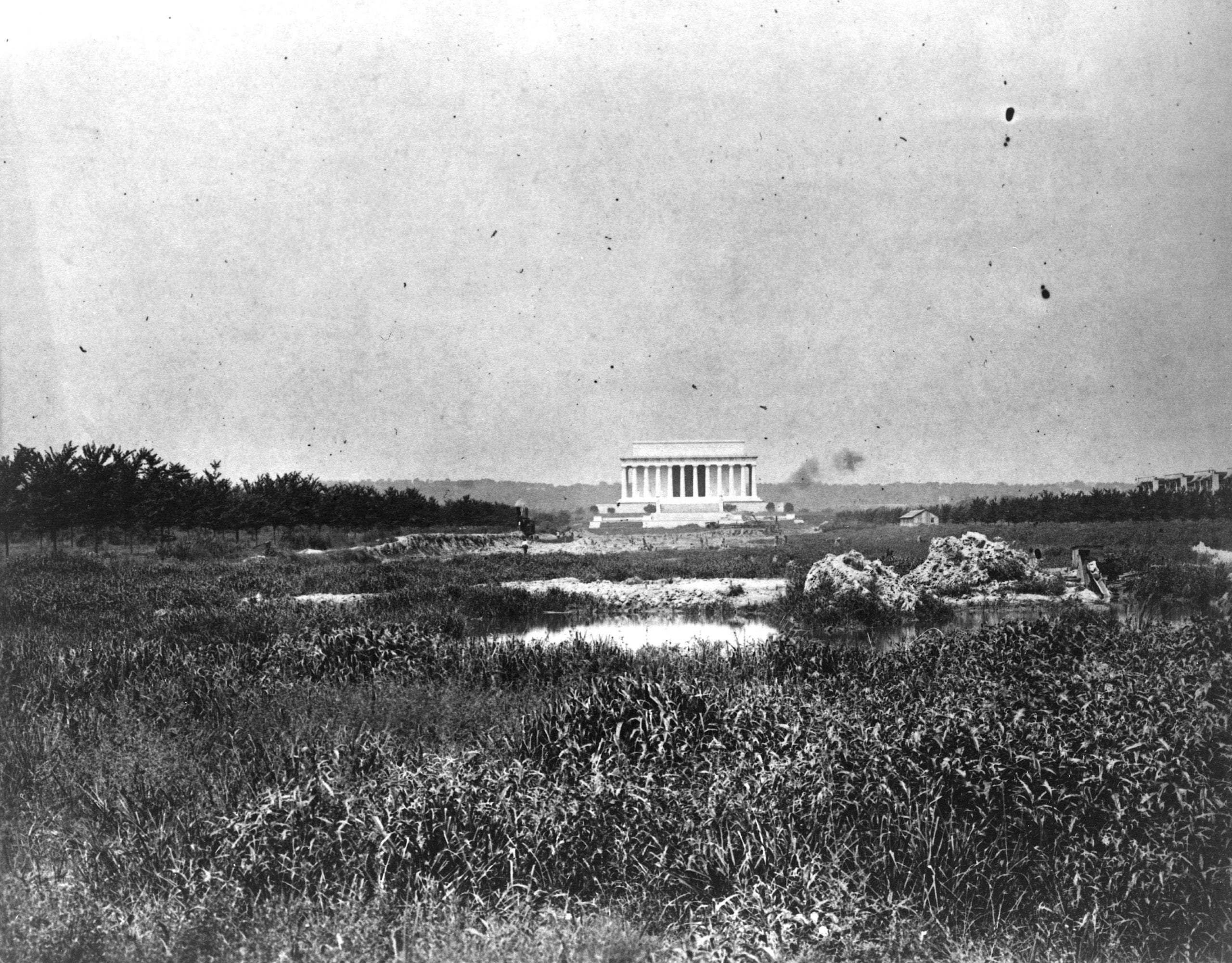
Here is the only known photo of the Lincoln Memorial in 1917, mid-construction. The foreground is still half-marsh.
The McMillan Plan Picked the Spot
By 1900 the Mall west of the Washington Monument was a long stretch of fill, train sheds, and the new Potomac Park. There was no plan for what should go on it. There also was no Lincoln memorial. Congress had spent thirty-five years failing to agree on one.
In 1901 the Senate empaneled the Senate Park Commission, better known as the McMillan Commission after its chair, Senator James McMillan of Michigan. The commission was Daniel Burnham, Frederick Law Olmsted Jr., Charles McKim, and Augustus Saint-Gaudens.
They went to Europe to look at axial planning, came back, and proposed the Mall we live with today: the long greensward, the Reflecting Pool, the cross-axes, and at the far west end of the new fill, on a deliberate axis with the Washington Monument and the Capitol, a Lincoln memorial.
That site was a fight. For most of the next decade, members of Congress proposed alternatives: the steps of the Capitol, Meridian Hill, a giant highway from Washington to Gettysburg with a memorial at each end. Joe Cannon, the Speaker of the House, called the Potomac Park site “a God-damned swamp” and meant it as an objection. He lost.
The Lincoln Memorial Commission was finally established by an Act of Congress signed February 9, 1911. President Taft chaired it. Taft would still be chairing it as Chief Justice when the memorial was dedicated eleven years later, and the commission stayed with the McMillan plan’s site.
We’ve written separately about the Reflecting Pool that runs east from the memorial and about the long fight over Memorial Bridge that crosses the Potomac just west of it. Both are part of the same McMillan-era idea.
The 1912 Designs That Lost
Once the site was set, two architects competed: Henry Bacon and John Russell Pope. Pope was the more famous name at the time. He went on to design the Jefferson Memorial and the National Gallery of Art. He submitted not one design but a portfolio.
We dug these up at the National Archives years ago. They are extraordinary. Pope drew the Lincoln Memorial as a Mayan temple. He drew it as a ziggurat. He drew it as a circular colonnade, a pyramid with porticoes, an Egyptian-flavored stepped tower. None of them looked anything like a Greek temple, and none of them looked anything like what got built.
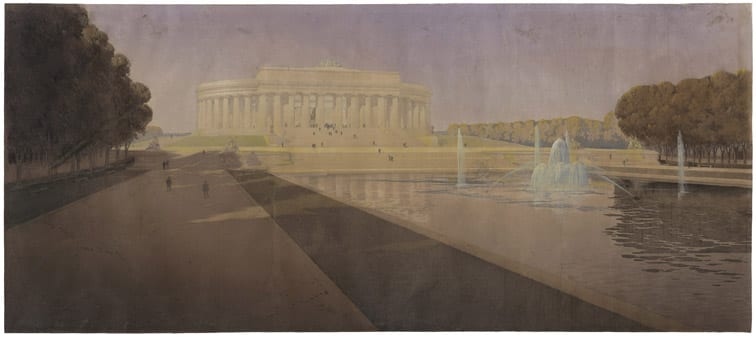
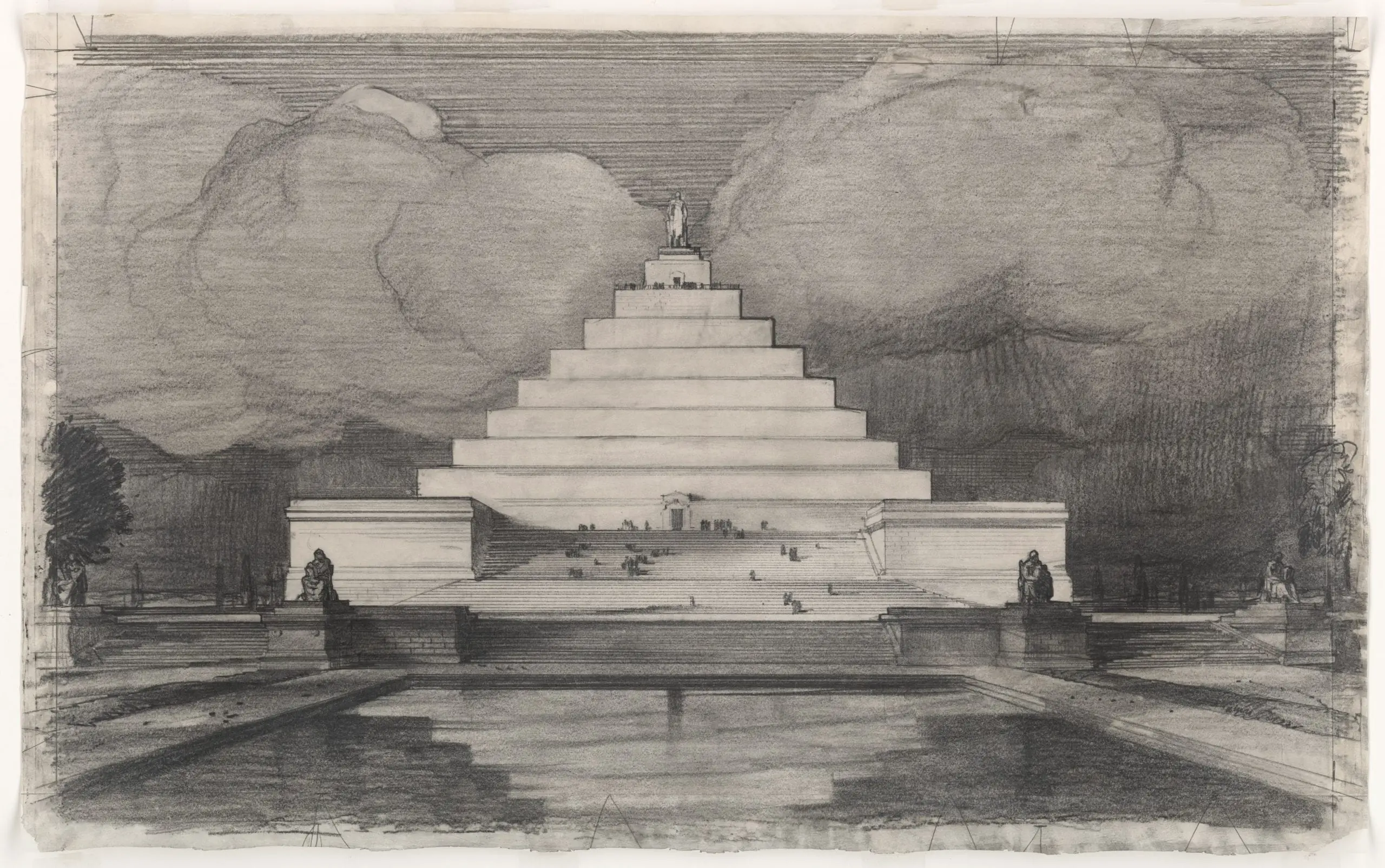
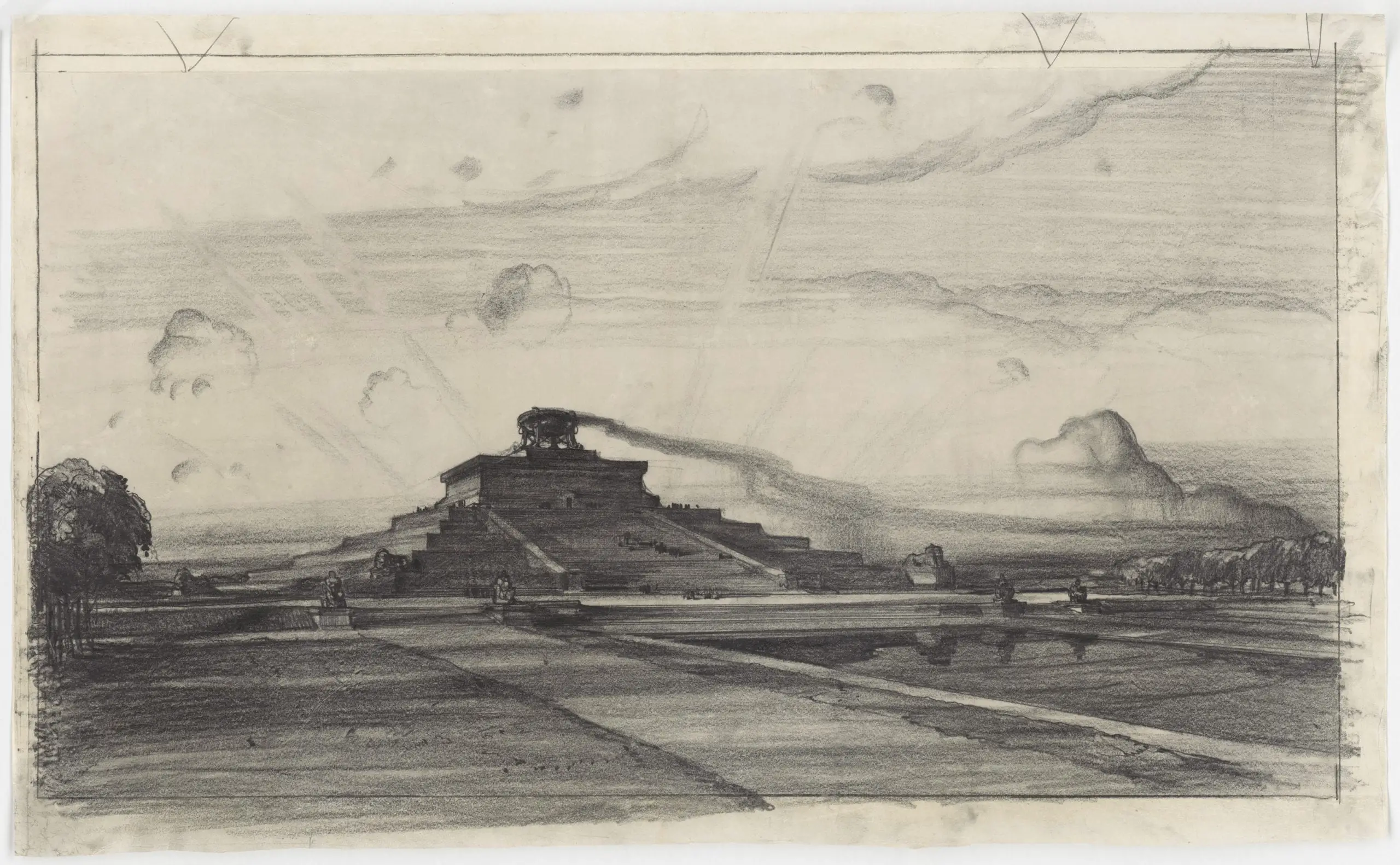
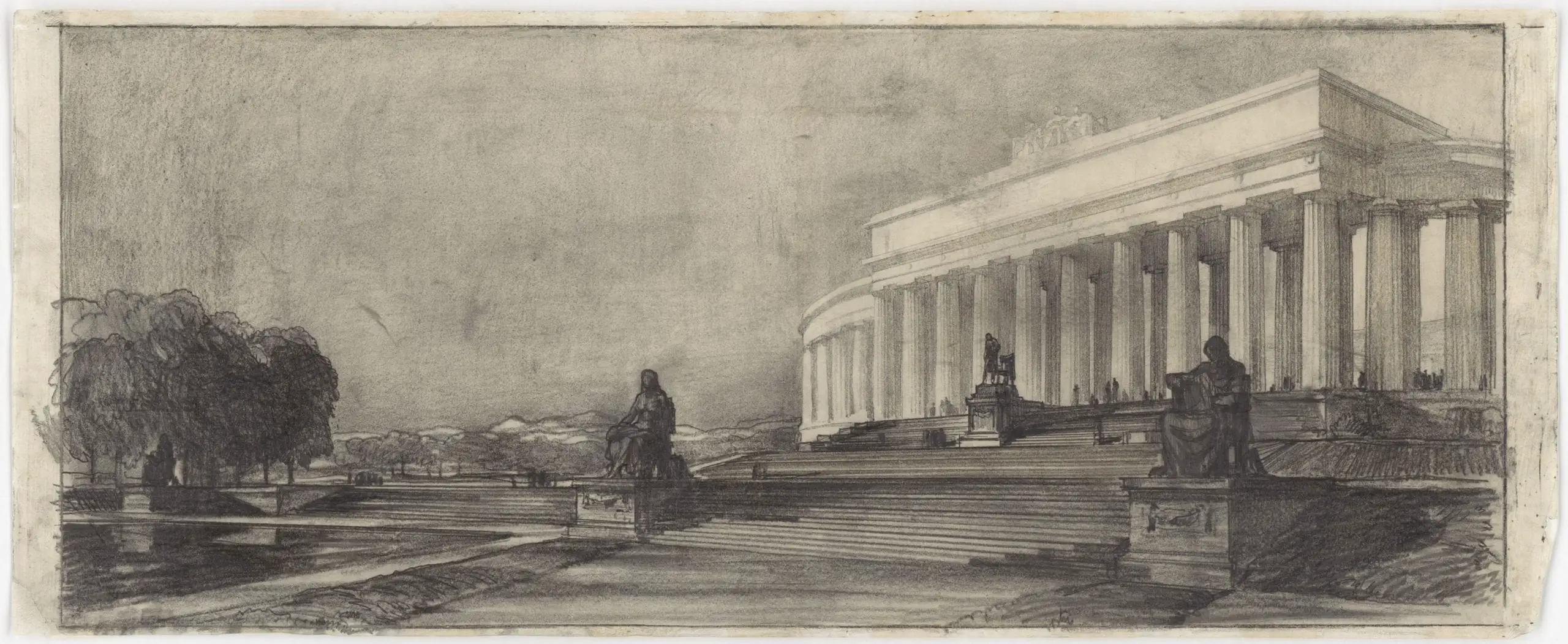
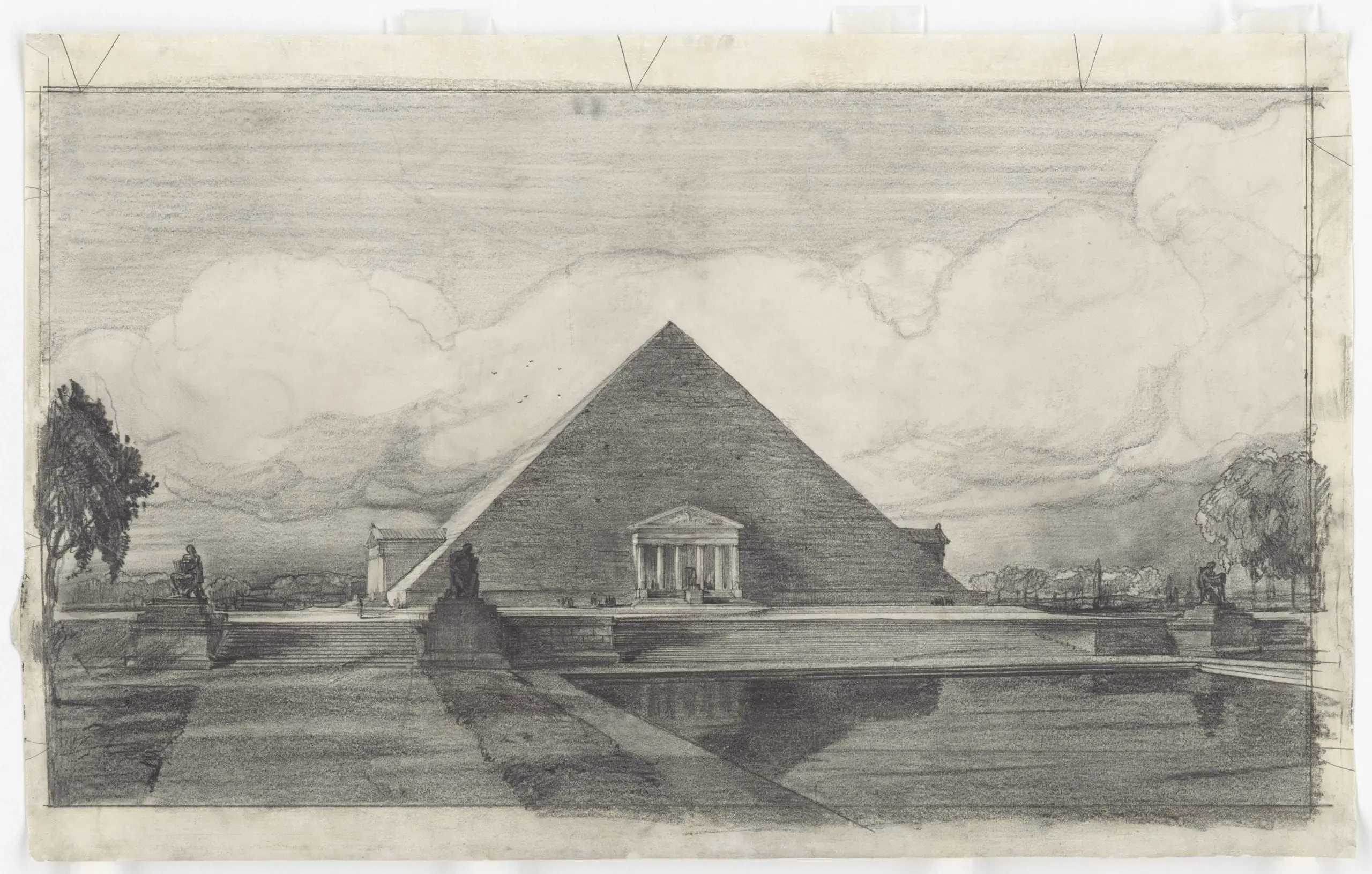
Bacon submitted one design. A Greek Doric temple, low and broad, sitting on a high stylobate. Thirty-six fluted columns ringing a closed cella. A seated Lincoln inside.
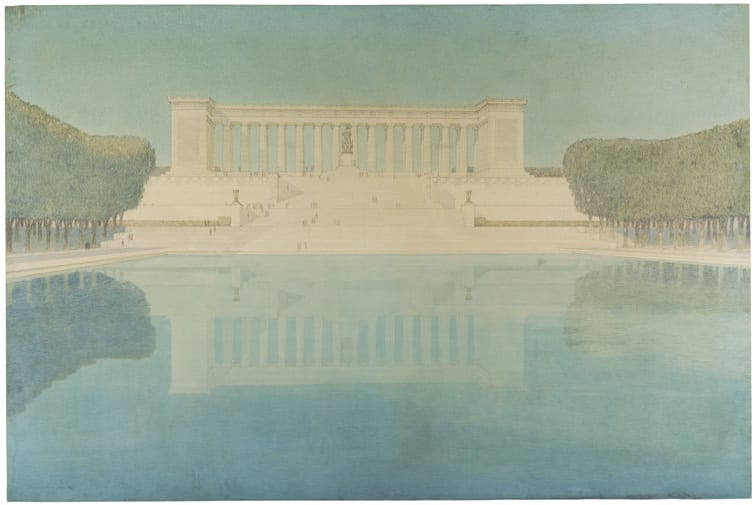
Bacon won the commission. He had spent years at McKim, Mead & White and would partner with Daniel Chester French on the Washington project as a working unit.
The thirty-six columns are not decoration. They are the count of states in the Union the day Lincoln died. Each column carries a state’s name and the year it was admitted, inscribed on the frieze above.
The forty-eight states present at the 1922 dedication get the higher attic frieze above the cornice. The names step in two registers: Lincoln’s Union below, the country at the moment of the memorial’s birth above.
Breaking Ground on Lincoln’s Birthday
On Lincoln’s 105th birthday, February 12, 1914, Col. William W. Harts of the Office of Public Buildings and Grounds turned the first earth on the Potomac Park site. Bacon was there.
So was former Senator Joseph C.S. Blackburn of Kentucky, the resident member of the Lincoln Memorial Commission and, as it happens, a former Confederate officer. So was the contractor, M.F. Comer of Toledo. So was a local Eagle Scout, Graeme T. Smallwood, in the official Library of Congress photograph.
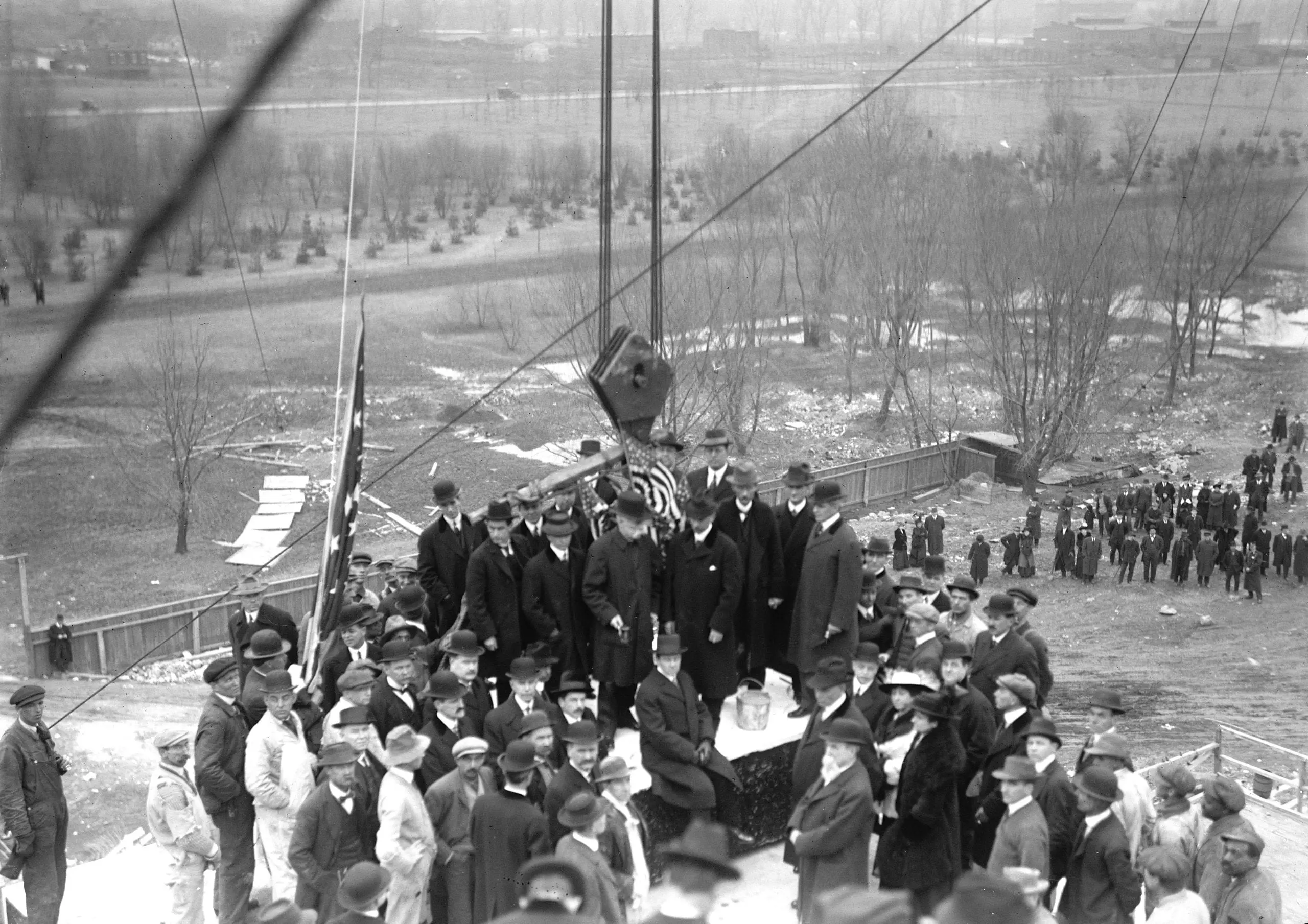
Exactly one year later, on February 12, 1915, Sen. Blackburn laid the cornerstone at 3:07 p.m. There was no formal ceremony. The day’s wire copy described it as “informal observation.”
The cornerstone of the two million dollar Lincoln Memorial structure was laid at 3:07 p.m., with no formal ceremony, only “informal observation.” Former Senator Blackburn of Kentucky, the resident member of the Lincoln Memorial commission, was in charge.
That is the entire story of the cornerstone. A former Confederate, on Lincoln’s birthday, setting the first stone of Lincoln’s temple, with no ceremony.
Five Years of Marble
What followed was seven years of slow assembly on the new ground. The foundation alone is the part most visitors never see. We will get there in a minute.
The exterior is Colorado Yule marble, quarried at Marble, Colorado, and shipped east by rail. The interior columns are Indiana limestone. The floor is pink Tennessee marble. The ceiling tiles are Alabama.
The seated Lincoln himself is Georgia white marble, in twenty-eight blocks, weighing about 175 tons assembled. The foundation is Massachusetts granite.
Every region of the country that quarried decent stone is in the building somewhere, which was the point. The memorial is a piece of national reunion masonry.
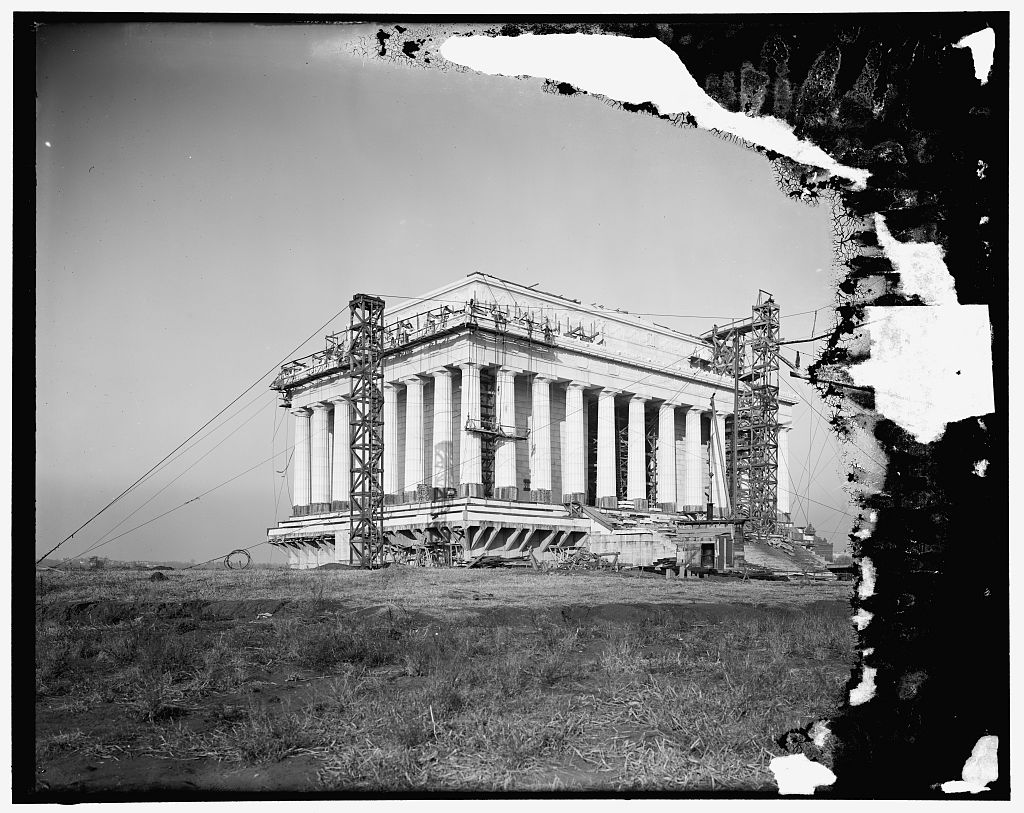
The seated Lincoln is its own story. Daniel Chester French sculpted the model. The Piccirilli Brothers, six brothers from the Bronx, did the actual cutting. They came to Washington and assembled the figure on site, block by block, inside the half-finished cella.
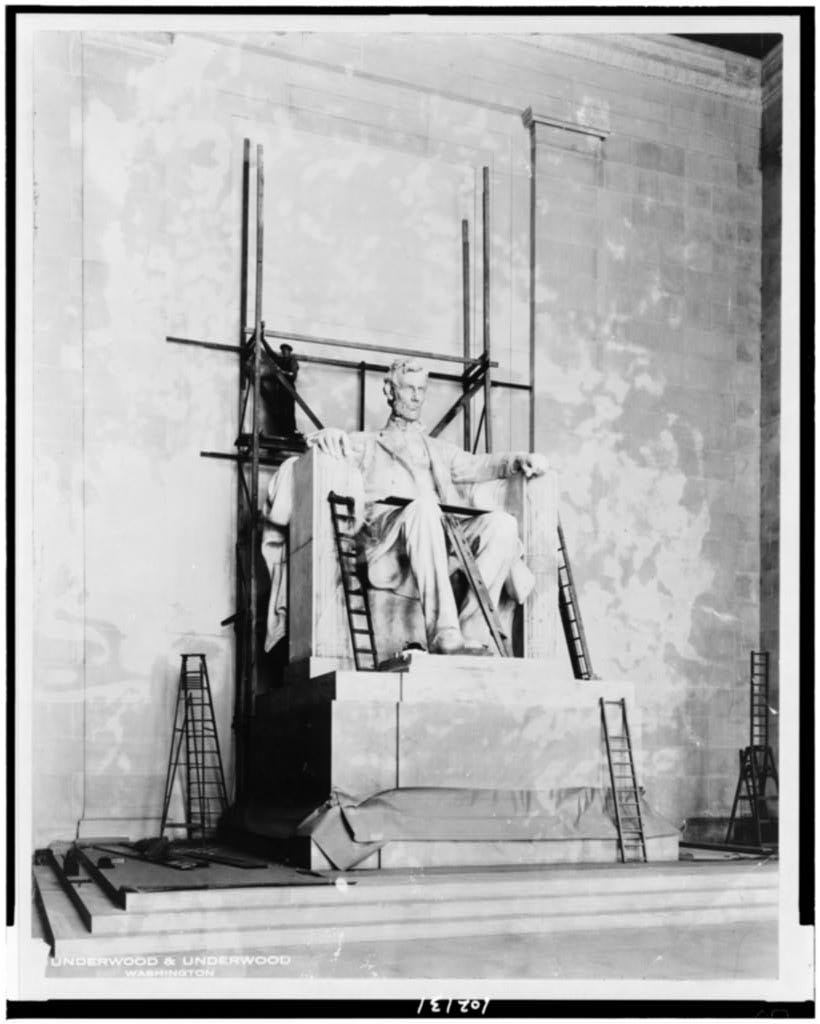
French nearly did not get the figure right the first time. His original model was smaller than what got built. When it was tested in scale inside the chamber, the statue looked lost in the room.
Christopher Thomas’s history of the project credits Bacon with pushing for the upscale. The seated Lincoln was finalized at nineteen feet, and the sense of the chamber changed. Lincoln stops being a man in a room and becomes presence in a room.
The murals on the side walls are Jules Guerin’s work. Two panels: “Emancipation” on the south wall above the inscription of the Gettysburg Address, “Reunion” on the north wall above the Second Inaugural. The Star, on dedication day, ran a side article on them with the kind of detail you would never get today.
The two decorations, representing Emancipation and Reunion, are on canvas, each piece of which weighs 600 pounds and cost $400. About 700 pounds of paint were used. Each canvas is sixty feet long and twelve feet wide. The figures are eight and a half feet high. The decorations were painted entirely by the artist without assistance. There are forty-eight figures in the two panels…The head of Mr. Bacon, the architect, appears in the decoration on the north wall, the fourth figure in the group at the left of the angel.
That is from the Evening Star, May 30, 1922, page 3. Bacon painted himself into his own building, watching from the wall above the Second Inaugural Address.
The whole thing came in at about $2,957,000, plus another $88,400 for French’s statue. Just over three million dollars in 1922. NPS gives that figure as the official cost.
The Secret Basement
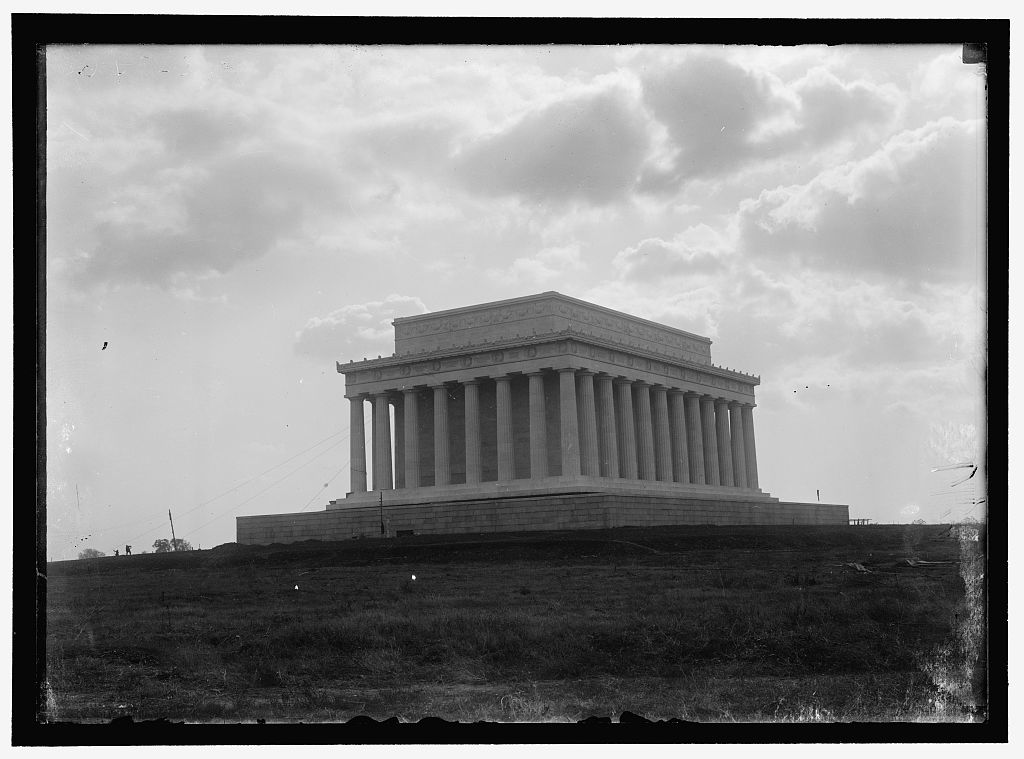
The memorial sits on a foundation cavity that is, depending how you measure it, three stories tall and roughly 43,800 square feet. Bacon designed it to do two things at once.
The first was structural. Bedrock under the Potomac Flats is fifty feet down. Bacon needed to spread the building’s weight over a large enough footprint that the new fill would not fail.
The second was aesthetic. Bacon wanted the temple to look like it sat on a natural rise, not on flat reclaimed mud. Hollowing out the foundation gave him both.
For sixty years almost nobody knew it was there. Then in 1975, NPS workers cutting through to install bathrooms broke into the chamber and looked around with flashlights. What they found is what made this story go around the GoDC desk for years.
Stalactites. Real ones. Decades of moisture seeping through the limestone overhead had deposited mineral teeth from the ceiling. Insects had moved in. So had small rodents. There was a small ecosystem under one of the most visited buildings in the country.
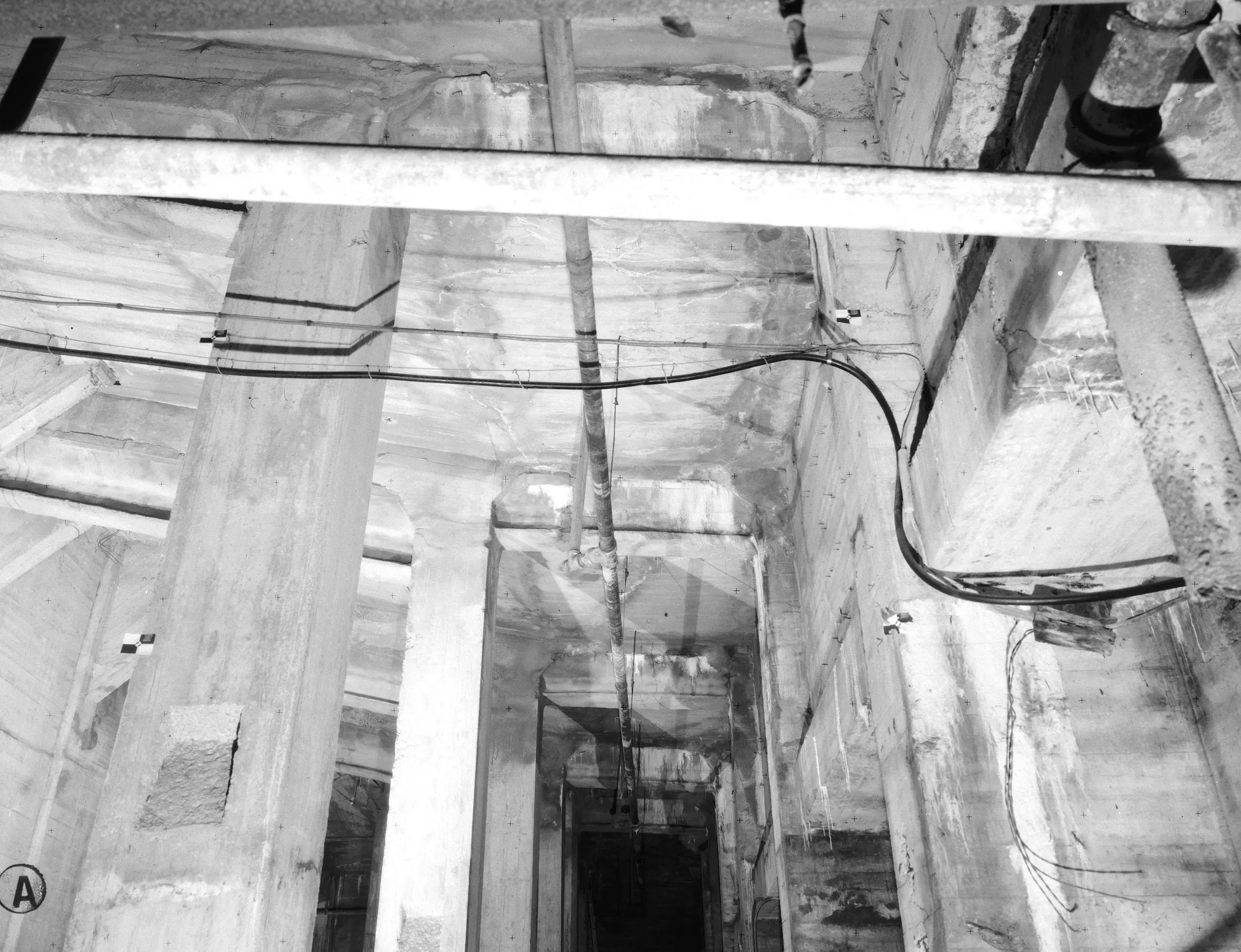
There was also graffiti. Construction workers, working alone in a dark cavern in 1916 and 1917 and 1918, had left their names. They had left the dates. They had drawn cartoons.
The chamber preserved a layer of pencil sketches of Mutt and Jeff, the comic strip characters who were everywhere in American newspapers in those years. Workers were writing on the walls of a building they were watching go up, and nobody was ever supposed to read it.
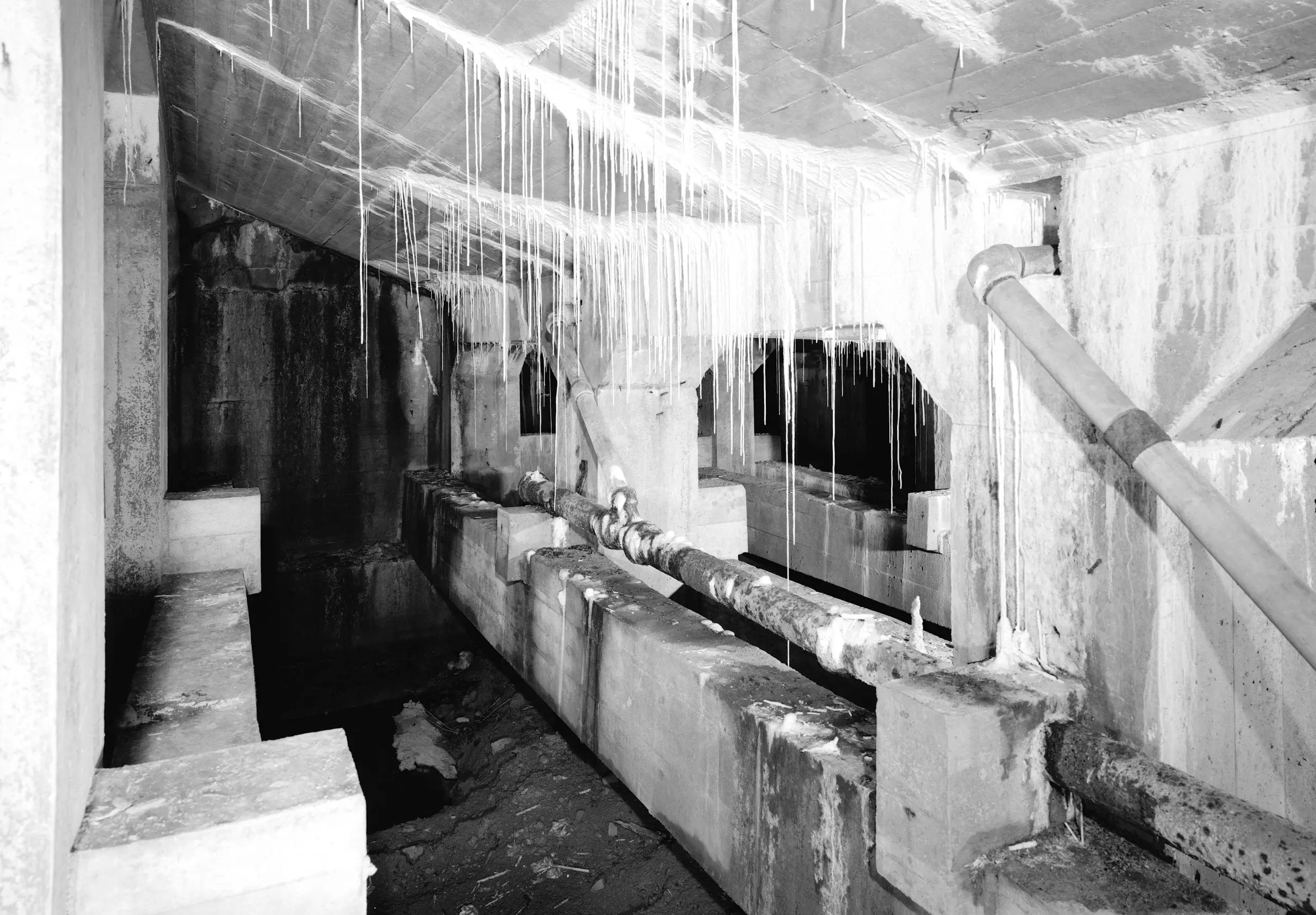
NPS started running flashlight tours in the late 1970s. They were brief, dim, eccentric, and in DC-tour-circles legendary. Then in 1989 a tourist on one of the tours flagged what looked like asbestos. NPS shut the tours down for safety. The chamber went dark again for thirty years.
It is coming back. The Trust for the National Mall is in the middle of a $69 million conversion of about 15,000 square feet of the undercroft into a museum and visitor center. Twenty-five million of the gift came from David M. Rubenstein.
The design uses floor-to-ceiling glass walls so the historic graffiti and the unfinished structural surfaces stay visible. NPS is targeting July 2026 for the opening, timed to the country’s 250th.
If you have not been to the memorial in a while, this is the year to go.
The Dedication, Memorial Day 1922
It was a Tuesday. May 30, 1922.
The Star ran two pieces that day. The first went out in the morning, before the ceremony, and is the kind of newspaper writing you only get when reporters are trying to put the day in front of you in advance.
Abraham Lincoln, the man and his memory, today dominated the capital of the nation for which he gave his life. On this Memorial day, while the usual exercises were held at the Arlington amphitheater in memory of Lincoln and the dead of America’s wars, the people of the National Capital were gathering for the solemn dedication at 2:30 o’clock this afternoon of the Lincoln Memorial at the foot of 23d street.
The weather box on page one said fair, eighty degrees, breezy. Witnesses described a blazing sun on white marble.
Fifty thousand people came. The Star said so the next morning, in a banner across page four:
In the name of more than a hundred and ten million Americans, President Harding accepted the great Lincoln Memorial at the dedication ceremonies held yesterday afternoon at the foot of 23d street in the presence of 50,000 people.
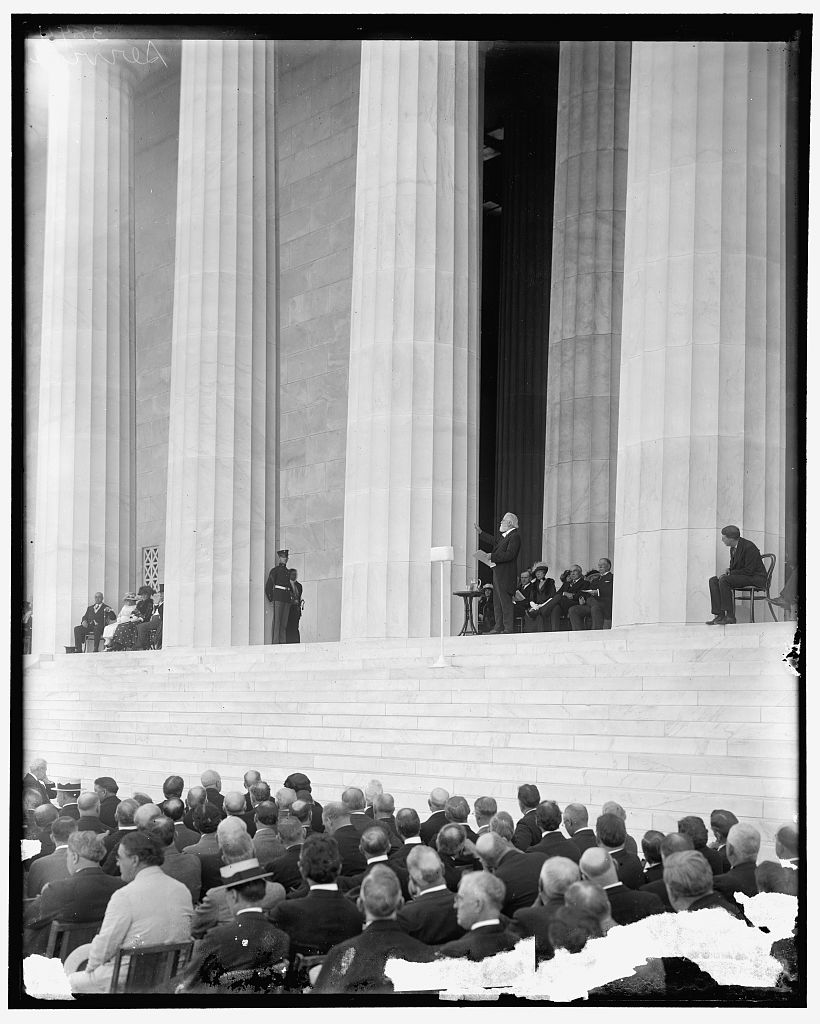
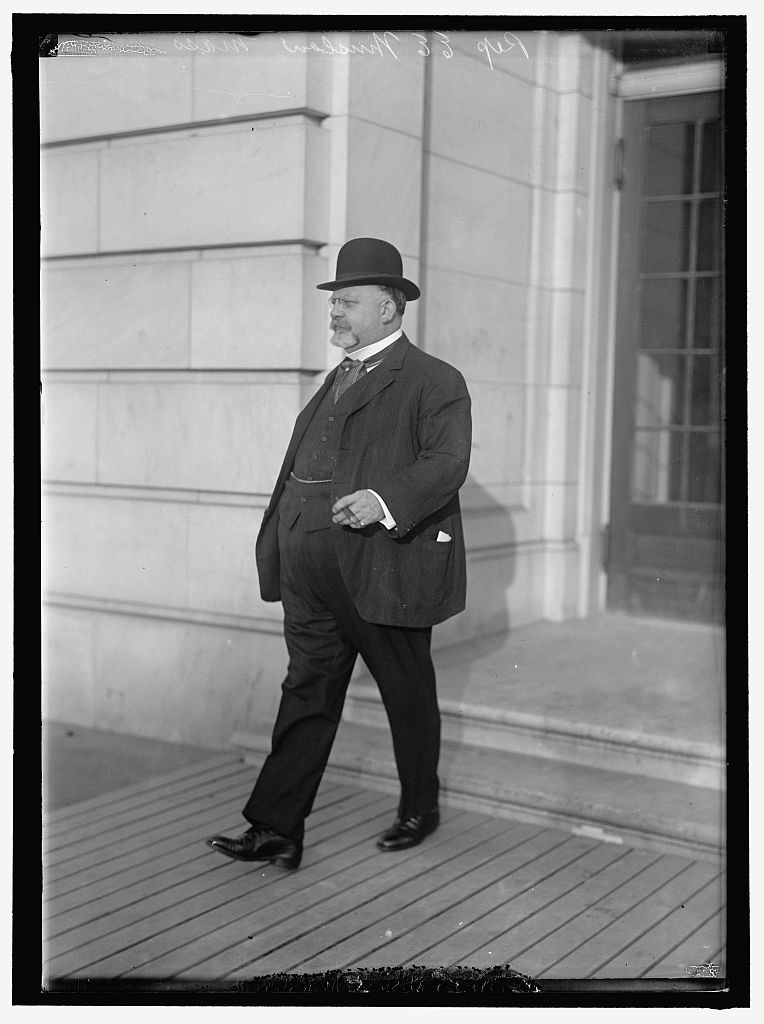
Chief Justice William Howard Taft, who eleven years earlier as President had signed the bill that created the Lincoln Memorial Commission, presented the building to the country. Harding accepted it on behalf of the country. Edwin Markham read his poem “Lincoln, the Man of the People.”
A Confederate veteran, Edward B. Willis of Denton, Texas, marched in the parade in gray, arm-in-arm with comrades in blue. He was the only gray uniform in the line.
One Confederate veteran marched in the parade. He was Edward B. Willis of Denton, Tex., a member of Sulrose Camp, No. 129, United Confederate Veterans. Walking arm-in-arm with his comrades in blue, his was the only uniform of gray in the parade.
The Reflecting Pool was empty. Not finished yet. Col. Sherrill, the engineer, told the Star he expected the water to go in by July 1. Workmen were still moving in the basin in the days after the ceremony. The view that day was of the new building, the new ground, the unfinished pool, and a crowd standing on the slope.
There were “loud speakers” rigged on the platform, which the Star described with novelty:
By means of “loud speakers” every word of the ceremony was distinctly heard by all.
That sentence does a lot of work. Memorial Day 1922 is not so long ago that the technology of standing in front of a crowd was settled.
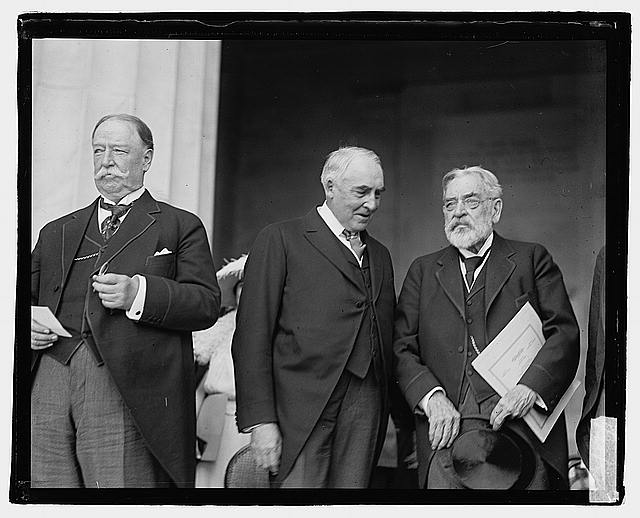
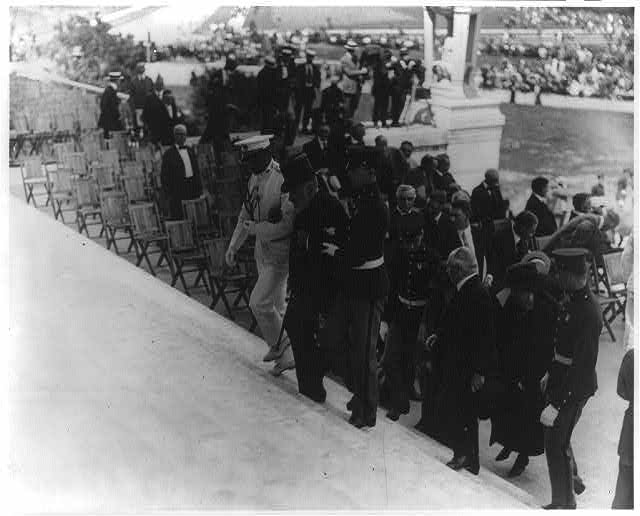
Robert Todd Lincoln was on the platform. He was 78, and would die four years later. The Star recorded that “Robert Lincoln, son of Abraham Lincoln, was given an ovation when he reached the platform.”
He was the only child of Lincoln to live to see the building, and as far as anyone knows, this was his last public appearance. He went home that day to his Georgetown house at 3014 N Street NW, the same house Ben Bradlee bought decades later.
We have a separate post on his attendance at the dedication and his life: Robert Todd Lincoln at the Lincoln Memorial Dedication, 1922.
The Speech That Was Not Delivered
Robert Russa Moton, the principal of Tuskegee Institute who had succeeded Booker T. Washington in 1915, was the principal Black speaker. He had a draft of a speech, and the Lincoln Memorial Commission, chaired by Taft, read it before the ceremony and decided large portions of it were unacceptable.
A telegram from Taft to Moton, dated May 23, 1922, asked Moton to “cut five hundred words” and to give the speech “more unity and symmetry by emphasizing tribute and lessening appeal.” The substantial cuts were to a passage that called the memorial a hypocrisy as long as the country still segregated and lynched the people Lincoln had freed.
The original passage Moton was forced to drop, preserved in his papers at the Library of Congress:
My fellow citizens, in the great name which we honor here today, I say unto you that this memorial which we erect in token of our veneration is but a hollow mockery, a symbol of hypocrisy, unless we together can make real in our national life, in every state and in every section, the things for which he died.
What he was allowed to say was very different. The Star quoted the delivered version on page four the next morning:
I speak for the colored race. Upon us, perhaps, more than upon any other group of the nation rests the immediate obligation to justify so dear a price for our emancipation.
And:
Twelve million black Americans share in the rejoicing of this day. As yet, no other name so warms the heart or stirs the depths of their gratitude as that of Abraham Lincoln. To him above all others we owe the privilege of sharing as fellow citizens in the consecration of this spot and the dedication of this shrine.
Black attendees at the dedication, including dignitaries who had been formally invited, were directed by a Marine to a roped-off “colored section.” Walter White wrote in The Crisis about Black guests at the dedication being treated as second-class citizens at the unveiling of a monument to the man who freed their forebears. The Star’s coverage does not mention the segregated seating at all.
That is how the Lincoln Memorial opened.
Taft’s Doric Address
For the record, the marble itself, the Star carried Taft’s presentation address in full on page four the next morning. The Doric line is the one that has lasted:
It is a magnificent gem set in a lovely valley between the hills, commanding them by its isolation and its entrancing beauty, an emblem of the purity of the best period of the Greek art in the simple Doric, the culmination of the highest art of which America is capable.
And his closing:
Here is a shrine at which all can worship. Here an altar upon which the supreme sacrifice was made in the cause of liberty. Here a sacred religious refuge in which those who love country and love God can find inspiration and repose.
The line about the Doric being the highest art America was capable of is what architectural historians quote when they get to Bacon’s choice of order. Bacon made the building modest. Taft made it humble.
What Came Later
Two moments after 1922 made the steps the building’s most-used room.
On Easter Sunday, April 9, 1939, the Daughters of the American Revolution refused to let Marian Anderson, the contralto, sing in Constitution Hall because she was Black. Eleanor Roosevelt resigned from the DAR over it on February 26 of that year.
Secretary of the Interior Harold Ickes arranged for Anderson to sing instead on the steps of the Lincoln Memorial. About 75,000 people came. NBC carried it live across the country. Anderson opened with “My Country, ‘Tis of Thee,” and the crowd sang along.
The building, designed for one martyr, accommodated a second moment of national meaning that had nothing to do with him directly and everything to do with him.
On August 28, 1963, around 250,000 people gathered between the steps and the Washington Monument for the March on Washington for Jobs and Freedom. The closing speech was Martin Luther King Jr.’s, the one we now call “I Have a Dream.” From a camera position over Lincoln’s left shoulder, the United Press International photographer James K. Atherton caught the entire crowd along both sides of the Reflecting Pool.
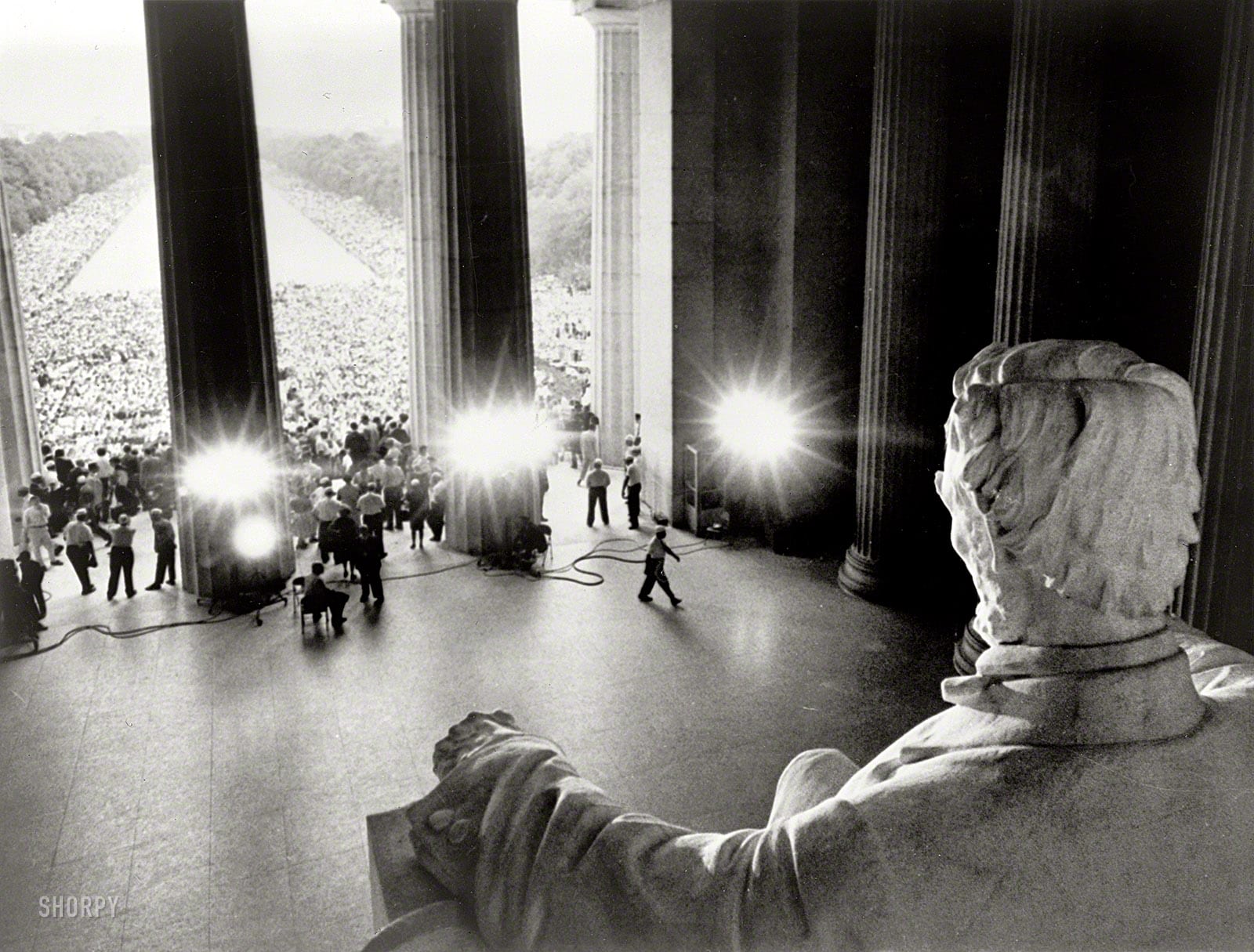
The thing both moments share is that they happened on the steps, not inside. Bacon’s building is closed at the back. The colonnade is on the front and sides.
The whole architectural argument of the place is that you climb to it, look at the statue, and turn around. The view from the steps is the rest of the country looking back at you.
That is where Anderson sang and King spoke. The architecture was designed for it before either of them were born.
The Strange Photo from 1923
For the lighter side of the file: a year after the dedication, an amphibian aircraft sat parked on the Reflecting Pool with the memorial directly behind it. Harris and Ewing got the shot.
We have a separate post on it: An Unbelievable Photo from 1923: An Amphibian Aircraft on the Reflecting Pool in Front of the Lincoln Memorial. The Reflecting Pool was new. People were figuring out what it was for.
There are also photos in our archive of children swimming in the Reflecting Pool in the 1920s when the Park Service let them.
The Building, Now
Bacon died in 1924, two years after the dedication. He never saw the Reflecting Pool full of either water or people. French lived another nine years. Robert Todd Lincoln died in 1926. Taft, who was the through-line of the entire project, lived to 1930.
The building is what they made. The thirty-six columns are still the count of states at Lincoln’s death. The forty-eight in the attic frieze are still a country that no longer exists in those numbers. The basement is opening as a museum. The Reflecting Pool, repainted and replumbed and re-fought-over, is still a Reflecting Pool. The steps still get marched on.
The mudflat is still down there too, fifty feet under the foundation. The whole thing is still on a swamp.
Ever run across photos or articles on the Christian Heurich Brewery that sat where the Kenedy Center now stands or the Robert Portner Brewery in Alexandria?
Reach out to the great folks at Heurich House … http://www.heurichhouse.org … they have amazing photos
wow!