
In 1931, two 166-foot columns topped with gold statues of Nike were supposed to rise from Memorial Circle on Columbia Island, greeting drivers as they crossed Arlington Memorial Bridge toward the cemetery.
They were killed. The Department of Commerce warned that columns that tall would interfere with nearby airfields. President Hoover ordered them removed from the plans.
Ninety-five years later, a 250-foot arch has been proposed for the same spot.
The site where Washington meets Virginia across the Potomac has been argued over since 1886. At least nine major designs have been proposed, debated, revised, and rejected for this crossing. Columns too tall for airplanes. A medieval fortress bridge with turrets. Thirty-six arches lined with statues of generals. A design competition won and then killed by a single senator.
This is the story of all of them.
The Convenient Fiction (1830s)
The origin story people tell about Memorial Bridge goes like this: Andrew Jackson wanted to build a grand bridge connecting North and South across the Potomac, a symbol of national unity in stone.
Secretary of State Daniel Webster repeated the claim on July 4, 1851, describing Jackson’s desire to “span [the Potomac] with arches of ever-enduring granite, symbolical of the firmly established union of the North and South.”
It’s a good story. Historian Matthew Gilmore has called it “a convenient fiction.” Jackson’s actual bridge interest was in reconstructing the Long Bridge after floods damaged it in 1831. The Long Bridge had always been strictly utilitarian and in no way symbolic, monumental, or memorial.
But convenient fictions have a way of building momentum.
A Medieval Fortress Across the Potomac (1886-1887)
The real push started on May 24, 1886, when Congress authorized the Department of War to study the feasibility of a memorial bridge. The Department suggested calling it the “Lincoln-Grant Memorial Bridge.”
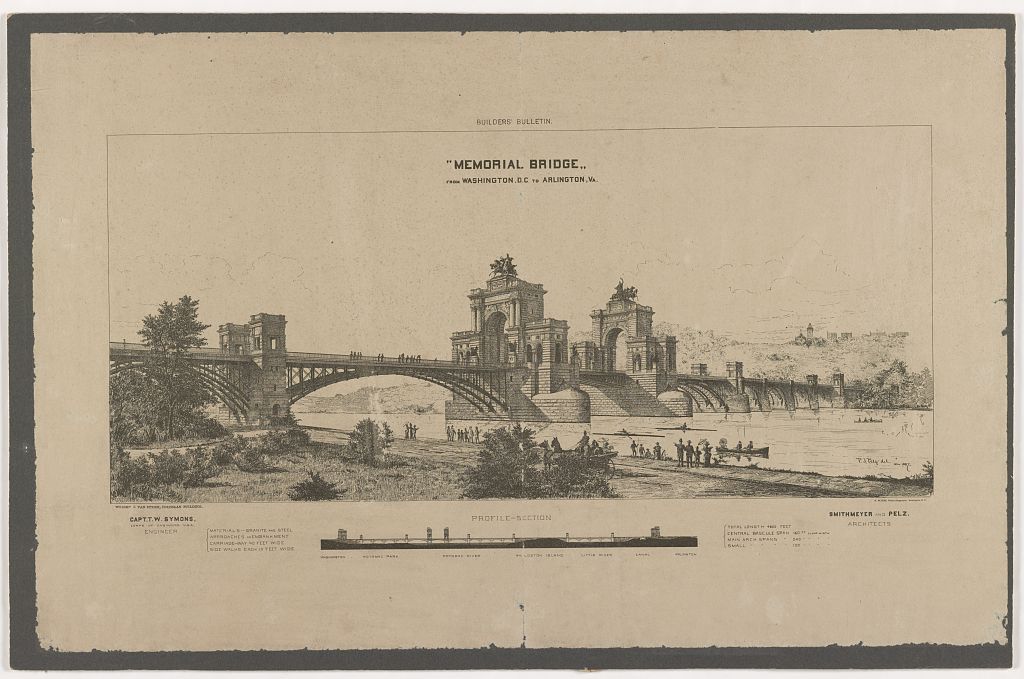
By February 1887, Representative Curtin of Pennsylvania had introduced a bill, and two men had produced a design that no one had ever seen anything like.
Captain T.W. Symons of the U.S. Corps of Engineers teamed up with architects Smithmeyer and Pelz. Paul J. Pelz was no minor figure. He was the co-designer of the Library of Congress.
What they drew was something out of medieval Europe.
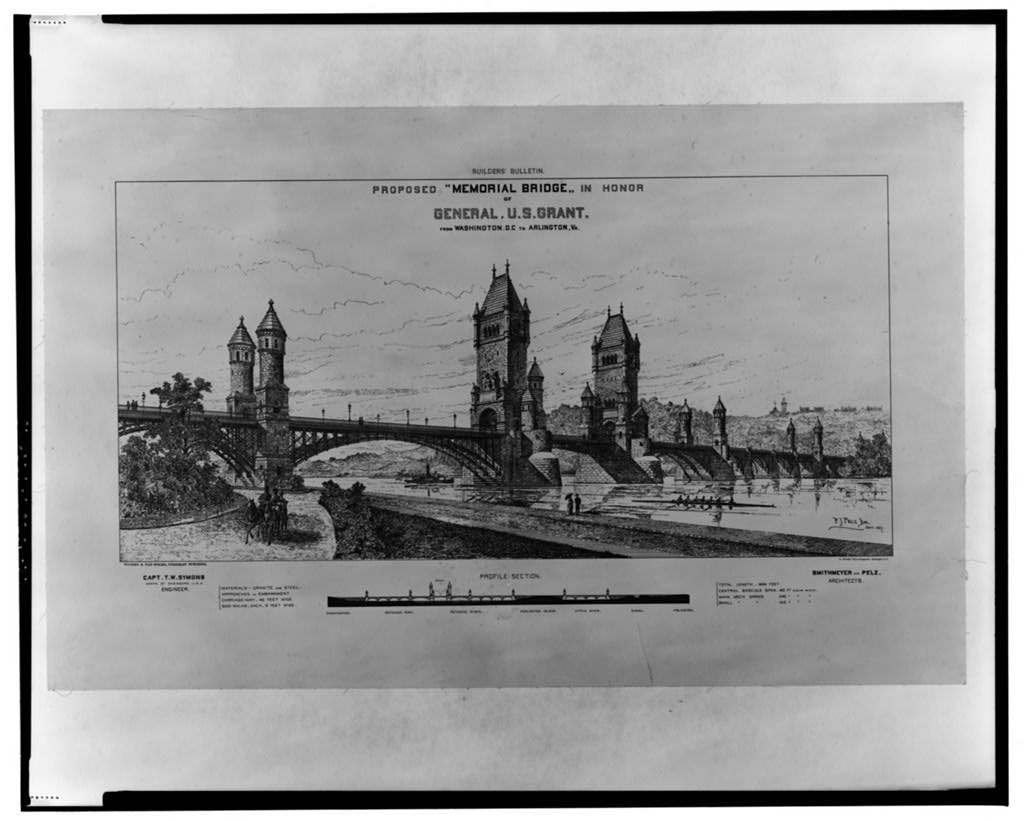
The design called for a medieval structure of granite and steel, with square and round towers and turrets, arches of different spans, and a drawbridge over the main channel. Two massive central towers. Two barbicans on each end. The resemblance to the causeway of a great fortress was deliberate.
The numbers: 4,650 feet long (630 feet short of a mile). A carriage way 40 feet wide. Sidewalks 10 feet each. The main arches spanning 240 feet. A bascule span of 160 feet. Height: 105 feet, with 98 feet of clearance for boats.
The Baltimore Sun declared: “No such elaborate and imposing structure of the bridge’s kind has ever been built or even contemplated before in the United States.”
This was 1887. London’s Tower Bridge design had been accepted just three years earlier. American Tower Bridge envy was real.
The price tag: $500,000 to start, with the full project estimated at over $1 million. The bridge was supposed to be finished for the 400th anniversary of the discovery of America in 1892.
Captain Symons appeared before the House Committee on Public Buildings and Grounds on February 18, 1887, arguing that “the bridge being a most suitable monument to the general who spanned the Potomac, was greatly needed.”
No action was taken.
The Design Competition Nobody Honored (1899-1900)
The idea refused to die. By 1899, Congress had appropriated $5,000 for a proper design competition. Four prominent bridge engineers from New York City were invited: George S. Morrison, Leffert L. Buck, William H. Burr, and William R. Hutton.
The winners were engineer William H. Burr and architect Edward P. Casey. Casey also designed the Taft Bridge, which still stands over Rock Creek Park.
Their design was colossally monumental. A steel and stone drawbridge with 36 arches. A classical tower over each end of the draw span, topped with bronze statues of Victory. Statues of famous generals and statesmen lining both sides. The whole thing stretching from Observatory Hill near New York Avenue across to Arlington Cemetery.
The Secretary of War formally approved it in April 1900.
Then Senator George Frisbie Hoar of Massachusetts killed it. He objected to the design and sparked political quarrels over whether the bridge should be a memorial at all, and if so, to whom or what.
One senator. One objection. Decades of work shelved.
The First Arch Proposal (1900)
The National Memorial Bridge Association tried again almost immediately. In October 1900, they commissioned Connecticut architect George Keller to produce a new design.
Keller was no amateur. He designed the Soldiers and Sailors Memorial Arch in Hartford, considered the first permanent triumphal arch in the United States. He also designed the James A. Garfield Memorial in Cleveland.
His design for Memorial Bridge took a different approach: low to the water, eliminating the draw span entirely. On the D.C. side, a monumental Romanesque Revival arch in a traffic circle. On the Virginia side, a memorial column celebrating the Union, also in a traffic circle.
By 1901, Keller’s design was widely seen as the appropriate one for the bridge.
It was never built either.
A monumental arch proposed for this site in 1900. Remember that detail.
The McMillan Plan Gets It Right (1901-1902)
On March 8, 1901, the Senate created the Senate Park Commission, chaired by Senator James McMillan. The members read like an all-star team of American design: Daniel Burnham, Frederick Law Olmsted Jr., Charles F. McKim, Augustus Saint-Gaudens.
Their January 1902 report laid out the vision that would eventually win. A bridge at the western end of the National Mall. Crossing to Arlington National Cemetery, aligned with Arlington House. A memorial to the unification of the nation after the Civil War.
The McMillan Commission’s key insight was restraint: “The broader and simpler the treatment of the bridge to Arlington the closer will be the connection between the reservations now separated by the Potomac.”
After the medieval fortresses and the 36-arch colossus, someone finally said: simpler.
Two Decades of Nothing (1902-1920)
It didn’t matter. In June 1902, the House “virtually sealed the fate of the proposed memorial bridge for this session.” Again.
By 1906, the project was “postponed indefinitely” after two new steel bridges were built across the Potomac. An article in the Baltimore Sun that year noted a sad detail: the stonecutters of America had donated a large cornerstone for the bridge, and this great plinth had “for several years rested on the inclosed Government lot adjoining the Lafayette Square Theater, opposite the Treasury Department.”
A cornerstone with no bridge. Just sitting there.
The Public Buildings Act of March 4, 1913, created the Arlington Memorial Bridge Commission, but World War I consumed everything. No money was appropriated until June 1920, when Congress finally released $25,000 that had been authorized seven years earlier.
The Traffic Jam That Built the Bridge (1921)
It took a car running out of gas to get the bridge built.
On November 11, 1921, President Warren Harding traveled to Arlington National Cemetery for the dedication of the Tomb of the Unknown Soldier. A small touring car ran out of gas on the Highway Bridge, triggering what the Associated Press called “the worst traffic jam the National Capital has seen in many years.”
Three thousand vehicles gridlocked. The Secret Service pulled Harding’s limousine off the road three times, drove across the bumpy fields of Potomac Park. The Evening Star reported that the motorcade “left the road three times and cut across the grass.”
Harding arrived mere minutes before he was due to speak. Former President Woodrow Wilson also rode in the cortege.
Journalist Jack Eisen later reflected: “That did it. The push was on.”
On December 18, 1922, Harding personally inspected proposed sites and selected the Lincoln Memorial alignment, exactly where the McMillan Commission had recommended 20 years earlier.
McKim, Mead & White Finally Build It (1923-1932)
On April 4, 1923, the bridge commission selected McKim, Mead and White. The Commission of Fine Arts recommended direct selection, not another open competition. They’d seen what competitions produced.
Lead architect William Mitchell Kendall submitted a design that embraced the McMillan Commission’s philosophy: a low Neoclassical arch bridge, originally 80 feet wide, expanded to 100 feet at the CFA’s request. The consulting engineer was J.W. Douglas. The bascule designer was Joseph B. Strauss Bascule Bridge Co. Strauss would later design the Golden Gate Bridge.
President Coolidge signed the bill into law on February 24, 1925.
Work commenced on March 15, 1926.
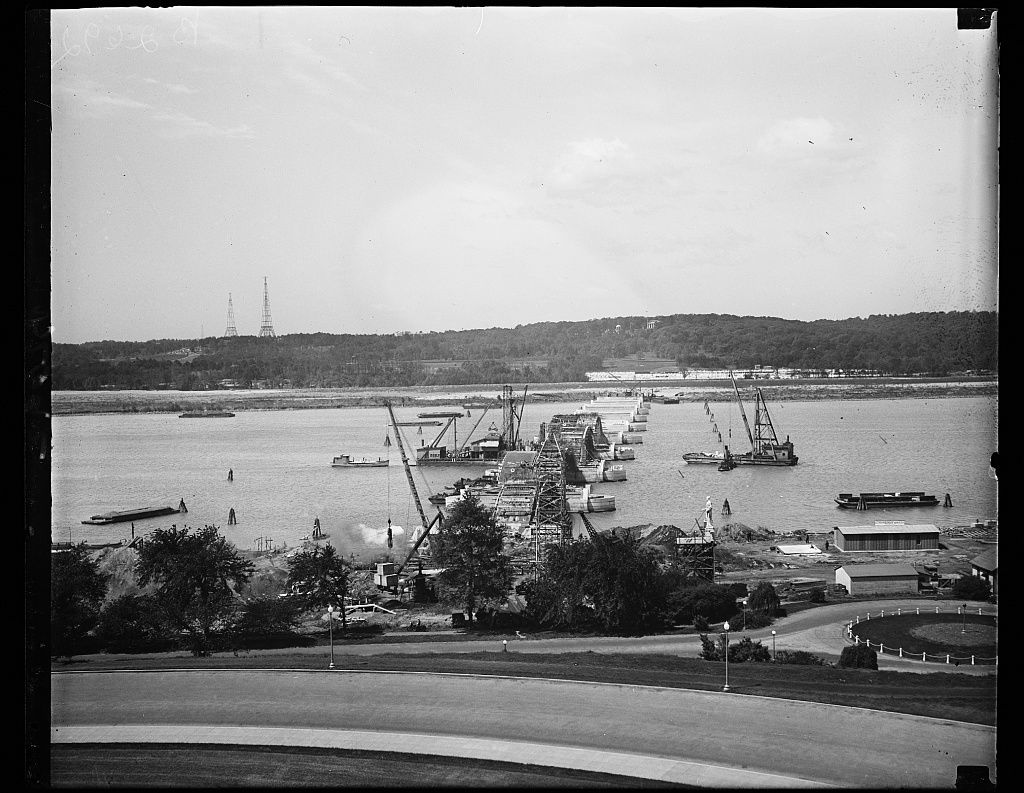
The bridge that emerged was nine spans, 2,138 feet long. Steel and reinforced concrete faced in white granite. The roadway sat 43 feet above water. Sixty feet of roadway width, with 15-foot sidewalks on each side.
The bascule span was the star: 216 feet long, 3,000 short tons, the longest, heaviest, and fastest-opening bascule span in the world.
Sculptor C. Paul Jennewein created 8-foot eagles for each pier, 12-foot bas-relief discs, and 6-foot bison heads on the arch keystones. Leo Friedlander designed the “Sacrifice” and “Valor” equestrian statues, though those wouldn’t be completed until 1951, cast in bronze in Florence and Milan and gifted by Italian Prime Minister Alcide De Gasperi.
Total project cost: roughly $21 million. The bridge alone: $7.25 million.
Too Tall for Airplanes (1927-1931)
But the bridge wasn’t the only thing planned for this corridor. Architect Kendall also proposed two 166-foot columns for the Great Plaza on Columbia Island, what we now call Memorial Circle. Each column would be topped with a gold statue of Nike, the Greek goddess of victory, representing the reunification of North and South.
Eagle pylons, 40 feet tall and topped with golden eagles, were planned for both ends of the bridge.
In 1930, cost-cutting under the Capper-Cramton Act eliminated most of the planned statuary. Then came the final blow.
In 1931, the Department of Commerce warned that 166-foot columns would interfere with nearby airfields. President Hoover ordered them removed from the plans entirely.
Too tall. The columns were too tall for airplanes.
Opening Day (1932)
On January 16, 1932, President Herbert Hoover, First Lady Lou Henry Hoover, and officials informally dedicated the bridge. A caravan of 12 automobiles traveled from the White House across the bridge. Hoover became the first person to drive across.
The next day, the bridge opened to the public on Saturdays and Sundays only, 8 a.m. to 5 p.m. There was no lighting yet.
Nearly 31,000 vehicles crossed on the first day.
Full-time opening with illumination came on May 6, 1932. The bridge was added to the National Register of Historic Places on April 4, 1980.
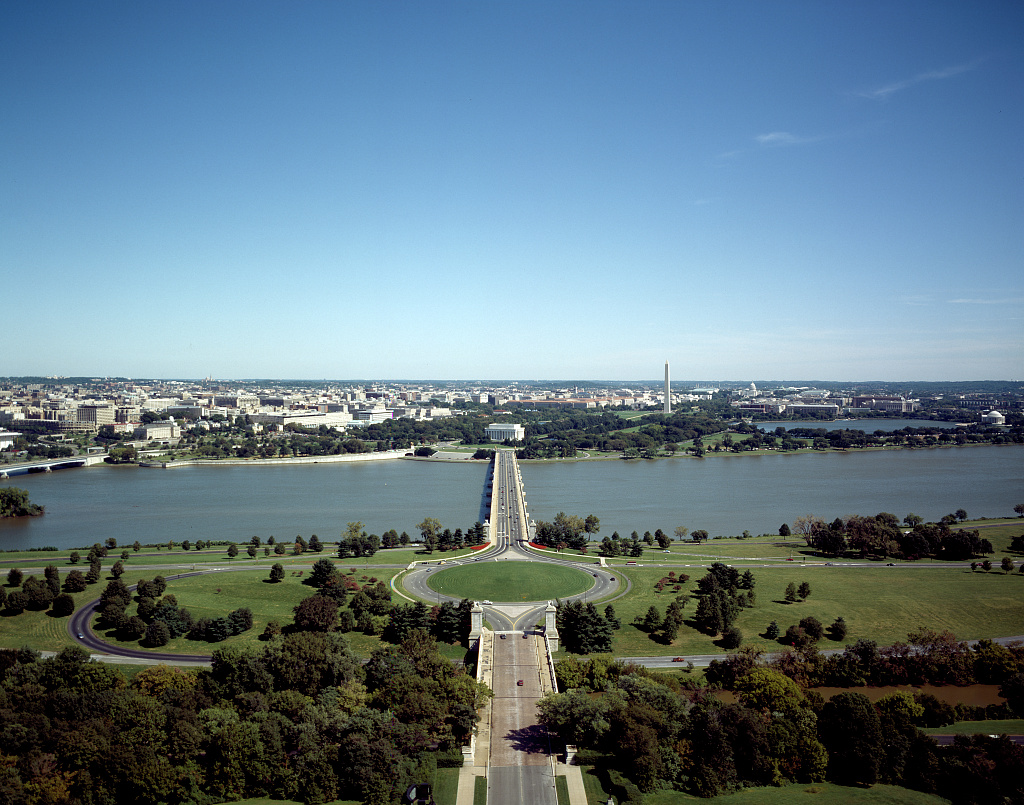
After 46 years, at least nine major proposals, one design competition, one killed-by-a-senator moment, one World War, one president bouncing across the grass of Potomac Park, and one set of columns rejected for being too tall for airplanes, the crossing finally existed.
Same Spot, 95 Years Later (2026)
Memorial Circle has been a traffic circle for nearly a century. Then, in January 2026, a new proposal arrived for the same piece of ground where the 166-foot columns were once rejected.
A 250-foot triumphal arch. The tallest in the world, surpassing the Arc de Triomphe in Paris by 86 feet. Designed by Nicolas Leo Charbonneau of Harrison Design. Topped with a 60-foot gilded winged figure and two golden eagles. Four golden lions at the base corners.
The Commission of Fine Arts voted 5-0 to approve the concept on April 16, 2026, after receiving roughly 1,000 public comments, 100 percent of them against.
A lawsuit filed in February 2026 by Public Citizen raised several objections, including a familiar one: the structure could pose an aviation hazard to Reagan National Airport.
Too tall. The same argument, at the same spot, 95 years apart.
Catesby Leigh, the art critic whose 2025 essay “Washington Needs an Arch” arguably helped inspire the project, had originally proposed something around 60 feet tall. When the 250-foot design was revealed, his assessment was blunt: “It’s way too big for that site.”
Historian Chandra Manning of Georgetown offered broader context: “I don’t know of a long U.S. tradition of building arches for things… sounds like an import from elsewhere.”
The Pattern
Since 1886, this spot has been proposed as the site of a medieval fortress bridge, a 36-arch colossus lined with generals, a Romanesque arch with a memorial column, 166-foot gold-topped columns, and now a 250-foot triumphal arch.
Every grand vision has been either killed, scaled back, or never funded.
The bridge that actually got built, the one that’s been there since 1932, is the one design that chose restraint.