

The Lincoln Memorial stands on what used to be shallow water and tidal mudflats in the Potomac River, built up into new land with dredged river mud. And at its dedication in 1922, one speaker had to cut the ending he’d written, an ending that called the memorial “a hollow mockery” unless the country lived up to Lincoln’s ideals.
Before engineers created West Potomac Park, this was part of the Potomac Flats. Congress funded a major reclamation project in 1882, and the Army Corps of Engineers dredged the river and used the material to build up the flats. More filling and grading prepared the site, and construction on the memorial began in 1914.
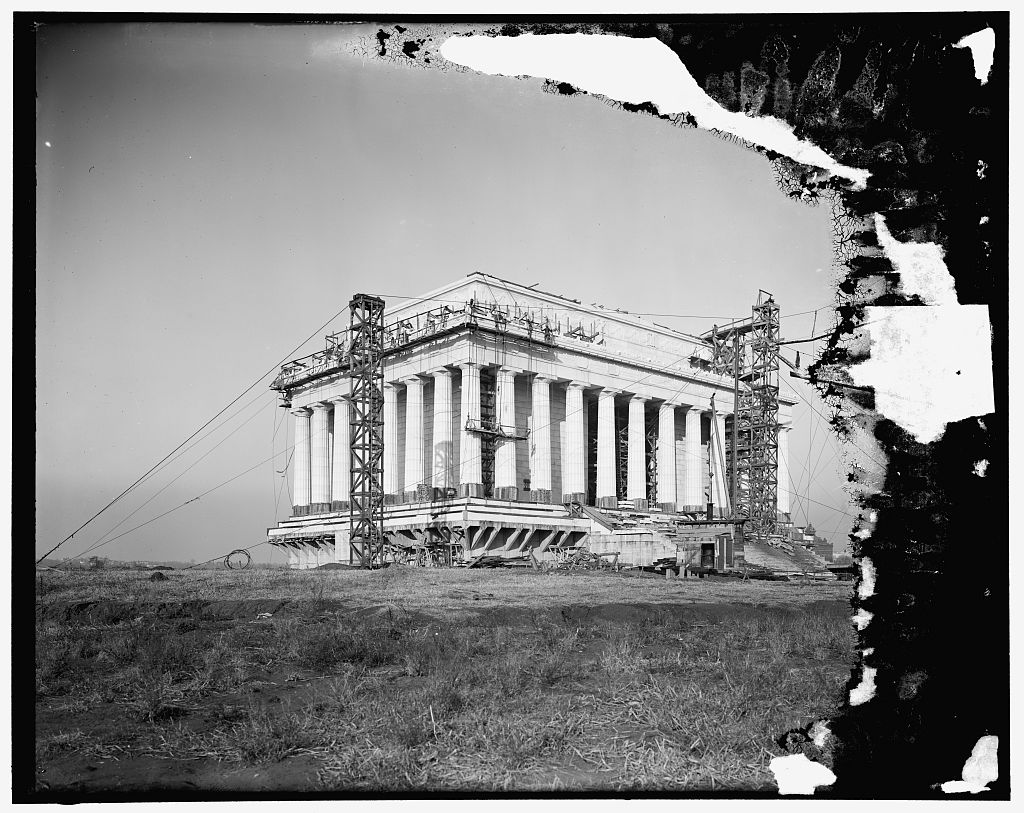
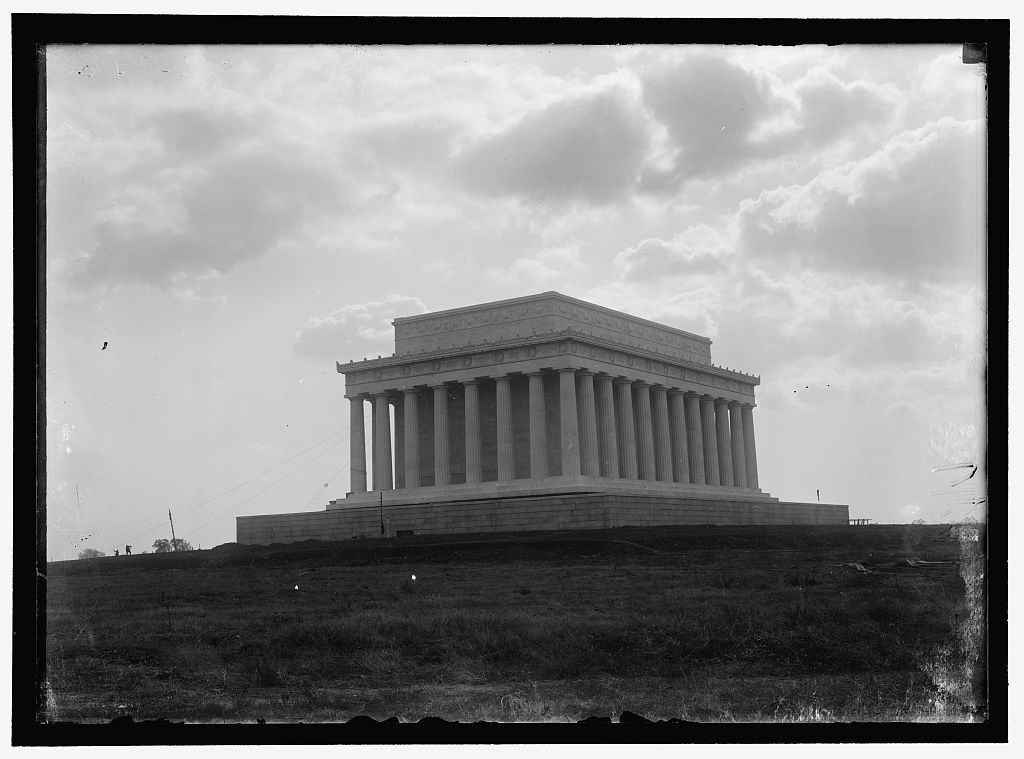
The photograph below, dated circa 1917 by the Library of Congress, catches the building under construction with marsh still in the foreground.
Below the finished memorial, 122 concrete piers reach down to bedrock, and part of the enormous space called the undercroft opened as a museum in June 2026. We’ll get to that underground view after a look at how the building got here.

How the McMillan Plan picked the spot
The new park gave Washington room for a memorial, but choosing the spot and the design took years. The McMillan Plan, published in 1902, proposed a Lincoln memorial at the western end of the Mall, on an axis with the Washington Monument and the Capitol.
The Senate Park Commission behind that plan included Daniel Burnham, Frederick Law Olmsted Jr., Charles McKim, and Augustus Saint-Gaudens. It’s usually called the McMillan Commission after Senator James McMillan of Michigan, who ran the Senate’s Committee on the District of Columbia and got the commission going. The plan went to Congress as that committee’s report.
Stand on the memorial steps and look toward the Washington Monument, and you’ll see what the planners had in mind, with the Reflecting Pool and the long view east tying it all together.
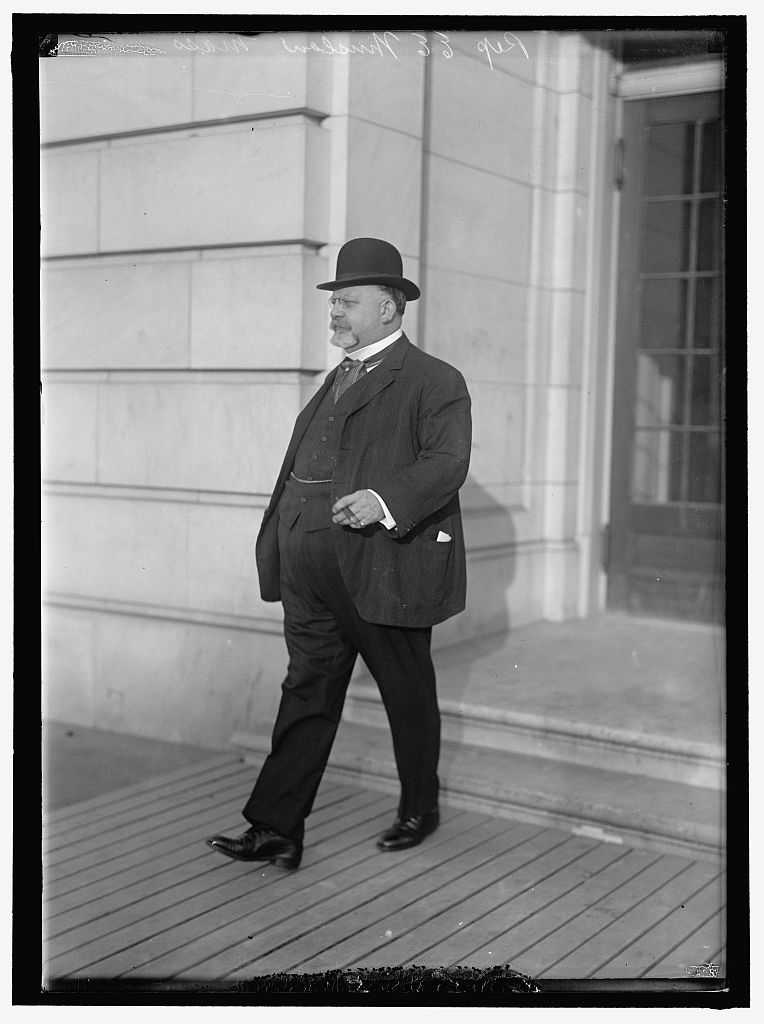
The riverfront location had competition, including Meridian Hill and the grounds of the Soldiers’ Home. Representative Joseph G. Cannon pushed for designs for those sites, while architect Henry Bacon prepared a proposal for Potomac Park.
Congress established the Lincoln Memorial Commission on February 9, 1911, with President William Howard Taft as chairman.
We’ve written separately about the Reflecting Pool that runs east from the memorial and about the long fight over Memorial Bridge that crosses the Potomac just west of it. Both are part of the same McMillan-era idea.
The 1912 designs that lost
Henry Bacon and John Russell Pope both prepared proposals for the memorial. Pope later designed the Jefferson Memorial, the National Gallery of Art’s West Building, and the National Archives, but his Lincoln Memorial drawings show a very different Washington.
We dug these up at the National Archives years ago, and they are extraordinary. Pope tried pyramids and stepped towers as well as classical designs with columns and columned porches, and his final proposal was an enormous circular monument. Can you imagine one of these at the end of the Mall?
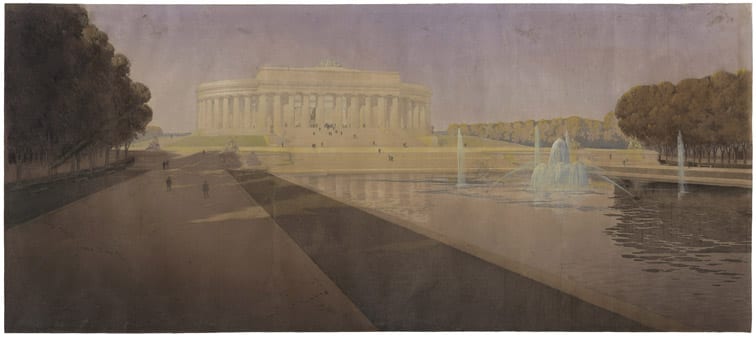


Bacon’s winning design was a Greek Doric temple, with a broad platform, a ring of columns, and a chamber for a seated Lincoln. Both architects took their proposals through more than one stage.
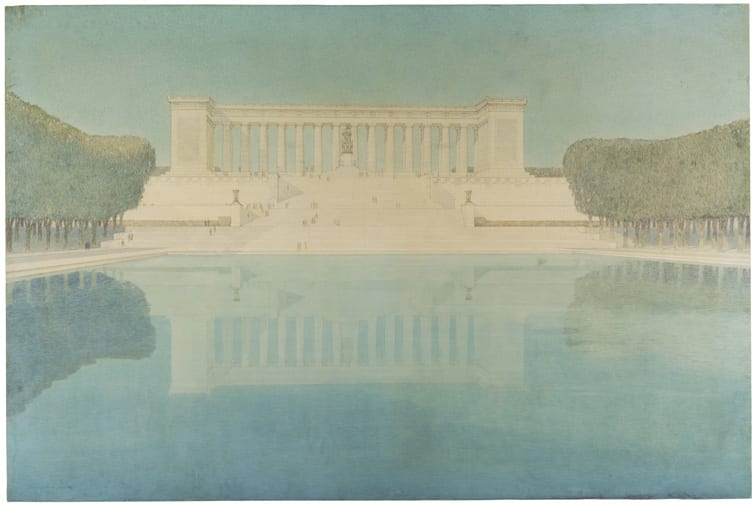
Bacon got the architectural commission, and Daniel Chester French became the sculptor of the seated Lincoln.
The thirty-six columns around the building represent the states in the Union at Lincoln’s death in 1865, and their names and admission dates run along the band above the columns. Higher up, another band lists the forty-eight states in the Union at the 1922 dedication, so the building records the country at two moments.
Breaking ground on Lincoln’s birthday
Groundbreaking took place on Lincoln’s birthday, February 12, 1914. The photograph below shows Col. William W. Harts at the site, with Henry Bacon and former Senator Joseph C.S. Blackburn among the men present.
Blackburn, a member of the Lincoln Memorial Commission, was a former Confederate officer, a striking detail in building a memorial to the president who led the Union through the Civil War.
The cornerstone was laid on February 12, 1915, exactly a year after groundbreaking. Stonemasons set the stone in place at 3:07 p.m., and Blackburn, as the commission’s Special Resident Commissioner, declared it set. The cavity held items including an American flag, a Bible, and a map of the Gettysburg battlefield.

Building the marble memorial
Construction continued through World War I and into the early 1920s. Before the marble temple could rise, workers had to build a foundation that reached through the reclaimed ground to bedrock.
The building brought together stone from several states: Colorado marble for the exterior, Indiana limestone for the interior, pink Tennessee marble for the floor, and Alabama marble overhead. Pink Massachusetts granite went into the lower steps and terrace walls, and Georgia marble went into Lincoln’s statue.
Bacon chose materials from different parts of the country to reinforce the memorial’s theme of national unity, a detail that’s easy to miss under all that white marble.
French’s seated Lincoln was carved from twenty-eight blocks of Georgia marble and is nineteen feet tall. Estimates of its weight vary: the Park Service’s statue page puts it at 175 tons, and the Smithsonian American Art Museum says about 170 tons of marble was left after carving.
French made the model, and the Piccirilli Brothers carved the marble in their New York studio. The pieces were assembled inside the memorial chamber in late 1919 and early 1920.
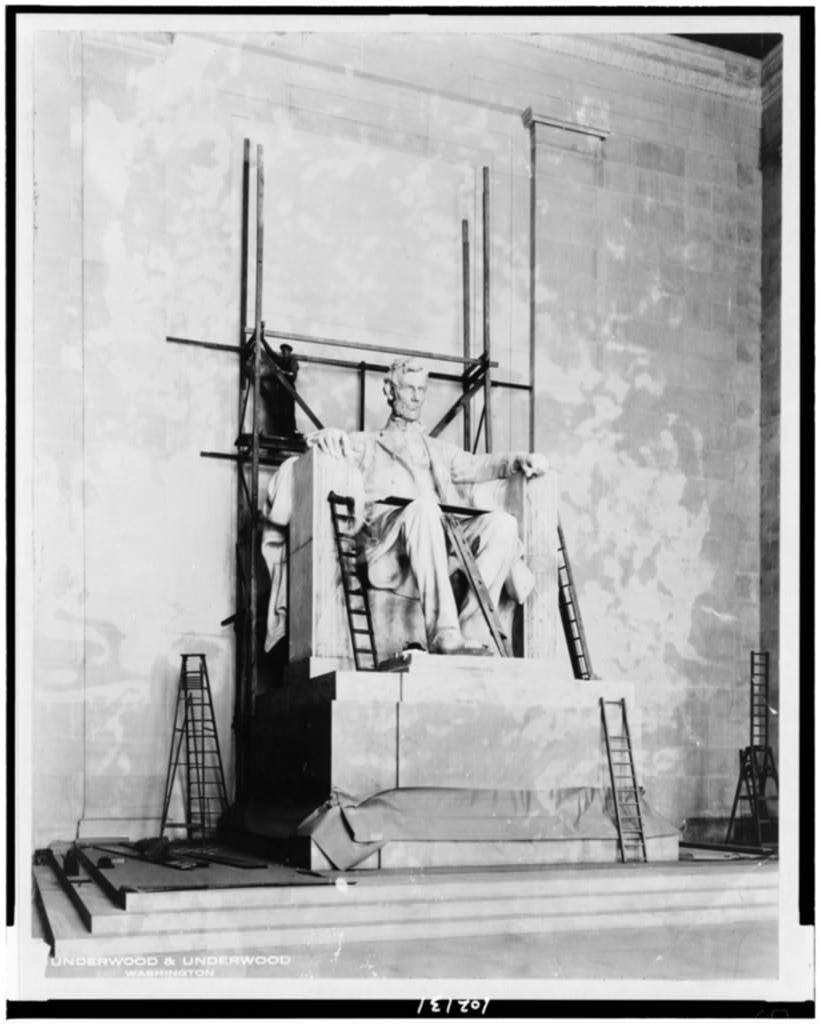
The statue got bigger during planning, because a smaller figure would have been overwhelmed by the chamber, and French and Bacon had to think about how Lincoln would look from the entrance as well as up close. Next time you’re there, take a look from the doorway first.
Jules Guérin painted the two murals above the inscriptions. Emancipation, on the south wall above the Gettysburg Address, represents freedom and liberty. Unity, on the north wall above the Second Inaugural Address, shows the Angel of Truth joining figures representing North and South.
Guérin even put the architect in Unity, and the National Park Service identifies Bacon as the fourth figure to the left of the Angel of Truth.
Congress first capped the cost at $2 million in 1911 and raised the ceiling twice, to $2,594,000 in 1916 and to $2,957,000 in 1921. Daniel Chester French’s two contracts for the statue and its pedestal came to $88,400 of that.
The undercroft beneath the marble
The space beneath the memorial is the undercroft, and the Trust for the National Mall puts it at about 43,800 square feet. Its concrete pillars look nothing like the marble chamber above.
The foundation has two main sections. Below the original park level, 122 concrete piers reach down to bedrock, and above them, another set of pillars and arches supports the memorial floor.
That’s the key to the swamp story. The memorial’s weight is carried down through the reclaimed ground instead of resting on a shallow layer of river fill.
The undercroft was part of the original construction, and the National Mall’s undercroft history records trial tours in April 1976 and regular weekly tours beginning in 1977.
One of its stranger sights is the stalactites beneath the memorial steps, where rainwater passing through the stone has left mineral deposits overhead, just like in a cave.

Construction workers also left graffiti, along with objects such as tools, bottles, and clothing. Those traces show us the people who built the memorial, not just the better-known names on the architectural drawings.
Some of the workers’ graffiti remains in areas visitors can’t enter, so the museum displays photographs of it, and windows let you look into the unfinished foundation space.

The old tours stopped in 1989 after asbestos was identified. Work on the new museum began in March 2023, and the undercroft reopened to the public on June 25, 2026.
About 15,000 square feet now holds exhibits about the memorial’s construction and its role in civil rights history, and floor-to-ceiling windows keep the concrete foundation in view.
Visits to the undercroft use timed-entry tickets, so check the Park Service’s visitor information before going. The main memorial chamber remains a separate visit.
The dedication on Memorial Day, 1922
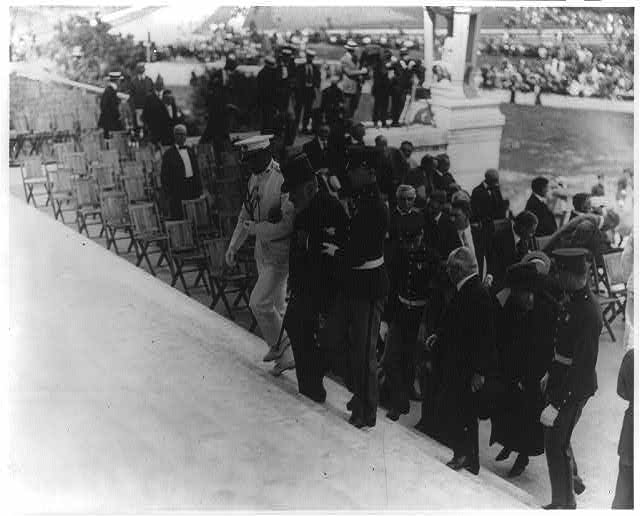
The memorial was dedicated on Tuesday, May 30, 1922, eight years after groundbreaking. President Warren G. Harding accepted it for the nation, and Abraham Lincoln’s son Robert Todd Lincoln attended.
The National Park Service puts the audience at more than 50,000, with Civil War veterans among them.
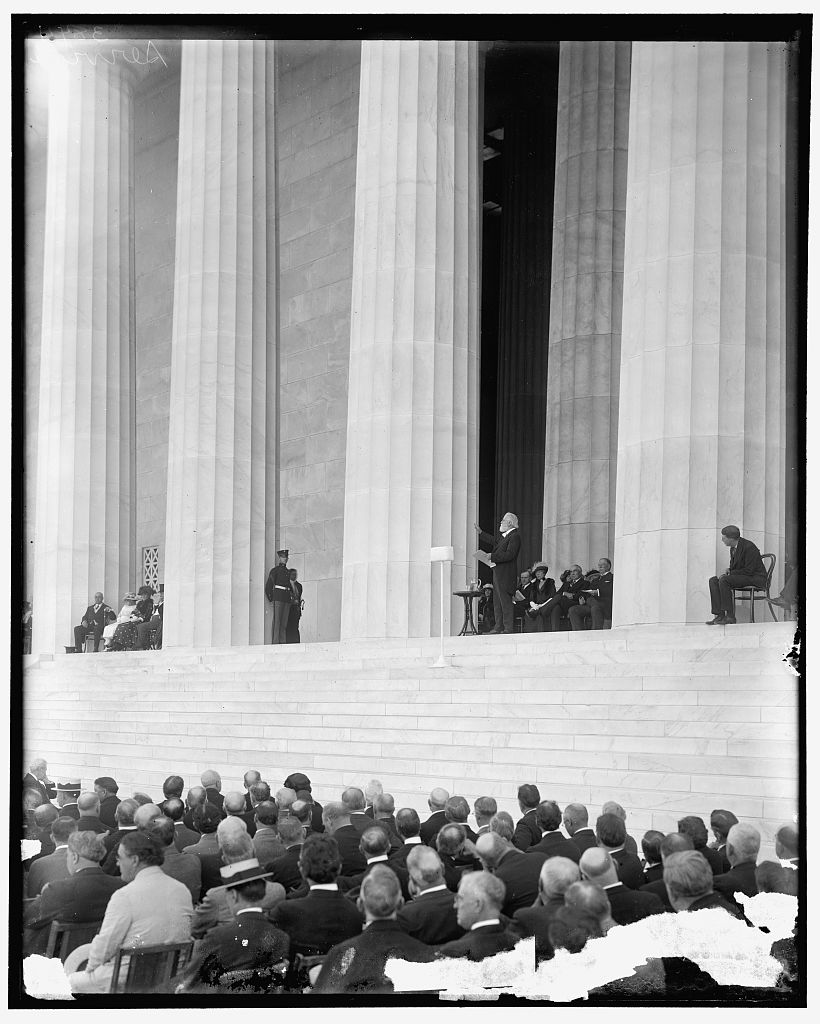
Taft, by then Chief Justice, still chaired the Lincoln Memorial Commission and presented the memorial, and Harding accepted it on behalf of the country. The program also included a poem by Edwin Markham, Lincoln, the Man of the People.
Work around the building continued after the dedication, including completion of the Reflecting Pool.
The ceremony was also broadcast on radio, so people who couldn’t be at the memorial could listen in.
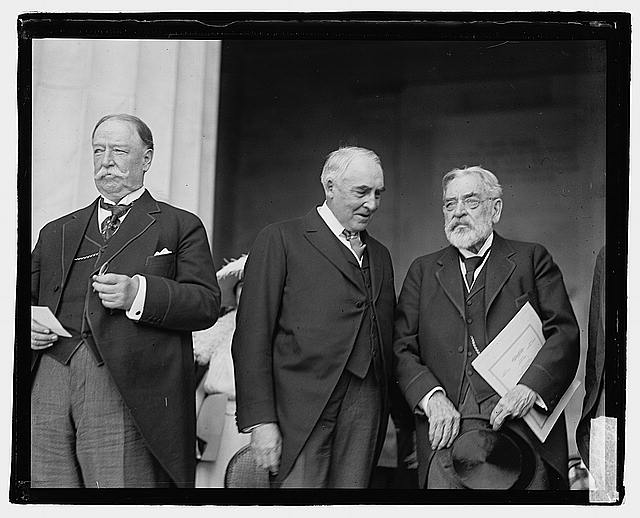
Robert Todd Lincoln sat on the platform with the officials dedicating the memorial to his father, and he’s in the photographs here, beside Taft and Harding.
We have a separate post on his attendance at the dedication and his life: Robert Todd Lincoln at the Lincoln Memorial Dedication, 1922.
The words Moton had to cut
Robert Russa Moton, principal of Tuskegee Institute, delivered the main address. Before the ceremony, Moton had to submit his text in advance for revision, and the organizers decided his draft was too outspoken. In the speech he actually gave, he replaced the whole concluding section, including a passage that challenged the country to live up to Lincoln’s ideals.
Moton’s unspoken words make uncomfortable reading alongside the memorial’s message of national unity. The draft reproduced by the Library of America included this challenge:
My fellow citizens, in the great name which we honor here today, I say unto you that this memorial which we erect in token of our veneration is but a hollow mockery, a symbol of hypocrisy, unless we together can make real in our national life, in every state and in every section, the things for which he died.
The speech Moton delivered still raised the question of whether emancipation had been followed by equal opportunity. In the transcript published by the National Park Service, he said:
I speak for the Negro race. Upon us, more perhaps than upon any other group of the Nation, rests the immediate obligation to justify so dear a price for our emancipation.
Near the end, he returned to what Lincoln meant to Black Americans:
Twelve million black Americans share in the rejoicing this day. As yet, no other name so warms the heart or stirs the depths of their gratitude as that of Abraham Lincoln. To him above all others we owe the privilege of sharing as fellow citizens in the consecration of this spot and the dedication of this shrine.
Black guests at the dedication were seated separately from white guests, and that segregation is central to the story: a memorial honoring emancipation opened with an audience divided by race.
It’s hard to look at the dedication photographs the same way once you know that.
Taft’s tribute to the new memorial
In his published presentation address, Taft praised Bacon’s Greek temple in terms worth reading alongside Moton’s experience of the ceremony:
It is a magnificent gem set in a lovely valley between the hills, commanding them by its isolation and its entrancing beauty, an emblem of the purity of the best period of the Greek art in the simple Doric, the culmination of the highest art of which America is capable, and therefore fit to commemorate a people’s love for the Nation’s savior and its greatest leader.
Taft closed by describing what he hoped people would find there:
Here is a shrine at which all can worship. Here an altar upon which the supreme sacrifice was made in the cause of Liberty. Here a sacred religious refuge in which those who love country and love God can find inspiration and repose.
The two speeches show different sides of the dedication: pride in the new national monument and the unfinished promise of equal citizenship.
Anderson, King, and the memorial steps
The memorial’s steps became the setting for two of the country’s best-known civil rights gatherings, in 1939 and 1963.
After the Daughters of the American Revolution refused to let Marian Anderson sing at Constitution Hall because she was Black, organizers found another venue. On Easter Sunday, April 9, 1939, she performed on the Lincoln Memorial steps.
The NAACP and Anderson’s manager, Sol Hurok, helped arrange the concert, with support from Interior Secretary Harold Ickes. An estimated 75,000 people attended, and radio carried her singing across the country. She opened with My Country, ‘Tis of Thee.
Eleanor Roosevelt resigned from the DAR in protest over Anderson’s exclusion. The concert gave an integrated audience a place at the memorial, seventeen years after the segregated dedication.
On August 28, 1963, more than 200,000 people gathered for the March on Washington for Jobs and Freedom. The National Archives puts the crowd at more than 250,000. Martin Luther King Jr. delivered his I Have a Dream speech from the memorial steps, with the crowd stretching along the Reflecting Pool.

That photograph looks out past Lincoln toward the demonstrators. Turn around after looking at the statue, and you face the space where those crowds gathered, a view that has become as much a part of the memorial’s history as the room behind it.
An airplane on the Reflecting Pool in 1923
For something lighter, there’s a photograph of an amphibian aircraft on the Reflecting Pool in 1923, with the new memorial rising directly behind it.
We’ve written about that scene separately: an amphibian aircraft on the Reflecting Pool in front of the Lincoln Memorial. It’s a long way from the marsh in the construction photograph.
Our archive also has photographs of children swimming in the Reflecting Pool in the 1920s.
What the construction photographs reveal
The construction photographs show the memorial before landscaping settled it into place, with cranes, bare ground, and marsh around a building we know as a finished monument.
The undercroft museum shows another part of that work, and its concrete pillars help explain how a memorial this heavy could stand on reclaimed river land.
Next time you climb the steps, remember the marsh in that early photograph. There was a lot of Washington to build before the statue could take its seat.
Lost Washington stories, in your inbox.
The newest story, plus a few from the archive.
Free. Unsubscribe anytime.
This older post was revised with help from AI. Here’s how we use AI.Suggest a correction