
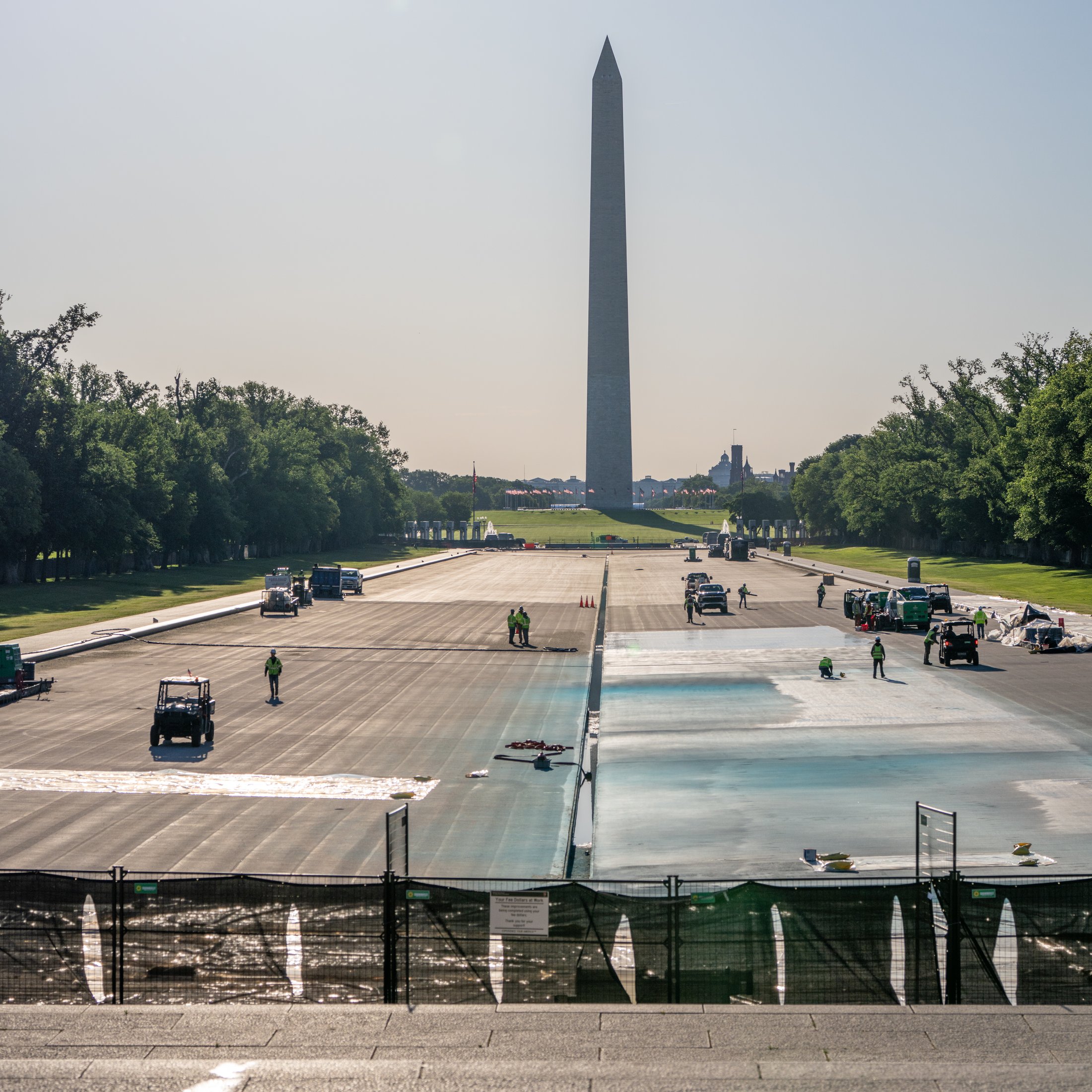
A presidential motorcade rolled across the bottom of the Lincoln Memorial Reflecting Pool on the evening of May 7th, 2026. There was no water in it. The granite floor had just been resurfaced in what President Donald Trump calls “American flag blue,” and he wanted to see it before sundown.
You almost certainly saw the photo. SUVs in convoy, Lincoln watching from his chair at the west end, the Washington Monument to the east, and fresh blue paint where 6.75 million gallons of water are supposed to be.
Trump told reporters the project cost “nearly $2 million” and that the result would be “much more beautiful than when they did it in 1922.” Standing in the empty basin he added, “Our country is about beauty, cleanliness, safety, great people. Not a filthy capital.”
Here is the strange thing about all of this. The architect Henry Bacon designed the Lincoln Memorial Reflecting Pool to be a mirror, not a surface you were supposed to look at.
The pool opened in 1923 with a plain asphalt and tile bottom, and when the National Park Service rebuilt it in 2012 the new floor was tinted a neutral gray to make the water more reflective, according to the Trust for the National Mall. Either way, the floor was supposed to disappear under the reflection. It was never supposed to be the show.
A mirror that was supposed to disappear
Bacon’s idea was a mirror. A long, narrow, shallow plane of water aligned exactly between the Lincoln Memorial and the Washington Monument so that, depending on where you stood, the marble Lincoln dissolved into the sky and the obelisk multiplied into two. Roughly 2,030 feet long, 167 feet wide, 18 inches deep at the edges and 30 inches in the middle. The whole point of those measurements was that they should vanish.
The pool is not a swimming pool, despite what one architect told NPR last month about “pool guys” refinishing it like Mar-a-Lago. The pool is an optical instrument.
Bacon did not invent the device. He had spent two years on a Rotch Traveling Scholarship sketching Greek and Roman architecture and worked at McKim, Mead & White before going out on his own. By 1897 he was already sketching a memorial to Abraham Lincoln. The reflecting pool was the last piece of a project that would consume the rest of his life.
Reclaimed mud, a speaker who hated it
The ground the pool sits on was not ground at all when Bacon was young. The marshy strip between the foot of the Washington Monument and the Potomac was called Kidwell Flats, and it was a tidal mosquito swamp.
From 1870 onward the Army Corps of Engineers ran dredgers through the river, and by August 30th, 1911, they had moved more than 12 million cubic yards of mud out of the Potomac and dumped it where the Lincoln Memorial and the reflecting pool now stand.
Speaker of the House Joseph Cannon hated the site. He famously said he would “never let a memorial to Abraham Lincoln be erected in that damned swamp.” He lost. West Potomac Park was confirmed in June 1911 and construction began in 1915.
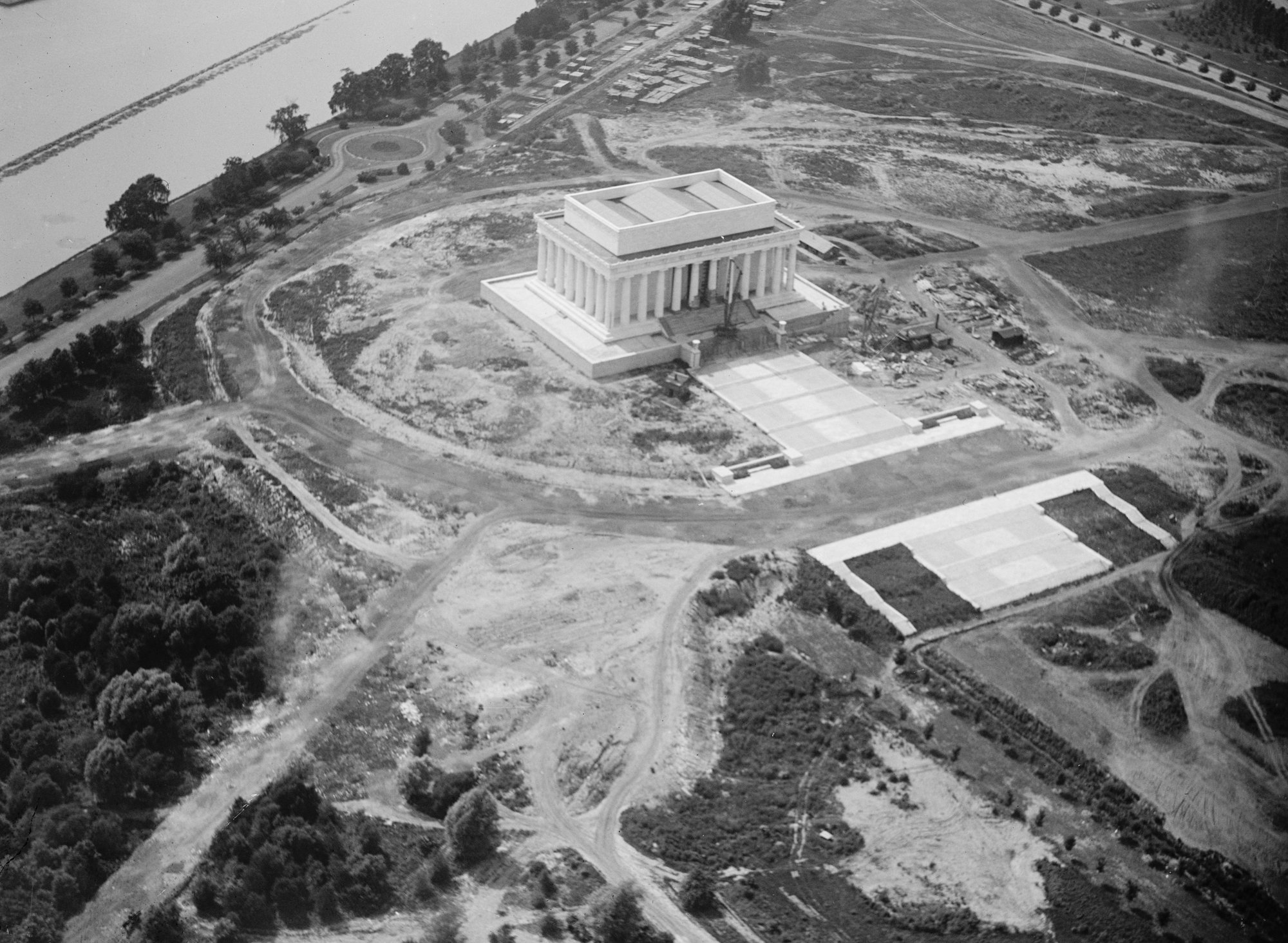
If you have ever wondered why the Lincoln Memorial sits on top of 122 concrete pillars driven 44 to 65 feet into the earth, that is the reason. They are reaching down through the dredged mud to find bedrock. The reflecting pool got no such foundation.
January 15th, 1902: A plan unveiled at the Corcoran
The reflecting pool came out of the McMillan Plan. On January 15th, 1902, Senator James McMillan of Michigan and his Senate Park Commission (the architects Daniel Burnham and Charles McKim, the landscape architect Frederick Law Olmsted Jr., and the sculptor Augustus Saint-Gaudens) opened a public exhibition at the Corcoran Gallery of Art.
President Theodore Roosevelt attended. The Washington Post covered it the next morning under the headline “The New Washington: Plans for Beautifying City Ready for Inspection.”
What the public saw at the Corcoran was a pair of vast scale models. One showed the Mall as it actually existed in 1901, a chain of Victorian gardens cut in two by the elevated tracks of the Baltimore and Potomac Railroad.
The other showed the Mall as the commission proposed to remake it. From that second model came almost everything you now associate with monumental Washington: the long open green, the Lincoln Memorial at the western anchor, Memorial Bridge, Union Station, and a rectangular reflecting basin pulled straight from Versailles.
The commission’s report did not hedge:
“During the century that has elapsed since the foundation of the city the great space known as the Mall…has been diverted from its original purpose and cut into fragments, each portion receiving a separate and individual informal treatment, thus invading what was a single composition. The original plan…has met universal approval. The departures from that plan are to be regretted and, wherever possible, remedied.”
They knew what they were proposing was generations of work. As the report put it, “The task is indeed a stupendous one; it is much greater than any one generation can hope to accomplish.”
McMillan died seven months later, in August 1902, and never saw a foot of any of it built.
The pool that was already a compromise
Here is the part nobody tells you. The pool you can see today, even when it has water in it and is not painted blue, is already a compromise version of what the McMillan Commission drew.
The 1902 plan called for a cruciform reflecting pool, a long basin with a perpendicular cross-axis at its midpoint and fountains at both ends. A second pool was to extend north from East Potomac Park to the foot of the Washington Monument, and the Monument itself was to be wrapped in a complex of granite terraces and arcades called the Washington Monument Gardens.
The cross-axis was never built. The second pool was never built. The terraces were never built. Engineers concluded the excavation would destabilize the Monument’s foundations.
What got constructed in 1922 and 1923 was the spine of the cruciform alone. We have written before about the 140-year fight over Memorial Bridge, another McMillan Plan element that took decades to push through Congress. The reflecting pool was built faster but smaller. It was also built badly.
Asphalt on mud
Excavation began March 25th, 1920. When the pool was finished in 1923, the bottom was laid in asphalt and tile directly on the soft, dredged riverbed. No underlying support structure. No pilings. Nearly seven million gallons of water sitting on something with the consistency of wet sponge.
It started leaking almost immediately and never really stopped.
By 1980 the unstable subgrade had deflected about twelve inches. Workers poured a new concrete slab on top of the existing one, but the added weight only worsened the settlement. By 1986, an engineering report told the Park Service the pool’s structural system was failing. By the late 2000s, the pool was losing roughly 500,000 gallons of water per week to cracks, leaks, and evaporation.
In November 2010, using $30.74 million in American Recovery and Reinvestment Act funds, the National Park Service tore out almost everything Bacon had built. In May 2011 contractors began driving 2,113 wood pilings, each 40 feet long, into the marshy clay below. The pool reopened on August 31st, 2012. Within weeks an algae bloom covered the surface and the Park Service had to drain it again.
A stage for history, not a pool
While Bacon’s pool was failing structurally it was succeeding as something else, almost by accident: the most photographed civic stage in America.
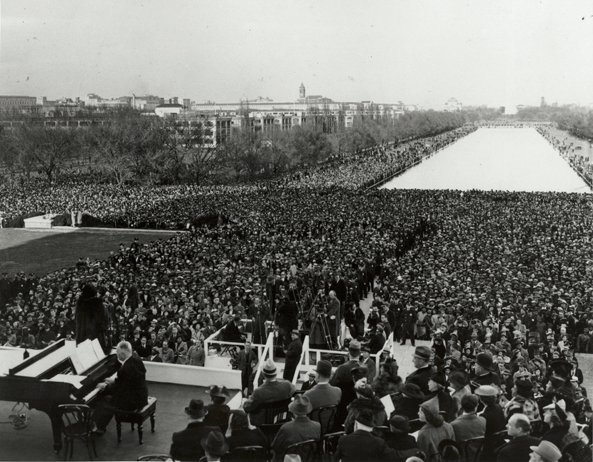
On Easter Sunday, April 9th, 1939, the contralto Marian Anderson sang to 75,000 people from the Lincoln Memorial steps after the Daughters of the American Revolution refused her Constitution Hall. The pool stretches behind the crowd in every overhead frame.
On August 28th, 1963, roughly 250,000 people lined both sides of the basin to hear Martin Luther King Jr. give his “I Have a Dream” speech.
On January 19th, 2021, then President-elect Joe Biden lined the rim with 400 lights, one for every thousand Americans dead from COVID-19.
People who will never read Bacon’s name have memorized his sightline.
We have written before about the pool in playful use, including a 1923 amphibian aircraft taking off from it and boys swimming in it during the 1920s when nobody had told them not to.
Bacon did not live to see any of it
Henry Bacon was 57 years old when his Lincoln Memorial was dedicated on May 30th, 1922. He had worked on the building, in some form, since 1897. In May 1923, President Warren G. Harding handed him the AIA Gold Medal at a ceremony on the steps of his own creation.
The reflecting pool was finished a few months later. Bacon was already sick.
He died on February 16th, 1924, of intestinal cancer in a New York City hospital. His pool was less than a year old. He never saw it leak, never saw the ice skaters that first winter, never saw Marian Anderson, never saw King, never saw the 2,113 pilings driven in 2011 to keep his mirror from sinking into the swamp.
What survives him in Washington is the pool, his early sketches of the Lincoln Memorial, and the alternate Lincoln Memorial designs that lost the 1912 competition. Everything else is gone.
And now it is blue
Standing in the empty basin on the evening of May 7th, surrounded by Interior Secretary Doug Burgum and Homeland Security Secretary Markwayne Mullin, Trump told reporters his contractor had talked him out of his first color choice. He had wanted turquoise, “like in the Bahamas.”
The contractor, “a guy who’s unbelievable at doing swimming pools,” recommended American flag blue instead. The administration says the pool will be refilled in time for July 4th and the country’s 250th anniversary.
Henry Bacon spent more than twenty years designing a mirror so quiet you would barely register it was there. The man currently standing in it just gave it a color.
The mud underneath has not moved.