
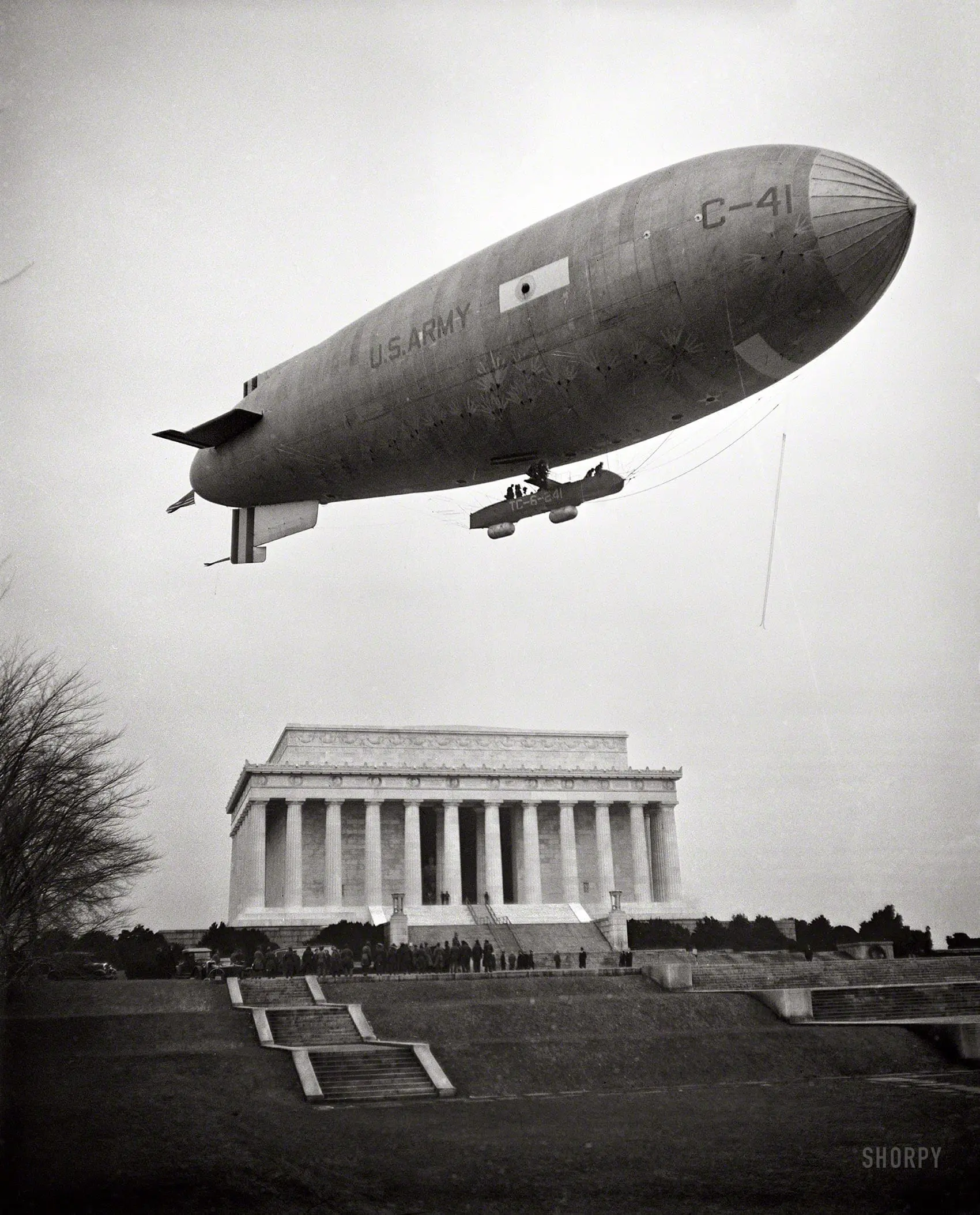
This is one of the strangest photographs in the Library of Congress collection of pre-war Washington. An Army blimp, the C-41, parked on the snowy lawn east of the Lincoln Memorial. A short line of airmen carrying a wreath up the steps. The Washington Monument off in the distance.
The whole tableau looks photoshopped, and it isn’t.
The date is February 12, 1930. The occasion is Abraham Lincoln’s 121st birthday. The man at the head of the wreath party is named William J. Flood. For the eleven years this photo has lived on Ghosts of DC, I have called him a Brigadier General. I had inherited that from Shorpy and the Library of Congress descriptive notes. I finally checked.
He wasn’t. In February 1930 he was a captain. He wouldn’t pin on a star until February 6, 1943, which the official Air Force biography is clear about. The caption error has been kicking around the internet for years. This post is where I finally fix ours.
What was flying that morning
The C-41 was a non-rigid TC-class blimp, built for coastal patrol, assigned to the 19th Airship Company at Langley Field, Virginia. By 1930 it was the Army’s lighter-than-air showpiece, the unit you sent to put on a public-relations spectacle.
This one was a beauty of a stunt. Land an Army blimp on the National Mall on Lincoln’s birthday, march a wreath party from the airship to the steps of the Lincoln Memorial, and let Harris & Ewing and the newsreel cameras do the rest.
Critical Past still has the silent reel of the airmen carrying the wreath. It runs under two minutes and shows the C-41 dropping low over the construction site that would become Memorial Bridge, settling onto the partly snow-covered field, and the wreath detail forming up. The lettering on the envelope is sharp enough to read: U.S. ARMY and C-41 in big block letters.

The Library of Congress holds the Harris & Ewing glass negative and a second view by Theodor Horydczak from the same ceremony, both in the public domain.
Captain Flood
Flood was a Peoria boy who went east for school, graduated from George Washington University, and took his Aviation Reserve commission on November 8, 1917. He shipped to France with the American Expeditionary Forces a month later and stayed until June 1919.
In Belgium in 1925 he finished second in the International Balloon Race. He came up through the Army’s Balloon and Airship School at Scott Field, Illinois, and commanded the 19th Airship Company at Langley from 1927 until April 1929.
He was the first pilot to pick up mail from the top of a building while in flight, and the first to pick up mail from a ship at sea.
By February 1930 he had moved up to the Office of the Chief of Air Corps in Washington. He was still very much the Army’s blimp man, which is presumably why he was at the head of the wreath detail.
The rest of his service reads like a separate war movie. He took command of the Army Air Base at Wheeler Field, Hawaii, in October 1941. Two months later he was wounded in the Japanese attack on Pearl Harbor.
The forgotten Army blimp program
The detail that surprises most people is that the Army flew blimps at all. The Navy is the service we associate with airships. But for most of the 1920s the U.S. Army operated more blimps than the U.S. Navy did, with bases at Scott Field, Illinois and Langley Field, Virginia.
The program ran from 1908, when the Signal Corps bought a single dirigible called the SC-1, until 1937, when Congress finally pulled the funding. Twenty-nine years of Army lighter-than-air, almost entirely forgotten.
The mission was always a little vague. Coastal patrol made sense on paper. Sub-spotting and harbor defense had been useful in the First World War.
By the early 1930s the airplane was eating every job the blimp could do, faster and cheaper, and the Army Air Corps was getting tired of writing checks for hangars that took up whole fields. In 1935 Major General Benjamin Foulois, the Chief of the Air Corps and himself a former dirigible pilot, recommended the program be terminated. In mid-1937 it was.
A handful of blimps went over to the Navy. The rest were broken up.
DC’s airship moments
For a city that doesn’t think of itself as an aviation town, Washington had a busy decade of airship visits before the C-41 wreath stunt.
The Army’s Italian-built semi-rigid Roma, the largest airship the Army ever operated, flew its first American flight out of Langley in November 1921. Three months later, on February 21, 1922, the Roma crashed into high-tension wires near the Norfolk Quartermaster Depot, burst into flames, and killed 34 of the 45 men aboard.
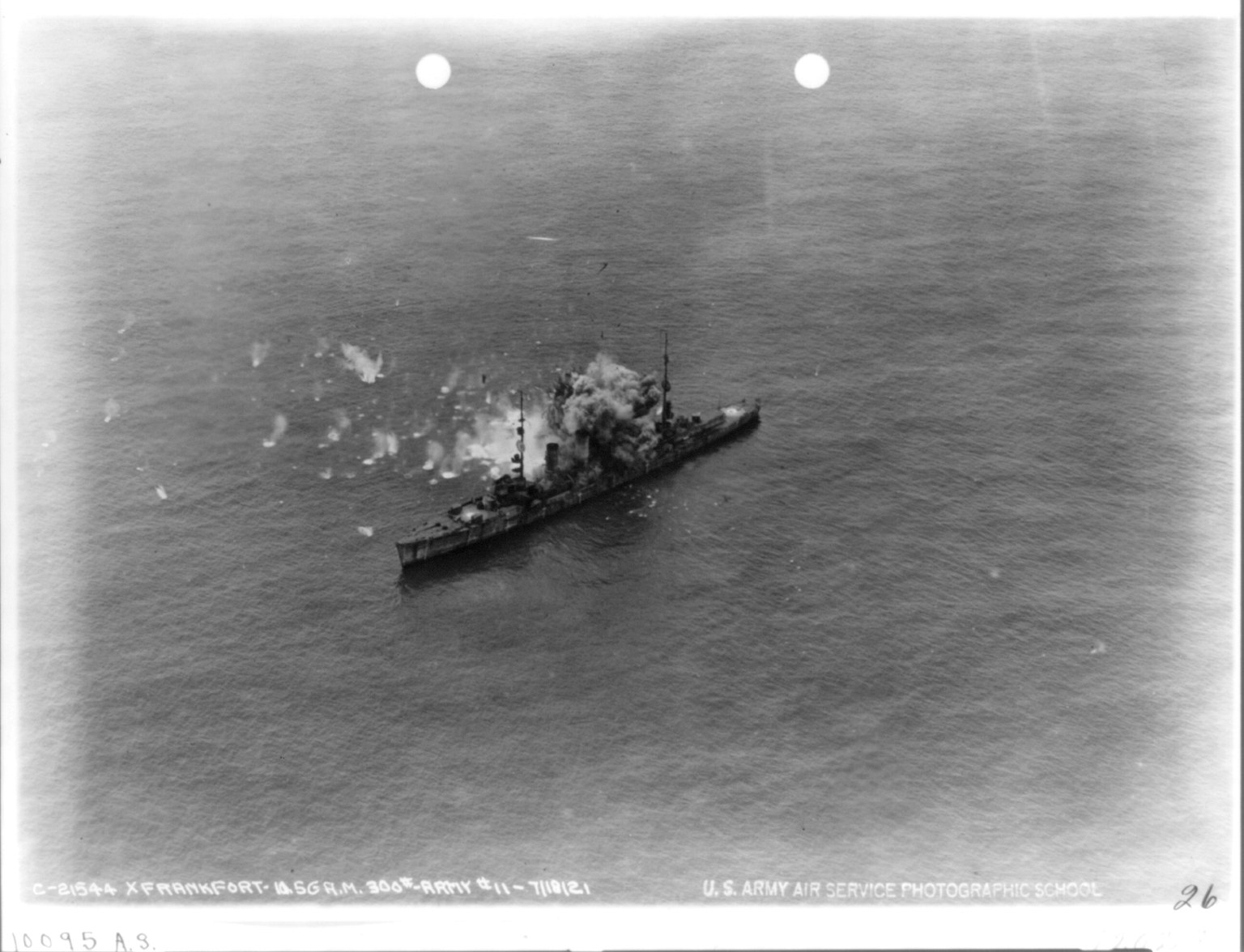
It was the worst aviation disaster in U.S. history to that point. The crash forced Congress to mandate non-flammable helium in all future U.S. airships.
The Navy’s USS Los Angeles, designation ZR-3, was christened by First Lady Grace Coolidge at Bolling Field on November 25, 1924. The Library of Congress has the photos of the ceremony, and another from the same day of President Coolidge inspecting the airship.

A few years earlier, at Scott Field, an Army TC-3 blimp flew with a trapeze rigged under its control car so that a small Sperry Messenger biplane could hook on and detach in midair. The first successful docking came on December 15, 1924.
The Navy adopted the trick later, scaled it up to the rigid airships USS Akron and USS Macon, and called them flying aircraft carriers. The Army was there first.
When the Graf Zeppelin floated over the U.S. Capitol in October 1928, it drew crowds onto rooftops. And by the early 1930s, tourists were paying for sightseeing rides on a Goodyear blimp out of Washington-Hoover Airport across the river, the field that the Pentagon and National Airport eventually paved over.
The kicker
The Lincoln Memorial wreath laying wasn’t the C-41’s only public stunt of 1930. The August 1930 issue of Popular Mechanics ran a piece called “Dirigible Grabs Mail Bag from Speeding Train.” It was the C-41 again, swinging a hook down to a moving Army postal car, the same trick Flood had pioneered on rooftops and ship decks.
Within seven years the program was over. The 19th Airship Company was dissolved. The C-41 was struck from the rolls. The Lincoln Memorial wreath photo was filed away under “Washington miscellaneous,” and the captain at the front of the line went on to fight a real war.
The blimp doesn’t fly there anymore. The captain made general. The story is the same one we keep finding in this city, which is that the thing you assume must have always looked the way it looks now turns out to have a much stranger past, one strange enough that Harris & Ewing showed up with a camera.
Ironic that after the postal clerk flew his gyrocopter into DC that Homeland Security proposed floating monitor zeppelins in a perimeter around the city. There’s nothing that’s new — including flying autogyros over DC: http://www.criticalpast.com/video/65675072957_Pitcairn-autogyro_Harold-Pitcairn_Lincoln-Memorial_Washington-Monument_White-House
http://www.criticalpast.com/video/65675068551_autogyro-aircraft_pilot-Jim-Ray_White-House-lawn_aircraft-take-off
http://www.criticalpast.com/video/65675039300_Picairn-PA-36-autogyro_testing_hovering_landing
Ray Milefsky