1201 S Street NW: From the Harmon Family Grocery to The Coffee Bar

1201 S St. NW

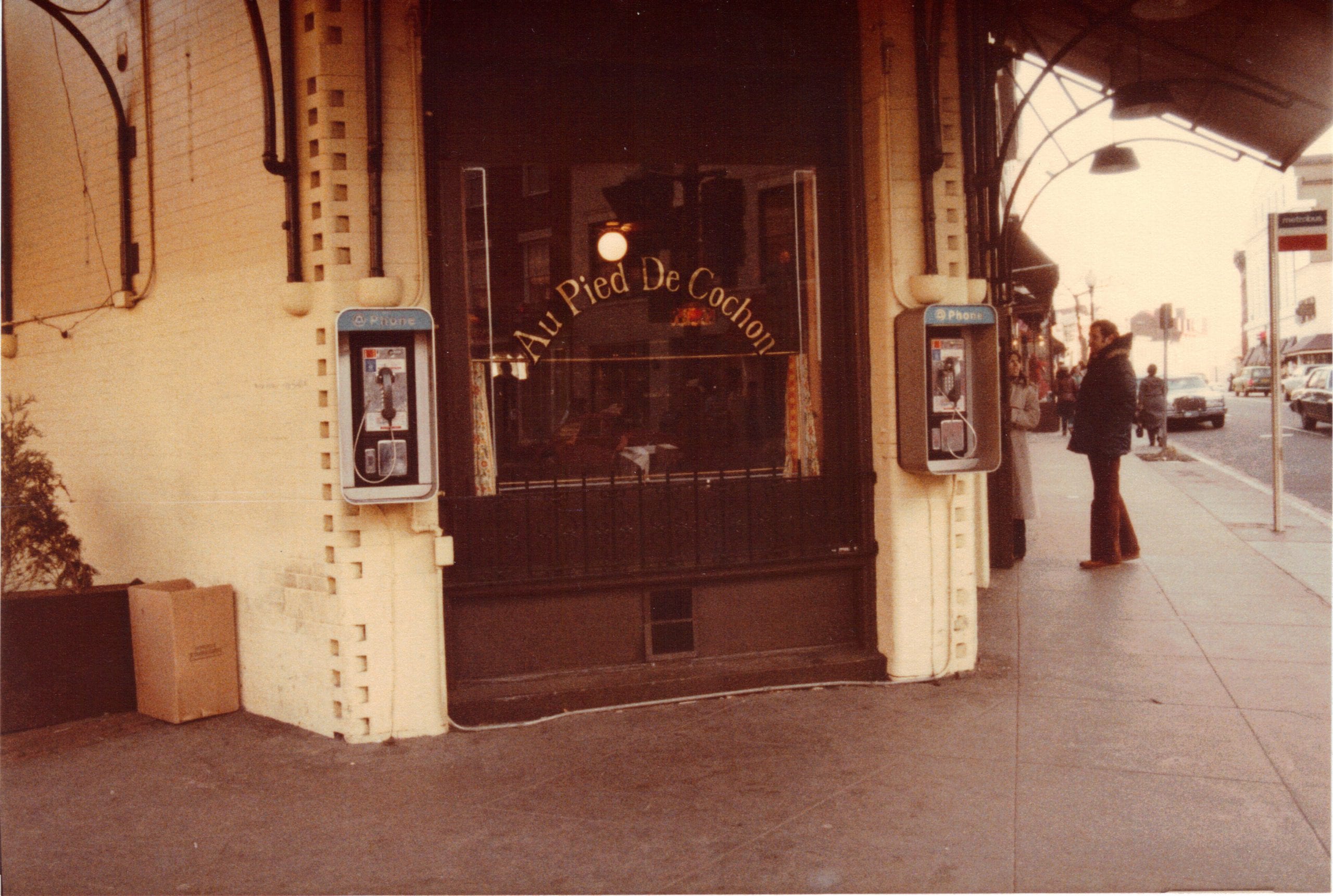
Ghosts of DC has a new favorite coffee joint at 1201 S St. NW. I went down this past Saturday with Mrs. Ghost and ran into Ms. EatMore DrinkMore (aka, Jenna). Maybe an “If Walls Could Talk” partner post with EMDM on a D.C. restaurant?

It’s been quite some time since our last IWCT post, so, to get this category going again, there’s no better place than our own Brooklyn-like coffeehouse at 12th and S St. NW, The Coffee Bar (EMDM did a review on them a short while ago).

The Coffee Bar @ 1201 S St. NW

Old maps of 12th and S Street NW

First, take a look at the Baist Real Estate Atlas’ for the intersection at 12th and S St. starting in 1909 below. You’ll notice that 12th St. used to go through S St., where now, Garrison Elementary School sits. The school was much smaller back then, sitting on 12th St., south of S St. In this map, the building marked as #35 is where The Coffee Bar is today.

Also, for reference, pink buildings are brick structure and yellow are frame structures.

1909 Baist Real Estate Atlas of 12th and S

Now, take a look at the area in the 1888 Sanborn Fire Insurance Map. You’ll notice that most of the structures were there back then. One major difference is that W.E. Hodges Coal Yard occupied to lot where the Garrison School now stands.

1888 Sanborn Fire Insurance Map of 12th and S St. NW

The Harmon family grocery store (and full house)

Miss Willie M. Kelly (Washington Post)

In 1940, there was a young couple, Woodrow Young (24) and Margaret Harmon (16) who were getting married. Margaret was listed as living at 1201 S St. Pretty young to be getting married as a teenager. A few years earlier, in 1937, another announcement had her brother Robert Harmon (20) getting married to Viola F. Scruggs (19).

And, in 1939 Miss Willie M. Kelly of Raeford, NC, married John C. Harmon at the Lincoln Temple Church, 11th and R St. NW.

We did some more digging on the Harmon family, and we were able to find their household in the 1940 U.S. Census.

John Wesley and Lillie B. Harmon were an older, African-American couple, originally from Delaware. In 1940, they were both 59 years old and lived above their grocery store at 1201 S St. NW.

Also in the house that year was their 16-year-old daughter Margaret, and another daughter, 11-year-old Sacajawea.

His other daughter Ruth, 25, lived in the home with her husband, Herman Walker, 35 and an art instructor, originally from Texas. They had two young children, Evangeline, almost two, and Herman Jr., seven months.

Three additional non-family members were living with them (full house!). James Spaulding, a 60-year-old widower from North Carolina, who worked as a brick layer, Emmett Poindexter, 61, and his wife Helen, 55, both from Virginia. Emmett worked as an independent laborer and Helen worked as a domestic for a local family.

That’s eleven people in one home! I’m guessing it only had one bathroom too.

Harmon family in the 1940 U.S. Census

By the way, I was also able to dig up a little more on Margaret Harmon. According to her Social Security records, she was born on March 24th, 1924 and only passed away a couple years ago, the day before Christmas Eve, 2011.

I also found some more on Lillie Harmon. She passed away in New York on August 25th, 1954, having lived 34 years in D.C. The obituary also stated that she had another daughter, Pocahontas.

That’s not all. After even more digging, I was able to find a feature in the Afro-American from Saturday, July 1st, 1939 entitled “Meet Your Neighbor” by Harry B. Anderson. John Wesley Harmon was the feature that day. (The following week would be a huge one for history, with Teddy Roosevelt‘s head on Mount Rushmore being dedicated on Sunday, July 2nd and Lou Gehrig‘s famous speech at Yankee Stadium being on Tuesday, July 4th.)

How long does the average colored business operate in Washington, for example, a grocery store?

Well, not wishing to offend nor discourage businessmen already set up in business, the answer to the above question: not over a year.

But J. Wesley Harmon, a local grocery store operator, with a flourishing business at Twelfth and S Streets, Northwest, is an exception, because he has been established for the past twenty years.

Trading in a vicinity where all the residents are members of his own group, he attributes his being able to stick to the same location to the fact that he has been patient and optimistic, always desiring to deal directly with his own race.

“Considering the many businesses of our group in the city which have dissolved almost overnight, after a brief life span, I guess it is rather an exception for me to state that I have been doing a fair business here for many years with all my patronage colored,” Mr. Harmon said, last week.

J. Wesley Harmon in the Afro-American (1939)

All this Mr. Harmon has reflected in his many years of commercial enterprise since he first went into business at the age of twenty-three, selling flour as the operator of his own flour mill in Sussex County, Del.

He thinks that he might have still been there after doing business for seven years had his initial concern not been destroyed by fire. After this, he taught in the Delaware County schools for a while, then worked in several other positions until 1915, when he came to Washington and attended Howard University.

Today he has but one aim in reference to his business, “I feel I have done a good job with my store all these years, because I have been able to raise a family of six children successfully and now my future aim is to turn the operation of my business over to them,” he declared.

His philosophy on life is give all you have to the world — even if it hurts — as you will find the results return doubled.

Meet Your Neighbor by Harry B. Anderson (Afro-American)

Well Mr. Harmon, your successful grocery store is now a successful, and quite popular local coffee joint. Maybe you’ll get a drink named after you to pay homage to your years of serving the local community.

K & D Food Market

In the 1970s, the building was occupied by a neighborhood market, K and D Food Market. According to the Washington Post crime blotter, the store was robbed my two armed men on Friday, December 3rd, 1971 (a week after Christina Applegate was born). Again, on Tuesday, January 29th, 1974 (the same day Ed Helms was born), the store was robbed by two masked men.

The market lasted into the 1990s, because there was a report of another robbery, this time in 1991, by three armed and masked men. These were ambitious robbers too, as K & D was one of five stores they robbed within three hours.

1201 S St. NW
1201 S St. NW

Sadly, there wasn’t much else available in the newspaper archives about 1201 S St., but it was great learning about the Harmon family.

Hobbit Houses Near Boundary Castle and a Surprise Historical Connection

The home at 1730 to 1738 V St. NW

GoDC buddy Wayne has kindly requested some digging into the story of the “hobbit homes” on V St. NW. We’re happy to oblige as we are quite curious of their origins. So, this will be a unique “If Walls Could Talk” for GoDCer Wayne. The homes we are investigating are situated about two blocks from … Read more

The History of Georgetown’s Gun Barrel Fence From the War of 1812

Georgetown's gun barrel fence

This is the best contribution thus far by a member of the GoDC community. This is from Tom H. in Bethesda, and when I first saw it, I was blown away at how professional it looked. Thanks Tom!

The video is a fascinating history of the gun barrel fence in Georgetown, made from 364 reclaimed Washington Navy Yard muskets.

Georgetown's gun barrel fence
Georgetown’s gun barrel fence

To complement this wonderful video, we dug up an article published in the Washington Herald on Sunday, June 25th, 1911.

Surmounting a crumbling retaining wall of age-worn stone which stands in front of three of the oldest houses in historic Georgetown is an iron fence which boats a more interesting history than the majority of fencing.

If you will examine the iron uprights standing close together, you will discover that near the top of each one is a projection, which apparently performs no office as a part of the fence. Research into the history of this partition of iron reveals the reason for the projections and many things besides.

Way back in 1814, when Washington was threatened by the invasion of British troops, which were hovering about the ancient hamlet of Bladensburg, Md., foraging and destroying property, the United States government had not the unlimited resources it now possesses.

So when the Capital City of the nation was in imminent peril of being destroyed by the hostile troops the authorities here appealed for help to the public-spirited citizens of the locality. Most of the wealth of the District of Columbia was then centered in Georgetown, as at that time it was one of the most important ports of entry of the Southern Atlantic seaboard. There were great shops and mills there in those days. Merchants of Georgetown had thriving business in the Westt [sic] India trade, importing molasses, coffee, sugar, and rum in large quantities. Among the foremost of these big merchants and landowners was Reuben Daw, whose posterity still figure conspicuously in the assessor’s book of Georgetown realty.

Reuben Daw and a number of others immediately advanced money for the defense of the Capital against the invading forces, asking no security from their government. When Washington was invaded by British troops under Col. Ross, shortly after the battle of Bladensburg, when the Americans, under Maj. Barry, were defeated and the Capital burned, the funds advanced by the Georgetown citizens did much good.

When the war of 1812 was over the government was nearly bankrupt and was in no position to repay debts for which no security was held. But the Secretary of the Navy, the commandant of the navy yard, or some officer in authority who was cognizant of the sacrifices made by the Georgetown citizens realized that something should be done for them. There was little that could be done, but it was finally decided to let those who so desired go to the navy yard and take anything in the way of castings that they could use.

Reuben Daw took advantage of this opportunity and asked for a consignment of antiquated flintlock muskets which were rusting in a neglected pile in an old warehouse. He received permission to remove them and took them to Georgetown.

About that time Mr. Daw built the mansion that still stands in Georgetown on P street, between Twenty-eighth and Twenty-ninth streets. Removing the stocks from the old guns, he had plates forged at one end and made them into the fence which still stands in front of the three houses just beyond Twenty-eighth street.

The small projections mentioned are the corroded remains of the sights at the ends of the gun barrels.

The barrels make an unusually serviceable fence, as the length of time they have stood testifies. They are in as good condition to-day as when they were put up, and it would take a good deal of force to knock the old fence down.

In different parts of Georgetown old iron castings may be seen which came from the navy yard in 1814 or 1815. Window gratings, boot scrapers, stair rails and many other contrivances were fashioned out of the junk taken from the navy yard, and on more than one piece of iron about Georgetown may be seen the coat-of-arms of the United States.

Nearly every on of the castings is directly traceable to the war of 1812, and when one of them is seen it may be taken as mute testimony of the patriotism of the original owner of the property.

Now this a great story. I’m sure the next time you’re walking the brick-lined streets of Georgetown, you’ll be even more observant of these marks of hidden history, connecting us back to the War of 1812.