Unpacking the Four Essential Human Freedoms: Franklin D. Roosevelt’s 1941 State of the Union Speech

Franklin D. Roosevelt (1933)

This is one of the greatest State of the Union speeches of all time … the one given, twelve presidents ago, by Franklin D. Roosevelt on January 6th, 1941. If you want the full text of the speech, go here.

This speech is known as the “Four Freedoms Speech.” It was his first State of the Union after winning an unprecedented third term and it is considered one of his most memorable and influential speeches.

Europe is embroiled in World War II and the President makes the case that America is under the greatest threat it has ever been under, and it is incumbent upon the nation to supply needed arms to our allies in Europe. The Lend-Lease Act was signed into law just two months later.

The closing statements of the speech are the most memorable, as he outlines the “four essential human freedoms,” which are critical for a secure and prosperous world.

The first is freedom of speech and expression — everywhere in the world.

The second is freedom of every person to worship God in his own way — everywhere in the world.

The third is freedom from want, which, translated into world terms, means economic understandings which will secure to every nation a healthy peacetime life for its inhabitants — everywhere in the world.

The fourth is freedom from fear, which, translated into world terms, means a world-wide reduction of armaments to such a point and in such a thorough fashion that no nation will be in a position to commit an act of physical aggression against any neighbor — anywhere in the world.

The first two freedoms are codified the Constitution, while the latter two go beyond the scope of America’s founding document but became the basis of the modern liberal vision both domestically and internationally.

Franklin D. Roosevelt (1933)
The 32nd President of the United States, Franklin Delano Roosevelt (1933)

Follow us on Facebook or Twitter if you’d like to get more updates.

Woodrow Wilson’s Role in Honoring the Unknown Soldier at Arlington National Cemetery

Here’s a video I came across on YouTube of the old president and recently inaugurated one attending the burial ceremony of the Unknown Soldier. President Wilson was instrumental in honoring those “unknown but to God” by having them interred in the Tomb of the Unknowns at Arlington National Cemetery.

The ceremony made all the national and local evening papers that day. Below is Philadelphia’s Evening Public Ledger (for only 2 cents) from November 11th, 1921.

Evening Public Ledger - Friday, November 11th, 1921
Evening Public Ledger – Friday, November 11th, 1921

Below is the photo on the front page of the paper (sorry for the slow download – it’s slightly higher resolution). The photo was taken by the Public Ledger’s photographer as it was being removed from the Capitol, getting ready for the slow march to Arlington National Cemetery.

Ready for the start to Arlington - Unknown Soldier
Ready for the start to Arlington – Unknown Soldier

Here’s something I found on the Woodrow Wilson House website (if you haven’t visited, you should):

On his last official day in office, March 4, 1921, Woodrow Wilson also set into motion another of our Veterans Day traditions, the honoring of those fallen in battle “unknown but to God.” As Wilson arrived at the Capitol for the inauguration of his successor, Warren G. Harding, he went to the President’s Room in the Senate and signed the legislation that designated the interment of the remains of an Unknown Soldier at Arlington Cemetery. Later that day, Wilson moved to his new home at 2340 S Street in Washington, which is now the Woodrow Wilson House. On November 11, 1921, former President Wilson attended the ceremonies in the Rotunda of the Capitol for the Unknown Soldier and later that day he returned to his home to greet the crowd that had gathered there.

Little known fact: Woodrow Wilson is the only president buried in Washington, D.C. He is buried in Washington National Cathedral.

UPDATE: I was just made aware of the Woodrow Wilson House blog. You should check it out and check out the house.

John F. Kennedy’s Inaugural Address: An Analysis of One of the Most Powerful Speeches of All Time
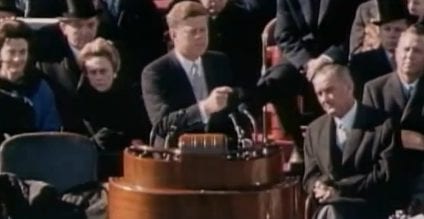
An in-depth look at one of the most powerful and important inaugural addresses of all time. Read the text or watch the full speech to see why this is something worth watching in its entirety. Includes a famous quote, start watching at 13:45.