
Why Is Andrews Air Force Base Named Andrews?

Do you know why it’s named Andrews Air Force Base? Who was Andrews? If you know, before reading this, you are an all-star GoDCer.

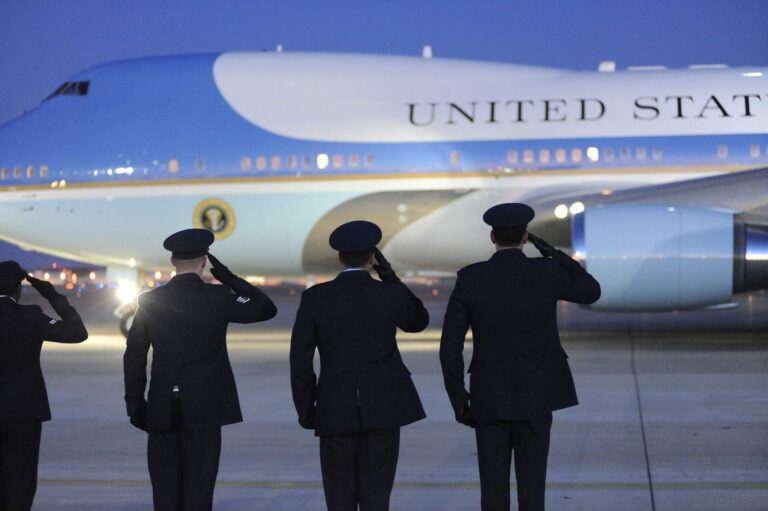
Andrews Air Force Base, Md. (May 21, 2005) - Air Force One takes off from Andrews Air Force Base, Md., during the 2005 Joint Service Open House. President George W. Bush was en route to Grand Rapids, Mich., to give a graduation speech to the 2005 graduates of Calvin College. The 89th Presidential Airlift Group at Andrews Air Force Base is responsible for Air Force One, which is housed in a 140,000-square-foot maintenance and support complex. The Joint Services Open House, held May 20-22, showcased civilian and military aircraft from the Nation’s armed forces which provided many flight demonstrations and static displays. U.S. Navy photo by Photographer’s Mate 2nd Class Daniel J. McLain (Wikipedia)
Andrews Air Force Base, Md. (May 21, 2005) – Air Force One takes off from Andrews Air Force Base, Md., during the 2005 Joint Service Open House. President George W. Bush was en route to Grand Rapids, Mich., to give a graduation speech to the 2005 graduates of Calvin College. The 89th Presidential Airlift Group at Andrews Air Force Base is responsible for Air Force One, which is housed in a 140,000-square-foot maintenance and support complex. The Joint Services Open House, held May 20-22, showcased civilian and military aircraft from the Nation’s armed forces which provided many flight demonstrations and static displays. U.S. Navy photo by Photographer’s Mate 2nd Class Daniel J. McLain (Wikipedia)

The base’s military history dates back to the Civil War, when Union troops occupied a church near Camp Springs, Maryland. The church still stands, and is used on the base as Chapel Two.

The 4,000-acre base began its current life in 1943 as Camp Springs Army Air Base. Toward the end of 1944, it was reported in the Baltimore Sun, on December 22nd, that the base was to become the air forces’ headquarters for the continental United States. The announcement was made the day earlier. Below is an excerpt from the article.

It will be responsible for air defense of the United States, for joint air-ground training and for training of service and combat units and crews and their preparation for deployment overseas, the announcement said.

The continental headquarters will be manned by personnel now assigned to AAF headquarters here, and new buildings and barracks will be built at Camp Springs airfield to accommodate them.

Brig. Gen. Eugene H. Deebe, of Long Beach, Cal., is to be the first commanding general of the CAF. He was formerly the highest ranking American air officer of the staff of Lord Louis Mounthatten in India.

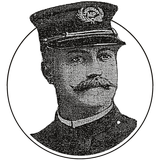
Lieut. Gen. Frank Maxwell Andrews

On February 7th, 1945, the base was renamed Andrews Field to honor Lieutenant General Frank Maxwell Andrews, who had died in Iceland, two years earlier in a plane crash. At the time, he was Commanding General, United States Forces, European Theater of Operators (i.e., kind of a big deal).

We dug up an interesting article about Andrews in the Washington Post from Mar 22nd, 1942.

Army legend has it that before World War I, when aviation was like flying on a leaf and a young lieutenant, “Andy” Andrews wanted to marry the general’s daughter, the general said Andy couldn’t be both his son-in-law and an army pilot.

So young Lieut. Andrews married the daughter and stayed in the cavalry–for three years.

In 1917 he transferred to the Army’s Neophyte Air Arm and with the Army of Occupation in Germany after the war had  the satisfaction of being father-in-law Maj. Gen. Henry T. Allen’s air service officer.

Today Lieut. Gen. Frank Maxwell Andrews is as tenacious in his aims as ever. And he aims to keep impregnable the theater of his Caribbean command which anchors in the Panama Canal Zone and fans out to the bases acquired from Britain.

Now, the base named for Lieut. Gen. Andrews is home to the 89th Airlift Wing of the United States Air Force, better known as the Presidential Airlift Group. You may recognize them for their most famous aircraft, Air Force One (there are actually two planes that serve as Air Force One).

And here is a cool video of Air Force One, taking off from Andrews Air Force Base.

The History of Georgetown’s Gun Barrel Fence From the War of 1812
Georgetown's gun barrel fence

This is the best contribution thus far by a member of the GoDC community. This is from Tom H. in Bethesda, and when I first saw it, I was blown away at how professional it looked. Thanks Tom!

The video is a fascinating history of the gun barrel fence in Georgetown, made from 364 reclaimed Washington Navy Yard muskets.

Georgetown's gun barrel fence
Georgetown’s gun barrel fence

To complement this wonderful video, we dug up an article published in the Washington Herald on Sunday, June 25th, 1911.

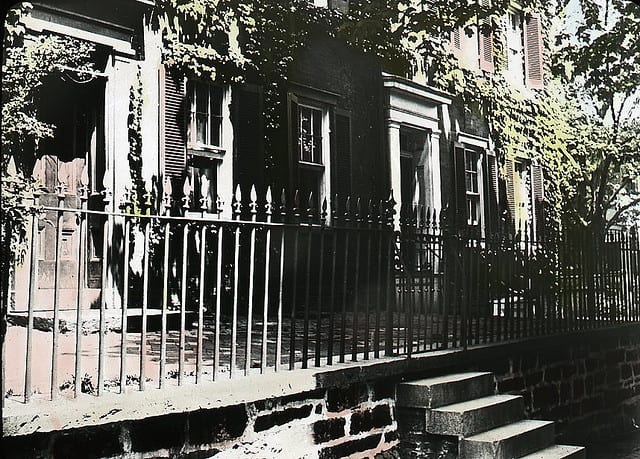
Surmounting a crumbling retaining wall of age-worn stone which stands in front of three of the oldest houses in historic Georgetown is an iron fence which boats a more interesting history than the majority of fencing.

If you will examine the iron uprights standing close together, you will discover that near the top of each one is a projection, which apparently performs no office as a part of the fence. Research into the history of this partition of iron reveals the reason for the projections and many things besides.

Way back in 1814, when Washington was threatened by the invasion of British troops, which were hovering about the ancient hamlet of Bladensburg, Md., foraging and destroying property, the United States government had not the unlimited resources it now possesses.

So when the Capital City of the nation was in imminent peril of being destroyed by the hostile troops the authorities here appealed for help to the public-spirited citizens of the locality. Most of the wealth of the District of Columbia was then centered in Georgetown, as at that time it was one of the most important ports of entry of the Southern Atlantic seaboard. There were great shops and mills there in those days. Merchants of Georgetown had thriving business in the Westt [sic] India trade, importing molasses, coffee, sugar, and rum in large quantities. Among the foremost of these big merchants and landowners was Reuben Daw, whose posterity still figure conspicuously in the assessor’s book of Georgetown realty.

Reuben Daw and a number of others immediately advanced money for the defense of the Capital against the invading forces, asking no security from their government. When Washington was invaded by British troops under Col. Ross, shortly after the battle of Bladensburg, when the Americans, under Maj. Barry, were defeated and the Capital burned, the funds advanced by the Georgetown citizens did much good.

When the war of 1812 was over the government was nearly bankrupt and was in no position to repay debts for which no security was held. But the Secretary of the Navy, the commandant of the navy yard, or some officer in authority who was cognizant of the sacrifices made by the Georgetown citizens realized that something should be done for them. There was little that could be done, but it was finally decided to let those who so desired go to the navy yard and take anything in the way of castings that they could use.

Reuben Daw took advantage of this opportunity and asked for a consignment of antiquated flintlock muskets which were rusting in a neglected pile in an old warehouse. He received permission to remove them and took them to Georgetown.

About that time Mr. Daw built the mansion that still stands in Georgetown on P street, between Twenty-eighth and Twenty-ninth streets. Removing the stocks from the old guns, he had plates forged at one end and made them into the fence which still stands in front of the three houses just beyond Twenty-eighth street.

The small projections mentioned are the corroded remains of the sights at the ends of the gun barrels.

The barrels make an unusually serviceable fence, as the length of time they have stood testifies. They are in as good condition to-day as when they were put up, and it would take a good deal of force to knock the old fence down.

In different parts of Georgetown old iron castings may be seen which came from the navy yard in 1814 or 1815. Window gratings, boot scrapers, stair rails and many other contrivances were fashioned out of the junk taken from the navy yard, and on more than one piece of iron about Georgetown may be seen the coat-of-arms of the United States.

Nearly every on of the castings is directly traceable to the war of 1812, and when one of them is seen it may be taken as mute testimony of the patriotism of the original owner of the property.

Now this a great story. I’m sure the next time you’re walking the brick-lined streets of Georgetown, you’ll be even more observant of these marks of hidden history, connecting us back to the War of 1812.

The First Red Scare: A Look Back at the Communist Protest Outside the State, War and Navy Building in 1928

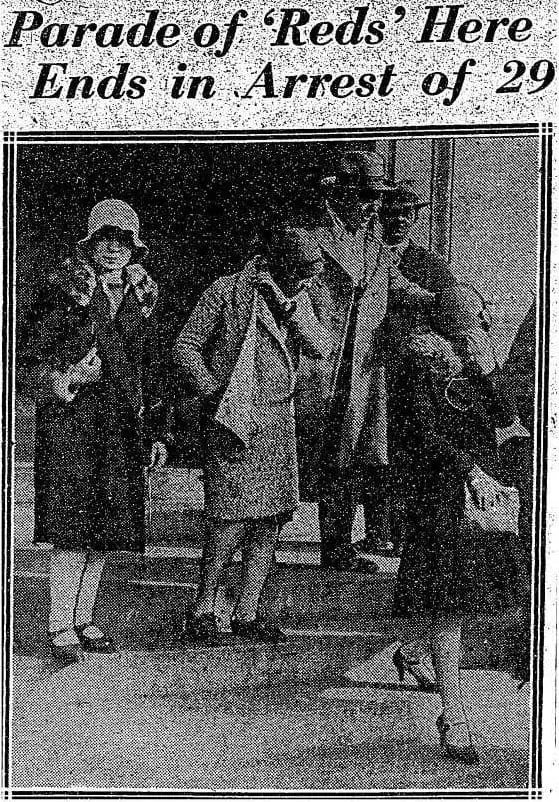
Parade of 'Reds' Here Ends in Arrest of 29 - November 11th, 1928 (Washington Post)

Take a look back at the first Red Scare of the 20th century, when a communist protest outside the State, War and Navy Building in 1928 led to the arrest of 29 people. Learn more about the International Defense League of America and the labor movement pushing socialist or communist ideologies on the working class.