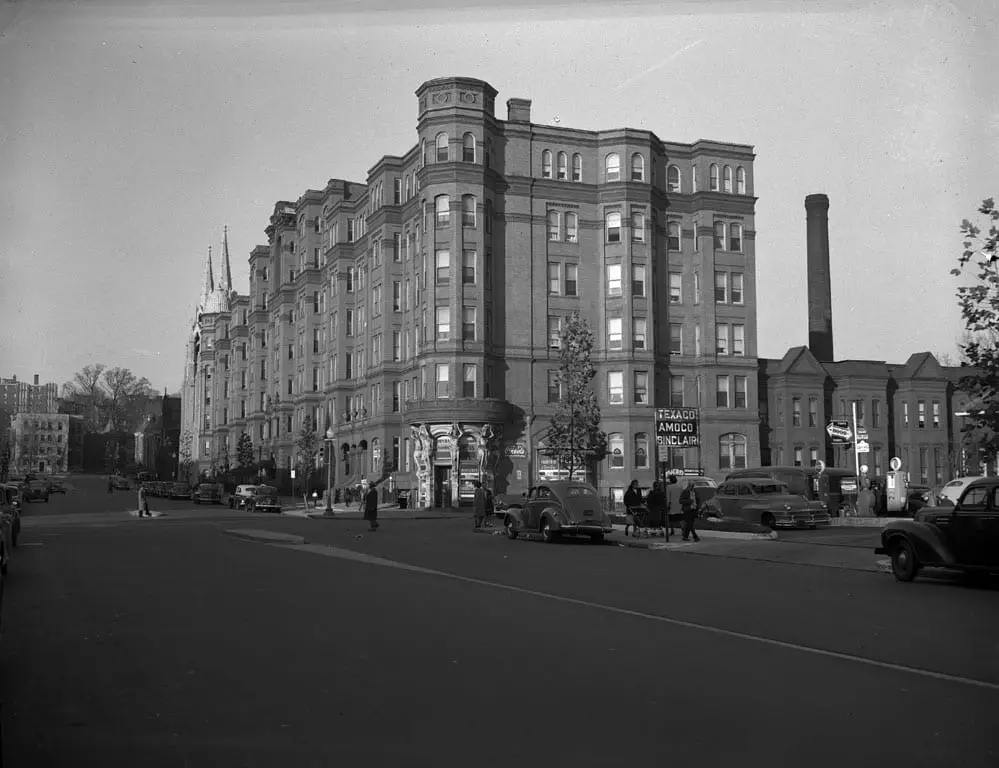
For about thirty years, if you were Duke Ellington coming home to Washington, or a Howard University law professor hosting a National Bar Association dinner, or a touring jazz star booked at the Howard Theatre, your address in segregated DC was the same building. It sat on the northwest corner of 15th and U Streets NW, and it had been somebody else’s elite apartment house for the previous forty.
That building was the Dunbar Hotel. It opened under that name in 1945, after an $800,000 conversion of a German brewer’s luxury apartment block called the Portner Flats. Until DC’s white hotels were forced to integrate in the late 1950s, the Dunbar was, for stretches of its life, the largest Black-owned hotel in the country, and it was where Black Washington met its visitors. By 1974, the wrecking ball had taken it down.
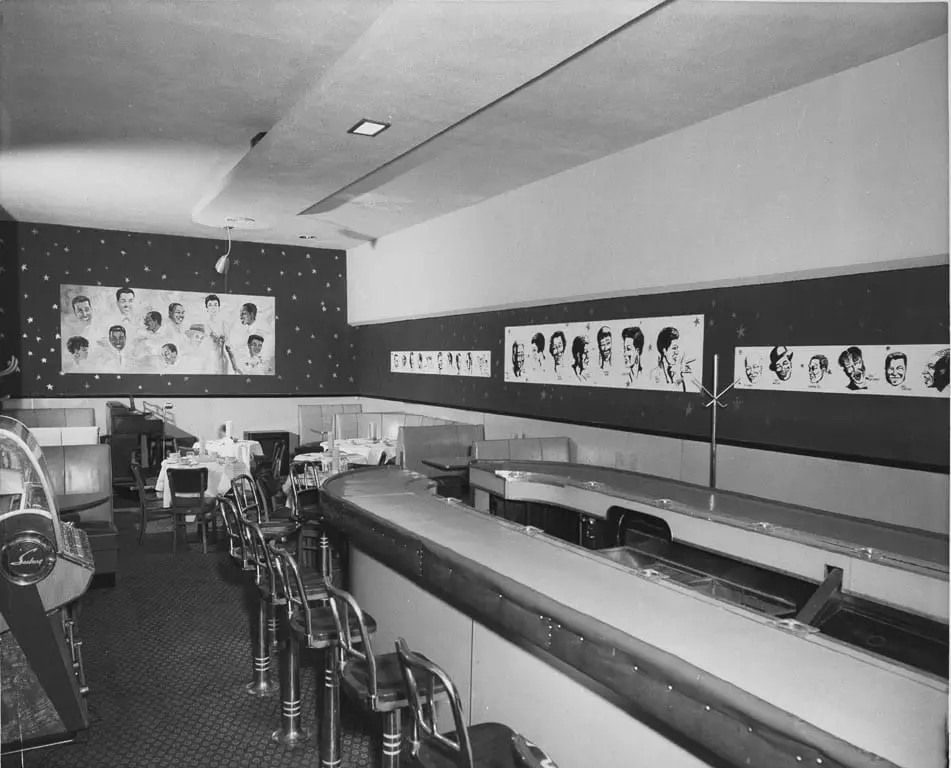
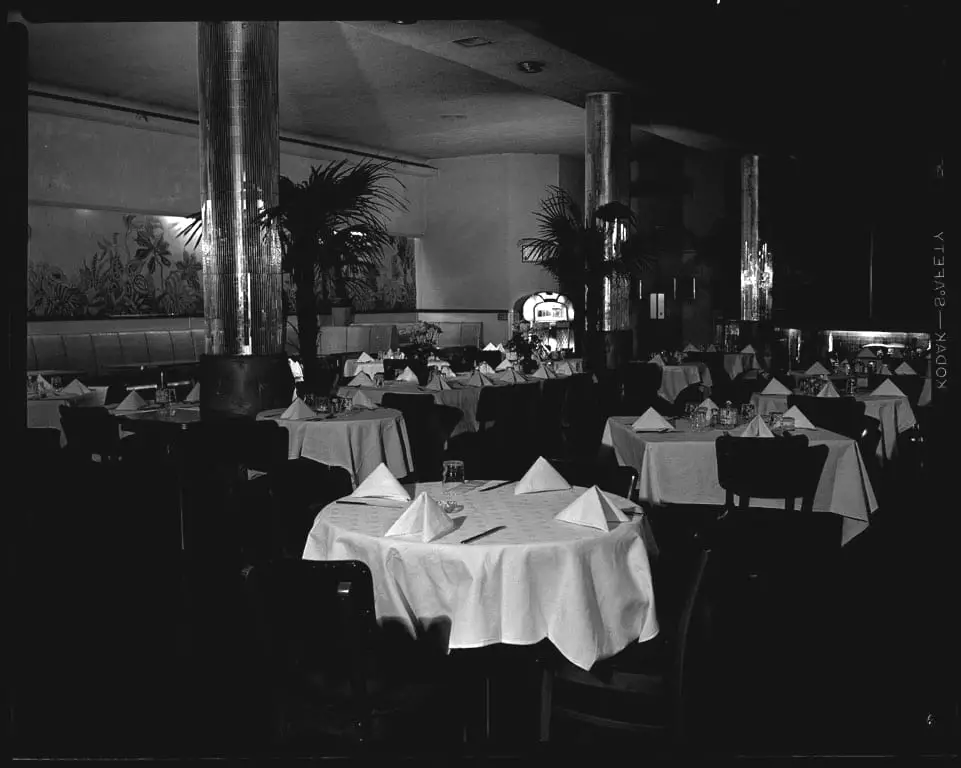
The Smithsonian sent us five photographs of the place. The exterior shot still shows the Texaco / Amoco / Sinclair sign of the gas station that crouched at its corner. The dining room shots show white linen, columns, and the kind of bar where Sammy Davis Jr. would have had a quiet drink at the end of a Howard set. Here is the longer story behind those frames.
From the brewer’s apartment house
The building started as a real estate gamble by Robert Portner, the Alexandria brewer who supplied beer to the Union Army during the Civil War, made a fortune at it, and moved his family across the river to Washington in 1881. By the 1890s he was deep into DC real estate. The Portner Flats was his showpiece. Construction began in 1897, the architect was Clement A. Didden, and the first apartments opened to luxury tenants on the corner of 15th and U.
U Street in 1897 was not yet U Street. The streetcar lines were just reaching that part of town and skeptics had a nickname for the project. They called it Portner’s Folly, on the theory that nobody serious would rent that far from the center of the city. The first phase rented out fast enough that Portner pushed an annex north along 15th the very next year.
The Portner flats, in Washington, are to be duplicated. An annex is to be erected on the lots immediately adjoining the site of the present building on the north, on 15th street, between U and V streets northwest. The cost of the improvements will be about $150,000.
Alexandria Gazette, December 2, 1898
By the time the third and final phase was finished in 1902, the Portner ran the full block from U Street to V Street along 15th. It was, at that moment, the largest apartment building in Washington. The newspapers stopped using the singular and started calling the residents “guests of the Portner Flats.”
Those guests were exactly who you’d guess. The Evening Star’s Senate directory in December 1900 placed Senator Jonathan P. Dolliver of Iowa at “Portner Flats” alongside the listings for the Cairo and the Hamilton. The manager, Volney Eaton, fielded a phone call in January 1901 from a delegation of the Blaine Club of Pennsylvania trying to book several hundred rooms for the inauguration. Mr. Eaton told them the Portner was “comparatively full of guests.”
It was the kind of building you ran with five tons of soft coal a day. A Washington Times piece from December 1904 took a detour to describe the boiler operation at “the Portner Flats Fifteenth and U Streets northwest,” where “a furnace is used which is automatically stoked from the bottom.” When Robert Portner built a separate power house on Portner Place to heat and light the whole complex, the neighbors on the forty-foot-wide street brought a public-hearing fight that the Evening Star covered at length in June 1903.
It was a luxury white building in a city that, by federal law and local custom, had a very specific guest list in mind. That stayed true for the next forty years.
1945: the Dunbar Hotel opens
Robert Portner died in 1906. The family held the building through the next four decades, but by the end of the Second World War the Portner Flats was an aging white-tenant apartment house in a neighborhood that had become the center of Black Washington. In 1945 the Portner family sold.
The new owners poured roughly $800,000 into the building and reconfigured 123 high-ceilinged apartments into 485 hotel rooms. They named it for Paul Laurence Dunbar, the Black poet who, a generation earlier, had lived a few blocks away in LeDroit Park and whose name was already attached to the city’s most prestigious Black high school. The Dunbar Hotel opened to guests in 1945.
It mattered because of where it was and what year it was. Until the Supreme Court’s District of Columbia v. John R. Thompson Co. decision in 1953 forced DC’s white-owned restaurants and hotels to serve Black customers, a Black traveler in Washington had a short list of places to legally book a room. The Dunbar, with 485 of them, was the marquee answer. It joined the Whitelaw Hotel at 13th and T, which had been Black-owned since 1919, as the city’s two anchor Black hotels.
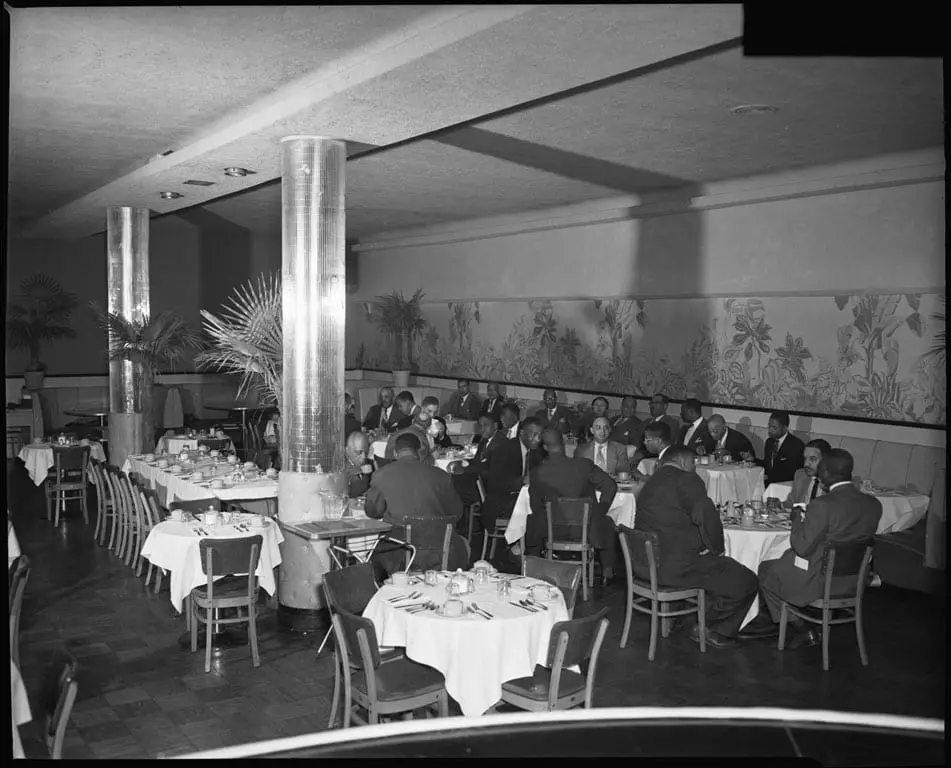
For musicians playing the Howard Theatre a few blocks east, the Dunbar lobby was a clubhouse. Duke Ellington, a Washington native who had grown up about a mile away, stayed there when he came home to play. Sammy Davis Jr., Nat King Cole, Billy Eckstine, Count Basie, Sarah Vaughan, and Pearl Bailey are all named among regular guests during the late 1940s and 1950s. The dining rooms and the bar in the Smithsonian photos are the rooms where those nights ended.
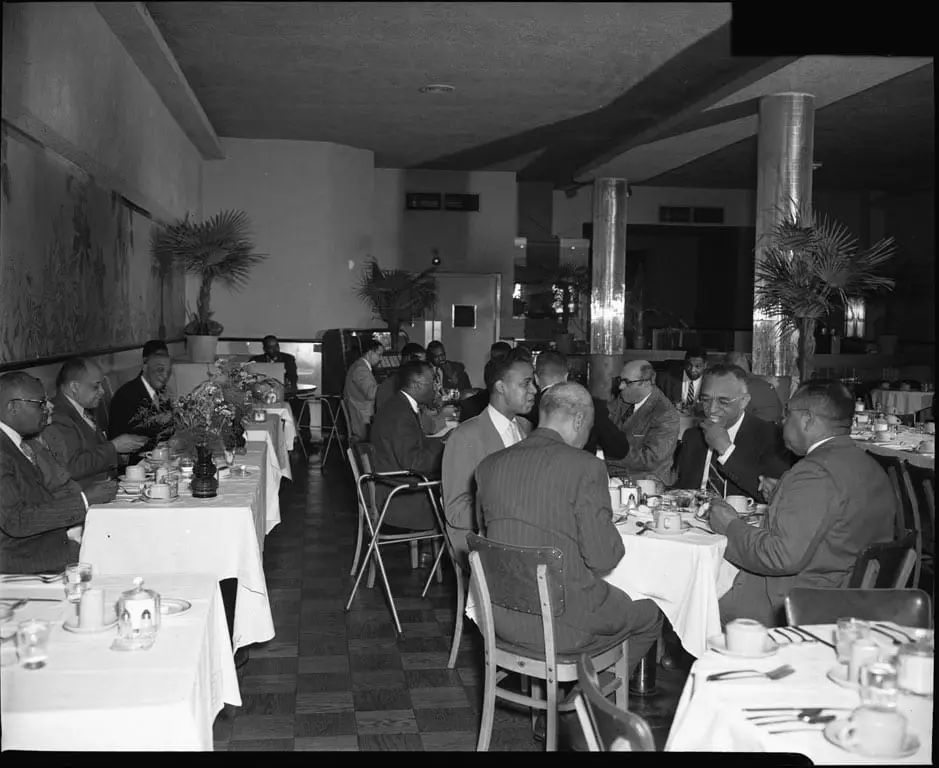
The Dunbar’s bar and ballrooms were also where Black professional Washington gathered. The Evening Star covered the National Bar Association’s 1949 dinner at the hotel, with civil-rights attorney Charles Hamilton Houston as the headline speaker. The Star described the room as full of “many Negro leaders and judges of the courts in the District.” This was the Howard Law faculty hotel, the Negro press hotel, the visiting Black diplomat hotel, the visiting Black Major Leaguer hotel.
The crackdown years
By the early 1950s the Dunbar was in trouble with the city. The Evening Star’s coverage of the District’s Alcoholic Beverage Control Board hearings in March 1951 is unmistakable about what the trouble was, and about who the hotel was for.
The Alcoholic Beverage Control Board today heard testimony in 23 charges of liquor law violations lodged against the Dunbar Hotel, Fifteenth and U streets N.W. … The ABC charges against the hotel, which caters to colored guests, include selling whisky to standing guests; allowing numbers game writing, and permitting solicitation for prostitution.
Evening Star, March 28, 1951
A few months later the District License Board took up the Dunbar’s appeal of License Superintendent C. T. Nottingham’s refusal to renew the hotel license at all. Manager Welker C. Underdown testified, the Star reported on July 26, 1951, that the Dunbar was “doing everything possible to correct the bad reputation that hotel acquired” after the ABC citations. The hotel had also lost its liquor license.
By 1952 the Star was covering federal narcotics testimony that placed drug deals and a hotel detective at the Dunbar, and police raids on Dunbar rooms. It is worth pausing on whose narrative this is. The Evening Star was a white-staffed paper covering, with vice-squad enthusiasm, a Black hotel that had been targeted by city regulators. The same building hosted, the same decade, the National Bar Association and Duke Ellington. Both pictures are true.
The bigger story underneath all this was integration. The Thompson decision in 1953 reopened DC’s white hotels to Black guests. The 1956 Federal-Aid Highway Act and the suburbanization of middle-class Washington pulled customers out of the U Street corridor. By the end of the 1950s the Dunbar’s central premise, that it was the place a Black traveler could go, was unraveling because Black travelers had other options for the first time. The hotel partially closed in 1964.
1968, condemnation, and the wrecking ball
The April 1968 riots that followed the assassination of Dr. King hit U Street hard. The Dunbar Hotel itself survived the fires, but the corridor around it did not, and the city it sat in began a slow disinvestment of the area that lasted twenty years. The District government bought the Dunbar in 1970. The building sat vacant for the next four.
A serious preservation movement to save the Dunbar did not exist in 1974. DC’s Historic Preservation Act would not pass until 1978, four years too late, and the building was not on any landmark list when the demolition contract went out. Preservationists who knew what the Dunbar had been argued for it. They lost. The Dunbar Hotel came down in 1974.
Campbell Heights, a senior apartment complex with a seven-story tower and low-rise garden buildings, was built on the cleared block in 1978. That is what stands at the corner of 15th and U today, set back behind a lawn where Robert Portner’s red-brick wall once met the sidewalk. There is no plaque on the building itself. The closest acknowledgment is the Cultural Tourism DC neighborhood marker a few feet from the corner, which tells the Portner-to-Dunbar story in three short paragraphs.
What the Smithsonian photos show
The five images in this post all come from the Smithsonian’s Archives Center collection AC0618, the Office of Imagery Preservation negatives. The exterior negative is uncaptioned but the cars and the Texaco / Amoco / Sinclair gas station sign at the corner date it to the late Portner Flats or early Dunbar era. The three dining-room frames and the bar frame are Dunbar-era interior shots, taken to document a building that, by then, almost nobody outside its guest list ever got to see.
If you ever wondered what the corner of 15th and U used to look like before Campbell Heights and the Reeves Center and the bike lanes, that exterior shot is your answer.
Frequently asked questions
When was the Dunbar Hotel built?
The building opened as the Dunbar Hotel in 1945, but the building itself was constructed in three stages from 1897 to 1902 as a luxury apartment house called the Portner Flats. The 1945 conversion reconfigured 123 apartments into 485 hotel rooms.
Where was the Dunbar Hotel located?
The Dunbar Hotel stood on the northwest corner of 15th and U Streets NW in Washington, DC. The building ran the full block north along 15th Street to V Street. Campbell Heights, a senior apartment complex built in 1978, occupies the site today.
Why was it called the Dunbar Hotel?
The hotel was named for Paul Laurence Dunbar, the prominent Black American poet who had once lived in LeDroit Park, a few blocks away. His name was already attached to the city’s most prestigious Black high school, which made him a natural choice for the city’s premier Black-owned hotel.
Was the Dunbar Hotel Black-owned?
Yes. When the Portner family sold the building in 1945, the new ownership group operated it as a hotel “which caters to colored guests,” in the language of the period’s Washington Evening Star coverage. At its peak the Dunbar was described as the largest Black-owned hotel in the United States.
Who stayed at the Dunbar Hotel?
During the segregation era, the Dunbar was the Washington address for touring Black entertainers and visiting Black professionals. Duke Ellington, Sammy Davis Jr., Nat King Cole, Billy Eckstine, Count Basie, Sarah Vaughan, and Pearl Bailey are all named among its regular guests. Howard University faculty, the Black bar, and visiting Negro press and athletes used the dining rooms and the bar.
When was the Dunbar Hotel demolished?
The Dunbar Hotel was demolished in 1974. The District government had purchased the building in 1970 and it sat vacant for four years. DC’s Historic Preservation Act did not pass until 1978, so the building was not on any landmark list when the demolition contract went out.
What was the Dunbar Hotel before it was a hotel?
It was the Portner Flats, a luxury white apartment building built in three stages between 1897 and 1902 by Alexandria brewer Robert Portner. When the third phase finished in 1902, it was the largest apartment building in Washington. Senators, judges, and the Washington establishment lived there.
Look at the 1950’s automobiles in the first picture, and the portraits in the bar. Then note the men sitting in the dining room. Conclusion: the Dunbar was a hotel for Afro-Americans in a very segregated Washington DC. Thanks for this.
The Dunbar Hotel was on the northeast corner of 15th & U NW, not the northwest. It is the current location of the Paul Lawrence Dunbar apartments.