
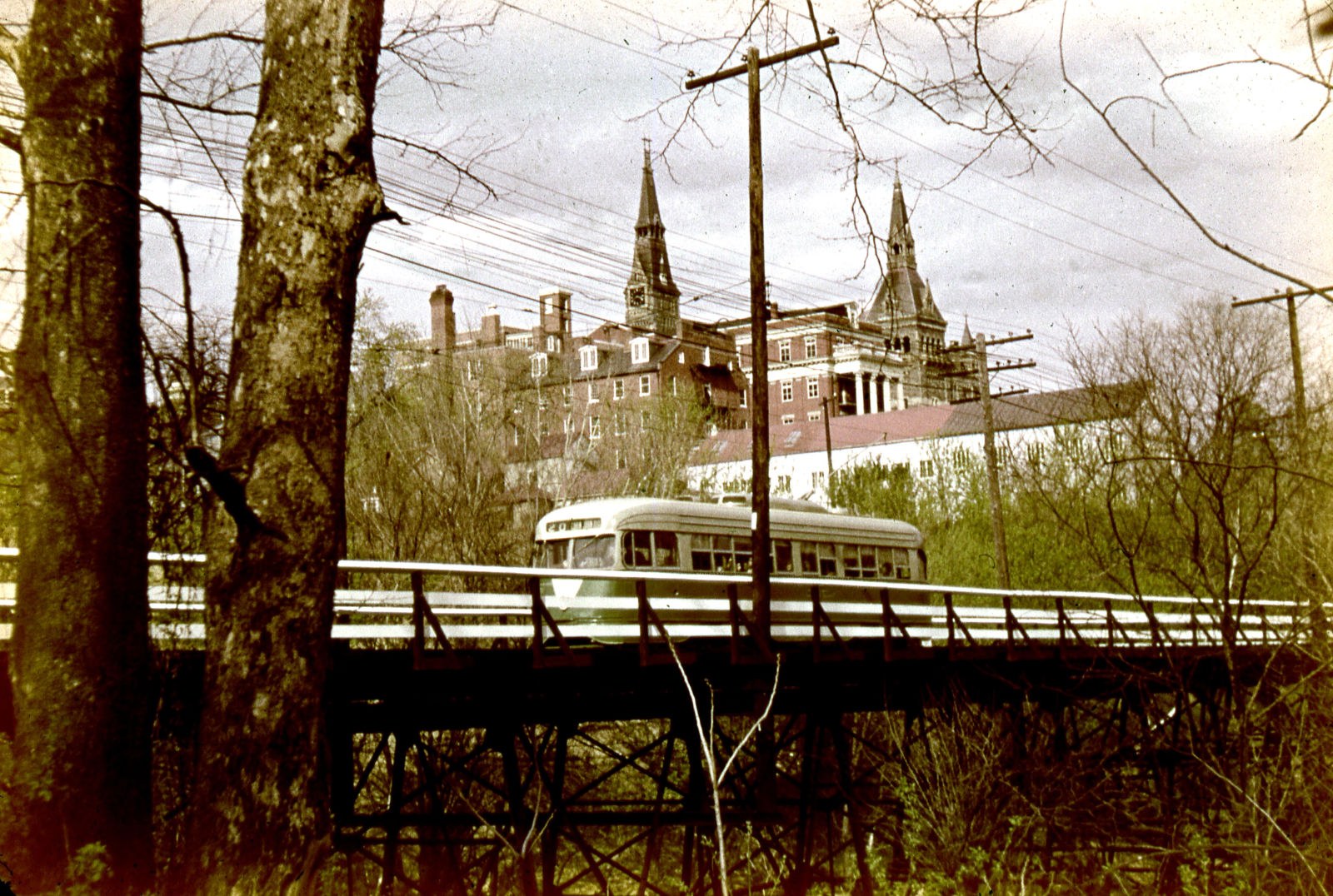
Look closely at the photo at the top of this post. It’s 1948, and a streetcar is rolling across the Foundry Branch trestle, high above the valley, with the spires of Georgetown University’s Healy Hall rising behind it.
That bridge is DC’s last streetcar bridge, and it’s coming down.
On July 15, 2026, the National Park Service released the final agreement that paves the way for Metro, which owns the trestle, to demolish it. The Park Service calls it “the last remaining streetcar bridge in the District of Columbia.” It has carried nothing since 1960.
If you’ve driven Canal Road near Georgetown University, you may have glimpsed it through the trees. A rusted steel truss hanging over Glover-Archbold Park, wrapped in vines. Here’s how it got there, and how it ended up like this.
A Congressional Charter and a Fight for the Right of Way
Congress chartered the Washington and Great Falls Electric Railway on July 29, 1892. The goal was a trolley from 36th and Prospect Streets in Georgetown out along the Potomac bluffs to Great Falls. It never got that far. The line ended at Cabin John, Maryland.
The original charter called for the tracks to run on an elevated metal structure. That proved too costly, and Congress amended the charter in 1894 to let the company build directly on the land.
Getting that land was a fight. On July 2, 1895, the Evening Star reported that Chief Justice Bingham had ordered several landowners, including the president and directors of Georgetown College, to show cause why their property should not be condemned for the railway.
The proceedings went forward, and by early September 1895 the company’s right of way to the District line was complete. The track reached the District line on September 28, 1895. It got to Cabin John around 1897.
The trestle over Foundry Branch went up in 1896, according to the Park Service. It carried the line across the deep stream valley just west of the college, where Glover-Archbold Park sits today.
The line also mattered for real estate. Developers had already platted the Palisades of the Potomac, and their 1896 newspaper ads sold lots on the strength of a short ride into the city on the new electric line.
By 1900 the company told Congress it had carried 1,826,336 passengers that year over 6.99 miles of road.
Riding Over the Trestles
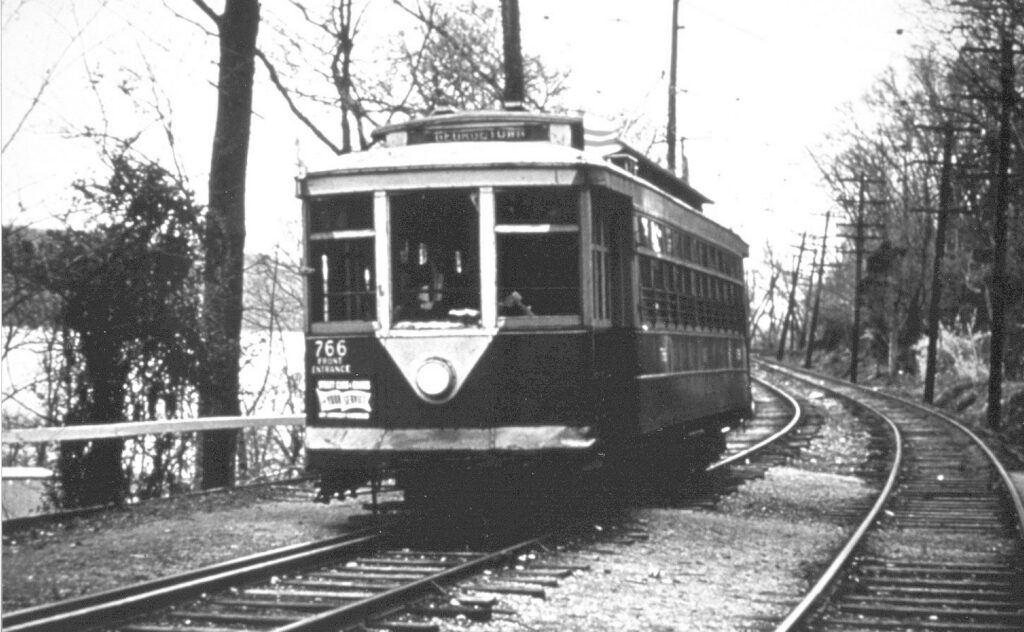
The line was famous for its scenery. It was also a little terrifying.
On August 26, 1899, the Evening Star ran a piece by a writer signing herself Pauline Pry, who spent a day riding the suburban trolley lines. Her verdict on the Great Falls line is the best description of these trestles we’ve found.
One ought to be in just this frame of mind to really have a nice time on the Great Falls railway. The beauty of the scenery is unsurpassed, but to be conscious of it you want to be utterly indifferent to life.
You crash along, now hugging the edge of a high, oozing mud embankment skirting the canal, now pounding over a wooden trestle forty or sixty feet above the ground, nothing but a worm-eaten rail between you and destruction if the car leaves the track. The motorman, meanwhile, is visiting with some friends sitting beside him.
Wooden trestles in this road are so numerous and so high I grow too dizzy to count them.
Evening Star, August 26, 1899
The danger wasn’t only on paper. The same day’s Evening Star reported that a man named J. E. Nelson was out and about again after he “fell early in the week through the first trestle out from Georgetown on the Great Falls electric railroad.” The item doesn’t say exactly where that was.
Notice the word Pauline Pry keeps using: wooden. That matters for the bridge standing today.
The trestle in Glover-Archbold Park is steel. Engineers who inspected it in 2019 described a pair of riveted steel trusses spanning 100 feet, sitting on steel approach trestles, about 252 feet end to end. A 2019 historic report prepared for DDOT says seven of the line’s wooden trestles, including Foundry Branch, were replaced with steel by 1899.
But Pauline Pry was still pounding over wooden trestles in late August 1899. So exactly when the steel went in at Foundry Branch is a loose end. We haven’t found the newspaper item that nails it down.
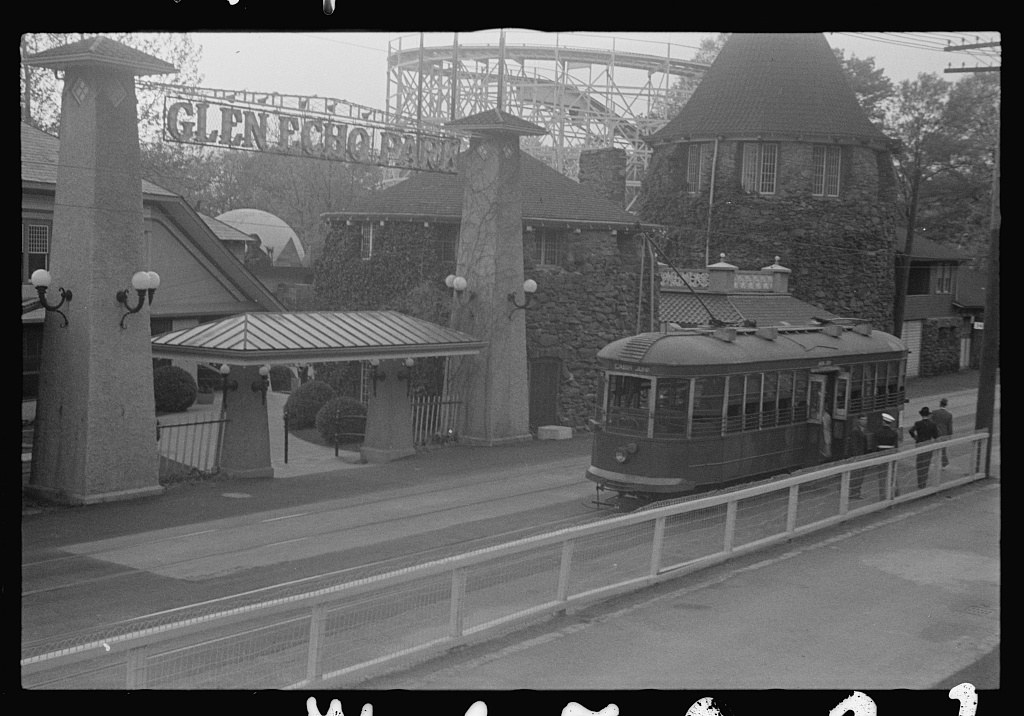
For the next six decades, the line carried riders to Glen Echo Park. The company changed hands and names: it became the Washington Railway and Electric Company in 1902, merged into Capital Transit in 1933, and the Cabin John run became the #20 streetcar route.
The line shows up on the 1936 Capital Transit streetcar map, running out through the Palisades, the area along old Conduit Road. We’ve written about the line itself in our post on the Cabin John Trolley.
The End of the Line
After a seven-week transit strike in 1955, Capital Transit lost its franchise to D.C. Transit, run by O. Roy Chalk. The new franchise came with a mandate to end streetcar service by 1963.
The Glen Echo line was abandoned in 1960. The rails came up and the cars went away, but the trestle was left standing over the valley.
The last DC streetcars made their final runs on January 28, 1962. Washington wouldn’t run rail transit again until Metro opened in 1976, though planners had been sketching subways as far back as the 1912 subway plan.
So how did Metro end up owning a trolley bridge it never used? The answer is a long legal fight over D.C. Transit’s fare overcharges. In 1997, orders from the U.S. Court of Appeals for the D.C. Circuit directed D.C. Transit to transfer the assets of restitution trust funds to WMATA. The trestle, and the land under it, came along with them.
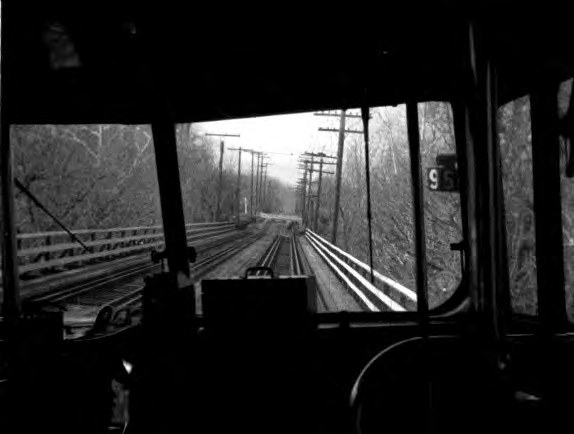
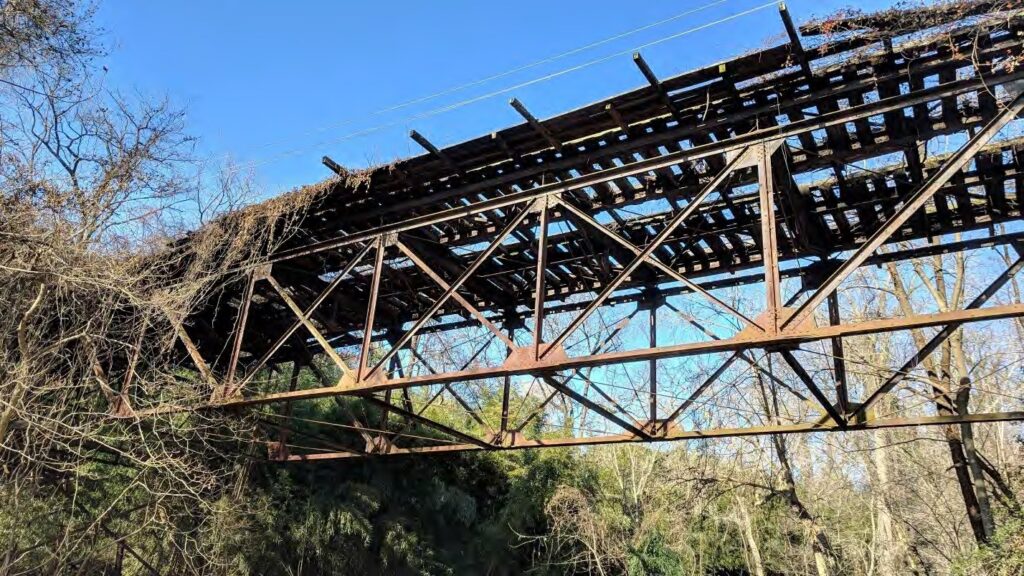
Then it sat, for more than half a century, and the woods grew up through it.
WMATA had the trestle studied in 2014 and found it structurally unsound. When the Park Service learned of those findings in 2016, it closed the trail that ran underneath.
The 2019 inspection for DDOT was blunt. The 100-foot truss was in decent shape. The steel towers holding it up were not. At the main supports holding up the truss, they wrote, it appeared that “vegetation growing within the steel section is providing the only means of support.”
The Fight to Save It
Preservationists tried hard. In 2018, DC’s Historic Preservation Review Board ruled that WMATA’s application to raze the trestle should be denied. The neighborhood associations in the Palisades, Foxhall Village and Georgetown backed a plan to turn it into a walking and biking bridge.
The bridge would have linked Georgetown with Foxhall, the area west of Georgetown once called Harlem, and eventually with a trail along the old trolley right of way through the Palisades.
In January 2020, DDOT finished its feasibility study and said it would not move forward with rehabilitating the trestle, citing cost and constructability. The study’s engineers had given a rough, order-of-magnitude estimate of about $2.75 million for their preferred rebuild.
Then came the courts. The Mayor’s Agent for Historic Preservation cleared the raze permit on September 23, 2020. The DC Preservation League appealed, and on September 15, 2022, the DC Court of Appeals vacated that approval and sent it back. On May 10, 2023, the Mayor’s Agent cleared the permit again.
Georgetown University students and neighbors organized to save the trestle, and the FY 2024 DC budget set aside $250,000 for planning its future. The final FY 2025 budget cut and redirected all of it.
On July 15, 2026, the Park Service finalized the agreement. Rock Creek Park superintendent Brian Joyner said removal was “the only responsible path forward to protect visitors.”
What Happens Now
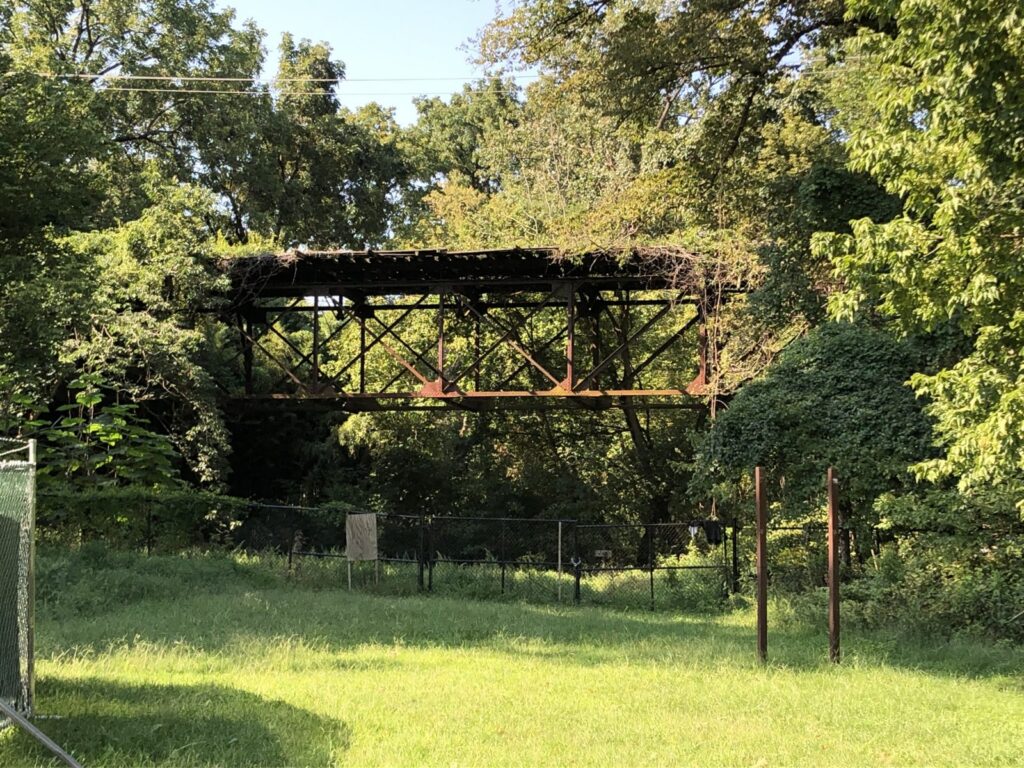
The agreement calls for the bridge to be formally documented, to Historic American Engineering Record standards, with large-format photographs and a short history. The trestle gets a permanent record.
It also calls for interpretive signage about the trestle, keeping the low concrete footers in place to mark where the bridge stood, and replanting the site. The Glover-Archbold trail underneath, closed since 2016, is to reopen.
As of mid-October 2026, we haven’t seen a demolition date announced.
When it goes, those low concrete footers will mark where the Glen Echo trolley once crossed the valley. To see the Palisades in its early trolley days, take a look at this 1909 map of the Palisades.
Go see it from Canal Road while it’s still there.
We dug this one up with help from AI and checked it against the original records below. Here’s how we use AI.