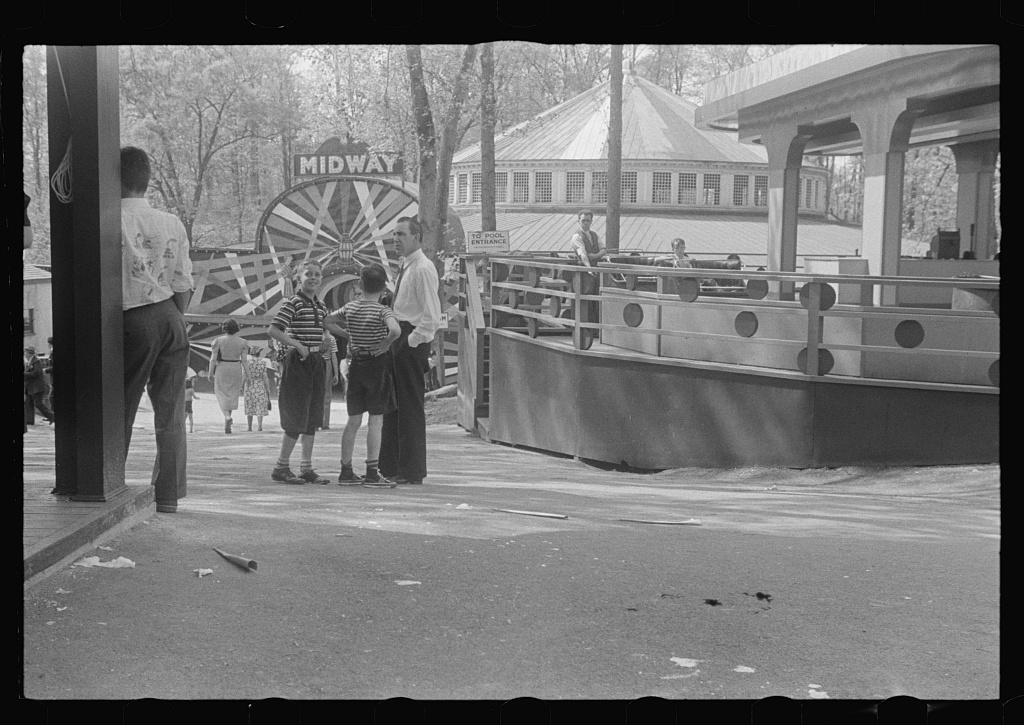
The Dentzel carousel at Glen Echo Park has been spinning, more or less continuously, since 1921. Same building. Same fifty-two carved animals (forty horses, four rabbits, four ostriches, one giraffe, one deer, one lion, one tiger). Same 1926 Wurlitzer band organ, one of only twelve of its kind known to survive.
It is also the spot where, on June 30, 1960, five Black students from Howard University were arrested for trying to ride.
You can go this weekend. Same horses. $2 a ticket.
The park around the carousel has lived through five separate identities to get there. Each one a story worth telling.
Two brothers, an egg beater, and a Potomac bluff
Edwin and Edward Baltzley were Ohio twins who moved to Washington in the early 1880s and took federal-clerk jobs. Edwin was secretary to Senator John Sherman. Edward clerked at the Treasury.
In 1885, Edwin patented a hand-cranked egg beater that reversed direction with each half-turn of the handle. The brothers manufactured the thing, sold the patent, and in 1888 plowed the proceeds into roughly 500 acres of Potomac bluff. They called it “Glen-Echo-on-the-Potomac” and planned to develop it as a high-end suburb.
To anchor the development, they needed an attraction. They picked the Chautauqua movement, then near its national peak, and incorporated the National Chautauqua Assembly of Glen Echo-on-the-Potomac on February 24, 1891. Opening ceremonies were on June 16 of that year. About a thousand people showed up.
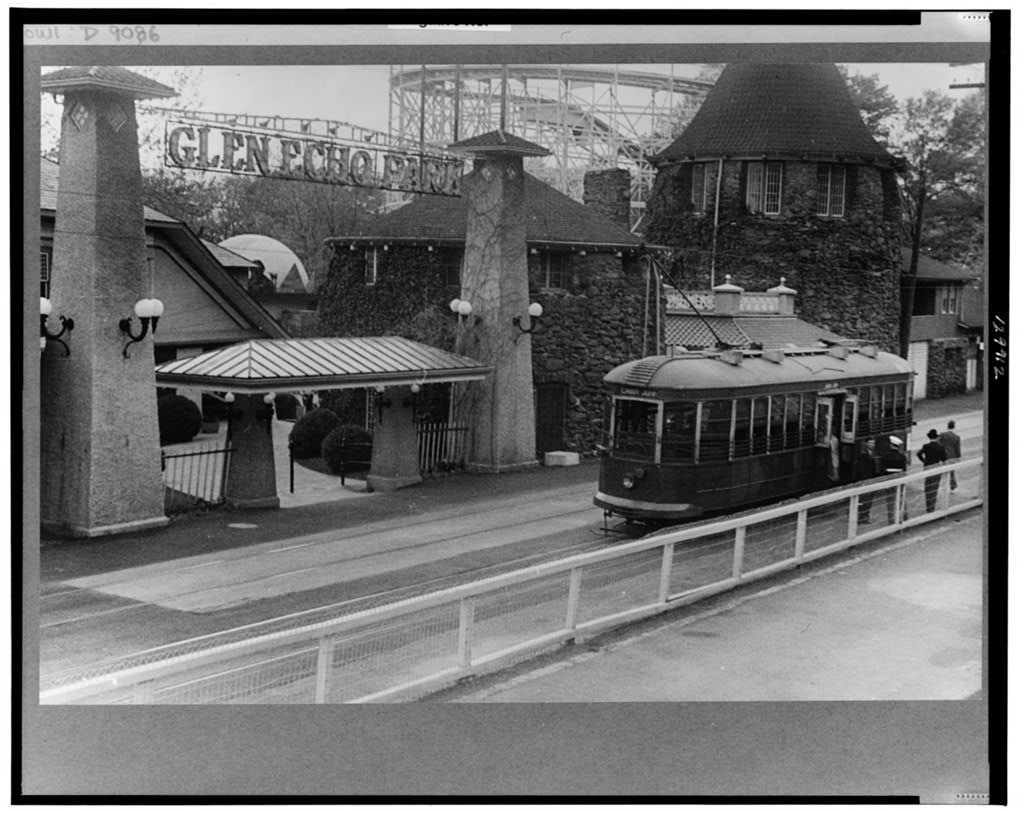
The Chautauqua promised lectures, music, art, and adult education in a sylvan riverside setting. The Baltzleys built a stone amphitheater, an arts and crafts hall, and the Chautauqua Tower (still standing). They donated a parcel to Clara Barton, who had founded the American Red Cross in 1881 and become a national figure after leading the Red Cross response to the 1889 Johnstown Flood.
The Chautauqua that lasted one summer
It ran one season.
In August 1891, Dr. Henry Spencer, head of the assembly’s business school, died of pneumonia. Word got around that the death was malaria. (Mosquito-borne disease was not yet understood; “malaria” got used loosely for almost anything contracted near water.) The papers ran with it. The story that Glen Echo’s air was full of malaria gutted ticket sales for the 1892 season.
The Chautauqua never reopened. The corporate entity dissolved into debt over the following years. Edwin built a wooden tower-and-stone castle for himself on the bluff and went broke. Edward eventually moved west, contracted mercury poisoning while panning for gold, and died in 1907.
The utopia outlived them both by more than a century.
Clara Barton moves in
The 1891 donation gave Barton a thirty-six-room frame house above the Potomac. She used it as a Red Cross warehouse through 1897, then remodeled the upper floors into living quarters and the lower as Red Cross national headquarters. She lived there until her death in 1912.
The house is now the Clara Barton National Historic Site, the first NPS unit dedicated to the accomplishments of a woman. Her previous DC base, the Missing Soldiers Office on 7th Street NW, is its own story.
The streetcar park
The Chautauqua land sat largely idle through the 1890s. A merry-go-round and a miniature railroad were added under a 1898–99 lease. Then in 1911 the Washington Railway and Electric Company bought the site and rebuilt it as a true trolley park, the endpoint of the Cabin John line out of Georgetown. The line we’ve written about before.
For the next fifty-seven years, Glen Echo was where Washington went on Saturdays.
The Crystal Pool opened in 1931, designed by the Philadelphia firm Alexander, Becker and Schoeppe. 1.5 million gallons. Capacity three thousand swimmers. Four sections (diving, deep, general, wading) plus a 10,000 square foot artificial sand beach.
The Spanish Ballroom went up in 1933 from the same firm, in Spanish Mission Revival with Art Deco accents, with a 7,000-square-foot maple dance floor. Still standing. Still booking swing dances every Saturday.
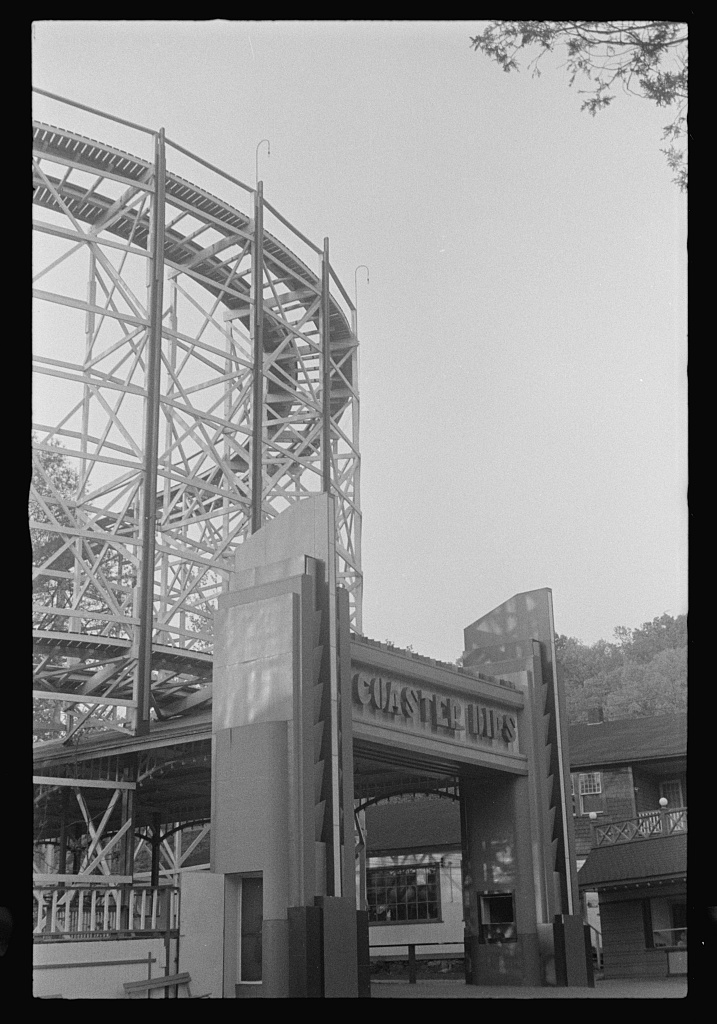
And then there was the Coaster Dips, the park’s signature ride, designed by Frank Moore and built in 1921. It cleared seventy feet at the lift hill. From the top you could see the Potomac.
The Dentzel carousel arrived the same year. Daniel C. Muller carved several of the horses. The 1926 Wurlitzer 165 band organ was added five years later. Both have been in continuous operation in the same building ever since.
The carousel sit-in
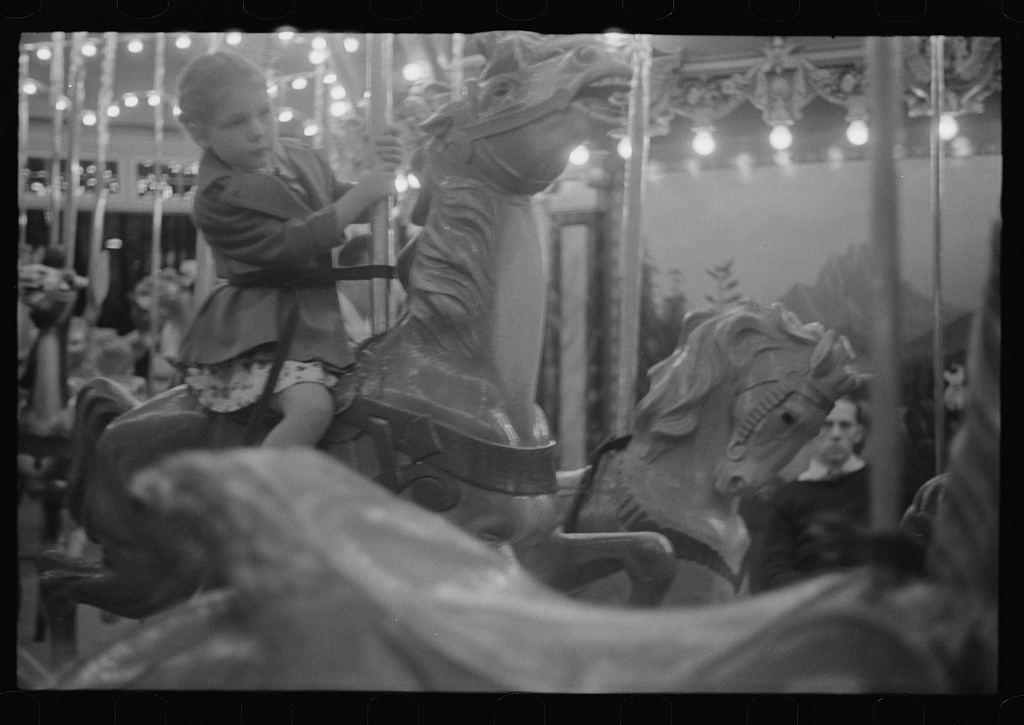
Glen Echo, like virtually every white-managed amusement park in the upper South, excluded Black customers. By 1960, that policy was both ordinary and indefensible.
A group of Howard University students had organized themselves as the Nonviolent Action Group (NAG) on June 26, 1960. Their first action came four days later.
On the evening of June 30, NAG organizer Laurence Henry, a twenty-six-year-old Howard divinity student, led roughly two dozen members, Black and white, plus two high schoolers to the park. The high schoolers were turned away at the gate. Henry and the rest reached the carousel, where a state-deputized security guard named Frank Collins stopped them. A radio reporter, Sam Smith, was recording.
Collins: Are you white or colored?
Henry: Am I white or colored?
Collins: That’s correct. That’s what I want to know. Can I ask your race?
Henry: My race? I belong to the human race.
Collins: All right. This park is segregated.
Henry: I don’t understand what you mean.
Collins: It’s strictly for white people.
Henry: You’re telling me that because my skin is black I cannot come into your park?
Collins: Not because your skin is black. I asked you what your race was.
After a two-and-a-half-hour standoff, five of the carousel protesters were arrested for trespassing: William L. Griffin, Cecil T. Washington Jr., Marvous Saunders, Michael A. Proctor, and Gwendolyn Greene, later Gwendolyn Britt, who would go on to serve in the Maryland State Senate. Among the NAG members on the picket line that first day was a Howard freshman named Stokely Carmichael.
The pickets continued. Weekdays from 3 p.m. until close. All day on weekends. From the end of June through September 11, the last day of the 1960 season, the line stretched along MacArthur Boulevard. Over thirty-eight arrests. Allies came from the AFL-CIO and from the next-door Bannockburn neighborhood, a liberal, largely Jewish enclave that had spent the 1950s fighting its own race-restrictive covenants.
And then there were the Nazis.
George Lincoln Rockwell’s American Nazi Party mounted parallel counter-demonstrations, throwing bottles and rocks at the NAG line and maintaining a constant threat of violence through the summer. The NPS Civil Rights site bulletin has the photographs: uniformed Nazi Party members on MacArthur Boulevard, jeering at college students fifteen miles from the White House, in 1960.
In February 1961, Bannockburn resident Hyman Bookbinder, by then an assistant to the Secretary of Commerce, asked the newly confirmed Attorney General Robert F. Kennedy for help. Kennedy threatened to revoke the federal lease the streetcar to the park ran on. On March 14, owners Abraham and Sam Baker announced that the park would open to all patrons. It reopened integrated on March 31.
The day before the public opening, Alfred Beal and Larry Murrell, both ten years old, were placed on Dentzel horses as the first Black children to ride. The site chosen was deliberate. The carousel had been the start of the standoff. It would be the end of it.
Closure and rebirth
The integrated park ran another seven seasons. Attendance never recovered.
Suburban kids had aged out of streetcar parks. The Capital Beltway, completed in August 1964, had remapped Washington weekends around drive-to destinations farther out. The Baker family ran the last full season in 1968 and announced in April 1969 that the park would not reopen.
The federal government acquired the site in a 1970 land swap and reopened it in 1971 as a National Park Service arts park. Since 2002, daily operations have been run by the Glen Echo Park Partnership for Arts and Culture, a nonprofit that handles classes and rentals while NPS keeps the land and the history.
The Spanish Ballroom still holds Saturday dances. The Crystal Pool is gone (drained 1968, locker rooms condemned, demolished March 1982). The Coaster Dips is gone too. So is everything else mechanical except the carousel.
The Dentzel still runs. Daniel Muller’s horses, the 1926 Wurlitzer, a $2 ticket. Same building. Same animals that on June 30, 1960, would not start.