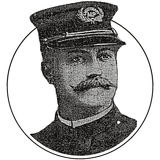

On Tuesday night, June 20, 1922, a 23-year-old Washington bandleader named Duke Ellington played a beauty contest at an amusement park in far Northeast DC. We know because the ad survives, and it’s an awesome find.
It ran in the Washington Tribune, the city’s Black weekly newspaper, ten days before the show.

The park was Suburban Gardens, at 50th and Hayes Streets NE in Deanwood. The city’s own heritage trail calls it “the first and only major amusement park within the city’s borders.”
Black Washingtonians built it for Black Washingtonians, and it ran for nearly twenty years. All that time, the region’s big trolley park wouldn’t let them through the gate.
The park Glen Echo wouldn’t let them into
In 1921, if you were a Black family in Washington and you wanted to ride a roller coaster, you had a problem. Glen Echo Park, out at the end of the trolley line in Maryland, was for whites only.
The rest of the city’s leisure map worked the same way. The Tidal Basin bathing beach, which opened in 1918, admitted white swimmers only. So a group of Black Washingtonians decided to build a park of their own.

“Built for Colored People By Colored People”
The park belonged to the Universal Development and Loan Company, a Black-owned real estate firm. When the company wrote a letter to the editor in August 1921, it was signed by its president, Chas. E. Lane, along with Jno. H. Paynter and Geo. A. Robinson.
By 1927 John H. Paynter was running the company as president. He also wrote Fugitives of the Pearl, a 1930 book about the 1848 escape attempt aboard the schooner Pearl.
The company’s supervising architect was Howard D. Woodson, a civil engineer who came to Washington from Pittsburgh in 1907. He went to work in the Treasury’s Office of the Supervising Architect, and a historical marker calls him “one of the first African American professionals to serve in that office.”
Woodson lived close by, too. He built his own house at 4918 Fitch Place NE in 1913, a short walk from where the park would go. He spent years pushing the city to build a high school east of the river, and when it opened in 1972, it carried his name.
Another local Black architect, Lewis Giles, helped design the grounds. And Sherman H. Dudley was among the investors.
Dudley was born around 1870 in Texas and started out singing in a medicine show, then became one of the biggest names in Black vaudeville. In 1911 he set up S. H. Dudley Theatrical Enterprises here in Washington, and his circuit of more than twenty theaters became the foundation of the Theater Owners Booking Association, better known as the T.O.B.A.
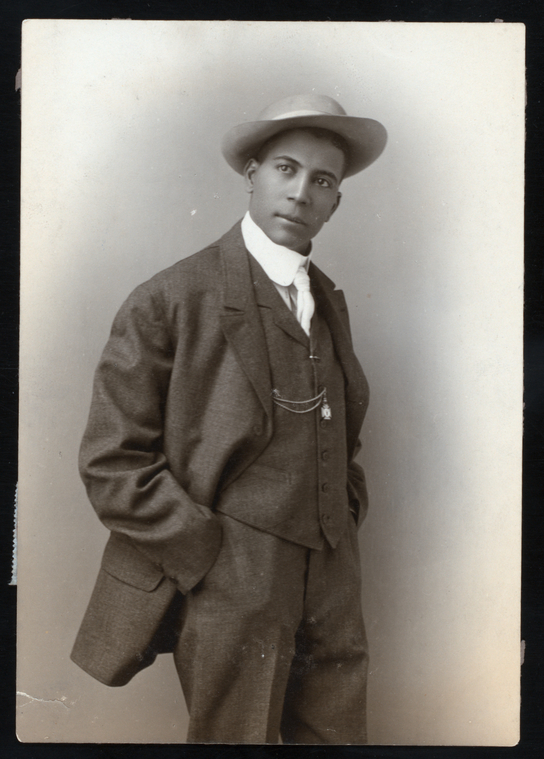
The owners were proud of what they had built, and they weren’t shy about saying so in the white press. Check out this display ad that ran in the Evening Star on May 28, 1922.

Opening night, and 7,000 people
Suburban Gardens opened on Saturday, June 25, 1921, and the Tribune billed it as “Washington’s Coney Island.”

That first season was pretty modest, with just a dance pavilion, a single café and a merry-go-round. To get there, ads told riders to “Take H St. Cars Marked District Line,” and the streetcar ran out Deane Avenue, now Nannie Helen Burroughs Avenue, to the park.
Things didn’t stay quiet for long. On the night of August 1, 1921, word got out that the Whitman Sisters, one of the biggest acts in Black vaudeville, would appear. Here’s how the Tribune described it on its front page:
“it was unofficially estimated that over 7000 people attended. The cause of this large gathering was the announcement of the appearance of the Whitman Sisters.”
So many people showed up that the fence at the entrance gave way. Then a young man waved to the crowd “in a maner that indicated distress and immediately the people began to run.” According to the Tribune, “Because of the presence of mind of a few, a stampede was averted.”
The band didn’t come out of it so well. “The trombone and drum were broken, and the violin was lost.” About 15 police officers were sent out to the park, but the Tribune reported that “They made no arrest whatever.”
The Washington Post told a different story, under the headline “Fifty Police End Fights.” The park’s owners fired back with an open letter, which the Tribune reprinted in the same issue. They counted “six thousand persons” and “A Squad of five officers,” and they took a swipe at the Post‘s reporting:
“There were no wrecked banjos however as the Suburban Gardens’ Orchestra does not include that instrument.”
Fifty police, fifteen or five? Seven thousand people or six thousand? It depends on which paper you read. What nobody disputed was that it was an enormous crowd for a park sitting on “nine acres of its sixty-five acre tract,” as the letter put it.
The roller coaster that “CANNOT FAIL”
The rides were paid for with Black money, sold one share at a time. On May 13, 1922, the Capital Coaster Company ran an ad in the Tribune announcing it was “SELLING STOCK AT TEN DOLLARS PER SHARE.” The pitch was about as confident as it gets: “SURE TO PAY / CANNOT FAIL.”
By December 1922 the company had numbers to show its investors. Its concessions at the park had taken in $24,390, in a season that started late and had 47 rainy days.
The big moneymaker was the Gravity Coaster, also called the Scenic Railway. It cost $30,000 to install, and the company owed only $5,295.60 on it. According to the ad, it ran “nearly a full mile in length,” and its two 16-passenger cars could carry 1,280 people an hour at 15 cents a ride.
“I HAVE SEEN THIS ONE DEVICE TAKE IN NEARLY $1,000.00 IN A SINGLE DAY,” says W. L. Board, Vice-President of the Company.
Of course, Board wasn’t exactly a neutral observer. He was a druggist and the company’s vice president.

The coaster had a name, too. The Cultural Tourism DC marker near the site calls it the Deep Dipper. Over the years the park added the Caterpillar, the Whip, the Dodgem and the Tumble Bug, along with a Ferris wheel, a children’s playground and more than 20 concessionaires.
And the crowds kept coming. On Labor Day 1922, according to the Tribune, “A record breaking crowd of over 16,000 people attended the barbecue and picnic at the Suburban Gardens.”
That kind of success got noticed. On October 7, 1922, the Tribune ran a front-page warning under the headline “A New Amusement Park Proposed By White Interests.”
It was “rumored that a new amusement park is being proposed by a group of white men to oppose the Suburban Gardens, and that a Colored man is to be used to ‘front’ the proposition.” If it opened, the paper promised, it “will positively be boycotted by us,” pointing to “several hundred thousand dollars invested by our own people.”
Duke Ellington at the pavilion
The dance pavilion was the heart of the place, where dancers did the Charleston, the Lindy Hop and the Black Bottom. The park also put on free band concerts, children’s costume pageants, stilt-walking clowns and contests, and in 1926 it brought in an aerial act billed as Marvelous Melville.
Now back to that June night in 1922. The Tribune‘s story on the beauty contest placed it at “50th and Hayes Avenue northeast” and promised that “Duke Ellington and his band will provide the music.” First prize was a “handsome four piece silver tea set.”
Within a year or so, Ellington had left for New York, and you know how that story goes.
The merry-go-round even had its own musician, Russell Wooding. He was a Washington bandleader who gave the teenage Ellington some of his first jobs, and he later played Broadway shows.
What about Cab Calloway? Local histories and the Cultural Tourism DC marker both name Calloway and Ellington among the stars who played the pavilion. The marker places them in “the 1920s or ’30s.” We haven’t found an ad for a Calloway night, though.
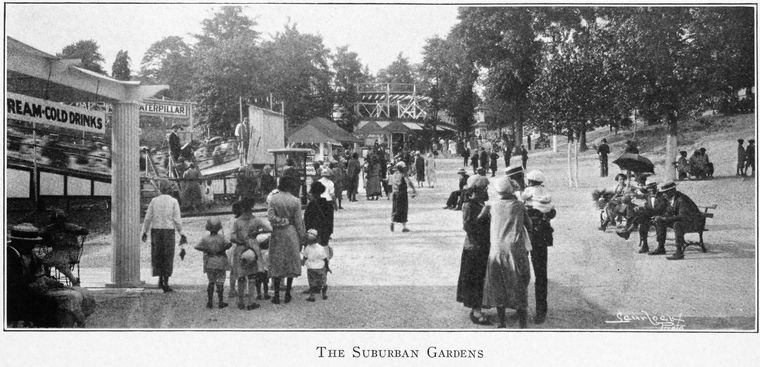
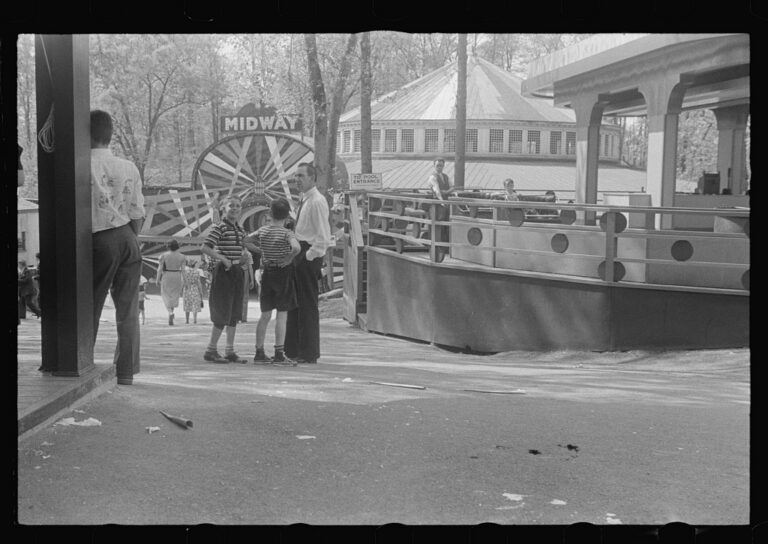
Take a close look at this 1927 photograph by the Scurlock Studio. On the left, a sign cut off at the edge advertises ice cream and cold drinks, with the Caterpillar ride behind it. Men in straw hats and women in summer dresses are strolling a broad dirt promenade under tall trees, and there’s a wicker baby carriage on the right.
It looks like just about any American amusement park photo from the 1920s, except that everyone in the frame is Black.
Clarence Darrow takes the stage
In January 1928 the company reorganized. According to the Tribune, controlling interest went to a group led by John A. Hyder as president, with George A. Robinson as vice president, A. S. Pinkett as secretary-treasurer and W. H. C. Brown as chairman of the board. F. Morris Murray ran the park as general manager, and admission was ten cents.
That spring the pavilion hosted a speaker you might not expect. On Sunday, April 22, 1928, Clarence Darrow, the Chicago lawyer who had defended John Scopes three years earlier, spoke at Suburban Gardens for the NAACP. Why there? The Tribune‘s Louis R. Lautier explained it in one line:
“The doors of Washington churches had been barred to Mr. Darrow because of his atheism.”
The Washington Times led with what Darrow told the crowd: “The salvation of the negro race lies with the negroes on earth today and not with a ‘power in the heavens.'” The Times counted 600 people in the audience, while the Tribune said “A misty rain during the day kept the crowd away. Only 500 persons heard Mr. Darrow speak.”
A mountain lion, a pool and a new operator
In January 1930, a mountain lion was reported on the loose in Far Northeast. On January 29, the Washington Daily News reported that police were “concentrating their hunting efforts today in the Suburban Gardens section”:
“Special watch was being kept on the old amusement park near 50th-st and Castle-rd. It is here that the lion is believed to have made his lair. The park is an ideal hide out for the beast.”
The paper doesn’t actually name the park, but in “the Suburban Gardens section,” it’s hard to imagine which other one it could be. And the park wasn’t abandoned, just closed for the winter.
That April, Suburban Gardens, Inc. took out a $12,000 permit for a concrete swimming pool at 5000 Hayes Street NE. A year later it added a $5,000 brick and concrete building for the carousel.
By 1932, the park’s Tribune ads carried a new line: “A LICHTMAN THEATRE ENTERPRISE.” Abe Lichtman was a white theater owner whose chain of movie houses catered to Black audiences. Back in 1926 he had bought the Howard Theatre, which ended Dudley’s run there.
Modern accounts say Lichtman bought the park around 1928 or 1929, but we couldn’t find any record of a sale. As late as 1935, the Tribune still described the Universal Development and Loan Company as the owner. What’s clear is that by 1932, Lichtman’s company was running the place.
Lichtman also proposed a movie theater in the neighborhood, and Nannie Helen Burroughs, who ran the National Training School for Women and Girls nearby, objected. The Strand Theater was built anyway, at 5129-5131 Grant Street NE.
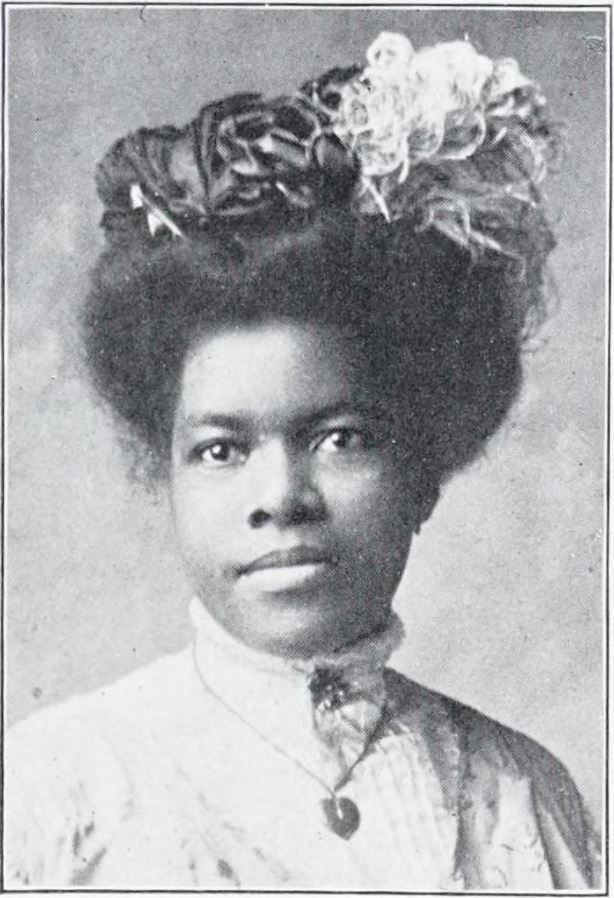
And what became of the park’s architect? In June 1932, Howard D. Woodson was advertising his own gas station in the Tribune, right at the park’s entrance: “GARDENS SERVICE STATION / Howard D. Woodson, Prop. / 4854 Deane Avenue, N. E. / At Gate of Suburban Gardens.”
By August 1935, the Tribune reported, the man running the park was “Arthur J. Brosseau, white.”
That November brought a tragic end for the company’s president. John A. Hyder, a 70-year-old real estate dealer, took his own life. A few weeks earlier he had been convicted in Police Court of operating an unlicensed still and put on probation.
His Tribune obituary on November 26, 1935 noted that he was still “president of the Universal Development and Loan Co., which organization owns the Suburban Gardens.”
Two parks, one night
Here’s a small item that says a lot. Each summer the Evening Star threw a party for the boys who delivered its papers, and on July 29, 1936, it announced that night’s plans:
“The white carrier boys are going to Glen Echo … Colored carrier boys will have a similar outing at Suburban Gardens at the same time. Instead of being furnished ice cream and orangeade, they will be given money with which to buy what they please.”

The outings kept going for years. On July 23, 1940, the Star announced that “The outing for white carriers is to be held at Glen Echo Park, while a similar party for the colored carriers is scheduled for Suburban Gardens.” The program promised “free swimming, free rides on roller coasters and other devices.”
That turned out to be one of the park’s last summers. According to the marker, Suburban Gardens “closed its gates for good in 1940.” Sherman Dudley died that same year, on March 1, at his farm in Maryland, where he raised thoroughbred cattle and racehorses.
From gardens to garden apartments
On January 18, 1941, the Evening Star listed building permits for “the Suburban Gardens Apartments, to be built on Jay and Just streets and Sheriff road N.E. The 13 separate buildings will cost $302,000 and will contain 204 apartments.”
Suburban Gardens, Inc. was the owner and R. Lloyd Goode Co. was the builder. The designer was Harvey Warwick, an architect who did dozens of garden apartment complexes around the area.
The project has been described as the “First FHA-insured project for black occupancy.” The marker on Jay Street counts 203 units “on the Jay Street ridge” and says the apartments drew middle-class African American war workers. “Former DC Mayor Sharon Pratt Dixon’s parents, Mildred and Carlisle Pratt, were among them.”
The old park grounds went a different way. “The U.S. government built temporary barracks for soldiers here in 1943,” according to the marker on 49th Street, and the site later became Merritt School. Today that building, at 5002 Hayes Street NE, is the Metropolitan Police Department’s Sixth District headquarters.
If you want to visit, two Cultural Tourism DC markers tell the story, both put up in 2009. “A Whirl on the Ferris Wheel” stands at 725 49th Street NE, and “From Gardens to Garden Apartments” is at 49th and Jay Streets NE.
Glen Echo, twenty years later
Glen Echo, about 12 miles away across town in Maryland, stayed whites-only for two more decades. On June 30, 1960, Laurence Henry, a Howard University student, led about two dozen members of the Non-violent Action Group onto the park’s Dentzel carousel. Five of them were arrested.
Protesters picketed for 11 weeks, until the park closed for the season on September 11. Then on March 14, 1961, Glen Echo announced it would desegregate. We tell that whole story in our Glen Echo post.
The rest of Washington’s leisure spaces opened up slowly, too. The NPS golf courses were desegregated in 1941, two years after Langston Golf Course opened for Black golfers on June 11, 1939. The Tidal Basin beach closed in 1925 rather than build a beach for Black swimmers.
And the Carter Barron Amphitheatre, integrated from the day it opened, arrived in Rock Creek Park in 1950. By then Suburban Gardens had been gone for a decade.
For nearly twenty years, the only major amusement park inside Washington belonged to the people Glen Echo turned away. Duke Ellington played there, Clarence Darrow spoke there, and a mountain lion may even have hidden there.
Today the site is a police station, and two markers in Deanwood remind you what used to be there.
Lost Washington stories, in your inbox.
The newest story, plus a few from the archive.
Free. Unsubscribe anytime.
We use AI to help research, write and edit stories across our sites. Here’s how we use AI.Suggest a correction