
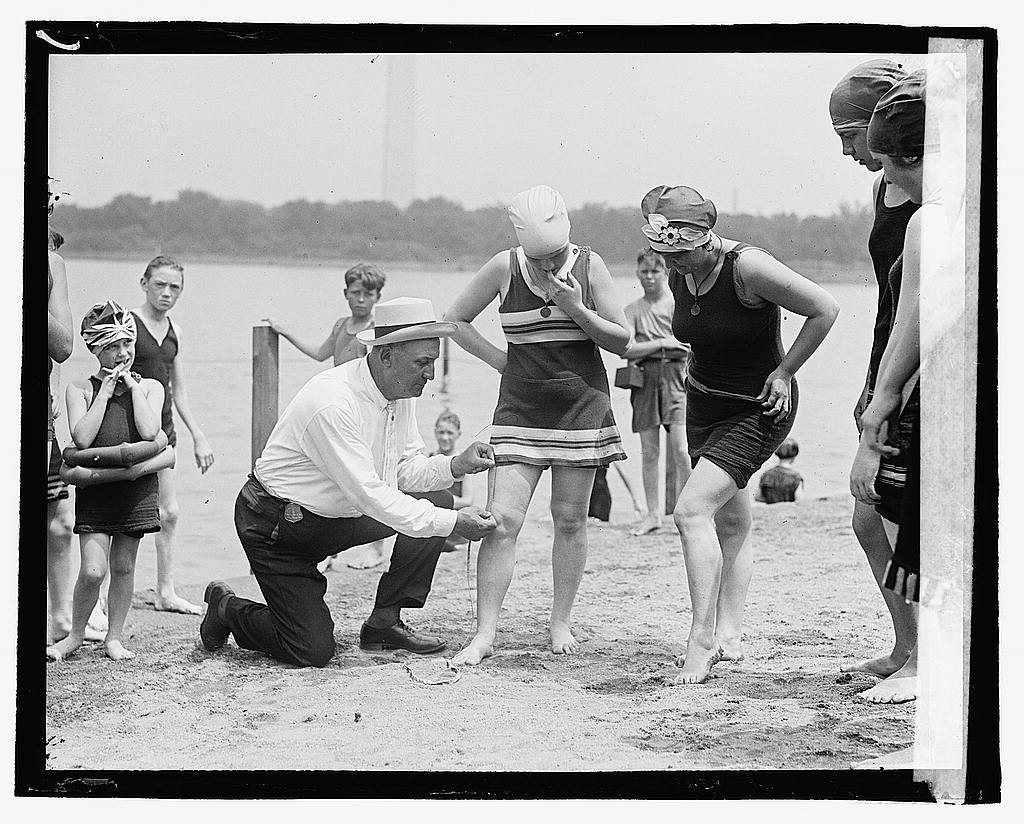
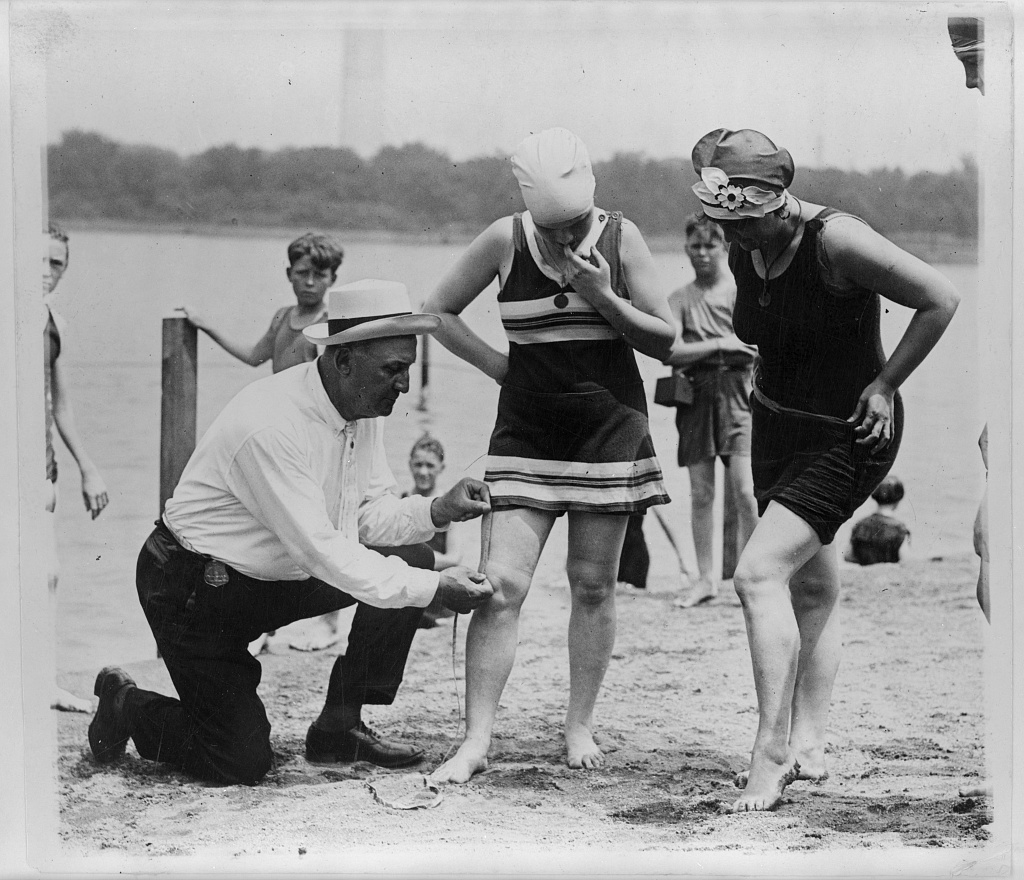
A Washington cop knelt on the sand of the Tidal Basin in the summer of 1922 with a tape measure pressed against a woman’s thigh. He was checking how far her swimsuit rode above the knee. The photographer was a few feet away, waiting. The shot ran in newspapers across the country, and it is still the picture most people see when they hear the words “Tidal Basin beach.”
What the picture doesn’t tell you is that the beach in question was about to become the center of a fight Congress would settle by tearing the whole thing down.
The cop with the tape measure
The officer is Bill Norton, the “bathing beach cop.” The woman is anonymous, as the women in these staged-modesty photos almost always were. The man directing the camera is Herbert E. French of the National Photo Company. The date the Library of Congress puts on the negative envelope is June 30, 1922.
The pretext for the tape measure was an order from Colonel Clarence O. Sherrill, the Army officer who ran the Office of Public Buildings and Grounds and oversaw most of the federal landscape in DC. Sherrill had decreed that bathing suits at the basin could not ride more than six inches above the knee. Norton was the man with the tape.
When I look at the photo, the staging is obvious. Norton is kneeling. The woman is smiling. A small crowd is watching. Nobody is being arrested. This is a publicity shot of an enforcement policy, not enforcement.
That doesn’t mean the policy wasn’t real. It was the era of municipal modesty squads at every public beach in the country, and Sherrill ran his federal patch of beach the same way. The press loved the story because the press always loves a beach story. The photo was reblogged for a hundred years afterward, including by me when I first wrote about it.
Which is the problem with stopping the story there.
How DC got a beach on the Mall
The Tidal Basin opened to swimmers on August 12, 1918. The Evening Star covered the opening that afternoon. Colonel C. R. Ridley, Sherrill’s predecessor at Public Buildings and Grounds, made a final inspection and gave the order to open the gates.
The available appropriation was twenty-five thousand dollars. The location, in the Star’s words, was “on the southeast side of the tidal basin, about half way between the inlet and outlet bridges.”
That is the curve of the basin where the Jefferson Memorial sits today.
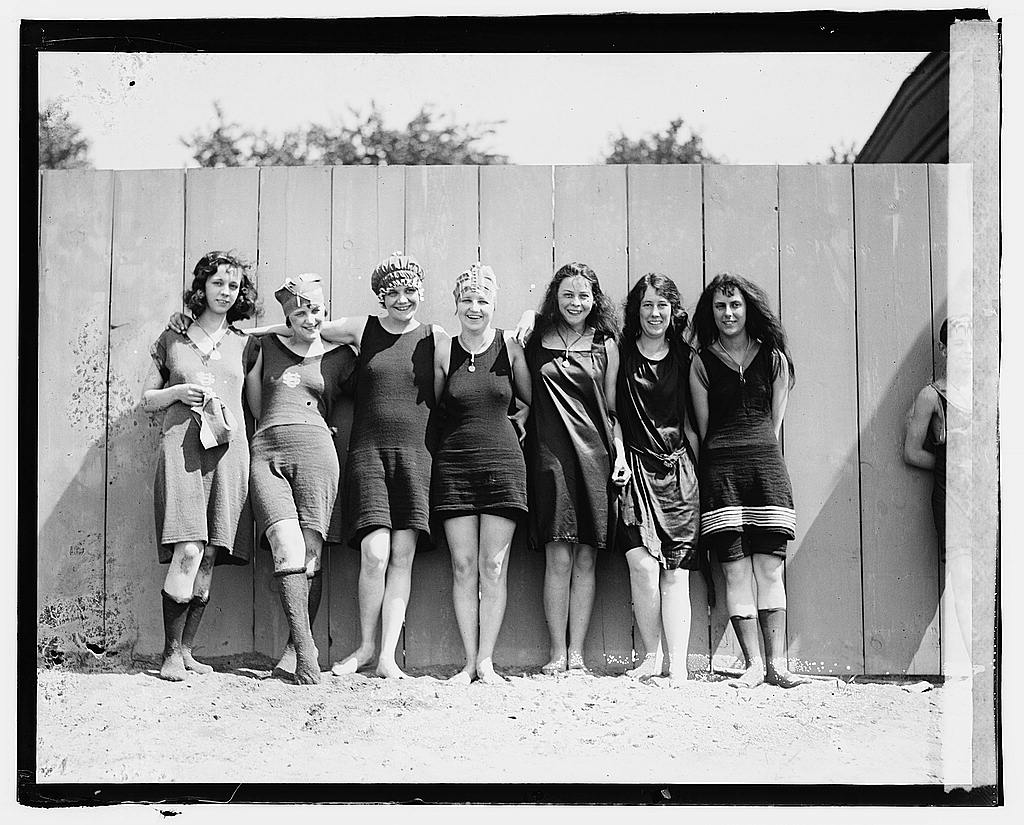
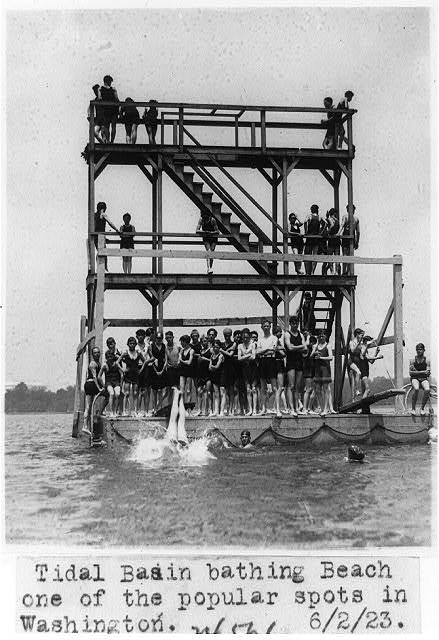
Two weeks later, the War Camp Community Service ran an “aquatic carnival” on the same stretch of sand. About two thousand people watched. By the summer of 1920, the Washington Post was running headlines about a single-day record of twenty thousand swimmers at the Tidal Basin. The beach was a hit. There were diving platforms, a bathhouse, swim instructors, beauty contests, and water carnivals every August.
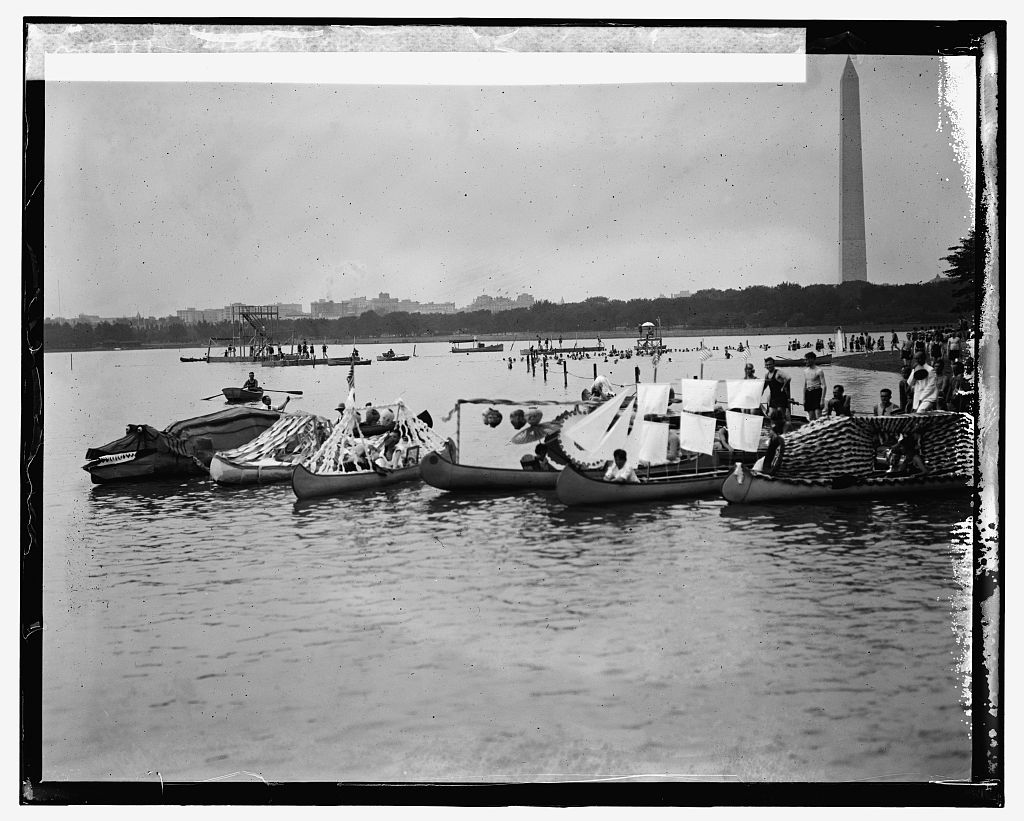
The National Photo Company stringers kept coming back to the basin through the early twenties.
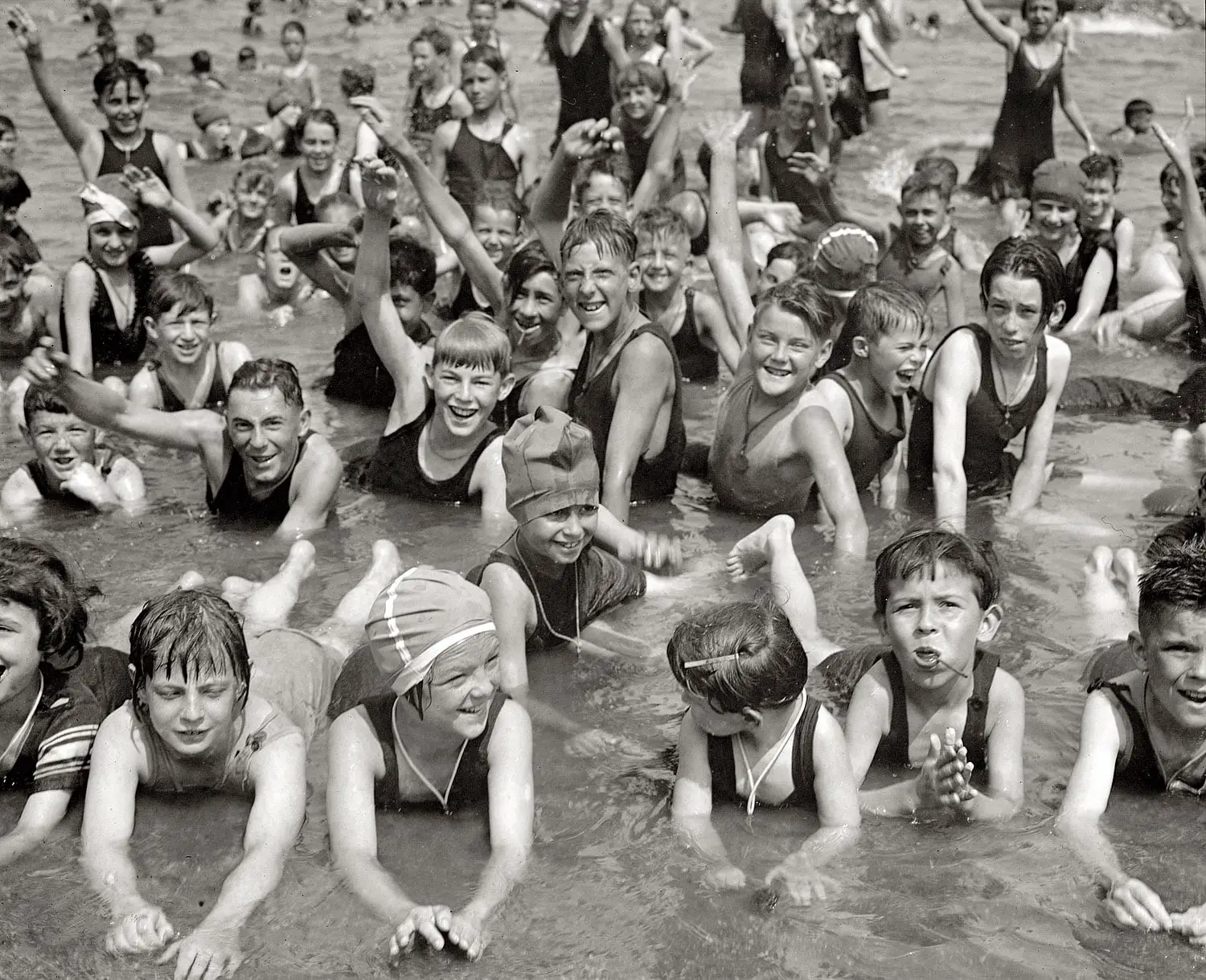
For a few summers it was the most popular outdoor amenity in Washington. (We’ve written about the beach’s annual beauty contest before.)
It was also closed to anyone who wasn’t white.
Whites only
The rope line was simple. The basin had one beach, the beach was on federal land, and federal officials ran it under the segregation rules of the era. Black Washingtonians could pay the same federal taxes that built the beach and walk past it on the way to the streetcar, and they could not swim there.
The official line from the Office of Public Buildings and Grounds was that a “colored” beach would be built somewhere else when funding came through. A line item of twenty-five thousand dollars sat in the books from 1922 onward, earmarked for that purpose.
Sherrill’s office kept proposing sites on the Virginia shore of the Potomac, near the south end of Columbia Island, or out past the end of the Francis Scott Key Bridge. Each one was a long ride from the Black neighborhoods of DC, on the far side of a river, and Black civic groups rejected each one.
In January 1923 the Washington Tribune, the city’s Black newspaper, ran a front-page story under the headline “Tidal Basin or No Beach.” A delegation led by a man named W. D. Nixon, president of the Civic Center of Affiliated Association of the District of Columbia, had met five times with Secretary of War John W. Weeks.
Their position was straightforward. The Tidal Basin or nothing. Black taxpayers had paid for the beach. They wanted the same beach, or one as good, on the same body of water.
The Civic Center won the next round. In 1924 Congress appropriated seventy-five thousand dollars for a second bathing beach on the Tidal Basin for Black Washingtonians. The proposed site was the opposite shore, the north bank, across the water from the existing white beach. By February of 1925 about twenty-five thousand dollars had already been spent on construction.
That’s the part of the story most people don’t know.
The beach that was never built
The north bank of the Tidal Basin in 1924 was an empty curve of reclaimed land, sketched out for the second beach. The plan was a mirror image of the white beach, with its own bathhouse and diving platforms, on the shore directly across the water. A bridge across the inlet. Two beaches sharing one basin. It would have been, by the standards of segregated Washington, an extraordinary built outcome.

I keep coming back to the geography of this. The 1924 plan put a federally funded Black bathing beach in the most monumental open space in Washington, on a curve of water visible from the White House and the Washington Monument. Inside the L’Enfant ceremonial core.
Anyone who used the Mall would see it. That visibility was the point for the Civic Center. It was also the point for the people who wanted it stopped.
By the time the construction money was flowing, a coalition of senators, the Commission of Fine Arts, the Public Health Service, and the War Department had decided that the answer to the second beach was not to build it. The answer was to take the first beach away from everybody.
February 18, 1925
The vote happened on the Senate floor during debate over the District of Columbia appropriation bill. The committee had reported a six-thousand-dollar maintenance line for the not-yet-finished colored beach. That was the trigger.
The lead opponent was Senator Thomas J. Walsh, Democrat of Montana, the same Walsh who had run the Teapot Dome hearings the year before. He rose to attack the maintenance line and, by extension, the basin’s use as a beach at all. The Washington Tribune recorded his speech a few days later. The language is worth reading at length.
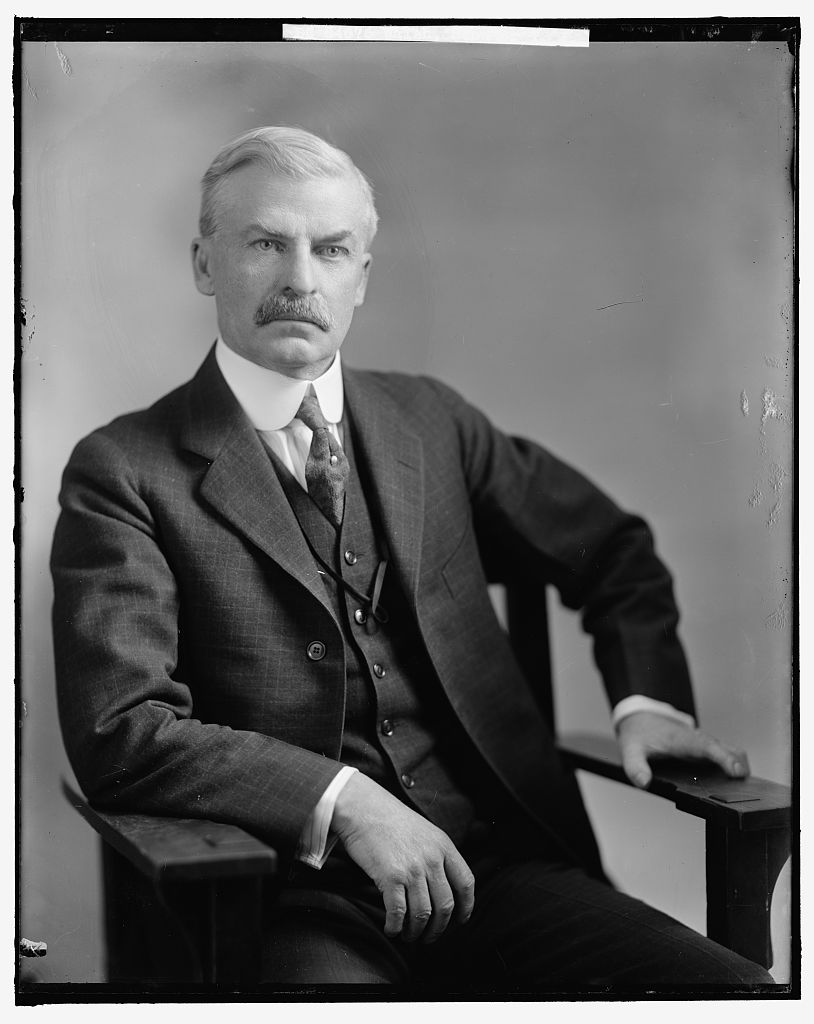
I am astonished to learn that the Tidal Basin is to be desecrated, no other word will characterize it, desecrated by the establishment in the most conspicuous place about the entire Basin of a bathing beach for the colored population of the city of Washington.
Walsh had backup. Senator Furnifold M. Simmons of North Carolina urged the Louisiana senator Edwin Broussard, who had wanted to preserve the white beach, to drop his objection and let both beaches go. Senator George Wharton Pepper of Pennsylvania said any bathing beach in the Tidal Basin was unwise.
Outside the chamber, Charles Moore of the Commission of Fine Arts had submitted a letter calling for the existing beach’s removal on aesthetic grounds. Secretary of War Weeks had submitted his own letter saying no beaches should be at the basin at all.
The floor manager for the committee, Senator Lawrence Phipps of Colorado, defended the colored-beach appropriation in language that gave the whole game away.
It [was] deemed essential to provide bathing facilities for the colored residents of the District, as otherwise they would demand their full and equal right to use the bathing beach which is now established and in use.
That is the line. Build the second beach so they don’t take the first one.
The Senate voted on the six-thousand-dollar maintenance amendment first. It failed fifty-three to twenty-two. The Evening Star ran the tally on the front page the next morning.
Walsh then moved to strike the twelve-thousand-dollar maintenance for the white beach and return the unspent balance of the seventy-five thousand to the Treasury. That motion carried on a voice vote. The House followed in conference the next week, with Representative Martin B. Madden of Illinois, chair of Appropriations, announcing that the basin would not be used for bathing that summer.
There was no cherry-tree pretext on the floor. That story is a retrospective tidy-up. The framings the senators actually used were the Commission of Fine Arts’ aesthetic objection, the Public Health Service’s water-contamination warning, and the general Senate appetite for cutting District spending.
The cleanest reading of the record is that Congress was not willing to fund a beach for Black Washingtonians and chose to close the white beach rather than face the alternative.
The diving platforms came down across the spring and summer of 1925. The bathhouses came down. The sand was hauled out. By the time of the next August carnival there was no beach to carnival on.
What’s there now
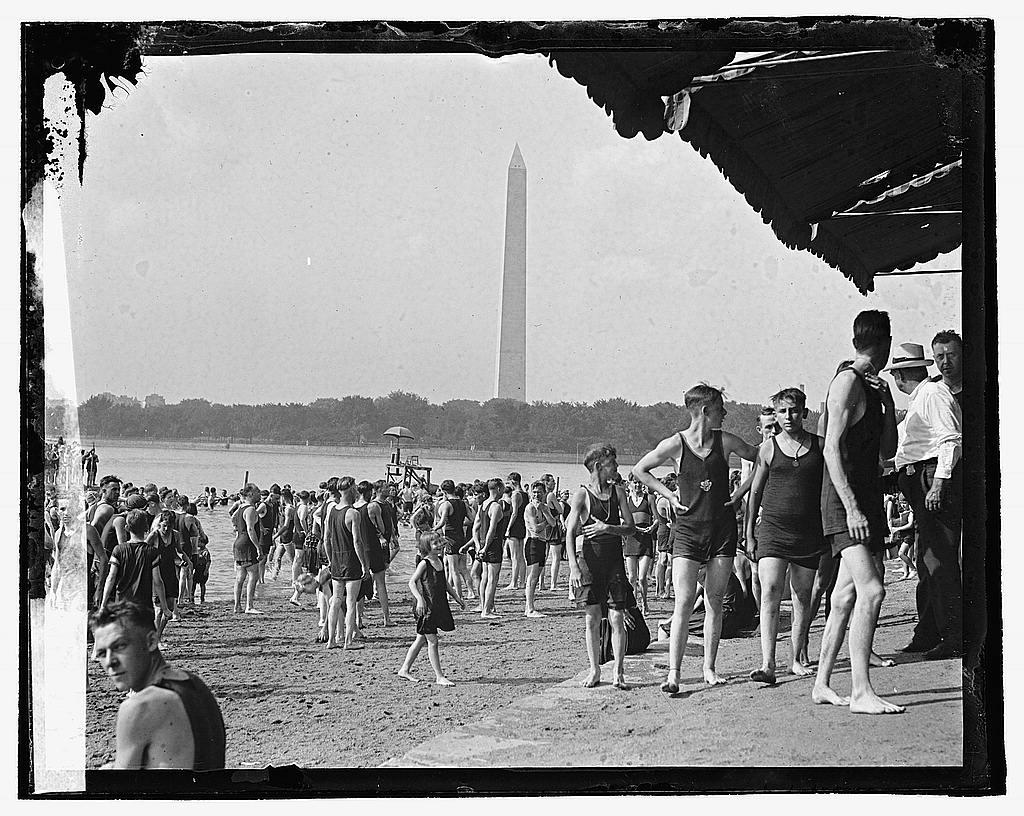
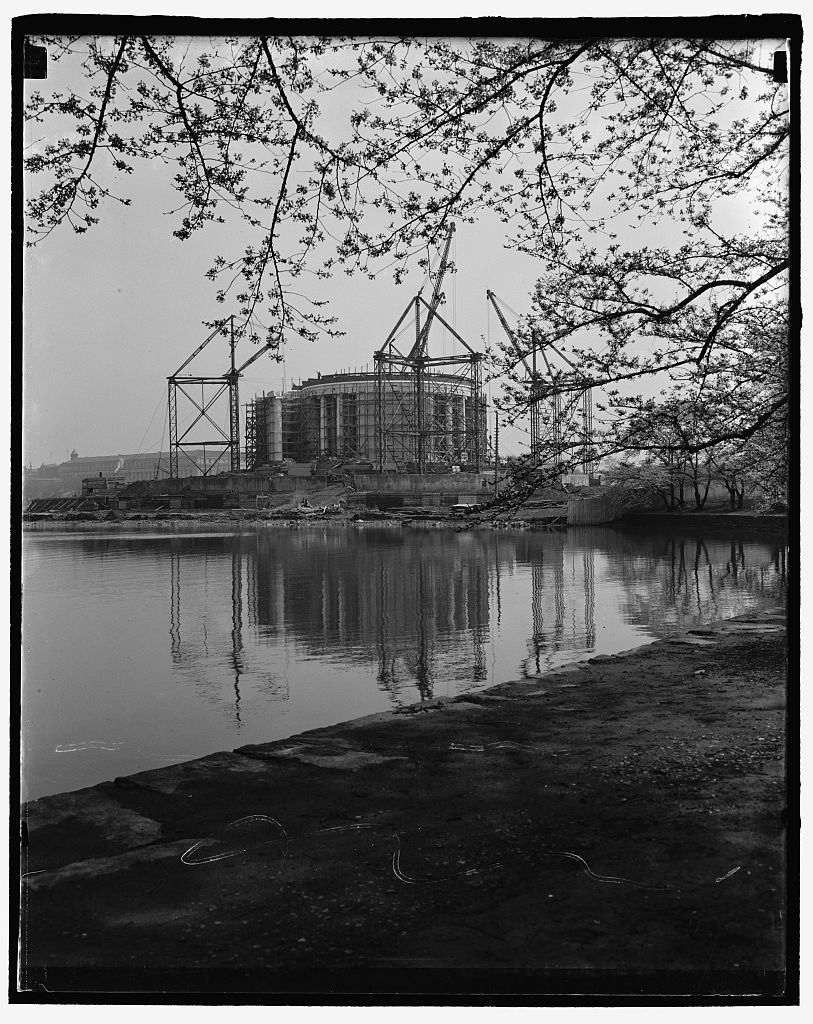
The south bank of the basin, where Bill Norton knelt with his tape measure in 1922 and where twenty thousand swimmers crowded the diving platform in 1920, is now the Jefferson Memorial. The cornerstone went down in 1939. It opened in 1943. The same federal landscape office that ran the beach approved the design. (The cherry-tree protests over the Jefferson Memorial site came a decade later, and they are a different fight.)
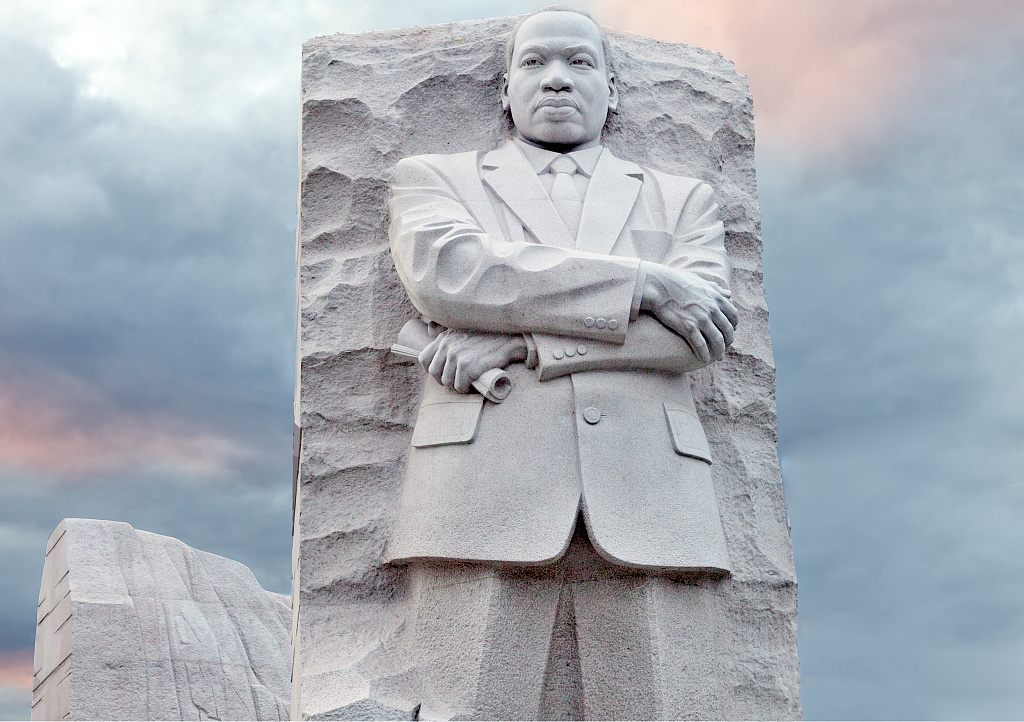
The north bank of the basin, where the never-built second beach was sketched out in 1924 and where construction had already begun in 1925, is now the Martin Luther King, Jr. Memorial. It opened in 2011.
I am wary of pulling neat moral threads across an eighty-six-year gap. But the geography is what it is. Two memorials on opposite banks of a small body of water. On the south side, the ground a whites-only beach occupied for seven summers. On the north side, the ground a Black beach was supposed to occupy, and never did, because Congress would rather close everyone’s beach than open one.
The Norton tape-measure photo is the famous picture from the basin. It deserves company.
Haha 😀 I’ve seen that picture before! Reminds me of Catholic school when they used to measure your hair to make sure it wasn’t too long.
Good stuff Tom! Can you imagine swimming in the Tidal Basin today? Btw, that entire area has a lot of little-known treasures, like the huge Olympic-sized swimming pool at Haines Point and from what I hear a small WWI memorial to soldiers from DC that is over-grown and hidden somewhere around the spaghetti of highways and bridges between the Tidal Basin and Haines Point.
Thanks! This one cracked me up…and no, I can’t imagine swimming there. I wonder when that stopped. 50s or 60s?
Definately by the 60s when the bikini was introduced and every cop in DC wanted the Tidal Basin beat !!
This is neat and before my time. However my friend, who died at 82 this summer, told me stories of a beach at the Tidal Basin. I had trouble believing him…in that dirty water??..His mother was the Life Guard there and apparently it was a hot spot to go back then. He was born in 1929 I think. Look at the two ring enter-tube (spelling?) on one of the girls, the bathing caps and of course the bathing suits. No Skinny Minnies there either..thin was not in..lol Looks like sand was there, thus the beach title.
Fanny Foxe enjoyed a dip there in 1974!
I just added this picture from 1922 at my Pinterest site; http://www.pinterest.com/pin/522699100473621073/
Hmm he seems all too pleased with that job. Yes hard to imagine a beach of any kind here in D.C. oh the things we missed. Then again, it’s not worth the trade for all the social progress we’ve made in the time since. Oh well.
Your friend was born after the closing of Tidal Basin Beach. Tidal Basin Beach as it was known opened in 1918 then closed seven years later in 1925 the issue of desegregation! Not his mother was not a lifeguard. Your friend was born five years after the closing of the beach and if still living 85 years young today.