Everyone knows the Willard Hotel. Three brothers from Westminster, Vermont, leased a Pennsylvania Avenue hotel in October 1847, slapped their last name on the awning, and made it the unofficial second-floor of the federal government. Lincoln slept there. Grant ducked in for a cigar.
Almost nobody knows the fourth brother.
His name was Caleb Clapp Willard. He was the youngest of the seven Vermont kids who came out of that farmhouse, and he ran the other Willard hotel. A block east. On the southeast corner of 14th and F NW. He just had the misfortune of calling it the Ebbitt House.
Westminster, Vermont, seventh of seven
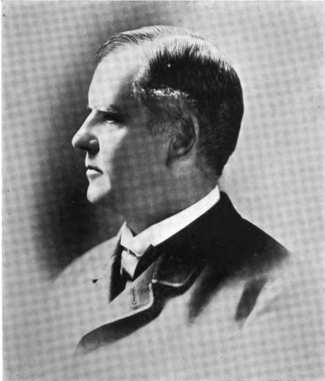
Caleb was born August 10, 1834, in Westminster, in Windham County in southeast Vermont. His father was Joseph Willard Jr., a farmer who married Susan Dorr Clapp in January 1816. She was the daughter of Caleb and Nancy Clapp, which is where his middle name and his first name both come from.
He was the youngest of seven. Edwin Dorr came first, around 1818. Then Joseph Clapp in November 1820. Then Henry Augustus on May 14, 1822. Then Mary Ann, Susan Dorr, and Cyprian Stevens. Caleb was an afterthought, born twelve years after Henry.
Joseph Willard Jr. died at Westminster on April 23, 1845, when Caleb was ten. The 1915 Willard Genealogy records him simply as “a farmer,” dead at 53.
By then the older boys were already gone. Henry was twenty-three and had been bouncing through hotel work for a few years. In October 1847 he leased the City Hotel on Pennsylvania Avenue, renamed it Willard’s, and started the family’s run in the federal capital.
The $40,000 loan
Caleb came down to Washington as a young man and went to work for Henry. The family’s own genealogy, published by the Willard Family Association in 1915, lays it out in a single direct paragraph on page 455:
He went to Washington, D. C., as a young man and learned the hotel business, showing himself an apt pupil of his brother Henry, who loaned him $40,000 with which to begin hotel keeping. He repaid it after some years, and made the Ebbitt Hotel famous, in the same class as “The Willard,” and acquired large property.
Forty thousand dollars in the late 1850s, brother to brother. (Roughly a million and a half today, give or take. Henry was good for it.) The family’s own record of how the second hotel was launched.
My friend John DeFerrari, who knows more about lost DC buildings than just about anyone, picks up the trail in his great Streets of Washington piece on the Willard brothers. Caleb, he writes, worked briefly inside Willard’s itself in the 1850s and fought in the Civil War before any of the Ebbitt House story begins. John doesn’t cite a unit or rank for the war service, and we are not going to invent one.
The Hygeia Hotel, 1859 to 1862
Caleb’s first try wasn’t the Ebbitt. It was the Hygeia, a resort hotel at Old Point Comfort, Virginia, on the gates of Fort Monroe at the mouth of the James River. (File this one under businesses you do not want to be running in April 1861.)
In 1859 he bought a half interest from Joseph Segar for fifteen thousand dollars and took over the day-to-day. The Hygeia drew the Tidewater elite and the army officers stationed at the fort. Caleb was twenty-five years old and running a resort hotel in Virginia.
Then April 1861 happened. Fort Monroe became the Union foothold in Confederate Virginia. The Peninsula Campaign launched from there. General Benjamin Butler declared escaped slaves “contraband of war” inside its walls.
In October 1862 the U.S. Army decided the Hygeia was in the way of operations at the fort, and they tore it down. No compensation to Segar. No compensation to Caleb.
He was twenty-eight, his stake was gone, and the Virginia hotel he’d run for three years was rubble.
September 1, 1864
Two years later, Caleb walked into a Washington real estate transaction that would carry the rest of his life.
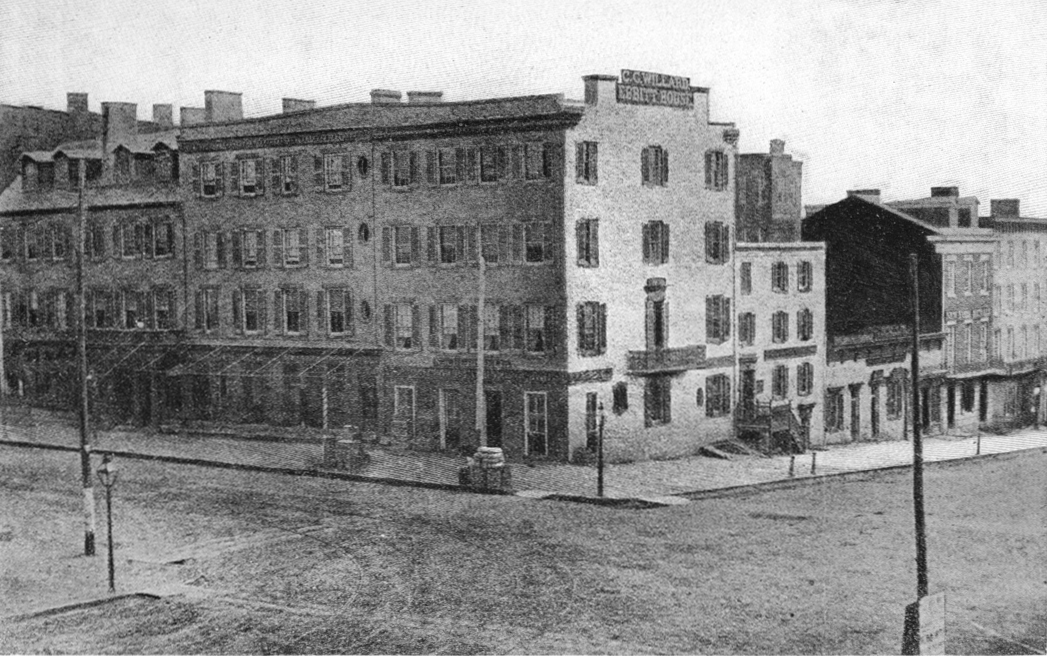
The southeast corner of 14th and F NW had been a four-townhouse boarding house since 1856, opened by a Vermonter named William E. Ebbitt. Ebbitt ran it for eight years, then on September 1, 1863, sold it to his son-in-law Albert H. Craney. Craney held it exactly one year.
On September 1, 1864, Caleb bought the Ebbitt House boarding house from Craney. The deed is documented by John B. Larner in his 1903 address to the Columbia Historical Society, where Larner exhibited an old photograph of the corner and walked the chain of title forward.
That photograph survives. Matthew Brady took it in November 1865.
Caleb didn’t stop there. The same year he bought Bushrod Reed’s adjoining property and physically joined the two buildings, walling in a four-foot alley between them and adding bathrooms above. On October 4, 1866, he took the next building south, the Farnham House, at auction for seventy-four thousand dollars.
Eight years of buying. Eight years of sewing together a square of downtown Washington one parcel at a time.
The Crystal Room
In 1872, Caleb tore the whole thing down.
In its place he built a six-story Second Empire hotel with a mansard roof, three hundred rooms, canopied windows, and an elevator. (For 1872 Washington, the elevator alone was a flex.) The dining room was two stories high, with floor-to-ceiling windows, white marble floors, and a frescoed ceiling. Massive chandeliers hung in the middle of the room.
People started calling it the Crystal Room.
This was the building that did the work. It became “Army and Navy Headquarters” almost immediately. William Tecumseh Sherman lived there. So did Winfield Scott Hancock. Rear Admiral Samuel Rhoads Franklin kept rooms.
And starting in 1877, a congressman from Ohio named William McKinley moved in with his wife Ida and stayed put. For most of his congressional career between 1877 and 1891, the future president of the United States ate breakfast in Caleb Willard’s hotel.
Not Henry’s. Caleb’s.
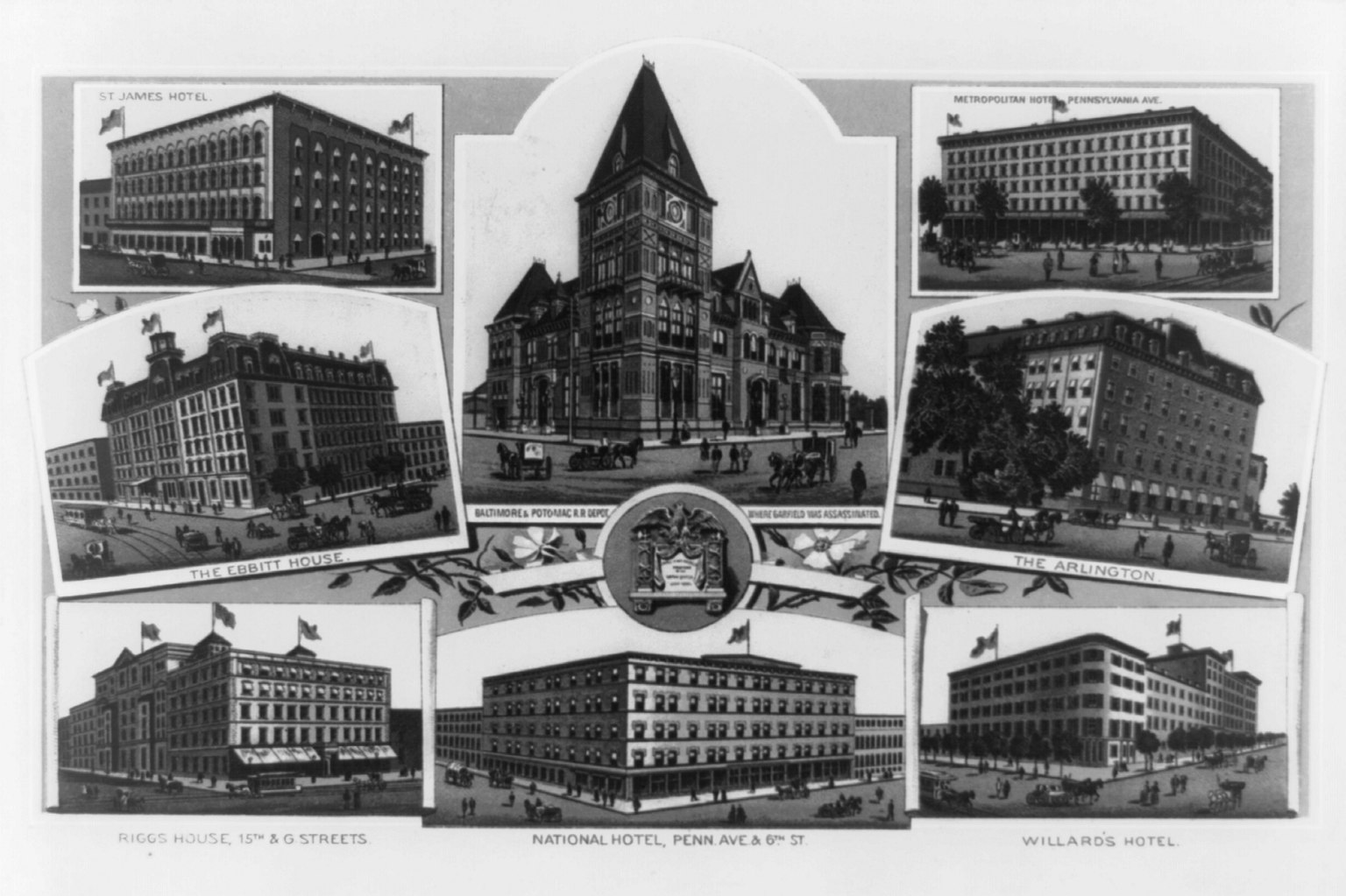
A block to the west, brother Henry was running the original Willard. Brother Joseph was a half-silent partner growing fabulously wealthy. The two Willard hotels and the corner between them was the most concentrated patch of federal-government hospitality in the country.
A million dollars and three brothers suing each other
By 1880, the family was rich beyond local measure. The Brooklyn Eagle ran a wealth survey of the Willard brothers that year and pegged Joseph at seven to ten million dollars, Henry at one and a half million, and Caleb at a million.
We are taking the Caleb figure from John DeFerrari (he tracked it back to the Eagle for his Streets of Washington work on the brothers), and we have not pulled the original clipping ourselves. Call it the Eagle‘s 1880 estimate, not a notarized statement.
A million dollars in 1880 is roughly thirty million today.
The three surviving brothers built mansions on 14th Street in the blocks north of their hotels. Then they fell to fighting each other in court over who owned what.
The most famous of the disputes is the silver-dollar story. Caleb wanted a small lot just east of the Ebbitt that Joseph owned. He offered to cover the lot in silver dollars as payment. Joseph said sure, as long as the dollars were standing on edge. The deal collapsed. (Joseph, by every surviving account, was a piece of work.)
John surfaced that one out of Garnett Laidlaw Eskew’s 1954 history of the Willard. It’s anecdote, not deed. But it’s the only anecdote anyone tells about the four Vermont brothers, and it tells you everything about how the family worked in the 1880s.
The 1889 sleigh and the last quiet years
By 1889 Caleb was fifty-five and starting to step back. In November of that year he hired Henry C. Burch and Charles E. Gibbs to take over the day-to-day. They refurnished the hotel from top to bottom over the next two years.
This is the moment the famous winter photograph belongs to.
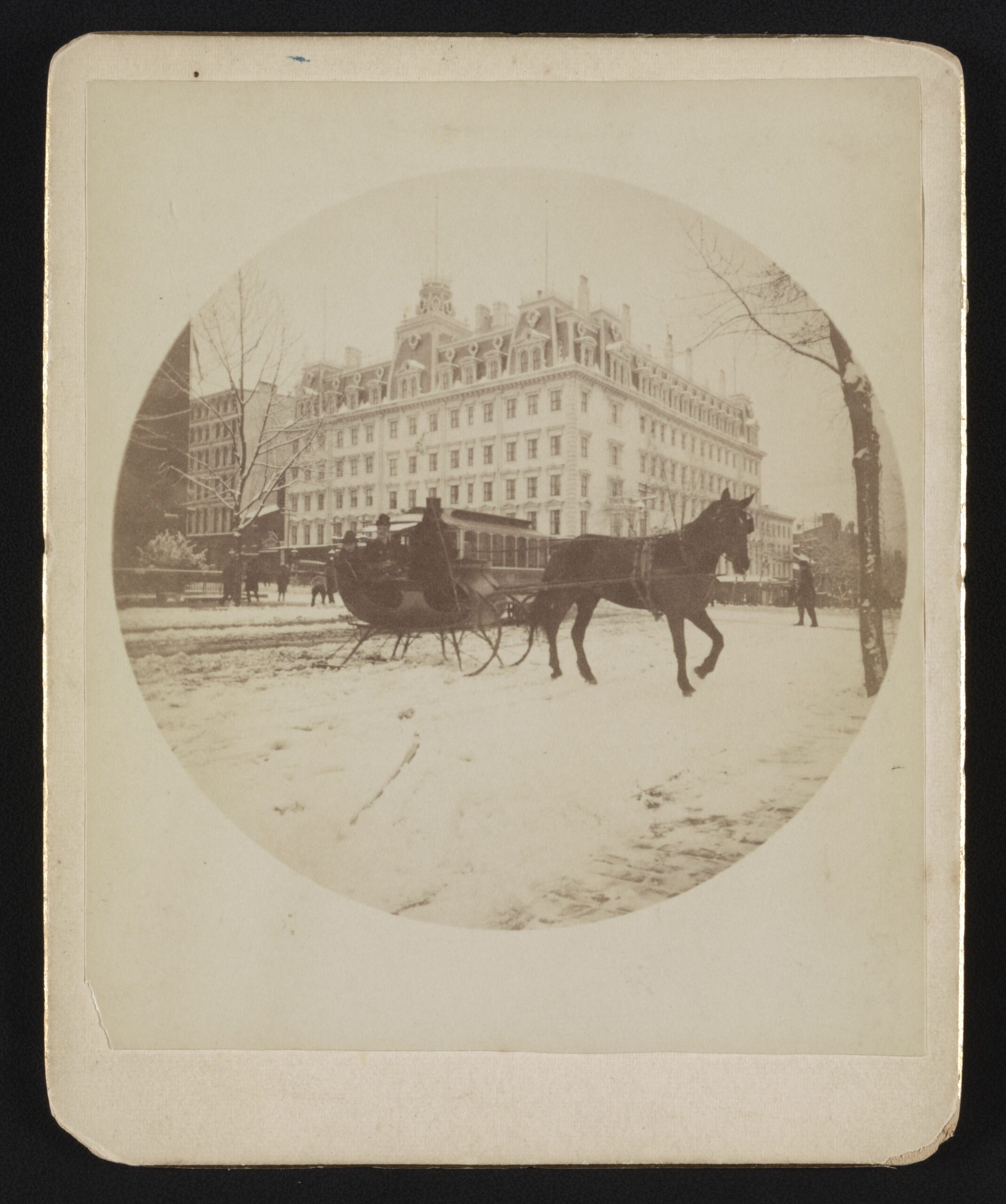
His first wife, Allie C. Jones, had died June 9, 1874, age thirty-seven. He remarried Lucy Stratton Parker, born August 3, 1843, twenty-one years his junior. His son Walter Jones Willard, born December 1, 1868, died November 4, 1892, at twenty-three. The family pages of the 1915 genealogy record all of it in two flat sentences.
Caleb was running an empire and burying his family at the same time.
Atlantic City, August 2, 1905
Caleb died at Atlantic City, New Jersey, on August 2, 1905. He was seventy years old.
The Washington Post ran his obituary on August 4. His funeral was at the Church of the Epiphany on G Street between 13th and 14th NW, two blocks from the hotel. He was buried at Oak Hill Cemetery in Georgetown, in the Reno Hill section, Lot 924.
Lucy outlived him by less than five years and died January 12, 1910.
The hotel’s last twenty years
The Ebbitt House outlasted Caleb by exactly two decades.
The Burch and Gibbs era stretched into the 1910s. The army-and-navy crowd thinned out. Newer hotels with private bathrooms and modern wiring kept opening downtown. The Willard estate finally sold the Ebbitt House in 1923.
On Friday, May 1, 1925, the Ebbitt House closed to the public at noon. Four days later, on Tuesday, May 5, the furnishings were auctioned off. Most pieces went for less than a dollar each.
In November 1925 the new owners announced the building would come down to make room for the National Press Club Building. The wrecking ball swung at 1:00 in the afternoon on January 6, 1926. National Press Club President Henry L. Sweinhart did the ceremonial first hit. (Reporters knocking down a hotel where presidents used to live. There is a column in that somewhere.)
What’s there today is the National Press Building, finished in 1927. Twelve stories of limestone, a Beaux-Arts base, and a courtyard where the boarding house used to stand.
The old Ebbitt’s bar moved a few doors down to 1427 F Street NW, where it became known as the Old Ebbitt Grill, before relocating once more in 1983 to its current home at 675 15th Street NW.
That’s the only piece of Caleb’s career you can still walk into. You can read the longer story of that survival in our piece on the restaurant.
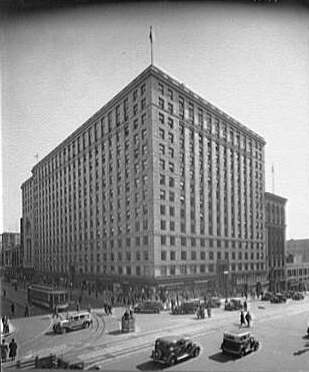
Walk past 14th and F NW today and there is nothing there to tell you that the youngest of the Westminster Willards once owned the corner, lived in the silver-dollar fight with his own brothers, and ran a hotel that a sitting president of the United States called home for thirteen years.
The family record says it plainly. He repaid the forty thousand. He made the Ebbitt famous. He acquired large property.
Then everyone forgot his name.