
In 1891, King Gojong paid $25,000 for a Victorian townhouse at 15 Iowa Circle. Nineteen years later, his empire was forced to sell it for five dollars. Days after that, the new owner flipped it to an American for ten. The building, today the Old Korean Legation Museum at 1500 13th Street NW, watched Joseon become an empire, the empire lose its sovereignty, and Korea spend the next century trying to get it back.
I keep coming back to that ten-dollar bill. It is the part of this story that is hardest to read.
The house Seth Phelps built on Iowa Circle
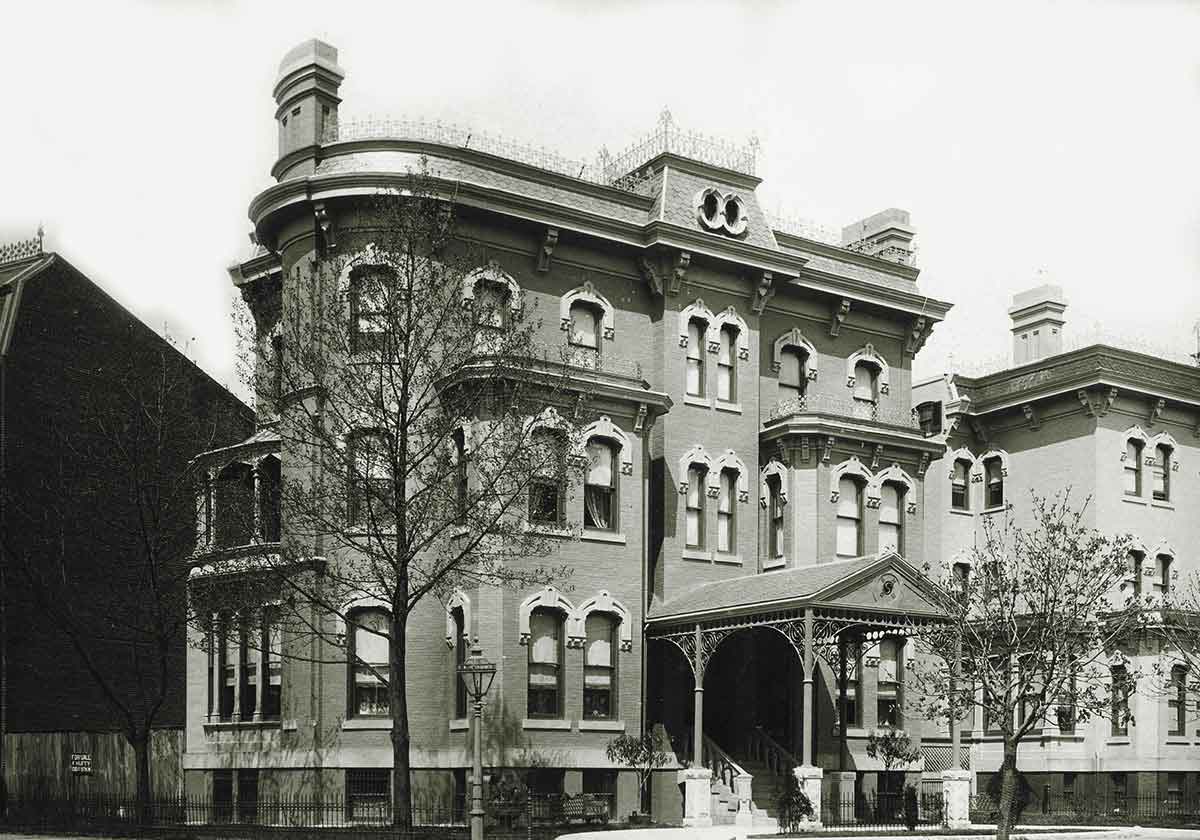
The District issued Seth Ledyard Phelps a building permit on December 16, 1877, for a seven-bedroom brick house at 15 Iowa Circle. The architect was Thomas M. Plowman. The builder was Joseph Williams. Total cost: $5,500.
Phelps had Ohio sandstone set into the facade, a tin roof, a cast-metal porch, and projecting bays that pushed the front rooms toward the new park. He was a Navy captain in the Mexican War and a riverboat fleet commander in the Civil War. By 1877 he was a District commissioner and a real estate developer flipping lots around the freshly graded Iowa Circle.
He filled in the circle. He commissioned 1502 13th next door, 1500 through 1504 Vermont Avenue, 1202 Q Street.
He didn’t get long in the house he built for himself. Phelps died in 1885. His widow Lizzie stayed on. Their daughter Sally would still own one of his Vermont Avenue houses in 1919.
For a sense of what the neighborhood looked like at the moment Korea moved in, see this 1892 plat map of Iowa Circle. The circle would not be renamed for John A. Logan until 1930.
Joseon finds Washington
The 1882 Treaty of Peace, Amity, Commerce and Navigation between the United States and Joseon was the first treaty Korea signed with a Western power. The next spring Lucius H. Foote arrived in Seoul as the first American minister. The Joseon court reciprocated slowly. China kept telling them not to.
For centuries Korea had been a tributary state of Qing China. When Joseon began sending diplomats abroad in the 1880s, Beijing set conditions: Korean envoys had to defer to Chinese ministers, present credentials in their presence, and conduct no business China hadn’t approved. King Gojong’s first attempt to send an envoy in 1887 was blocked outright.
The second attempt got through. Pak Chŏng-yang sailed from Yokohama with a small staff that included translator Yi Chae-yeon, secretary Yi Ha-young, and the American missionary Horace N. Allen, who held a third-rank position in the Joseon government as foreign counselor. They reached Washington on January 1, 1888.
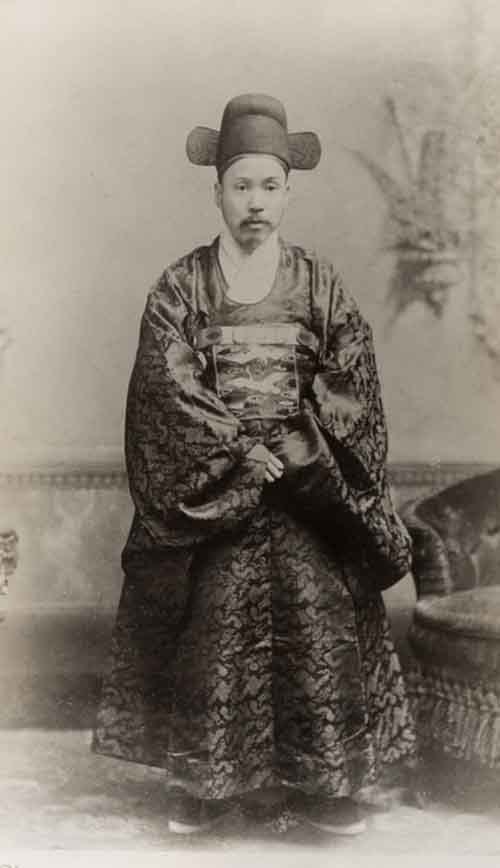
On January 17 they walked into the White House and handed Grover Cleveland their credentials, with no Chinese minister in the room. The slight registered. China demanded that Korea recall and punish Pak. Joseon let him stay.
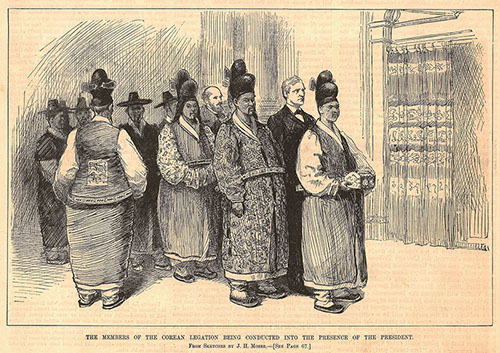
(For context, Japan’s first embassy to the U.S. arrived in 1860, twenty-eight years earlier, with a much larger party and a very different diplomatic situation.)
The first legation office opened two days later at the Fisher House. Several sources put the address at 1513 O Street NW; the museum’s own materials say only “near the White House.” It was small, the staff cramped. They needed a real legation.
A flag over Iowa Circle
On February 13, 1889, the Korean Legation moved into the Phelps house at 15 Iowa Circle. The Evening Star noted it the next day in the Social Matters column, calling the building “the new legation building, No. 1500 13th street, Iowa circle.”
Three months later, on May 8, 1889, somebody set up a camera on the front lawn. The photograph that resulted is the most reproduced image of the legation.
The Joseon staff stand at the entrance in gat, the wide-brimmed horsehair hats of Korean officialdom. Horace Allen stands among them in a frock coat. Above the rooftop a flagpole flies the taegeukgi, the Korean national flag.
The inscription at the bottom of the print reads, in classical Chinese, “the ninth day of the fourth month of the 498th year from the foundation of the nation.”
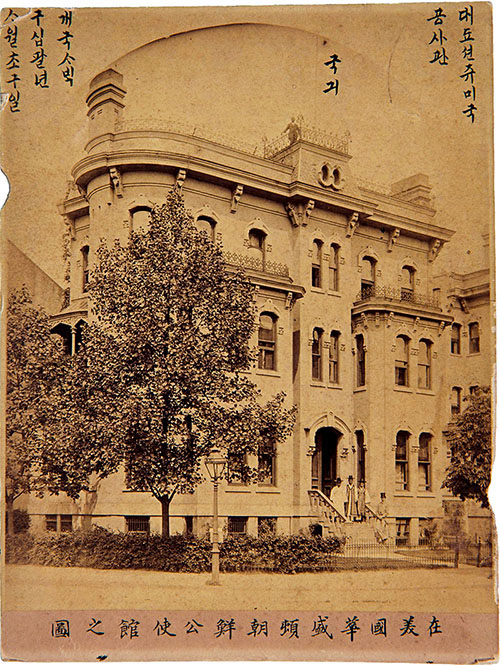
Joseon had been a kingdom for almost five centuries and was, for one afternoon, posing for proof it still was.
In 1891 the Korean government bought the house outright from Phelps’s son-in-law, Sevellon A. Brown, for $25,000. That was a serious sum out of Gojong’s treasury, more than four times the building’s original construction cost, and a stake in the ground that this mission was not temporary.
The legation years and Lady Bae
The most reliable contemporary chronicler of the legation was the Washington Post’s society desk. Korean ministers and their families were unusual enough in 1890s Washington that any movement got coverage.
The wife of chargé d’affaires Ye Cha Yun arrived in late January 1889. Her family name was Bae and she is usually called Lady Bae in modern accounts; in the Washington papers she was Mrs. Ye. A Post correspondent who watched her step off the train wrote that she was “so muffled in folds of green silk that no one could scarcely see her.”
She did not stay muffled. Within weeks she was hosting receptions, accepting invitations from First Lady Frances Cleveland, attending the opera in the box next to First Lady Caroline Harrison’s party, riding through Logan Circle in an open carriage, and worshipping at the Presbyterian Church of the Covenant.
On October 12, 1890, Lady Bae gave birth to a son at the legation. They named him Ye Washon, in honor of the city. He was the first Korean born on American soil. He lived two months. He is buried at Oak Hill Cemetery in Georgetown.
Two weeks after the funeral she went back to work. On February 4 and February 11, 1891, she presided over receptions at 1500 13th in a hanbok of pale-blue silk under a yellow brocaded jacket. She stood for over four hours each evening.
Diplomatic Washington was sometimes cruel to the legation. Ye Cha Yun told the Post that children pelted his carriage with stones near the White House and shouted “Chinee, Chinee” at him during the Easter Egg Roll.
A boy threw a piece of slate at Lady Bae from the curb on Vermont Avenue near Logan Circle and bruised her cheek. (The boy drowned in Rock Creek about a year later, which the Post noted with what reads as a thin layer of editorial schadenfreude.)
A fire, a flue, and a sovereign mission
The legation kept its routines. In April 1898 a faulty third-floor flue set the building on fire. Neighbors ran in to drag documents to safety. Minister Chin Pom Ye and his family, on the first floor, were unhurt.
The walls and woodwork burned but the legation rebuilt. A contractor named A. J. Fisher & Co. wrote up the repair specifications on April 13, 1900. An inventory clerk listed every chair and writing brush in every room in August 1901.

The point of all the inventories and repairs and society columns is that this was a working legation, not a symbol. People lived here and answered diplomatic mail here and tried to enroll the next generation of Korean students at Roanoke College from here, for about sixteen years.
The protectorate, the closure, and the $5 sale
The Russo-Japanese War ended in September 1905 with Japan in command of the Korean peninsula’s foreign policy. The Eulsa Treaty, signed under military duress in November, made Korea a Japanese protectorate. Korea no longer had the right to conduct foreign relations.
On November 24, 1905, Secretary of State Elihu Root wrote to the Korean chargé in Washington that the United States would henceforth conduct Korea-related business through the Japanese legation. The Washington Post on November 26 ran the headline “Korean Legation Supplanted.”
Minister Yun Chun Kim packed up. In late January 1906 he paid a farewell call at the State Department, and on January 25 the Post followed up with “Korean Legation at an End.” The Foreign Relations of the United States volume for 1905 reprints the entire diplomatic exchange under “Japanese supervision over Korean foreign and administrative affairs” if you want to read it cold.
The building sat. It still belonged to the Korean Empire on paper, but Korea no longer had the standing to use it.
In August 1910 Japan formally annexed Korea. The Japan-Korea Treaty of 1910 erased the Korean Empire as an independent state. The transfer of the Washington legation followed in two stages.
First, the Japanese government bought the building from the now-deposed Gojong. The real estate contract is preserved. It reads, in part:
The Japanese Legation pays $5 to Joseon’s emperor, who shall unconditionally hand over the ownership of the property.
Five dollars. From a sovereign government to a deposed monarch, in exchange for a building that government had paid $25,000 for nineteen years earlier.
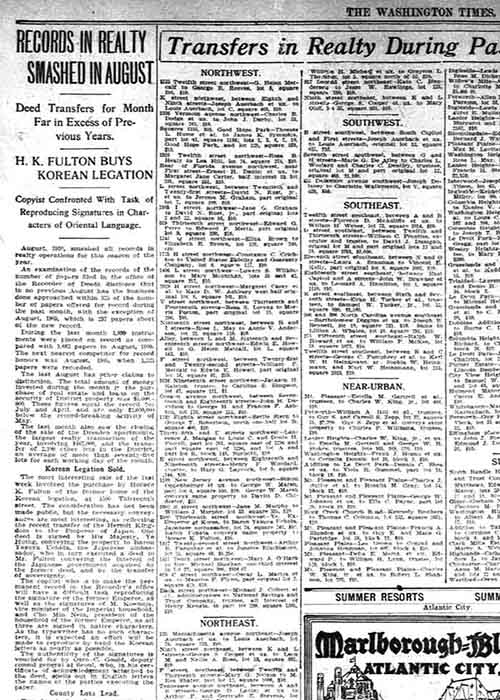
Days later, the Japanese minister sold the same building to an American buyer named Horace K. Fulton for ten dollars. That is the part of the transaction that read as the insult. It would have been easier, in a way, if Japan had kept the building and used it. Instead they flipped it for a five-dollar profit, the way you’d offload a piece of furniture you didn’t want.
The middle decades
The new American owner did not hold the building long. Over the next sixty-odd years it cycled through private ownership, served as a recreation center for African American residents in the 1940s, and at some point became a union hall for the Teamsters. The Logan Circle neighborhood declined and then declined further. By the 1970s the block was rough.
Timothy and Lauretta Jenkins bought 1500 13th in 1977. The house next door at 1502 13th, the one Phelps had built at the same time as the legation, had been a brothel until a DC judge shut it down the previous year. The Post headline was “Court Shuts NW House Of Ill Fame,” February 13, 1976. The Jenkinses moved in anyway.
They knew vaguely that the building had once housed a Korean legation. They did not understand what it meant until, sometime in the 1980s, a man stood on the sidewalk staring up at the house. Timothy Jenkins went out and asked him in.
The man turned out to be a retired Korean Army general and the grandson of the first Korean minister to the United States. Lauretta later said the visitor “walked around so reverentially that it struck a note with us.”
After that, Koreans started showing up regularly to ask if the building was for sale. The Jenkinses kept saying no. They were worried what would happen to the house if they let it go to a developer.
A 102-year return
A grassroots Korean American fundraising campaign in the mid-2000s raised about $80,000. That wasn’t going to be enough. In 2008 the South Korean embassy opened formal negotiations. The Jenkinses initially asked $6 million. The Korean government allocated three billion won, around $2.6 million.
In 2012 a real estate agency working for South Korea’s Cultural Heritage Administration agreed terms. The property had appraised at $1.65 million. The final sale price was $3.5 million. Lauretta Jenkins’s worry about the next owner had functioned as leverage. The premium got her comfort that the building would be preserved.
Kim Jong-gyu of South Korea’s National Trust for Cultural Heritage said at the time that this was “not just a purchase of a building, but a restoration of our national pride deprived by Japan.” Amy Lee, a granddaughter of King Gojong who had campaigned for the purchase, told the AP: “I’m glad we have become strong enough and have enough money to buy it back.”
The Cultural Heritage Administration restored the building between 2015 and 2018 to its 1889-1905 appearance, using period photographs and the legation’s own inventory records. The parlor where Lady Bae greeted visitors. The Jeongdang where portraits of the king and crown prince hung. The minister’s bedroom. The legation staff office, with an English-Korean dictionary still on a reading stand.
On May 22, 2018, the South Korean flag was hoisted above 1500 13th Street for the first time in 113 years. The Old Korean Legation Museum opened formally a few days later, timed to President Moon Jae-in’s state visit. The building was added to the District of Columbia Inventory of Historic Sites on July 25, 2024, and to the National Register of Historic Places on September 9, 2024.

The legation outlived the empire that took it. You can walk in, free, Tuesday through Sunday.
For another DC building that outlived its diplomats, see how the old Irish Free State Legation on Connecticut Avenue became Russia House.