On the evening of December 21, 1833, the actor James Henry Hackett walked to the edge of the stage at the Washington Theater, in his Colonel Nimrod Wildfire costume of leather leggings and wildcat-skin cap, and bowed to David Crockett.
Crockett was seated in the front row, stage center, in a reserved seat the management had set aside for him.
He stood up and bowed back.
The Lion of the West, the James Kirke Paulding play in which Hackett starred, was a hit. Wildfire was openly modeled on Crockett: a Tennessee frontiersman with a windy backwoods drawl, dropped into the parlors of polite society for laughs.
The man and the cartoon were sharing a room.
The Washington Theater stood at 11th and C Streets NW, a few blocks from the boarding house Crockett kept on Pennsylvania Avenue. He had returned to Congress that fall for what would be his final term, after a two-year exile from office. He was, by then, a national celebrity. And his actual legislative record was on its way to being buried under coonskin cap.
This post is about the legislative record.
Arrival in Washington City, 1827
Crockett came to the 20th Congress in March 1827, forty-one years old, elected from the West Tennessee district that ran across the Chickasaw frontier. He arrived as a Jackson supporter. By the time he left office he would be a Jackson opponent, and the break ran straight through one of the most consequential votes of the nineteenth century.
He took a room at Mrs. Ball’s boarding house. The playwright Richard Byrne, who spent years researching Crockett’s Washington for a musical, locates the boarding house on Pennsylvania Avenue at 7th Street NW. The Federal Trade Commission building covers the site now.
In 1827, the avenue Crockett walked was muddy in the rain, putrid in the summer, and lined with what was, for Washington City, the densest concentration of hotels and boarding houses in the country. The journalist Anne Royall, working out of Capitol Hill that decade, described the principal part of Pennsylvania Avenue as “built in a marsh, which a common shower overflows.”
We have written before about what life in Washington City in the 1830s looked like at street level.
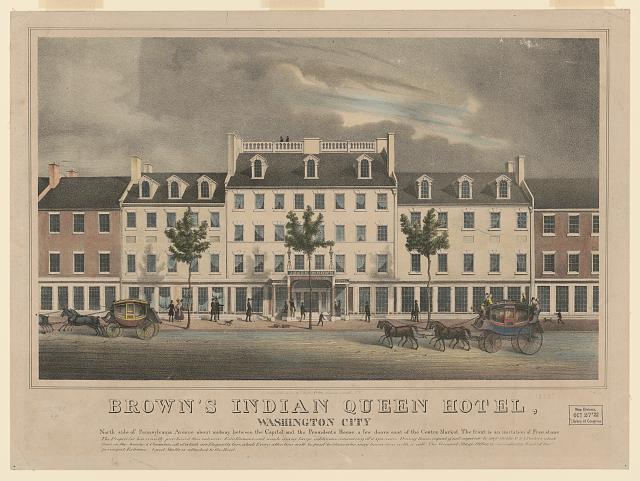
Directly opposite Mrs. Ball’s, on the north side of Pennsylvania Avenue, stood Brown’s Indian Queen Hotel, the most prestigious address in the city. Crockett would eventually move across the street into the Indian Queen during his third term, after the Whigs began funding him as a possible presidential candidate.
For now he was at Mrs. Ball’s, where legislators commonly shared a bed to save money.
This is what the historians call the “mess” system. Congressmen who could not afford houses lived in clusters in boarding houses, ate together at long tables, voted together, drank together, fought together. Crockett’s Tennessee mess included John Bell, Cave Johnson, James K. Polk, Robert Desha, and the rest of the delegation.
They were Jackson men almost to a man. So was Crockett, on the day he arrived.
The slow break
Crockett’s signature legislation as a congressman was a vacant lands bill, a measure to let Tennessee squatters buy small parcels of federal land cheaply, ahead of the speculators. It was the kind of thing his West Tennessee constituents understood directly: poor settlers who had cleared a few acres in the woods and feared losing them to anyone with cash.
He fought for that bill in three Congresses. He never got it passed.
The Tennessee delegation, including Polk and Bell, wanted the same federal land sold and the proceeds funneled back to the state. Crockett wanted the land in the squatters’ hands. He was outvoted by his own delegation.
The internal-improvements fights were the second wedge. Crockett supported federal money for the roads, bridges, and canals that his impoverished district needed. Jackson, on principle, did not.
On May 27, 1830, Jackson vetoed the Maysville Road bill, which would have purchased federal stock in a sixty-mile turnpike from the Ohio River to Lexington, Kentucky. The road ran inside a single state, Jackson said. Federal money had no business there.
The veto killed the Whig internal-improvements program in Jackson’s first term. It also passed over the desk of every western congressman who had counted on federal road money for his constituents.
The Maysville veto came one day after the vote Crockett had cast that ended his political career.
May 1830, the load-bearing center
The Cherokee Nation in 1830 was not a fading population waiting to be moved. It was a constitutional republic in its eighth year, with a written government, a bilingual newspaper, a national capital at New Echota in northwest Georgia, and a principal chief who was about to spend the rest of his life fighting the United States in court and in Congress.
The Cherokee Constitution had been adopted on July 26, 1827, at New Echota, after a convention that ran from July 4. It was patterned on the United States Constitution, with three branches, a bicameral legislature, and a principal chief. Article I declared the boundaries of the Cherokee Nation and the sovereignty of its people.
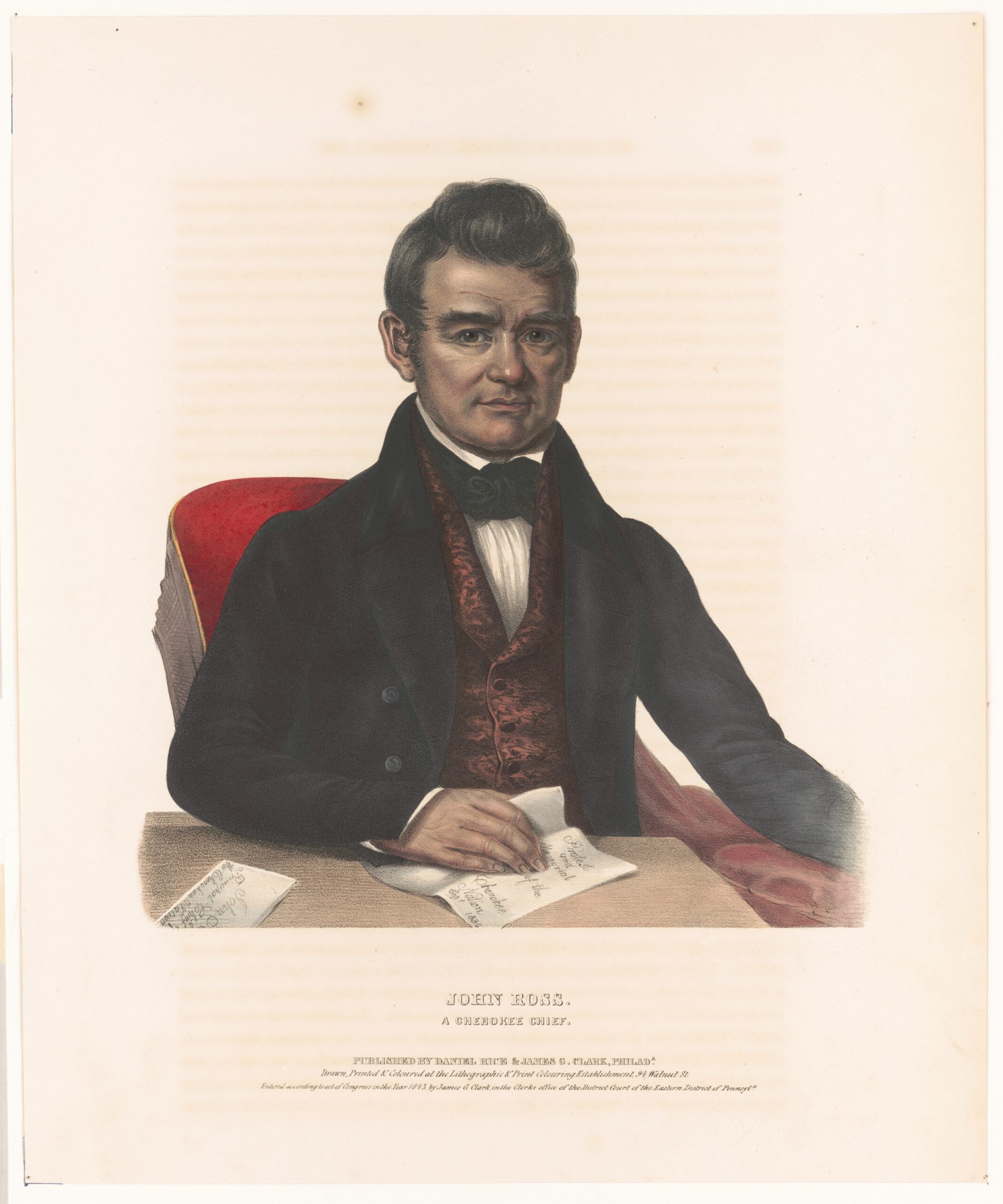
Principal Chief Pathkiller died on January 8, 1827. His successor Charles Hicks died two weeks later. After an interim period under Hicks’s brother William, the National Council elected John Ross as permanent principal chief in October 1828. He would hold the office until his death in 1866.
The Cherokee Phoenix, the nation’s weekly newspaper, had begun publishing on February 21, 1828, at New Echota. Every column ran in parallel English and Cherokee, printed in the syllabary Sequoyah had developed earlier in the decade. The editor was Elias Boudinot.
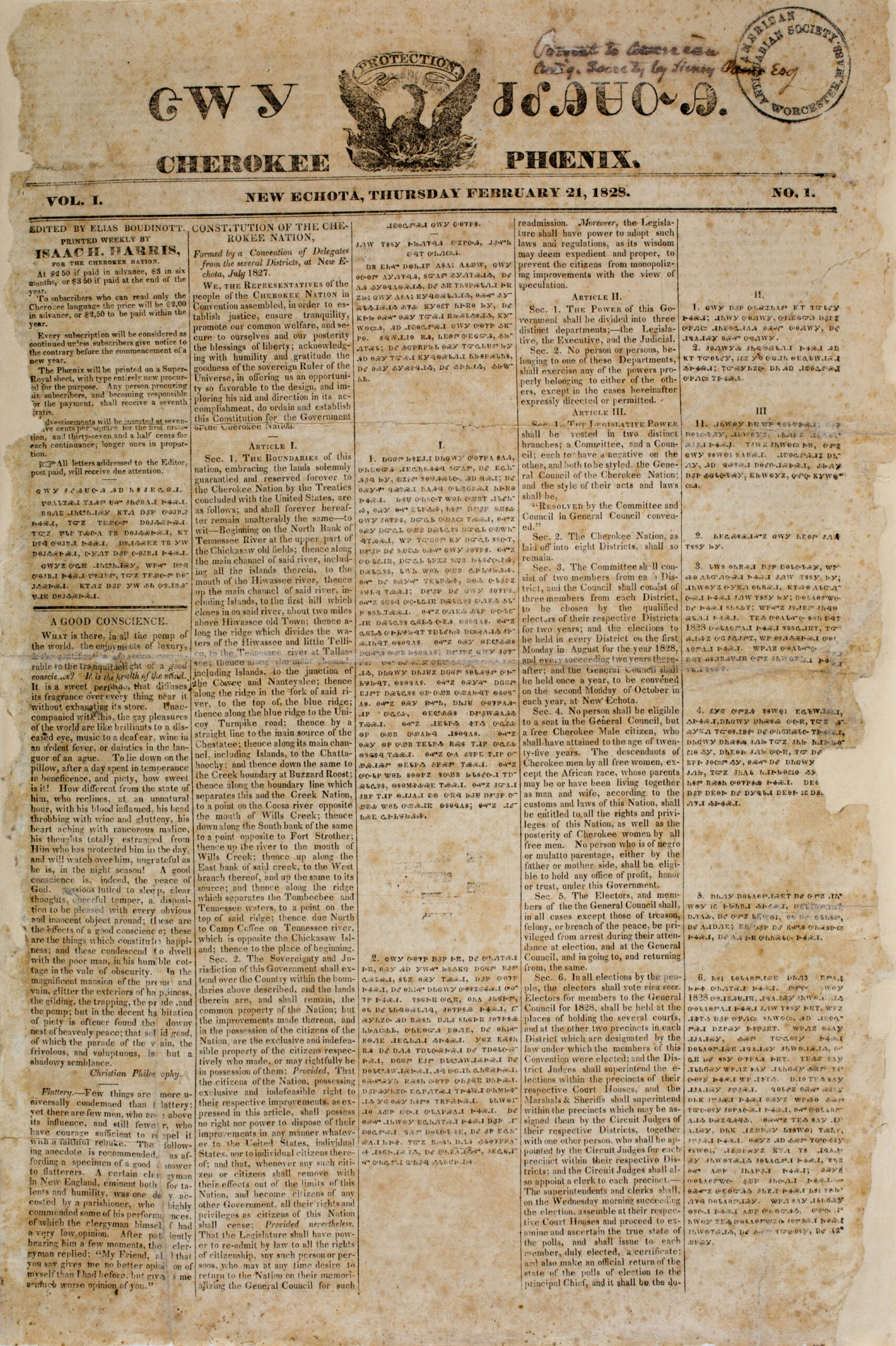
The Phoenix carried reports from the U.S. Congress, anti-removal arguments, treaty texts, and the case law that would become Cherokee Nation v. Georgia and Worcester v. Georgia. It was the first newspaper produced by Native Americans in the United States and the first bilingual newspaper of any kind in the country.
The Cherokee Nation was already in the fight that Crockett would join, late, from the other side of the floor.
By the spring of 1830, Andrew Jackson had bundled the Cherokee question, the Creek question, the Choctaw and Chickasaw questions, and pushed the whole thing through the Senate as a single bill. S. 102, the Indian Removal Bill, passed the Senate on April 24, 1830, twenty-eight votes to nineteen.
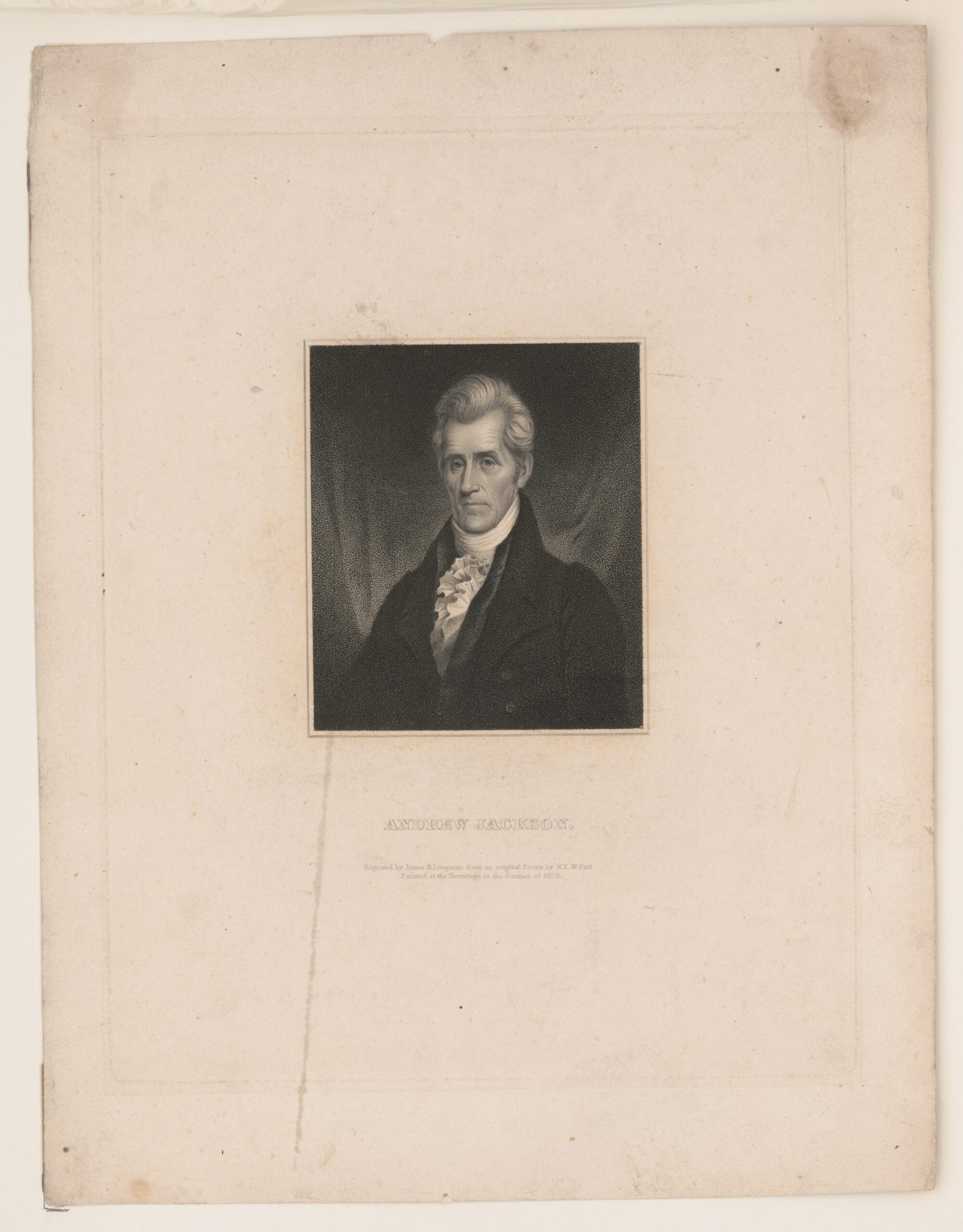
The House debate dragged through May. On Wednesday, May 19, in the Committee of the Whole, after the Massachusetts congressman Isaac Bates had spoken against the bill for two and a half hours, the National Journal reported the next morning that “Mr. CROCKET then rose and stated his determination to vote against the bill.”
What followed was the only floor remarks of Crockett’s congressional service that we have in something close to his own words. They were not entered in the Register of Debates.
They survive because they were printed within months as part of a Perkins and Marvin anthology in Boston, and reprinted in the Cherokee Phoenix on July 3, 1830. The text we read is the version Crockett, or his House messmate Thomas Chilton, who often did Crockett’s writing, prepared for the press. The Crockett biographers James Shackford and Michael Lofaro both treat Chilton as the likely polisher of the printed prose.
So this is the speech as it went into the public record, not a stenographic transcript.
In the printed version of his remarks, Crockett told the House this:
He had his constituents to settle with, he was aware; and should like to please them as well as other gentlemen; but he had also a settlement to make at the bar of his God; and what his conscience dictated to be just and right he would do, be the consequences what they might.
He explained his objections in legal terms before he reached the moral ones. The bill placed half a million dollars in the Executive’s hands, with no oversight by Congress. It departed from every prior dealing the United States had had with the Indian nations. And it ignored the treaties already in force.
He had always viewed the native Indian tribes of this country as a sovereign people. He believed they had been recognised as such from the very foundation of this government, and the United States were bound by treaty to protect them; it was their duty to do so.
He turned to his own district. Four counties along his border touched Chickasaw country. He knew the families. Nothing, he said, could induce him to vote to drive them west of the Mississippi.
And then he spoke about the Cherokee:
He knew personally that a part of the tribe of the Cherokees were unwilling to go. When the proposal was made to them, they said, “No; we will take death here at our homes. Let them come and tomahawk us here at home: we are willing to die, but never to remove.” He had heard them use this language.
The closing of the printed speech is the line that got Crockett his nineteenth-century reputation for stubbornness:
If he should be the only member of that House who voted against the bill, and the only man in the United States who disapproved it, he would still vote against it; and it would be matter of rejoicing to him till the day he died, that he had given the vote.
The vote came one week later.
On Wednesday, May 26, 1830, the bill came up for third reading.
The procedural fight was brutal. Tied votes broke the previous question motion back and forth. The Speaker, Andrew Stevenson of Virginia, cast the deciding vote in favor of the administration when the chamber split 93-93. The Hemphill commission substitute, which would have sent investigators to the Indian nations before any forced exchange, was set aside.
Then the South Carolina congressman George McDuffie rose and demanded a vote. He told the House that Georgia would not back down, and that if Congress refused to act, “the guilt of blood may rest upon us.”
The House passed S. 102 on third reading, 102 yeas to 97 nays. The Tennessee delegation voted yea almost in unison: John Bell, John Blair, Cave Johnson, James K. Polk, James Standifer, Pryor Lea, Robert Desha. The only Tennessean in the nay column was Crockett.
The next day, Jackson vetoed Henry Clay’s Maysville Road bill. The day after that, May 28, 1830, he signed the Indian Removal Act. The three acts of that week, the House passage, the Maysville veto, and the signed Removal law, sealed Crockett’s break with the administration.
The consequences Crockett did not stop
It is tempting to write the rest of the story with Crockett at the center. He is not at the center. He cast one vote, lost, and went home.
In March 1832, the Supreme Court decided Worcester v. Georgia. Samuel Worcester was a Vermont missionary working with the Cherokee at Brainerd, Tennessee. Georgia had arrested him under a state law requiring whites on Cherokee land to take a loyalty oath to the state.
The Marshall Court vacated the conviction and held the Georgia law unconstitutional. Chief Justice Marshall wrote that the Cherokee Nation was “a distinct community, occupying its own territory, with boundaries accurately described, in which the laws of Georgia can have no force, and which the citizens of Georgia have no right to enter, but with the assent of the Cherokees themselves.”
It was a sweeping vindication of Cherokee sovereignty. Georgia ignored it. Jackson did not enforce it.
There is a famous quote here. You may have read it: “John Marshall has made his decision, now let him enforce it.”
Jackson did not say that. The line first appeared in the first volume of Horace Greeley’s The American Conflict, published in 1864, almost two decades after Jackson’s death. Jackson’s actual private correspondence in 1832 said something less swaggering and more honest about federal power. The Court’s opinion, he wrote, was “still born” because the Court could not “coerce Georgia to yield to its mandate.”
The result was the same. The decision did not protect the Cherokee Nation. Georgia kept arresting, kept seizing, kept surveying.
In December 1835, a minority faction of Cherokee called the Treaty Party signed a removal treaty at New Echota. The signatories included Major Ridge, his son John Ridge, and Elias Boudinot, the former editor of the Phoenix.
Principal Chief John Ross was not present and did not sign. The Cherokee National Council had explicitly rejected the proposed terms two months earlier. Ross drew up a petition of protest with nearly sixteen thousand Cherokee signatures and personally delivered it to Congress in the spring of 1838. The Senate ratified the Treaty of New Echota anyway, by a single vote in May 1836.
The forced removal began in the summer of 1838 under General Winfield Scott.
Of the roughly sixteen thousand Cherokee marched west, the demographer Russell Thornton estimates that more than four thousand died directly from the removal itself, with thousands of additional lives lost over the following decades when his model accounts for the births that did not occur. Other historians give ranges from four thousand to eight thousand direct deaths. The lower figure is the floor.
On June 22, 1839, in the new Cherokee lands west of the Mississippi, members of the Ross faction killed Major Ridge in Arkansas, his son John Ridge at Honey Creek, and Elias Boudinot at Park Hill in present-day Oklahoma. They were marked for death by Cherokee law for signing the Treaty of New Echota without the Nation’s authority. The civil war that followed lasted years.
Crockett’s one vote did not stop this. It was not meant to.
He told the House on May 19, 1830 that he expected to stand alone, and he stood alone within his own delegation. The Cherokee Nation had been fighting the United States for years before he opposed Jackson on the floor, and continued to fight it for years after he left the House.
The reason to put Crockett’s vote in the record is not because it changed the outcome. It did not. The reason is that he was the one Tennessean willing to put his career on the line for a no vote, and his colleagues were not.
The price he paid
Crockett went home to West Tennessee in the summer of 1830 to find a re-election fight already organized against him. The Jackson administration funded an opponent. The Tennessee newspapers turned on him. In the August 1831 election, William Fitzgerald beat him narrowly.
He came back in 1833.
With Whig money and a tour of the Northeast to promote his autobiography and his future, Crockett was being floated as a possible Whig candidate for the presidency.
The first publication was A Narrative of the Life of David Crockett, of the State of Tennessee, written in collaboration with Thomas Chilton and published in 1834 by E. L. Carey and A. Hart of Philadelphia.
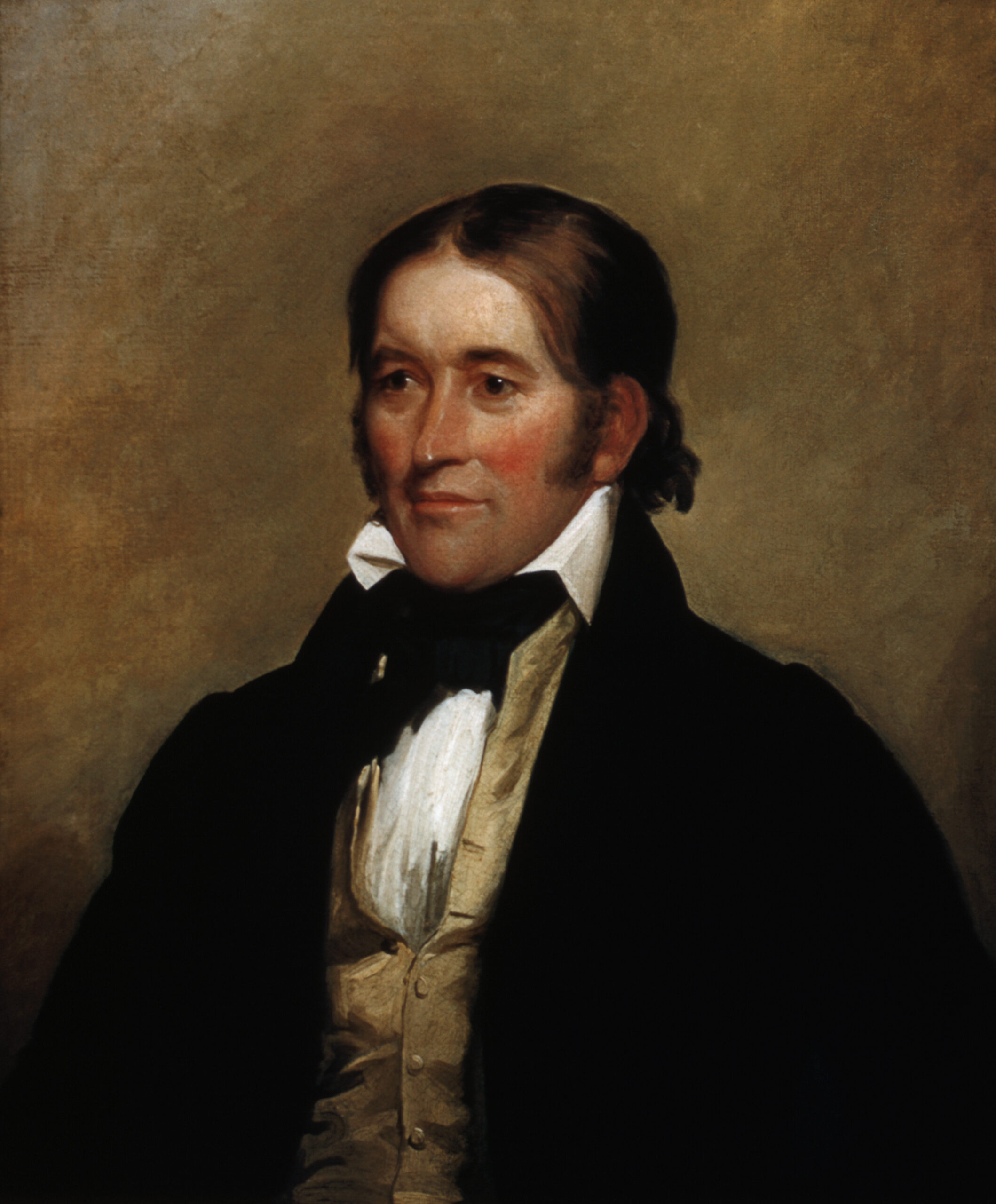
He sat for Chester Harding in Boston, in a dark suit and white cravat, for the portrait the National Portrait Gallery hangs today. The face is the one Crockett wanted on the book jacket. No fur, no rifle, no dogs.
Then he toured Philadelphia, New York, and Boston in the spring of 1834. He produced a second book, An Account of Col. Crockett’s Tour to the North and Down East, published the next year. By the time of the December 1833 Hackett bow at the Washington Theater, the celebrity engine was running so fast that the man and his caricature could share a building.
The celebrity did not translate into a fourth term. In August 1835, Crockett lost his seat by 252 votes to Adam Huntsman, a peg-legged lawyer the Jackson men ran against him. He had been outspent, outflanked, and outmaneuvered in the district he had once won by walking it on foot.
The line he gave at a farewell drinking party at the Union Hotel bar in Memphis on November 1, 1835 is the line still quoted on highway billboards in Texas today. It was reported by men who were there rather than recorded on paper. “Since you have chosen to elect a man with a timber toe to succeed me, you may all go to hell, and I will go to Texas.”
The version we have is the version his companions remembered. Tom Chilton was not around to polish it for the press this time.
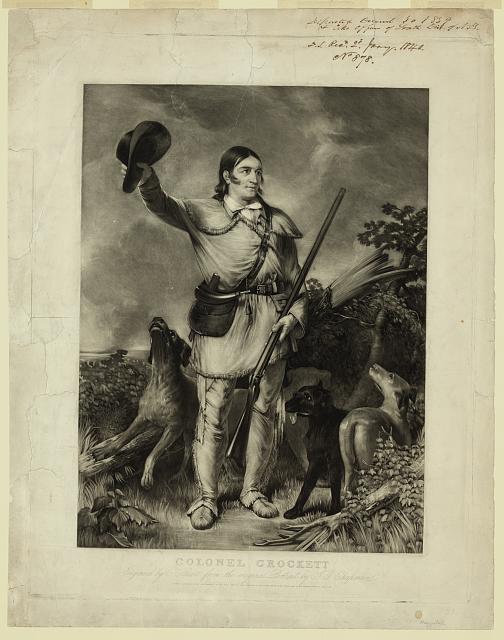
Within four months Crockett was dead at the Alamo, March 6, 1836. And within a year the dime novels and the woodcuts had begun manufacturing the coonskin-cap frontiersman the Harding portrait does not show.
A note on a speech he did not give
You may have read another Crockett speech. It is called “Not Yours to Give.” It tells a story about Crockett refusing a charity appropriation for the widow of a naval officer after a chastening encounter with a constituent named Horatio Bunce, who explains that the federal government has no constitutional authority to be generous with money it does not own.
Libertarian websites still circulate it. It is not real.
The story was published in January 1867 in Harper’s Magazine, under the pseudonym James J. Bethune, by a writer named Edward S. Ellis. Ellis was born in 1840, four years after Crockett died at the Alamo.
The Georgetown fire he places at the center of the story was an Alexandria fire, and the relevant House vote happened before Crockett took his seat. The Crockett scholar James R. Boylston published the definitive debunking in 2004.
There is no contemporary record of any such speech, because Crockett never gave it.
The Indian Removal vote is the speech we have. It is in the printed record.
The text Crockett, or Chilton on his behalf, prepared for the public after May 19, 1830 is what survives, and it has the weight of a man who knew the vote would end his career. The modern compendium of Crockett’s congressional record is James R. Boylston and Allen J. Wiener’s David Crockett in Congress (2009), the annotated source where most of the verifiable speeches and votes live in one place.
It cost him his seat. He gave it.
What sits on the corner today
Mrs. Ball’s boarding house is gone. The Washington Theater is gone. The Indian Queen across the avenue, where Crockett moved up to during his third term, is gone, although a fragment of its facade survived until 1984. The 1830s shape of Pennsylvania Avenue is buried under federal buildings.
Crockett’s name is on a state park in Tennessee, a national forest, a Disney miniseries, and a U.S. Navy missile. His one floor speech in Congress is in a Boston pamphlet from 1830. The Cherokee Phoenix reprinted it on July 3 of the same year, four columns down from a notice for flour.
Until you go looking, you would not know it is there.
The vote is the part of him that matters.