Walk past 1111 Pennsylvania Avenue today and you’ll see a postmodern office building wrapped in a glass-and-stone skin, leased end to end by the law firm of Morgan, Lewis & Bockius. It looks like every other K Street tower in the District. It is not.
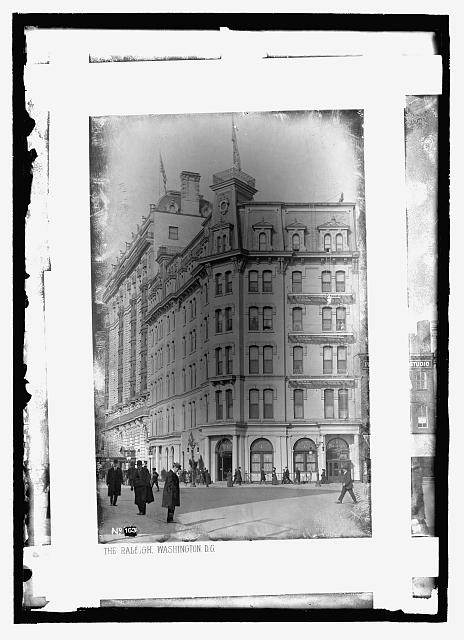
For seventy-one years, that corner held one of the grandest hotels in Washington. The Raleigh stood across the avenue from the Old Post Office, eventually rose thirteen stories from the curb, and ran a top-floor ballroom that hosted everyone from cabinet secretaries to Buddy Holly. Then, in 1964, a wrecking crew took it down.
This is the story of the building that used to be there.
Before the Raleigh: A Corner That Could Not Stand Still
The northeast corner of 12th and Pennsylvania has never sat still. The first building on the lot was the Fountain Inn, thrown up in 1815 after British troops finished burning Washington the year before. It lasted thirty-two years.
In 1847 the Fuller Hotel replaced it. The Fuller was renamed the Kirkwood House, and that is where Andrew Johnson was sleeping on the night of April 14, 1865, when Lincoln was shot a few blocks away at Ford’s Theatre. The next morning, on the third floor of the Kirkwood, Johnson took the oath of office and became president.
Booth’s plot had a co-conspirator assigned to kill Johnson too. George Atzerodt rented a room at the Kirkwood, lost his nerve, drank himself stupid at a nearby bar, and never went up the stairs.
The Kirkwood came down in 1875.
In its place rose the Shepherd Centennial Building, a seven-story Second Empire pile timed to the country’s hundredth birthday. The U.S. Pension Office took the upper floors until 1885. The Palais Royal department store took the Pennsylvania Avenue ground floor in 1877 and stayed for sixteen years. By the early 1890s the office floors were emptying out, and the owners decided to try something different.
1893: A Hotel Inside an Office Building
In 1893, Washington architect Leon E. Dessez was hired to convert the Shepherd Centennial Building into a hotel. They named it the Raleigh.
Dessez was a DC architect with a quiet, accomplished portfolio. He designed the Vice President’s House at Number One Observatory Circle. He designed the Stoddert apartment building in Georgetown, the Century Building at 5th and D, which was Washington’s first office building built entirely of reinforced concrete, and a string of Chevy Chase houses, where he was the community’s first resident. The Raleigh conversion was not flashy. He took the office floors, broke up the corridors, and rebuilt them as guest rooms.
The hotel filled up. By 1897 the demand was strong enough that three more floors went on top of the existing structure.
1898: Hardenbergh Arrives
The next move changed the Raleigh’s class.
In 1898 the owners brought in Henry Janeway Hardenbergh of New York. By that point Hardenbergh had already designed the Dakota Apartments on Central Park West. He had built the Waldorf in Manhattan in 1893 and the Astoria next door in 1897. He would go on to design the Plaza Hotel in 1907 and the Copley Plaza in Boston. He was, as one architectural history put it, “America’s premier architect of grand hotels.”
He was also at work, around the same time, on the Willard Hotel renovation a few blocks west on Pennsylvania Avenue. The Willard and the Raleigh became architectural cousins, both in his hand. We’ve covered the Willard Hotel’s own near-death and $73 million rescue elsewhere on the site.
Hardenbergh’s 1898 addition was a major Beaux-Arts block planted on 12th Street, just north of the original 1893 hotel. It was twelve stories. It dwarfed the older Second Empire portion to the south. He came back in 1905 and enlarged it further.
The Raleigh now had two architectural personalities crammed into one address: the older Shepherd Centennial leftovers on the corner, and Hardenbergh’s confident new Beaux-Arts pile reaching up the side street.
That mismatch was not going to last.
1910: Congress Raises the Roof
In 1910 the Raleigh’s owners wanted to tear down the original 1893 portion and replace it with something taller. The plan was a thirteen-story showpiece on Pennsylvania Avenue, matching the Hardenbergh tower next door.
There was a problem. Federal law capped buildings on Pennsylvania Avenue at 130 feet. The proposed new Raleigh wanted 160.
So Congress changed the law.
That is one of the small, telling facts of the Raleigh story. Congress raised the Pennsylvania Avenue height limit from 130 feet to 160 feet in 1910 specifically to accommodate the new Raleigh Hotel. James Goode documents this in Capital Losses, the standard reference on Washington’s destroyed buildings. A single hotel project moved a federal building code. (Goode also catalogs the lost hotels of Pennsylvania Avenue down at 6th and 3rd Streets: the National, Brown’s Indian Queen, and the Southern, all razed before the Raleigh came down.)
The original 1876 Shepherd Centennial portion came down in 1911. Hardenbergh designed the replacement.
The 1911 Hotel: What It Looked Like
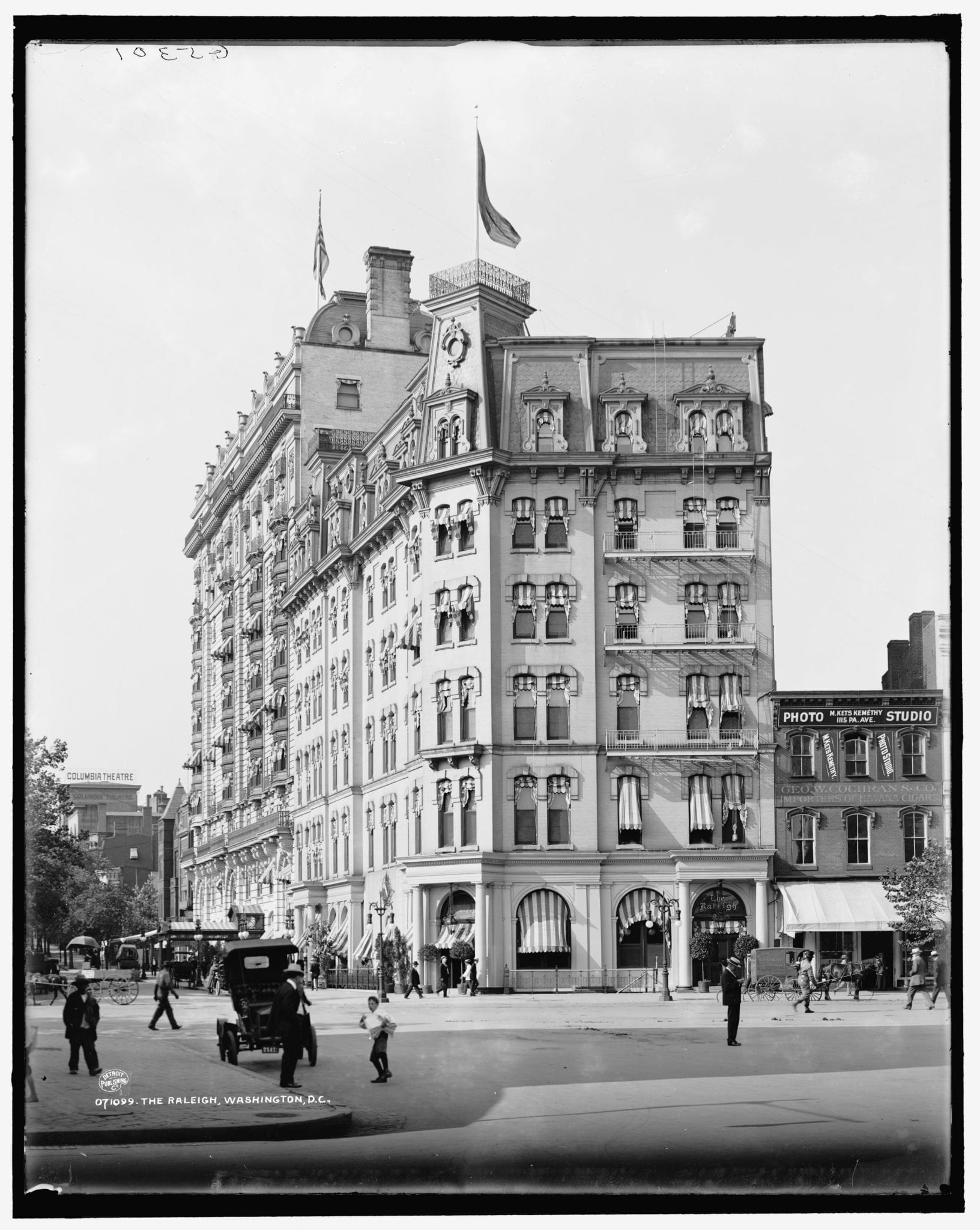
The new building was thirteen stories of rusticated brick over a white limestone base, dressed with terra cotta. The two stories above the upper balustrade and the central dome were pure Hardenbergh, the same Beaux-Arts vocabulary he was using uptown in New York.
The April 1913 issue of Architectural Review ran the floor plans. The basement, the office floor, the sixth floor, the tenth floor. The kitchen was on the ground floor, not buried in the basement, which was unusual for the period and which made for shorter trips to the dining room.
The top floor held a gold-and-white ballroom. That ballroom would matter, decades later, more than the architects who built it ever expected.
The Prime: A Mecca for Pennsylvania Avenue
For the first half of the twentieth century the Raleigh was, alongside the Willard, one of the two grandest hotels on Pennsylvania Avenue. It sat directly across the street from the Old Post Office Building. Diplomats, lobbyists, congressmen, theater producers, and visiting performers moved through its lobby. The hotel was, in the language of one period account, “a Mecca for patrons of the performing arts.”
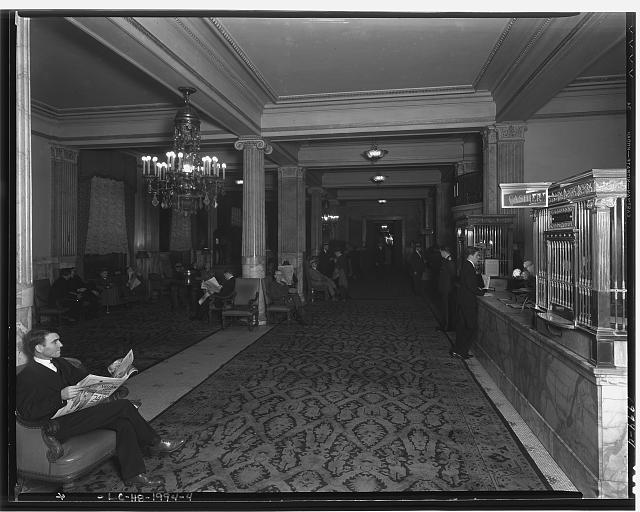
The lobby was deep and dark and quiet. Marble columns. Heavy chairs. A man in a suit reading a newspaper while a bellhop walked through the frame.
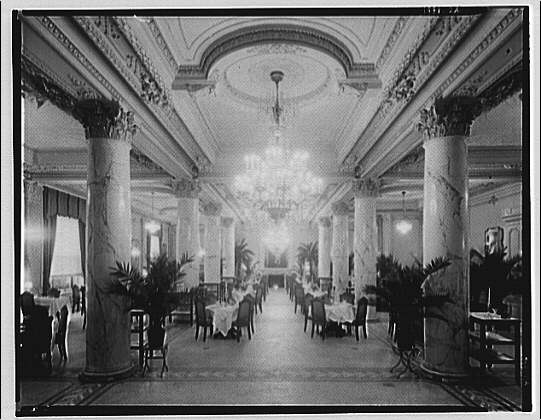
The dining rooms were where the hotel’s reputation lived. Crystal chandeliers, columned bays, white linen, professional service. The Pall Mall Room, on the ground floor, became one of the city’s signature night spots in the 1940s and 1950s. People still collect the original Pall Mall Room menus today.
The longest-running figure in the hotel’s prime was its manager, Curt C. Schiffeler. Schiffeler ran the Raleigh from 1936 until his retirement in 1954. Eighteen years. He cultivated a warm, almost informal hospitality that regulars liked, and the hotel kept a loyal clientele right through World War II.
Then the Mayflower happened.
The Mayflower Steals the Show
The Mayflower opened uptown on Connecticut Avenue in 1925. By the 1930s it had eclipsed the Raleigh as Washington’s premier hotel for inaugurations, banquets, and out-of-town money. We’ve written about the Mayflower’s own colorful history, including its long-running role in DC scandal and politics.
The Raleigh tried to keep up. There was a major interior renovation in 1936. The Pall Mall Room was renovated and pushed harder as a draw. But the building itself was now forty-three years old at the corner, and twenty-five years old in its 1911 main hall, and Pennsylvania Avenue itself was sliding into a postwar funk that nobody on the Hill seemed willing to address.
By the 1950s the avenue was, according to nearly every account from the period, a depressed strip of pawnshops, dingy storefronts, and aging buildings. President Eisenhower’s inaugural drive in 1953 passed through it. Kennedy’s drive in January 1961 passed through it too, and Kennedy is the one who decided to fix it.
The Raleigh, sitting right in the middle of it, was running out of guests.
1956: A Top-Floor Ballroom Becomes Television
The strangest second life the Raleigh had was as a TV studio.
On July 22, 1956, WTTG, the Metropolitan Broadcasting station that became Channel 5, launched a teen dance show called Milt Grant’s Record Hop. The host was Milton Grant, a Washington broadcaster then working at WOL radio, which simulcast the new TV show’s audio. The set was the gold-and-white ballroom on the top floor of the Raleigh Hotel.
Six days a week. Weekday afternoons at five o’clock, Saturdays at noon. By April 1957 the show had been renamed The Milt Grant Show. By 1958 it was the highest-rated local program in Washington. When ABC put American Bandstand on the network in 1957 opposite Grant in the Washington market, Grant won the head-to-head ratings.
Grant opened every show with the same call and response.
“Hi, kids!”
“Hi, Milt.”
“What’s our favorite drink?”
“Pepsi!”
Pepsi was the lead advertiser. Grant produced the show and sold the ads himself. At one point his contract had to be renegotiated because, as a 1988 Regardie’s profile reported, he was making more money than John Kluge, the chief executive of Metropolitan Broadcasting, the station’s owner.
The guest list, week after week, was the rock and roll era arriving in real time. Buddy Holly. Chuck Berry. Nat King Cole. Bobby Darin. Ike & Tina Turner. Harry Belafonte. Frankie Avalon. Fabian. Link Wray. A young Charlie Daniels with his band the Jaguars. They came to Washington and they came up to the top floor of the Raleigh and they performed in front of teenagers who had ridden streetcars and buses downtown.
One of those teenagers, a “semiregular” on the floor, was a high school kid named Carl Bernstein. He would go on to crack Watergate.
The show was not innocent of its era. Black dancers were only allowed on the floor on Tuesdays, and they were never allowed to dance with white partners. Years later WOOK-TV, a UHF station serving the Black community, would launch Teenarama Dance Party to fill that gap.
Grant kept the show going at the Raleigh ballroom until WTTG cancelled it on April 15, 1961. The cancellation was a mystery to media observers and to the high schoolers who picketed the Washington Post building hoping to bring it back. It did not come back.
The ballroom went quiet.
The Avenue Decides Against It
By the time The Milt Grant Show signed off, John F. Kennedy had been in office for three months. Riding from the Capitol to the White House on inauguration day, he had looked at Pennsylvania Avenue out the window of his limousine and decided the route was an embarrassment to the country.
He created the President’s Council on Pennsylvania Avenue and put Nathaniel Owings of Skidmore, Owings & Merrill in charge. The council’s 1964 report called for the wholesale demolition of buildings on the north side of Pennsylvania Avenue, the Raleigh’s side, replaced with massive modern structures meant to dignify the ceremonial route between Capitol and White House.
Kennedy never read the final report. He was assassinated in November of 1963, and the report was published the following spring. We’ve written about Kennedy’s lost 1964 plan to remake Pennsylvania Avenue, with its tunnels and its proposed National Square, in a separate post. Most of it never happened. The piece that did happen was the demolition.
The Raleigh closed in 1963. The furnishings were sold off in a public auction. In 1964, the wrecking crews moved in.
What Replaced It
By 1965 a Philadelphia developer named Jerry Wolman had bought the lot. Wolman was already famous for owning the Philadelphia Eagles. He proposed a twelve-story office building, and the District zoning officials made him pull the Pennsylvania Avenue facade back fifty feet from the curb to comply with the new redevelopment plan.
In exchange for the lost square footage, they let him cantilever the building thirty feet over the 12th Street sidewalk. The architect was Edmund W. Dreyfuss & Associates. The style was Brutalist. The building opened in 1968 and was named the Presidential Building. The original address was 415 12th Street NW. The DC public schools leased seven of its floors.
That building is still standing, but you would not recognize it. Between 2000 and 2002, a $40 million renovation by Shalom Baranes Associates ripped off the Brutalist concrete and wrapped the structure in a new postmodern facade. They added two stories. They moved the front entrance from 12th Street to Pennsylvania Avenue, and they changed the address to 1111 Pennsylvania Avenue NW.
The 1974 Pennsylvania Avenue Development Corporation legislation, which we’ve covered in a separate post on the 1974 blueprint for the avenue’s revitalization, helped pay for the new look.
The law firm of Morgan, Lewis & Bockius took the entire building in 2002 and renewed the lease in 2014.
What Remains
A few blocks east, the Hotel Harrington, which opened in 1914 and held on at 11th and E Streets NW until it finally closed in 2023, outlived the Raleigh by more than half a century. The Willard, just up Pennsylvania Avenue, was nearly demolished too, sat boarded up for eighteen years in the 1970s and 1980s, and was rescued in a $73 million renovation. The Mayflower is still open on Connecticut Avenue.
The Raleigh got no rescue.
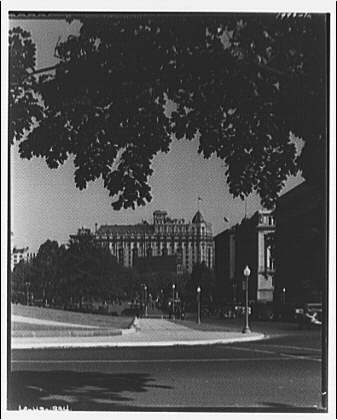
There is no plaque at the corner of 12th and Pennsylvania. The block is a glass and stone law firm now. If you stand on the south side of the avenue, in front of the Old Post Office, and you look across, you can roughly trace where Hardenbergh’s terra cotta and limestone used to climb.
A reader once commented that he installed some of the Raleigh’s salvaged woodwork in a home in Somerset, Maryland. Somewhere out in the suburbs, a few rooms still hold a piece of that ballroom.
The rest of it is gone.