
The Army and Navy Club has been on the corner of 17th and I Streets NW since 1891. That is 135 years on the same lot.
The facade you see today is from 1912. Almost everything behind it was rebuilt in 1987.
That gap, the survival of a stone shell wrapped around a 1980s steel frame, is the story of this building.
The clubhouse that started in a rented room
A handful of Army and Navy officers founded the club in 1885, calling it the Army and Navy Club of Washington. The original rooms were rented. There was no clubhouse.
By 1891 the membership had grown enough to put up a building of its own. The club acquired the lot at 17th and I, on the south side of what had recently been laid out as Farragut Square, and moved into a purpose-built clubhouse there.
That first clubhouse on the corner is the one in the Detroit Publishing photograph below.
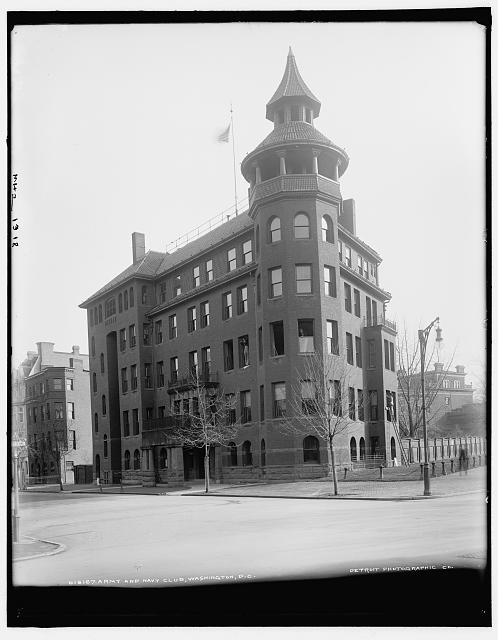
It is five stories of red brick with a fat corner turret and a slate roof, late-Victorian to a fault. You can see the older row of townhouses still standing to the left, the new electric streetlights, and that the streets are unpaved.
It lasted about twenty years.
The architect question and the 1912 building
By the early 1910s the membership had outgrown the Victorian clubhouse. The club commissioned a new building on the same lot. It opened on August 9, 1912 and is the building that stands there today.
Who designed it is a question with two answers, depending on which archive you read.
The DC Preservation League’s record for the building lists the architect as Albert L. Harris, alone. Wikipedia and SAH ARCHIPEDIA both credit Hornblower & Marshall, with Harris supervising the construction.
Both are pointing at the same fact pattern from different angles.
Harris had been a junior architect at Hornblower & Marshall for about seven years. He supervised construction on the new clubhouse, and in 1911, while the work was underway, he was made a partner in the firm. The building opened the next year.
So you can credit the design to the firm that drew it. You can credit it to the architect on site who became a partner before the doors opened. Both are right. The contested attribution is itself a footnote worth keeping.
What got built is a six-story neoclassical block in pale brick and limestone trim, with a rusticated base, arched second-floor windows under iron balconies, and a heavy cornice up top. It is a serious building, dialed deliberately back from the more theatrical Victorian one it replaced.
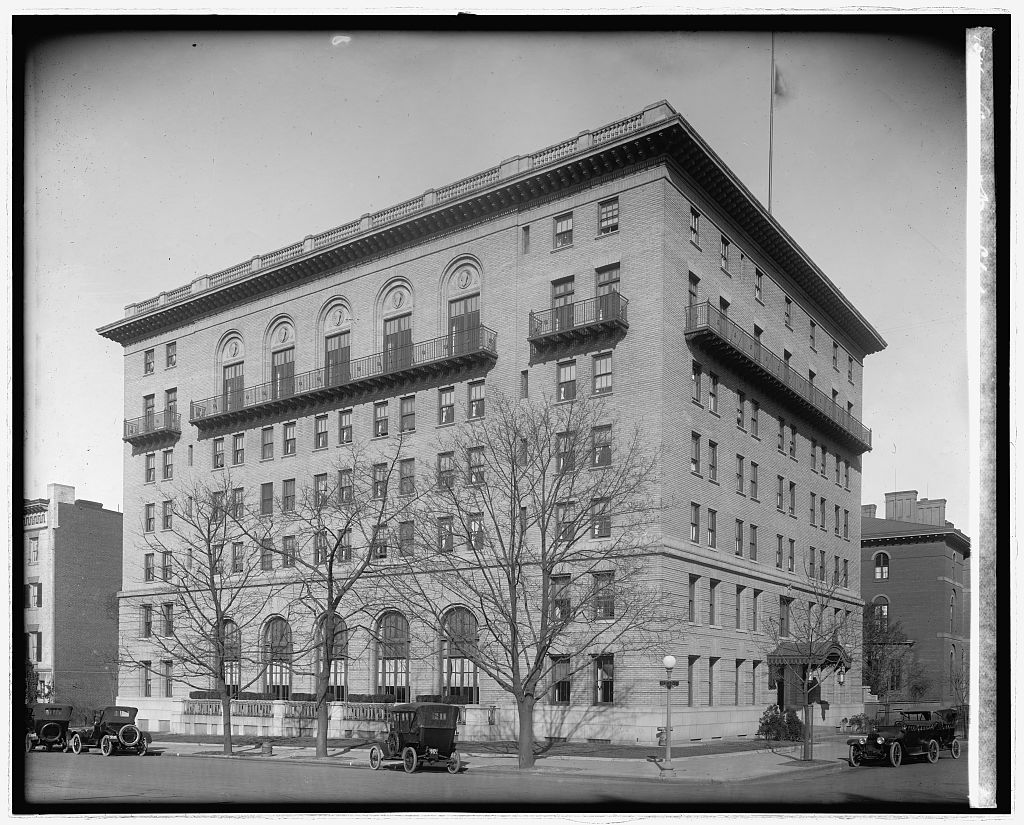
The National Photo Company photographed it from the corner not long after it opened. Two early automobiles are parked at the curb. The trees on I Street are still saplings.
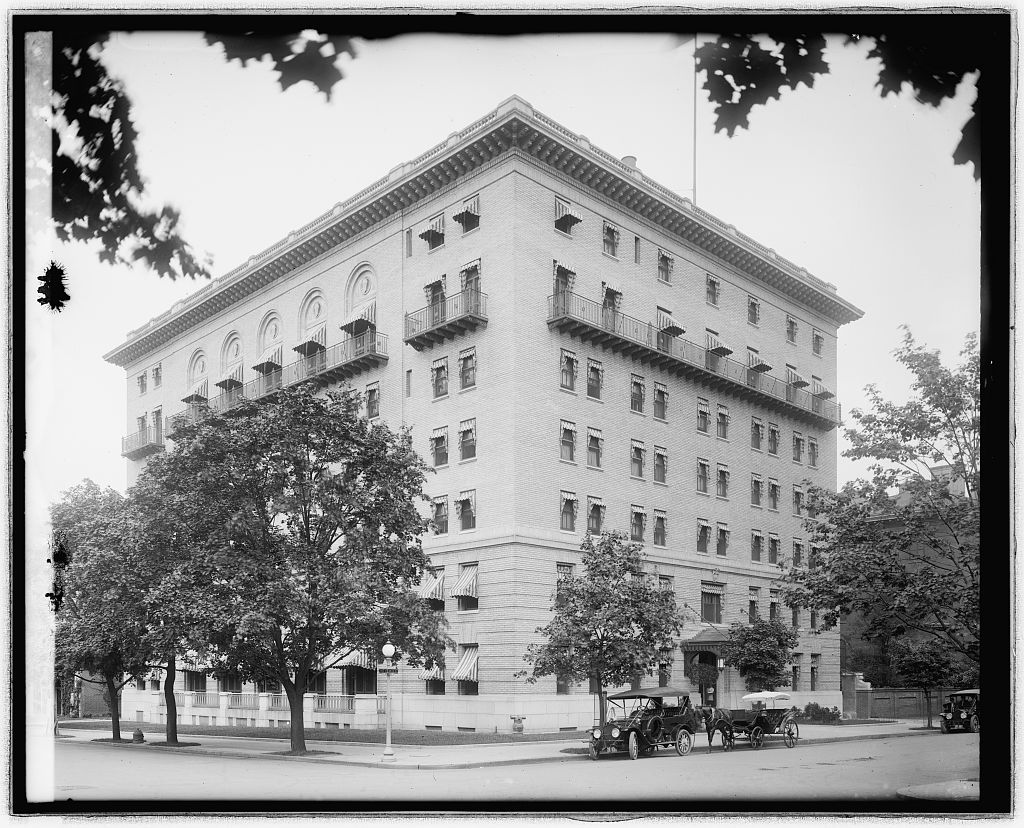
The club in the world wars
The 1912 building was an officers’ club, and in two world wars it functioned as one.
During World War I the War Department set up the Commission on Training Camp Activities, a body charged with running morale, sanitation, and (more honestly) anti-prostitution and anti-alcohol programs around the new training cantonments. In 1918 the commission gathered at the club for a group portrait. The National Photo Company shot the picture inside one of the paneled rooms.
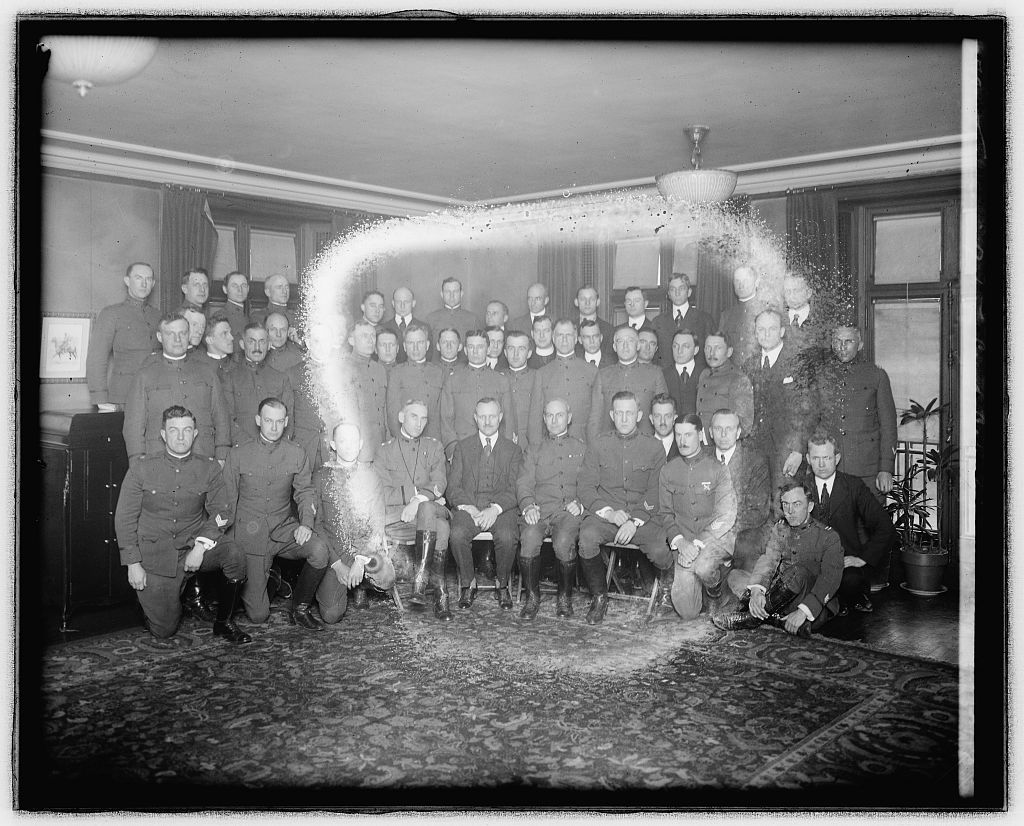
The glass negative is scratched and there is a long arc of damage running across it. You can still pick out the rug, the chandelier, and a few dozen uniformed officers and civilians staring back at the camera.
The club hosted that kind of thing constantly, and in December 1936 Harris & Ewing captured a quieter moment. Brigadier General David L. Brainard, then 80 years old, was honored at the club on his birthday. He was the last survivor of the 1881 Greely Arctic Expedition, an ill-fated military mission to the high Arctic that ended with most of the party dead of starvation and exposure on Cape Sabine. Brainard had been one of six who came home.
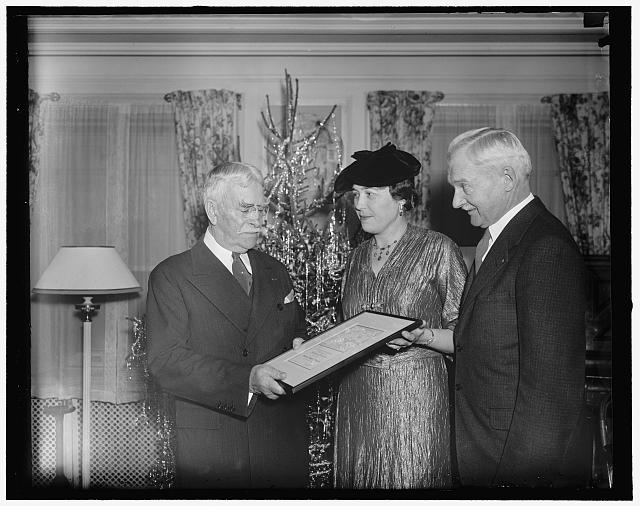
He stood at the club that night between two presenters and accepted a framed scroll. A Christmas tree was in the window behind him.
Through World War II the club functioned the same way: meals for officers on leave, lodging for transient brass, the address you put on your card when you came through Washington.
The 1987 gut renovation
By the early 1980s the 1912 building was tired.
The club decided to gut it. Not tear it down. Gut it. The exterior walls would stay. The interior, the floor plates, the mechanical systems, and the back of the building would all be removed and rebuilt, and a new high-rise wing would be added behind the historic facade.
The architect for the project was Shalom Baranes, the DC preservation specialist whose firm has done a lot of this kind of work in the city.
The dedication was supposed to bring President Reagan to the club. A heavy snowstorm hit Washington on the planned day and the ceremony was scrubbed. Reagan did not make it. The Washington Post, the Los Angeles Times, and the New York Times all covered the project, with the LAT and NYT both running 1988 pieces on the unusual scope of the renovation, including the preserved chandeliers and a facade kept intact while the building behind it came down.
What sat on the lot after that work is technically a 1987 building wearing a 1912 face.
The building today
Walk past it now and the trick is invisible. The pale brick, the arched second-floor windows, the iron balconies, the cornice, all of that is the 1912 work. The high-rise wing wraps behind it and is set back enough not to fight the historic block.
Inside, almost nothing is original except those rescued chandeliers and the bones of the room plan. The club itself has been continuously in operation since 1885, which is the part that makes the lot interesting. The institution is older than the facade. The facade is older than the building.
I think about that when I walk through Farragut Square. The square itself looked very different in 1919 than it does now. The Army and Navy Club is the one fixed point on the corner, even if what counts as “the Army and Navy Club” depends on which slice of time you cut.
The Cairo Hotel, eight blocks up 17th and a turn east at Q Street, went through a similar period of crisis and reinvention. The Cairo got saved by being made into apartments. The Army and Navy Club got saved by being gutted from the inside and rebuilt around the shell of itself. Different paths to the same outcome, which is that the corner you stand on is still legible as the corner it was a hundred years ago.
That is more than most blocks in this city can say.