
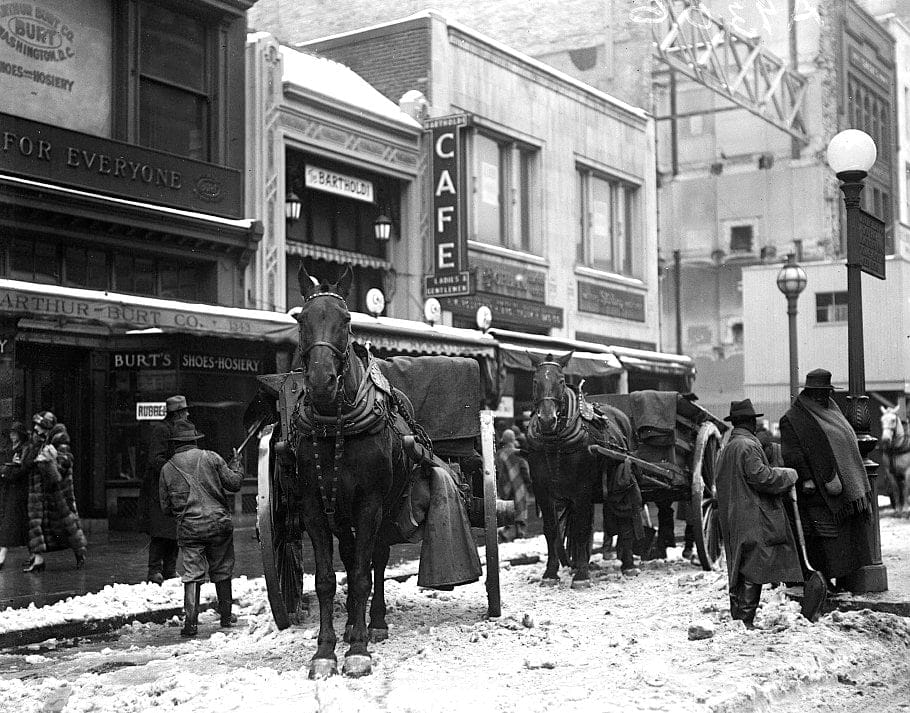
In late 1925, M. O. Eldridge tried to ban horses from Washington’s biggest streets. The order lasted about five months. It was undone by a reporter, a Missouri congressman, and a mule named Stupid.
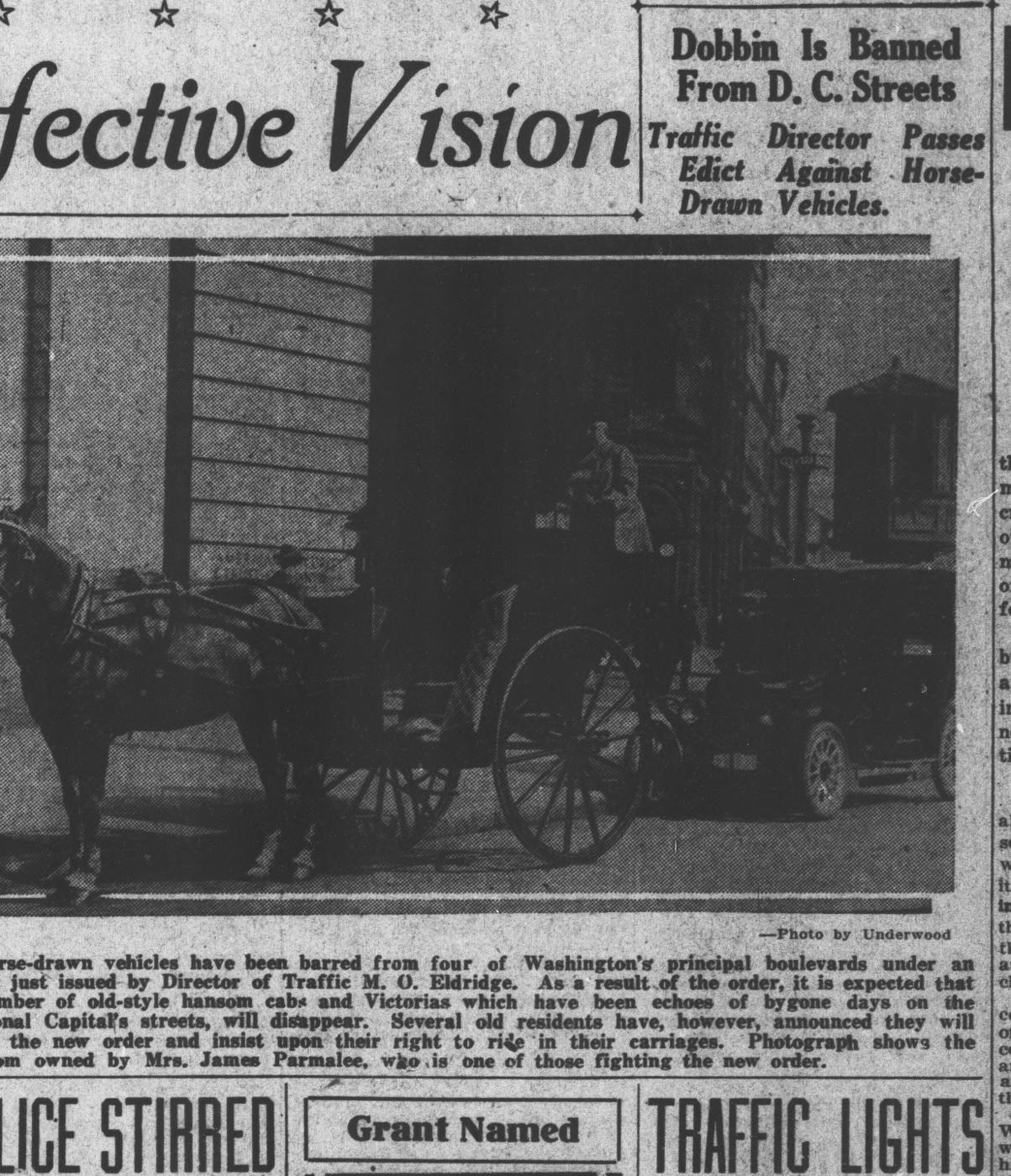
Eldridge was the District’s traffic director, and he meant it. Solid-tired trucks and horse-drawn vehicles were barred from Sixteenth Street, Massachusetts Avenue, and a handful of other principal boulevards. The Washington Times ran the news under the headline “Dobbin Is Banned From D.C. Streets.”
It did not go as Eldridge had planned.
The order
The ban was part of a broader push to modernize Washington’s traffic. The same week the order took effect, Eldridge was switching on a new automatic traffic signal system on Sixteenth Street. Red, amber, green. Stop, caution, go. The Washington Times described the inauguration as “hectic,” with limousines, taxis, and flivvers moving in sluggish streams through the new lights at Scott Circle.
And in Eldridge’s vision, the new era didn’t include horses. The hansom cabs, the Victorias, the coal wagons, the produce carts. These were congestion. They were slower, they were unpredictable, and they didn’t belong on the boulevards of a modern capital. (Worth remembering that one of the city’s lost traffic circles, Truxton Circle, was still in place at this point. The “congestion around the circles” was a real, daily problem.)
The Evening Star reported on December 9, 1925 that the regulation barred “solid tire and horse vehicle” traffic from certain streets. By December 11, the paper noted the ban had been “adopted primarily to alleviate congestion around the circles.”
The reaction was immediate.
The merchants push back
The Merchants and Manufacturers’ Association and the Commercial Vehicle Owners’ Association announced they would seek an injunction. For the city’s coal dealers, produce men, and dairy haulers, the horse and wagon weren’t relics. They were how business got done. Trucks were expensive. Not every small operator could afford one.
The Evening Star reported that the two groups were “going to apply to the courts for a restraining order to prevent the enforcement” of the rule, and that they were asking every trade organization in the city to join them.
The Washington Board of Trade took a more cautious approach. They decided to “see how the new rule worked out” before joining any legal fight.
But the merchants weren’t the only ones upset.
The society women and their carriages
Some of Washington’s wealthiest residents had kept their horse-drawn carriages long after most people switched to automobiles. Not out of necessity. Out of preference. Mrs. Henry F. Dimock, Mrs. James Parmalee, and Mrs. Arthur D. Addison all maintained fine carriages and well-bred horses on Sixteenth Street. The visual is right there in this 1890 photograph of carriages out in Rock Creek.
When the ban went into effect, they were suddenly barred from driving their own carriages on their own street.
Mrs. Dimock went to the District Building to protest in person. She was turned away. Engineer Commissioner J. Franklin Bell later told reporters, “I will see anyone who calls at my office, and if Mrs. Dimock called yesterday it was unfortunate if I was otherwise engaged.” Commissioner Cuno H. Rudolph said he hadn’t known she was there until she’d already left. Rudolph’s secretary, Harry Allman, advised her to put her case in writing.
The Washington Times ran a photograph of Mrs. Parmalee’s hansom cab with the caption: “Several old residents have, however, announced they will fight the new order and insist upon their right to ride in their carriages.”
So you had two very different groups united against the same regulation. Working-class merchants who needed their horse-drawn wagons to survive, and wealthy society women who simply preferred their carriages. That’s not a coalition you see every day.
A mule named Stupid
This is where the story gets good.
William K. Conway, a reporter for the Washington Times, decided to test the ban’s logic. The regulation prohibited “horse-drawn vehicles” from Sixteenth Street. Conway got himself a mule.
He wrote the whole thing up under his own byline in the January 6, 1926 edition of the Washington Times:
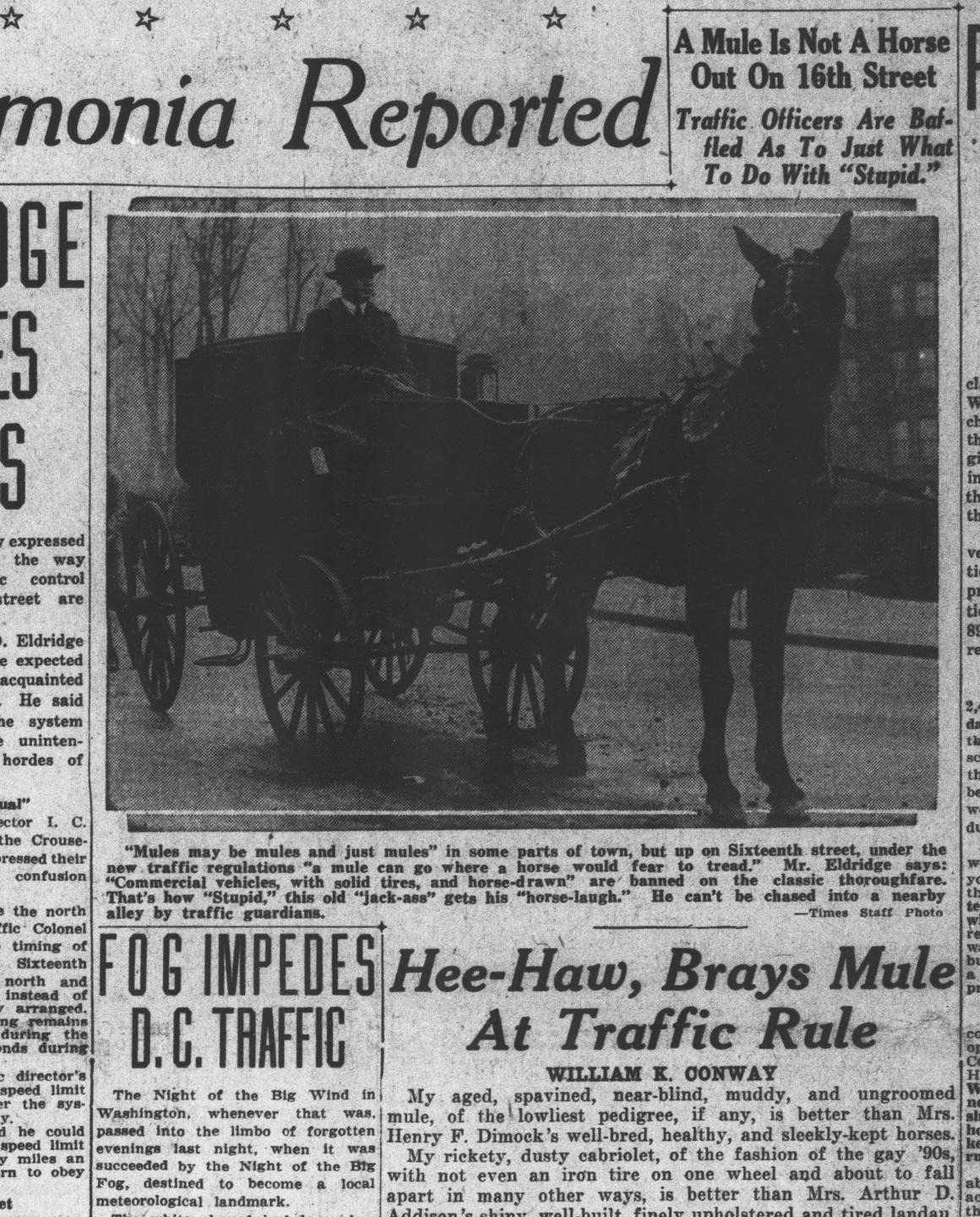
“My aged, spavined, near-blind, muddy, and ungroomed mule, of the lowliest pedigree, if any, is better than Mrs. Henry F. Dimock’s well-bred, healthy, and sleekly-kept horses. My rickety, dusty cabriolet, of the fashion of the gay ’90s, with not even an iron tire on one wheel and about to fall apart in many other ways, is better than Mrs. Arthur D. Addison’s shiny, well-built, finely upholstered and tired landau.”
“I know this because Traffic Director Eldridge and many of his representatives in the Police Department have told me so. They didn’t tell me in words. They told me by direct and unmistakable action.”
Conway and a second Times reporter, Brandon B. Woolley, took the mule (whose name was “Stupid”) up Sixteenth Street past Scott Circle in full view of traffic officials, District commissioners, the chairman of the House District Committee, and a crowd of citizens.
Traffic Lieutenant Lamb ordered them to police court. Conway refused. His argument: the rule banned horse-drawn vehicles, and a mule is not a horse. He had already confirmed this earlier in the day with Dr. John R. Mohler, chief of the Bureau of Animal Industry.
Sergeant Milton D. Smith stepped in and advised against arrest. As the Times put it, “Sergeant Smith knows a mule from a horse.”
After what Conway described as “councils of war among several groups of officials, in which the mule appeared only mildly interested,” Lieutenant Lamb gave them permission to drive wherever they pleased.
The rule had not been changed for horses. It was changed in about three minutes at Scott Circle for a lowly mule.
Congress weighs in
The mule stunt made national news. Papers from Alaska to Texas to South Carolina picked up the story. And it caught the attention of Congress.
On January 20, 1926, Representative William L. Nelson of Missouri took the floor of the House. The Evening Star covered it the next day under the headline “Statues of Generals in Autos Is Depressing Fear of Nelson.”
Nelson, who made a point of noting that Missouri was “the home of the Missouri mule,” delivered what the Star called “a ringing protest against Traffic Director Eldridge’s move banning horses from Sixteenth street and Massachusetts avenue.”
He told the House:
“Let us keep real live horses, pleasure horses, if you please, on Washington streets, rather than hasten the day when the youngster who would learn of horse formation must visit the Smithsonian Institution.”
Then he painted a picture:
“Vision, too, if you can, when in public places here in Washington, city of statues, commanding generals shall be shown, not mounted on fiery steeds, but seated in luxurious limousines!”
And he addressed the mule incident directly:
“It was with considerable amusement and equal satisfaction that I read in Washington papers of how this new traffic rule barring horse-drawn pleasure vehicles had been successfully defied by the driver of a mule-drawn pleasure vehicle. It should not, however, have required the use of a Missouri mule to show just how asinine are such regulations, lacking, as they do, even the semblance of good horse sense.”
Nelson’s speech drew hearty applause. Representative Loring M. Black Jr. of New York called back across the chamber: “What could you expect for the horse in Washington after the President went forth in full array on an iron horse?”
The judge rules
The fight moved to the courts. On May 20, 1926, the Washington Daily News reported the outcome under the headline “Court Rules Horses May Travel 16th-st; Calls Ban Illegal.”
Police Court Judge McMahon threw out the charges against Fenton Goldman and Harvey Wheeler, who had been cited for driving horse-drawn vehicles on Sixteenth Street on March 18. His ruling was direct:
“The regulation barring horse drawn vehicles, altho within the letter, is not within the intention of Congress and therefore cannot be within the statute.”
Eldridge had overstepped. The act that gave the traffic director authority to regulate traffic didn’t give him the power to ban an entire class of vehicle from the roads. The judge struck it down.
Horses were back on Sixteenth Street.
What happened next
The ban didn’t survive, but the horses were on borrowed time anyway. By the late 1920s, the automobile had won Washington’s streets not through regulation but through economics. Trucks were getting cheaper. Delivery routes were getting longer. The math stopped working for the horse-drawn wagon. The last working horses didn’t disappear because of a court order or a traffic regulation. They just quietly became unnecessary.
The moment is worth remembering. The same regulation looked very different depending on where you stood. To a traffic planner, congestion and progress. To a coal merchant, his livelihood. To a society woman with a fine carriage, a way of life. To a newspaper reporter with a mule named Stupid, a very good story.
For a few months, the past won.