
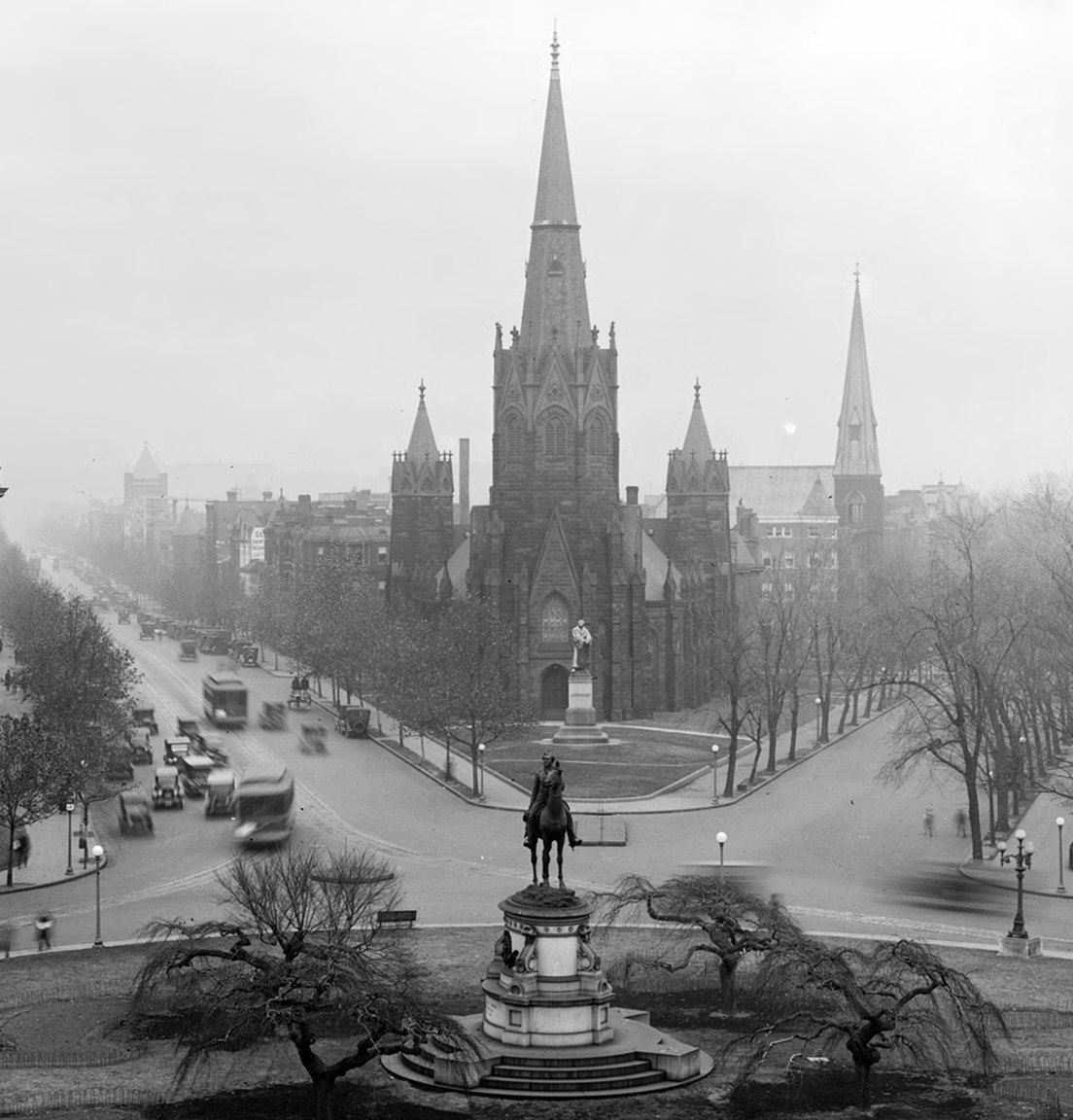
A friend mentioned recently that he got married at Luther Place Memorial Church. I told him what I always say when someone points me at a building: I walk by places like that all the time wondering about the stories inside them. I said I’d look into it.
Worth every minute.
The Statue Named the Church
The congregation started in 1873 under a completely different name: Memorial Evangelical Lutheran Church of Washington, D.C. The “memorial” in that name pointed back to the Civil War. More on that in a moment.
The bronze statue of Martin Luther didn’t arrive until May 21st, 1884, eleven years after the church opened. When it did, it arrived big.
German-American societies from across the region marched in parade formation through downtown Washington to Thomas Circle. Over 10,000 people attended the dedication. The ceremony was conducted largely in German.
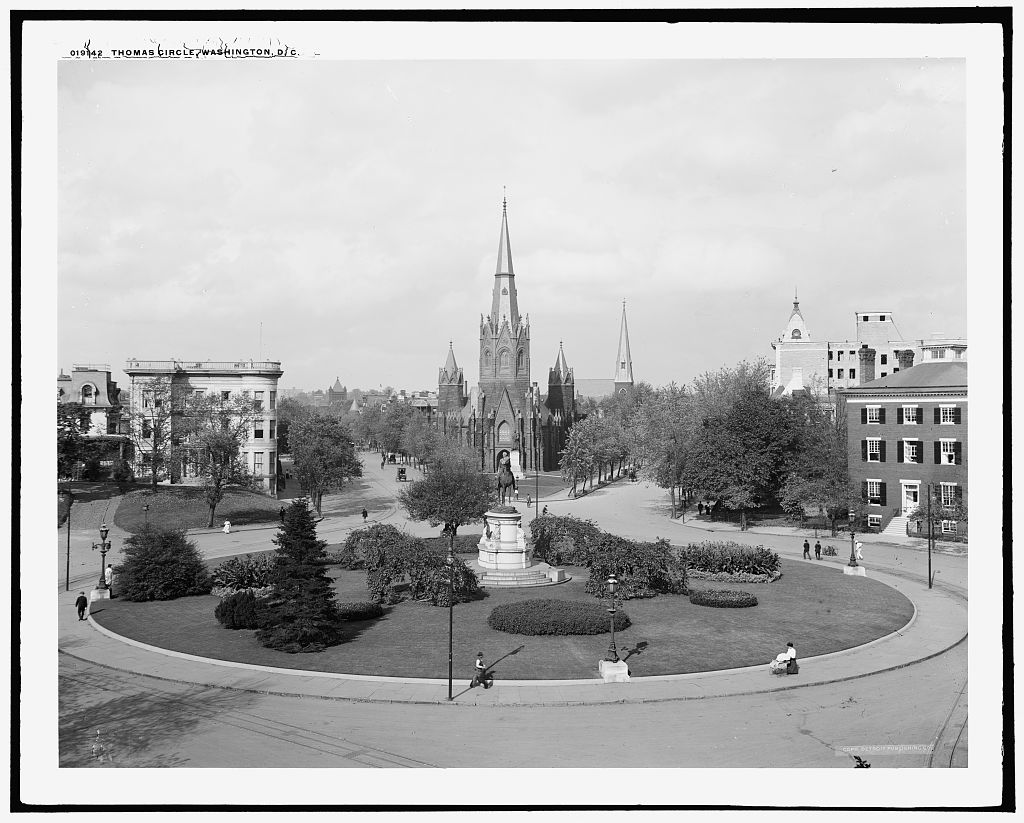
The statue is a replica of the Luther Monument in Worms, Germany, the same one unveiled by King Wilhelm I of Prussia in June 1868. The Washington version was cast in Lauchhammer, Prussia, shipped across the Atlantic, and set on a granite pedestal designed by Adolf Cluss.
Cluss was the German-born architect who was the most important builder in post-Civil War Washington. He had already given the city Eastern Market, the Franklin School, dozens of public school buildings, and the mansion a few blocks up Massachusetts Avenue that would become the German Embassy.
Total cost for statue and pedestal: $9,000.
It was the city’s first outdoor sculpture of a religious figure, and the first public monument to Martin Luther anywhere in the United States.
After the dedication, people started calling the church “Luther Place” informally. Eventually the name stuck officially. The original name, the one pointing back to the end of slavery, faded from common use. It still appears in the full formal name today, but most people passing by have no idea it’s there.
Built as a Memorial to the End of Slavery
The founding pastor, the Reverend John Butler, was an abolitionist. He envisioned the church as, in his own words, “a memorial to God’s goodness in delivering the land from slavery and from war.” The cornerstone was laid on October 31st, 1870, just five years after the war ended.
Butler wasn’t being subtle.
Two of the original pews in the sanctuary were dedicated to Generals Grant and Lee. The church was built to hold both sides of the war in one room. Pews were also memorialized to General Howard and Senator Sumner. The windows in the main tower were inscribed with the names Luther, Calvin, and Wesley.
The building was constructed from red Seneca sandstone, the reddish-brown Maryland quarry stone used in the Smithsonian Castle and dozens of other prominent Washington buildings of the era. The style is High Victorian Gothic. An original design by Judson York was revised as too expensive, and architects J.C. Harkness and Henry Davis built it in the shape of a ship.
That wasn’t accidental. A ship is a traditional Christian symbol for the church as a vessel. The interior rafters were built in the shape of a ship’s keel. If you’ve ever been inside, you were standing in the hull.
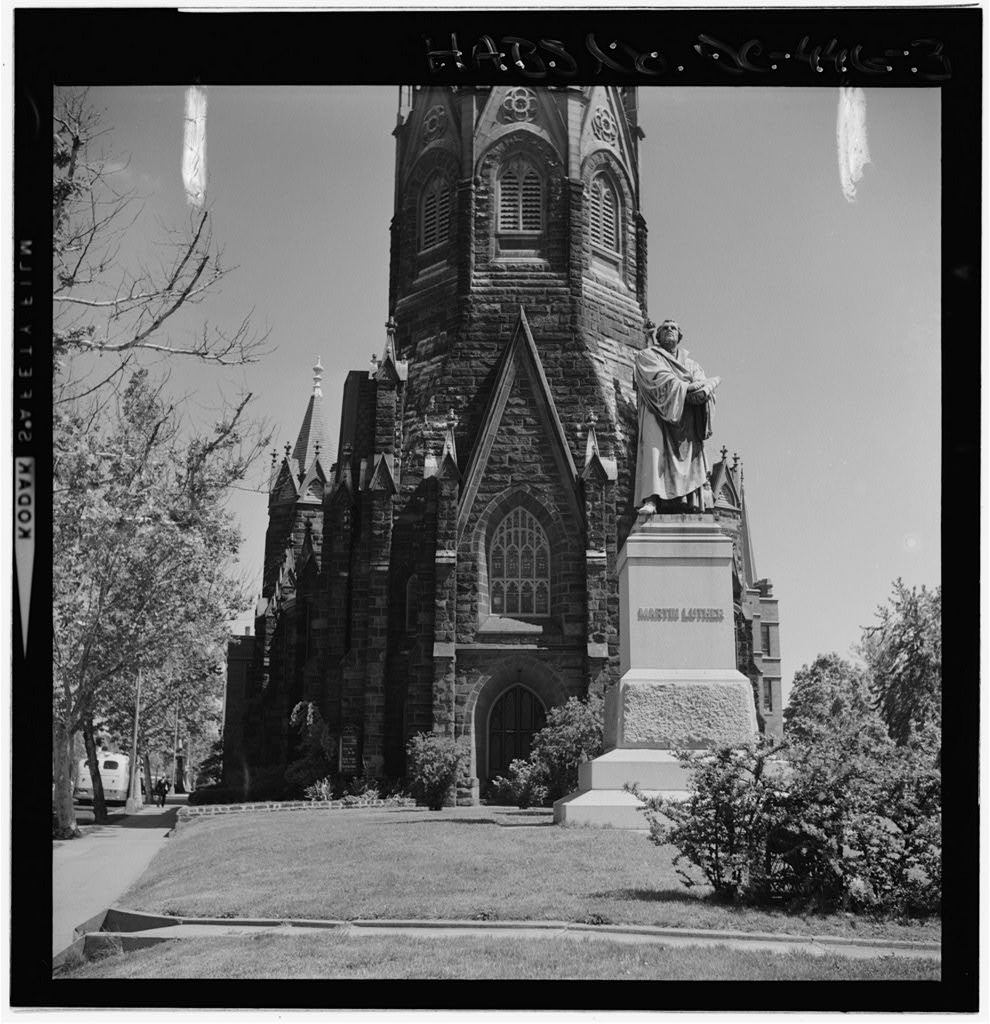
The three towers were completed in 1883, paid for by congregation member George Ryneal Jr. as a memorial to his parents. The statue commission followed the next year.
Butler’s convictions shaped more than the architecture. Under his leadership, the congregation ordained Daniel Wiseman, an African American pastor, in 1873. That was a genuinely unusual act for a Lutheran church at that moment. Wiseman went on to found Our Redeemer, Washington’s first Black Lutheran congregation.
Butler led the church for more than thirty years. Then, on the night of January 29th, 1904, someone noticed smoke coming from the ceiling.
The Night of the Fire
That evening was Dr. Butler’s seventy-eighth birthday. The congregation had gathered in the main auditorium for a reception in his honor. The Evening Star would later report that the event was so enjoyable, people “were in no hurry to get away.”
A few minutes before 10 o’clock, smoke drifted down from the ceiling near the large gas chandelier. There was no ladder long enough to reach it. The janitor, George Tinker, tried climbing into the air chamber between ceiling and roof. The smoke was too thick. Butler’s son, Rev. Charles Butler, ran out and turned in the first alarm.
The Evening Star’s account the following morning:
“It was not until the smoke and blaze got uncomfortably near the parishioners that they retreated, and then most of them remained on the street in the vicinity. The snow-covered streets rendered it utterly impossible for the horses of the fire department to make fast time in responding to the several alarms, and those who were watching the progress of the flames almost began to think that the firemen would not reach the edifice in time to even save the outer walls.”
Twelve fire companies ultimately responded, including the water tower.
An investigation traced the cause to a leaky gas pipe feeding the chandelier. The fire caught in the air chamber above the ceiling and drove straight into the main spire over the entrance. The tower burned from within, bright enough to be seen from all parts of the city. Then it fell.
The big organ was practically wrecked.
Total damage: $25,000.
The Eighth Street Hebrew Temple offered its building to the congregation while repairs were made.
When the church was rebuilt, the interior gained something new: a series of stained glass windows depicting twelve figures of the Protestant Reformation. They’re still there.
Butler had only a few more years in the pulpit. His death in 1909 set off a succession struggle that connected Luther Place to one of the most widely read novelists in American history.
The Two-Year Pastor Who Wrote The Robe
When Butler died, part of the congregation wanted his son to take the pulpit. Rev. Charles H. Butler, the same man who had turned in the fire alarm five years earlier, had real support inside the church. The Evening Star reported in September 1909 that “seceding members” who backed the Butler family were “still out” after the council made its decision.
The council chose someone else.
They picked the Rev. Lloyd C. Douglas, pastor of the First English Lutheran Church of Lancaster, Ohio. Douglas had preached a guest sermon at Luther Place on August 22nd, 1909 and made what the Evening Star called “quite a favorable impression.” By fall 1909, he had the job.
Douglas served for roughly two years. In March 1911 he was still building the congregation, bringing in a new organist from an Episcopal church in Baltimore. Then, around August of that year, he resigned. The Washington Times reported that September:
“The vacancy in the pastorate of the Luther Place Church, caused by the resignation last month of the Rev. Lloyd C. Douglas, has revived the rumor [of consolidation with St. Paul’s Lutheran Church]. A successor will not be chosen for several weeks.”
The council spent months finding a replacement. A congregational meeting in early October 1911 failed to select anyone. There was an official “denial of any friction over the selection,” which in old newspaper language usually means there was friction. The Rev. Henry Anstatt of Christ Lutheran Church in Gettysburg, Pennsylvania finally took the pulpit on January 7th, 1912.
Douglas moved on. He kept preaching and lecturing for years. Then in 1929 he submitted a manuscript called “Magnificent Obsession” to publishers. Two major publishers turned it down. A small religious press in Chicago took it, printing 2,500 copies.
It kept selling until Houghton Mifflin republished it as a mainstream novel. It was adapted into a Hollywood film. His follow-up, “The Robe,” published in 1942, became one of the bestselling American novels of the 20th century and inspired the first film released in CinemaScope.
In a New York Times interview that year, Douglas described himself simply: “a parson, you know, and not only that, a lecturer.”
The Washington Post reviewed “The Robe” that October and found it “trite and disappointing.”
Millions of readers disagreed.
That pastor spent two years at the corner of 14th and Vermont, left quietly while the congregation couldn’t agree on his replacement, and eighteen years later was one of the most widely read novelists in America.
The Statue That Survived World War I
When the United States entered World War I, anti-German sentiment in Washington ran hot. The city had spent decades filling its public spaces with monuments to German historical figures, and by 1917 and 1918 some of those had become targets. The Frederick the Great statue, a gift from the German government, was removed, with proposals circulating to melt it into bullets for the war effort.
The Martin Luther statue on Thomas Circle was a different matter.
In February 1918, the New York Tribune surveyed the wartime fate of Washington’s monuments. When the reporter reached Thomas Circle, he wrote:
“In Thomas Square, on fashionable Massachusetts Avenue, stands the stolid and heroic figure of Martin Luther, with his hand clenched upon a Bible. The figure suggests the author of the robust ‘Table Talks.’ He has not come under any recent Kultur ban.”
Luther survived because he was read as a figure of Protestant religious history, not German nationalism. The same impulse that targeted the Kaiser’s gift to the Army left the reformer from Wittenberg alone.
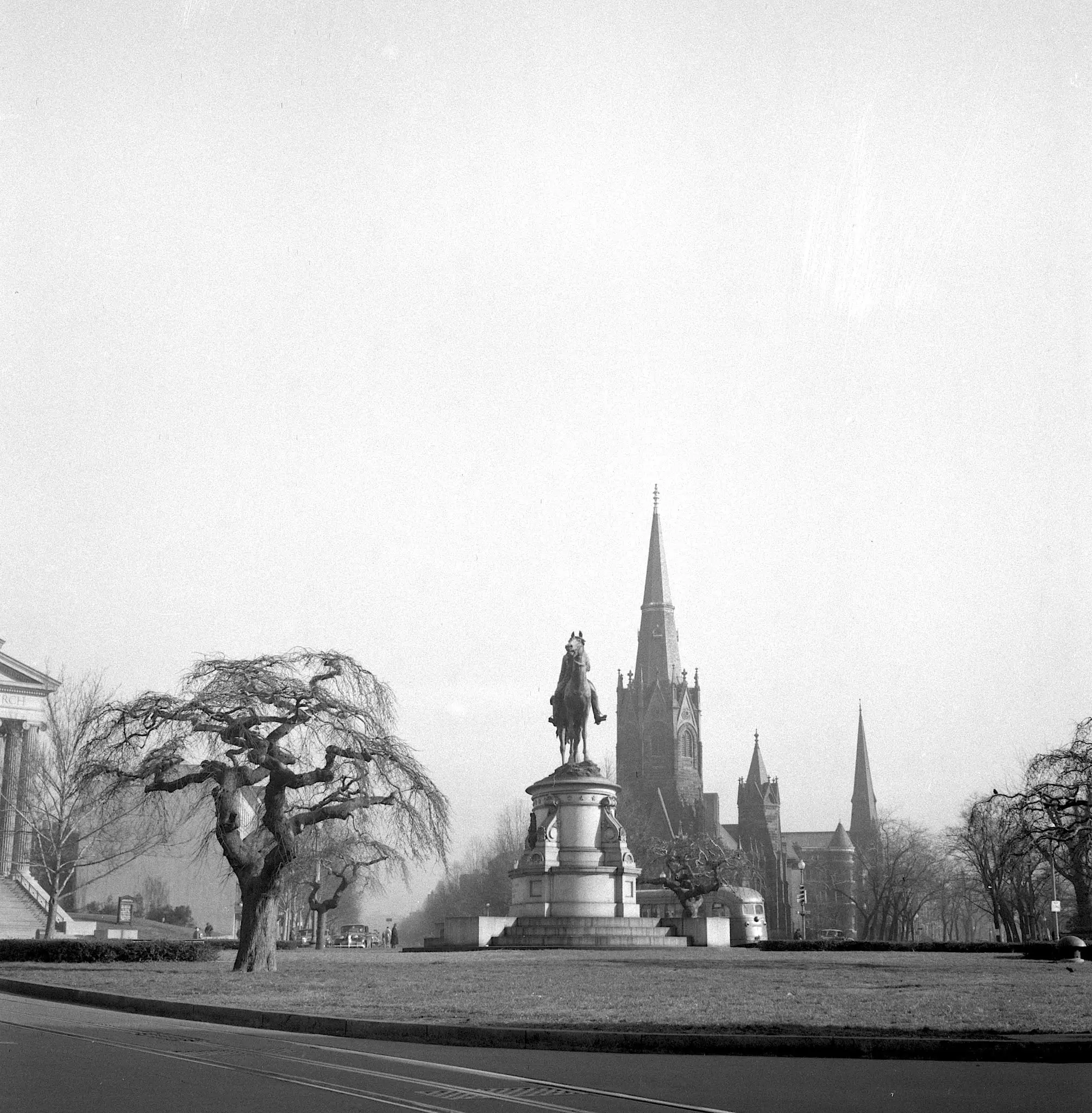
April 1968
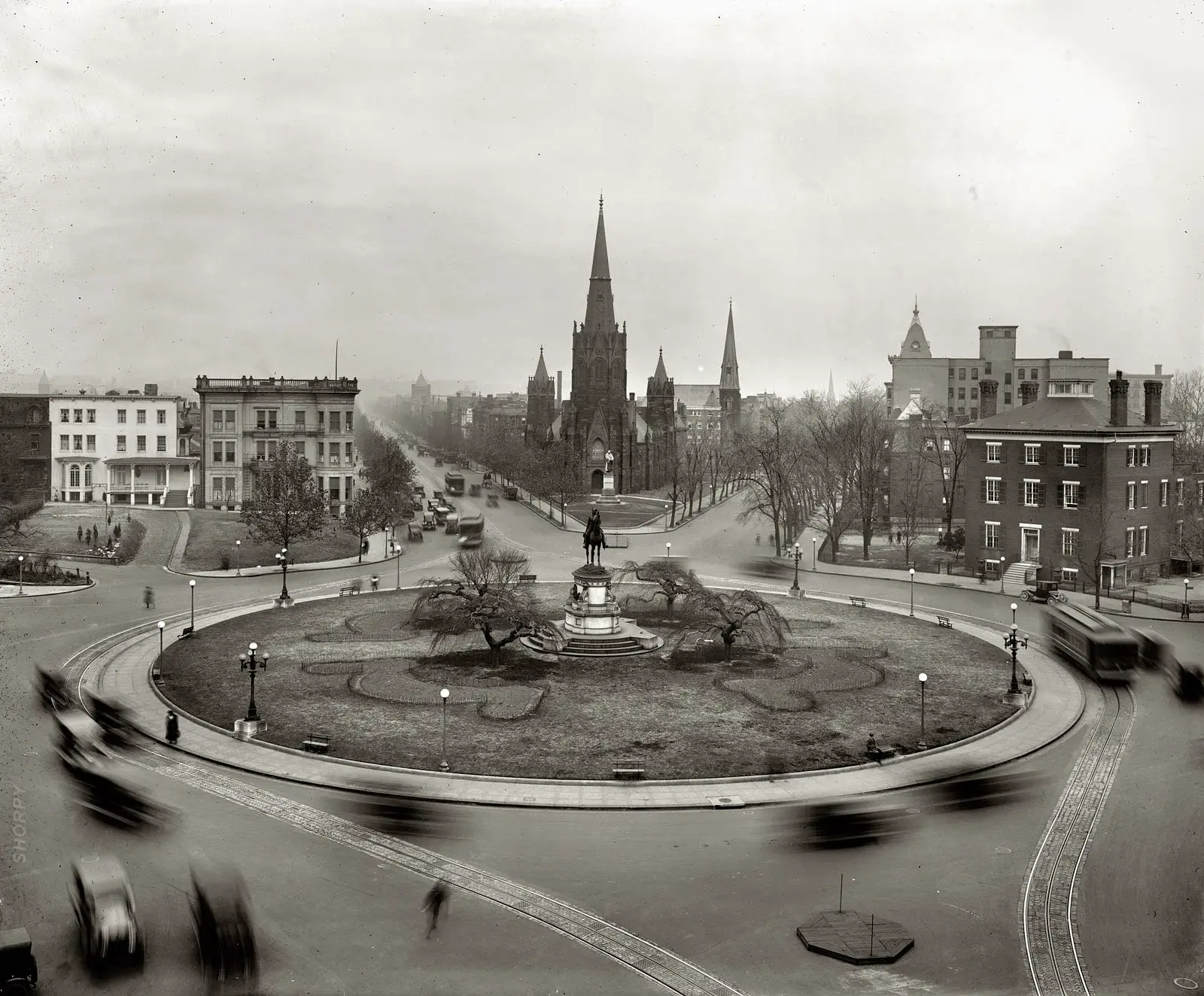
On April 4th, 1968, Martin Luther King Jr. was assassinated in Memphis. Within hours, Washington began to burn. The 14th Street corridor, running directly past Thomas Circle, was at the center of it.
Luther Place kept its doors open continuously for three days. The congregation sheltered, fed, and clothed more than 10,000 people displaced along the corridor.
According to the church’s own account, members of the Black Muslim community stood guard outside Luther Place during the worst of it, physically protecting the building and its volunteers from the arsonists moving through the neighborhood.
A Lutheran church on Thomas Circle, protected by Nation of Islam members while the blocks around it burned.
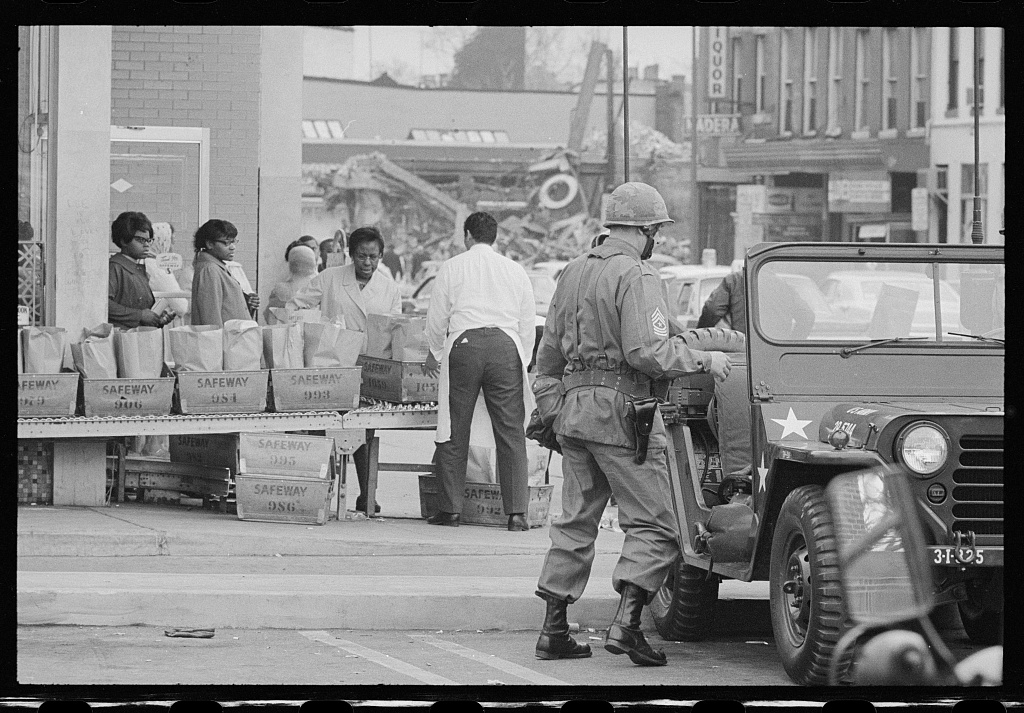
The church that had been built as a memorial to peace after one national catastrophe became a refuge during another. What it witnessed from its own doorstep would shape everything that came next.
John Steinbruck and N Street Village
The Rev. John Steinbruck arrived at Luther Place in 1970. He was a Navy veteran who had studied economics at the Wharton School, then read Albert Schweitzer and turned toward ministry instead. He found a neighborhood still visibly scarred by the riots. From the church’s roof, a Washington Post reporter would note in 1977, you could see abandoned buildings lining 14th Street, prostitutes working the corners, shop windows wrapped in greasy paper.
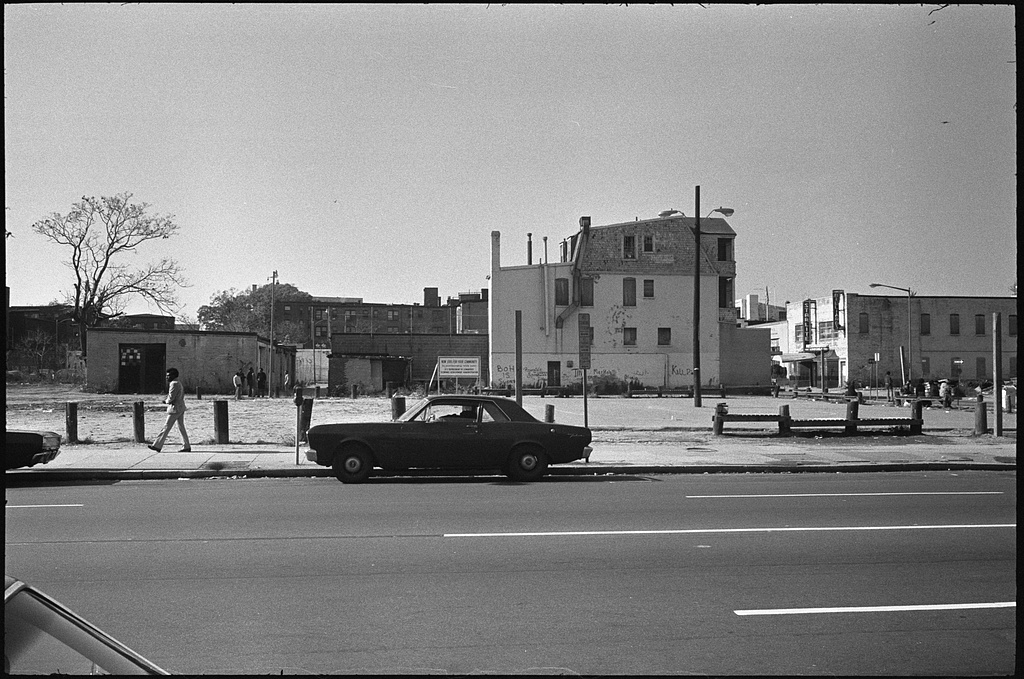
Steinbruck’s response was to open the doors wider.
Starting in 1972, he led the conversion of several church-owned rowhouses on N Street NW into a network of services: a free medical clinic, food and clothing center, housing for homeless women, the DC Hotline, and a residence for volunteers. All funded by private donations.
Then, in the brutal cold of winter 1976, Luther Place went further, opening the sanctuary floor to homeless women with nowhere to go. First blankets on the floor. Then mattresses. Steinbruck described it plainly to the Post: the church was packed at 11 a.m. on Sunday, and filled again at 11 p.m. with homeless people sleeping on the floor. “If we’re going to talk about the bread of life,” he said, “it better be real bread. Otherwise, it’s phony.”
He was arrested outside the South African embassy for protesting apartheid. He traveled to Moscow to support Jewish refuseniks and was temporarily detained by Soviet authorities. In the early 1980s, Luther Place became the first church in Washington to offer sanctuary to undocumented immigrants from Central America, drawing criticism from the Reagan administration.
The work brought friction closer to home too. In 1993, after pressure from neighbors and the Logan Circle Community Association, Luther Place received five $500 fines for lacking proper permits for its long-established residential programs. The D.C. Council member, Jack Evans, sided with the neighborhood. The church’s parish administrator, Connie Sharp, replied: “We all can’t live here, but that doesn’t make the commitment of this congregation any less.”
By 1987, Luther Place Shelter Ministries was reaching 70,000 people a year. By 1991, N Street Village was serving 1,800 women annually. In 1996, Steinbruck achieved the goal he had been fighting for: an eight-story building near Thomas Circle providing housing and services for more than 200 homeless women.
He retired in 1997 and moved to Delaware. He died on March 1st, 2015, at 84. The Washington Post described him as “one of Washington’s most forceful and most effective advocates for the dispossessed.”
N Street Village still operates today.
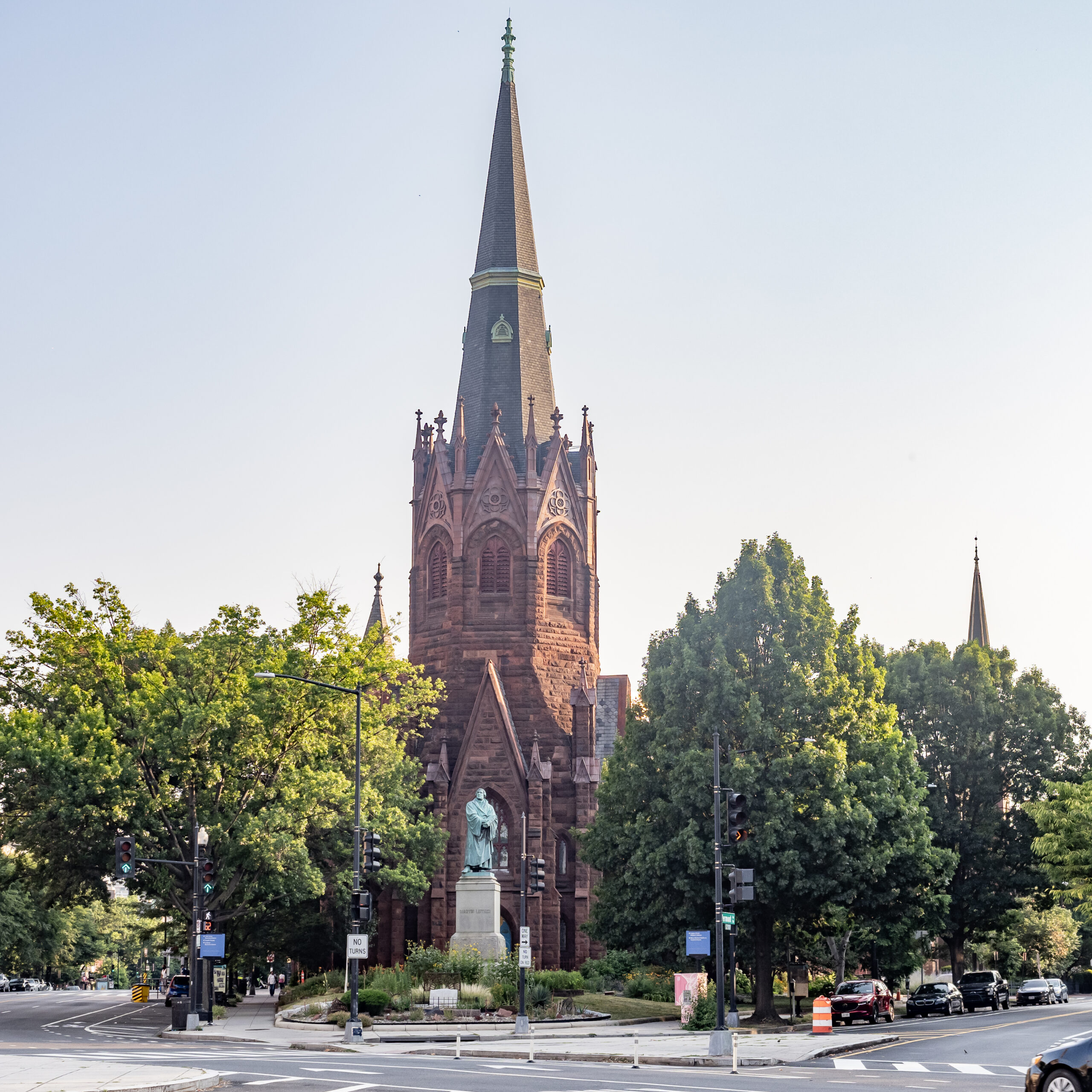
Most people driving past on 14th Street see the Gothic tower and the German reformer out front and keep going. Reasonable enough.
The statue has been there since 1884. It’s seen everything.
Luther Place Memorial Church is located at 1226 Vermont Avenue NW, at Thomas Circle. You can learn more about the congregation’s history at lutherplace.org/history.
Some of our stories are researched and written with help from AI, and checked by a person before they run. Here’s how we use AI.