
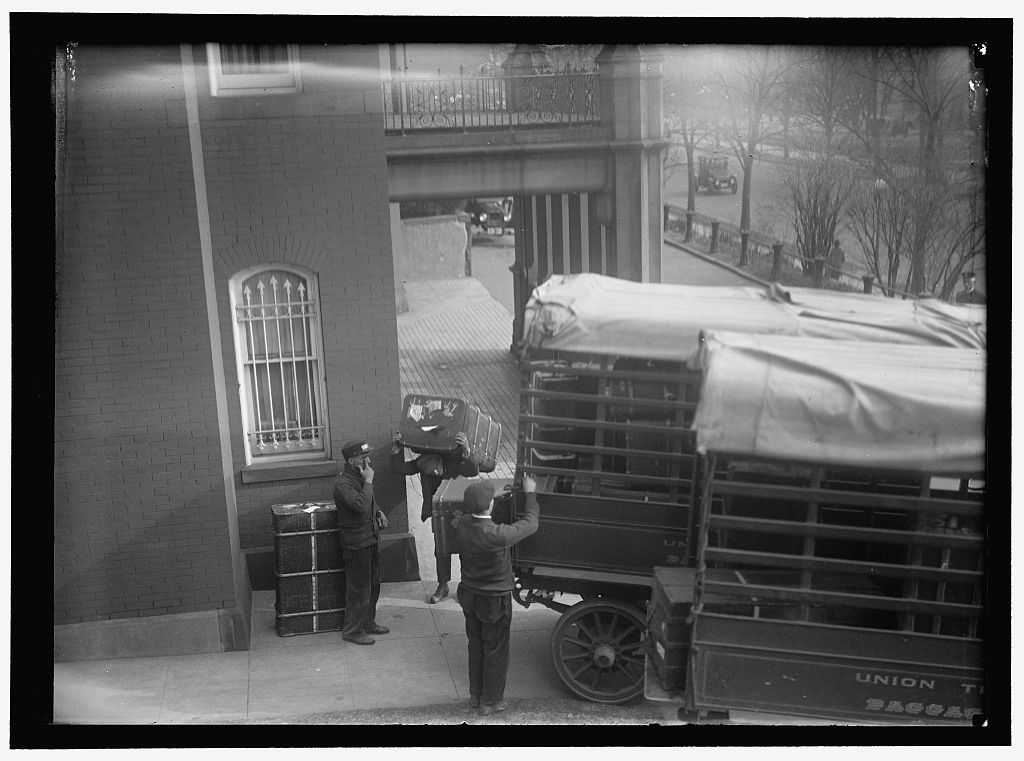
You’ve probably seen this photograph. A February 1917 Harris & Ewing image of an Adams Express Company delivery truck parked at an embassy doorway on Massachusetts Avenue, waiting for its load. Shorpy runs it with the caption Auf Wiedersehen: 1917. It’s a fine photograph with a great title and you could stop right there.
The embassy is the German Embassy at 1435 Massachusetts Avenue NW, a seventy-room mansion the German government had owned since 1893 and was about to lose twice. The truck is waiting for Count Johann Heinrich von Bernstorff, German ambassador to the United States.
President Wilson had severed diplomatic relations days earlier. The trucks were loading the Count’s belongings for a train to Hoboken. In two months the United States would be at war.
The photograph is the middle act of a story that runs from 1881 to a parking lot.
A Confederate Officer, a German Architect, and a $25,000 House
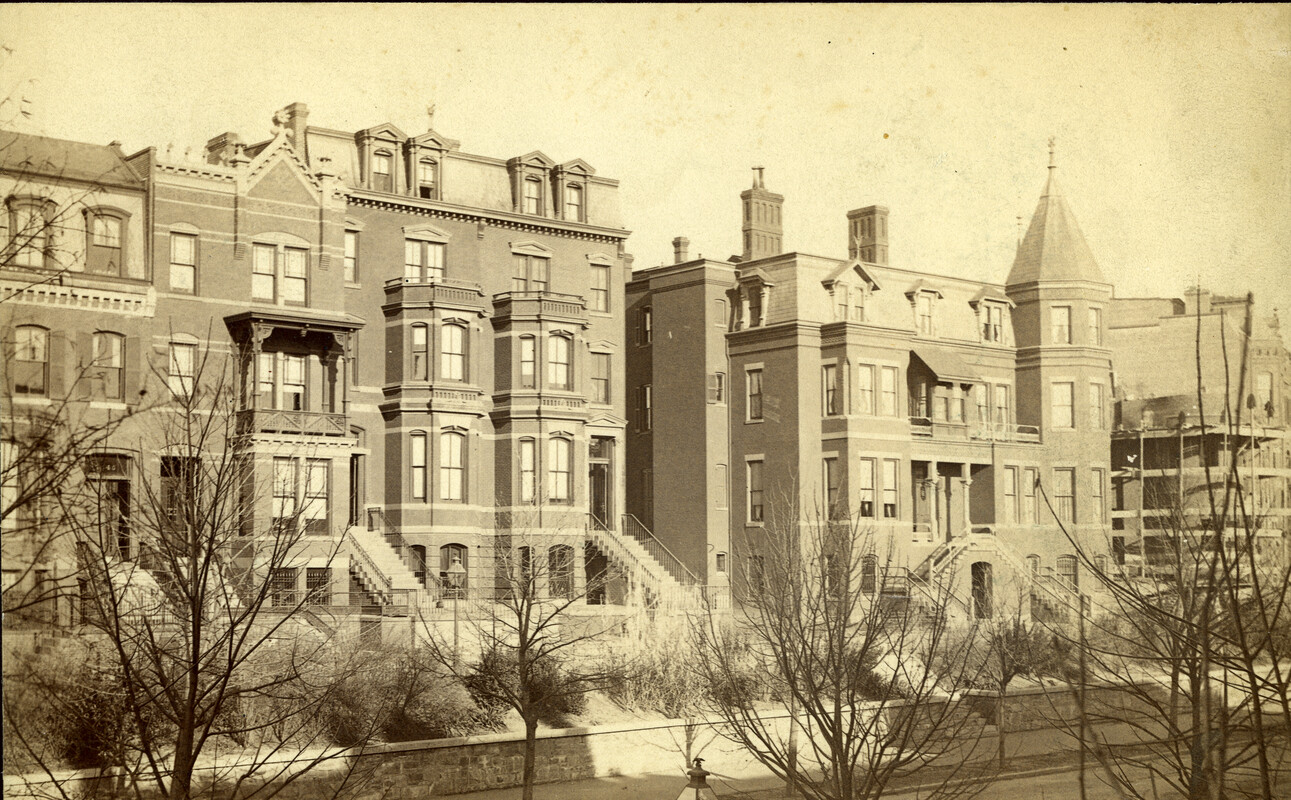
The house was built in 1881 for Major Thomas Ferguson, a South Carolina native who had fought for the Confederacy and then, somehow, became assistant director of the United States Fish Commission under Spencer Baird. He married well. He moved to Baltimore, then to Washington, and built a house worthy of both the marriage and the career.
He spent $25,000 on it, on a block where most neighbors paid $8,000 to $10,000. The property came with sizable stables out back.
The architects were Adolf Cluss and Paul Schulze. Cluss is a name you see on a lot of lost Washington buildings. German-born, a onetime correspondent of Karl Marx, he left Germany after the 1848 revolutions and eventually stepped away from radical politics in America. By the 1880s he was the most prolific architect in the city.
Eastern Market. Franklin School. Sumner School. The Smithsonian Arts and Industries Building. The granite pedestal for the Martin Luther statue at Luther Place Memorial Church on Thomas Circle. We’ve written about another lost Cluss mansion at 6th and M NW, pulled down in 1971. The Ferguson house was its Embassy Row cousin.
The location was Highland Terrace, an elevated residential block set back from Massachusetts Avenue by a tree-lined service road, between Thomas Circle and Scott Circle. The address was 1435 Massachusetts Avenue NW, though as the building grew it would swallow 1441 as well.
On the 1919 Baist atlas, the German Embassy’s footprint is drawn larger than any of its neighbors on the block. Directly across Mass Ave, in the triangle formed by the avenue’s diagonal cut through the grid, stood the French Embassy. The two mansions faced each other across fewer than a hundred feet of pavement. That detail will matter later.
Ferguson only lived there a decade. In 1894, President Cleveland appointed him U.S. ambassador to Sweden and Norway. The Ferguson house was about to become an embassy. Just not his.
Germany Buys In
The German government purchased the house in 1893, and over the following years expanded it into something else entirely. By the turn of the century the Ferguson residence had become a seventy-room chancery with thirteen bathrooms, a dome-ceilinged ballroom, and a hexagonal spire.
The opening ball was a statement. Five hundred guests from the diplomatic corps. Members of Congress. Chief Justice Melville Fuller. The U.S. Marine Band providing the music.
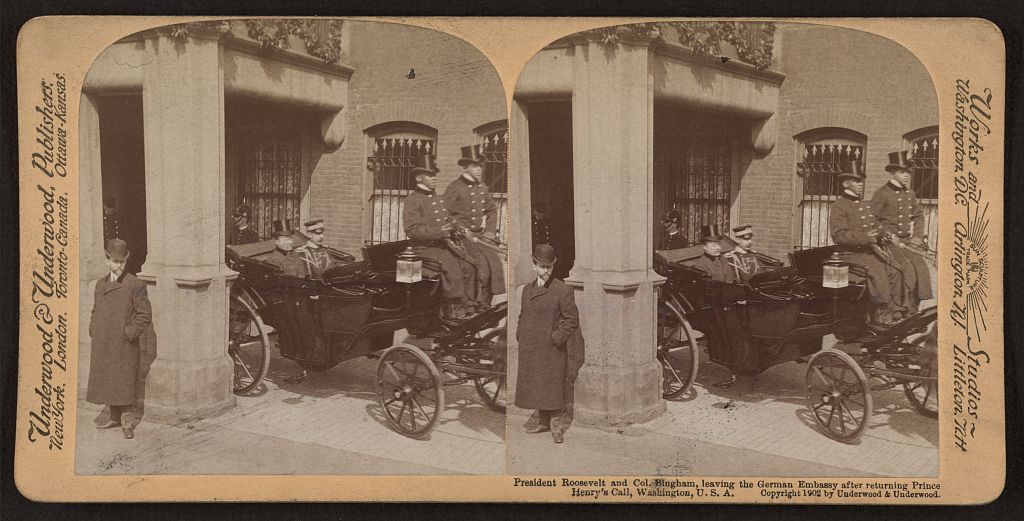
In February 1902, Kaiser Wilhelm II’s brother, Prince Henry of Prussia, made a high-profile visit to the United States and came through Washington. President Theodore Roosevelt paid an official visit to the German Embassy to return the call. There’s a stereograph in the Library of Congress of Roosevelt and Colonel Bingham walking down the embassy steps that afternoon.
For two decades, that was what diplomacy between Germany and the United States looked like.
Massachusetts Avenue then was not yet Embassy Row. The stretch between Scott Circle and Sheridan Circle was Millionaires’ Row, full of mining heiresses and railroad fortunes and newspaper tycoons. The Depression emptied the mansions and the embassies moved in, which is how the neighborhood became what it is now.
The Ferguson house got there first. A few blocks west, the old Windom House at 16th and Mass would later become the Australian Embassy. The pattern repeated up and down the avenue.
The Count Arrives
Count Johann Heinrich von Bernstorff arrived as German ambassador in 1908. Berlin had underestimated the posting. The Foreign Office considered America a second-rank power, a continent-sized curiosity better suited to a competent mid-career diplomat than to a star.
Bernstorff would prove them wrong.
He had the full pedigree. Born in London in 1862, postings in Constantinople, Belgrade, St. Petersburg, Munich, London, and Cairo. He also had something no previous German ambassador to the United States had ever had: an American wife. Jeanne Luckemeyer was the New York-born daughter of a prosperous German silk merchant, and she was an asset.
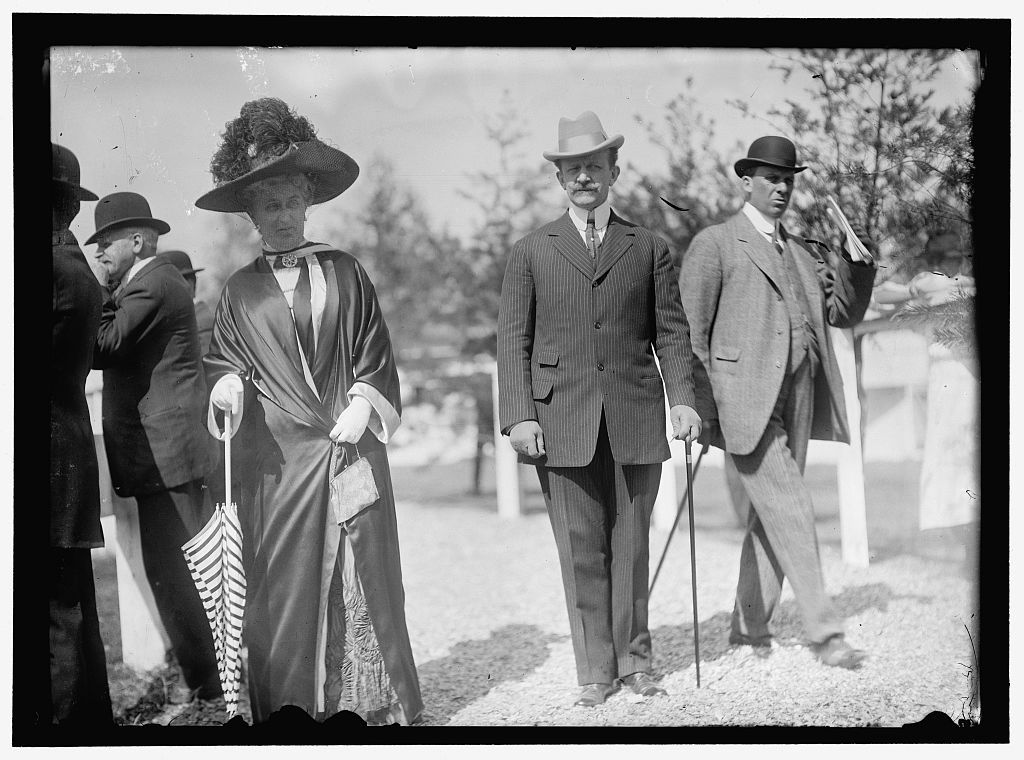
The Bernstorffs went to horse shows. They went to the White House. They went to dinners. In January 1912, they were at the Knox home on K Street for the annual cabinet dinner honoring the Tafts. We’ve seen them there before, in a society column that listed them alongside the British, Italian, and Russian ambassadors.
He was also, quietly, sleeping with someone other than the Countess. British intelligence had compromising material on him. A photograph, of Bernstorff in swimming attire with his arms around two similarly dressed women, neither of them his wife.
After the war, in 1918, Brown University revoked the honorary Doctor of Laws it had conferred on him in 1910. The citation referred to “conduct dishonorable alike in a gentleman and a diplomat.”
For most of his tenure, though, the embassy operated the way embassies are supposed to operate. He tried to charm. He tried to persuade. He tried to keep his country and its host country from going to war.
The Dirty Secret
It didn’t last. From the outbreak of war in the summer of 1914, the seventy-room mansion on Massachusetts Avenue became the coordinating node of the most aggressive foreign sabotage operation ever run on American soil.
Start with the Lusitania warning. On May 1st, 1915, the day the Cunard liner sailed from New York on its final voyage, American newspapers ran, next to Cunard’s advertisement, a notice placed and authenticated by the German Embassy in Washington:
NOTICE! TRAVELLERS intending to embark on the Atlantic voyage are reminded that a state of war exists between Germany and her allies and Great Britain and her allies; that the zone of war includes the waters adjacent to the British Isles; that, in accordance with formal notice given by the Imperial German Government, vessels flying the flag of Great Britain, or of any of her allies, are liable to destruction in those waters and that travellers sailing in the war zone on ships of Great Britain or her allies do so at their own risk.
IMPERIAL GERMAN EMBASSY, WASHINGTON, D.C., APRIL 22nd, 1915.
We’ve covered that notice before. Six days later, a German submarine put a torpedo into the Lusitania’s starboard side. Nearly twelve hundred people drowned. A hundred and twenty-eight of them were American.
Behind the public diplomacy, the embassy was running spies.
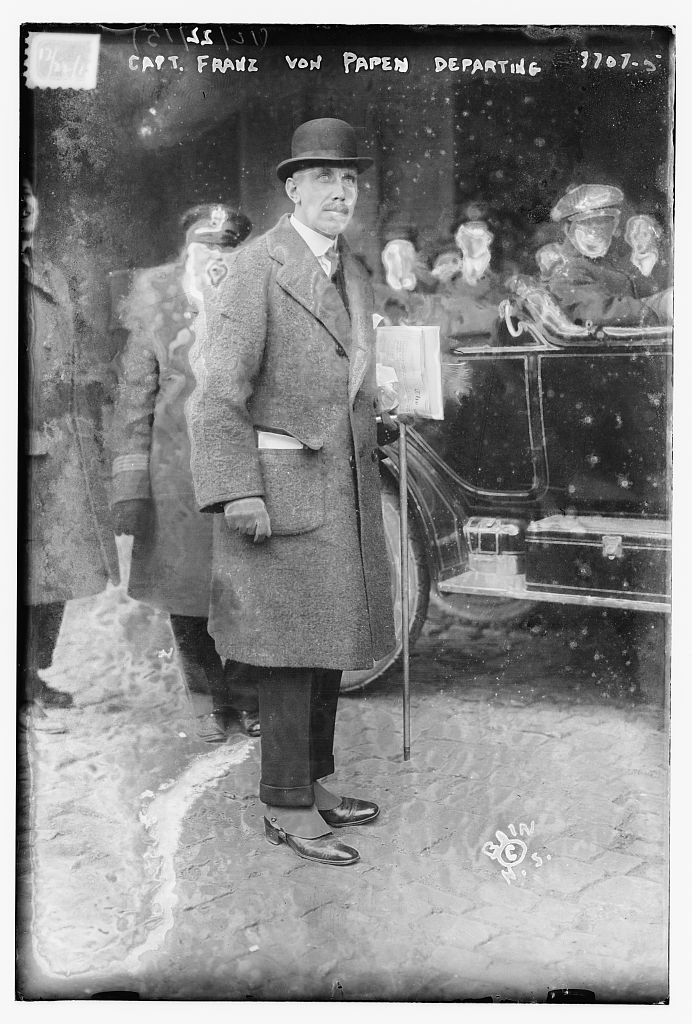
The military attaché was Captain Franz von Papen, who would later be Hitler’s vice-chancellor and one of the defendants at Nuremberg. The naval attaché was Captain Karl Boy-Ed. Commercial attaché Heinrich Albert handled the money.
From the fall of 1914 onward they funded a campaign of bombings, passport forgery, and industrial sabotage across the country. Von Papen was expelled on December 3rd, 1915. On his way home, British authorities seized his checkbook stubs and reprinted them in a white paper that documented spy payments.
Black Tom
The largest attack came on July 30th, 1916. At 2:08 in the morning, German agents detonated roughly two million pounds of small-arms ammunition and artillery shells stored on Black Tom Island, a pier complex in Jersey City just across the harbor from the Statue of Liberty.
Seven people were killed. More than a hundred were injured. Twenty million dollars in property was destroyed, roughly six hundred million in today’s money. The explosion registered as a 5.5 on the Richter scale.
Shrapnel lodged in the arm of the Statue of Liberty. The torch has been closed to the public ever since.
This was a German sabotage operation. It was run, financed, and coordinated from the chancery on Massachusetts Avenue.
Bernstorff officially denied knowledge of all of it.
Historians have since established he was intricately involved.
The Severance
On January 9th, 1917, the German high command decided to resume unrestricted submarine warfare against all shipping in the Atlantic war zone. Bernstorff had spent two years quietly working with Wilson’s confidant Colonel Edward M. House on a secret peace channel. He warned Berlin that the decision “would lead America to enter the war on the side of the Allies.”
Berlin ignored him.
On February 1st, the U-boats were unleashed. On February 3rd, President Wilson severed diplomatic relations with Germany.
Colonel House wrote Bernstorff a private note that week. “It is too sad that your Government should have declared the unrestricted U-boat war at a moment when we were so near to peace.”
Nine years of life in a seventy-room mansion had to be packed in a matter of days.
Across the street, the French Embassy had a view. France had been at war with Germany for two and a half years. From their windows the French could watch the Germans carry trunks out to the curb.
At some point that week, Harris & Ewing set up cameras outside the embassy and exposed a series of plates. Trucks from Adams Express Company, Union Transfer Baggage Company, and a local carrier called U.T.Co. pulled up at the curb one by one. The U.T.Co. electric vans had a distinctive double steering wheel, one for each pair of rear wheels. Workers carried boxes out in a steady line.
On February 6th, Secretary of State Robert Lansing sent a cable to the U.S. ambassador in Spain that is a small bureaucratic masterpiece:
Complete arrangements have been made for departure of Count and Countess Bernstorff, the Embassy staff, and all German consuls in the United States, with their families, as stated in my 213, February 5. All, about 200 in number, will sail on Frederik VIII, February 13.
The sailing slipped by two days. On February 14th, Count and Countess Bernstorff and a Princess Von Hatzfelt arrived in New York by train from Washington. On February 15th, the Danish liner Frederik VIII cast off from Hoboken, bound for Copenhagen.
Halifax
The ship didn’t go straight to Copenhagen.
The British had granted the Germans safe passage on one condition: the Frederik VIII would call at Halifax, Nova Scotia, for “a detailed search.” The search was not a customs exercise.
It was a British Naval Intelligence operation, orchestrated by Admiral Sir William Reginald “Blinker” Hall. Hall’s cryptographers were at that moment decoding a cable that would soon be known as the Zimmermann Telegram. He had studied Bernstorff’s own intercepted communications for two and a half years and had developed a high regard for his powers of persuasion. He wanted Bernstorff out of the game for as long as possible.
The Royal Navy held the ship at Halifax for nearly twelve days. The Count, the Countess, Princess Von Hatzfelt, and two hundred other Germans were confined on board with no outside communication.
On February 19th, 1917, the Washington Times reported from Halifax that the liner “was in the river there” while the examination “continued shrouded in official secrecy,” and that “fine weather brought those aboard the Frederik VIII on deck, where curious crowds gathered on shore to see the ship carrying the dismissed ambassador through the war zone.”
On February 24th, while Bernstorff was still detained at Halifax, Britain handed the Zimmermann telegram to Wilson. The cable, drafted in Berlin and passed through the German Embassy in Washington under Bernstorff’s name on its way to Mexico City, had proposed a German-Mexican military alliance against the United States, with Texas, New Mexico, and Arizona dangled to Mexico as the prize.
On February 27th, the Frederik VIII was finally released. On March 1st, the Zimmermann telegram ran in American newspapers. On April 6th, 1917, the United States declared war on Germany.
By that point, the house on Massachusetts Avenue had been empty for nearly two months.
Germany Comes Back
Germany came back. In 1921, relations were restored, and the German government reoccupied the old embassy. The ballroom filled with parties again.
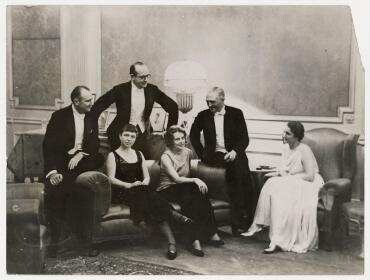
In 1932, the pioneering photojournalist Erich Salomon photographed an evening reception at 1435 Mass Ave with Ambassador Friedrich von Prittwitz und Gaffron in the frame. Salomon would flee Nazi Germany the following year, be arrested in the Netherlands during the occupation, and be murdered at Auschwitz. His reception photograph is one of the few documented interior views of the old embassy we still have.
In 1938, the German government approved plans for a new chancery building to replace the aging mansion. The plans were sidetracked by the approaching war and the new embassy never got built.
On December 11th, 1941, Germany declared war on the United States. On December 12th, Switzerland assumed “protecting power” status and took custody of the chancery.
On December 19th, German Chargé d’Affaires Hans Thomsen and roughly two hundred embassy staff and dependents boarded a secretly scheduled Pullman train out of Washington. They were bound for the Greenbrier Hotel in White Sulphur Springs, West Virginia. They spent seven months there in something like luxury internment while the State Department negotiated their exchange for American diplomats abroad.
The last diplomat left the Greenbrier on July 9th, 1942. The embassy on Massachusetts Avenue sat empty for years.
When reporters and eventually Jean White of the Washington Post got into the wartime file, what came out was strange.
That on Pearl Harbor Day, bits of ashy paper wafted from the chimney. That the Germans had used top-floor rooms to house radio equipment. That when the U.S. government finally took custody in 1945, officials found $3 million in American greenbacks inside the building, “reportedly money for espionage payments.”
The custodian, Frank X. Korber, had been at the building since 1932. He remembered helping carry “sacks” containing another $4.5 million up to two safes in earlier years. As of November 1959, one man-tall wall safe was still sitting on the third floor.
The Fall
The postwar chain of title was unglamorous.
In 1945, the Justice Department’s Alien Property Office seized the building. In 1948, the furnishings were auctioned for under $50,000. In 1951, a Morris Cafritz bid was rejected and the property sold to James S. Kerwin of Meadowbrook, Pennsylvania, for $165,000.
The new Federal Republic of Germany, refounded in 1949, declined to return to the old address. With $300,000 in U.S. compensation, Bonn bought a new ambassadorial residence at 1900 Foxhall Road and planned a new chancery to go with it. From there, West Germany would host chancellors on state visits to Washington for the rest of the century.
In the fall of 1959, a Washington real estate investor named Louis Burman bought the mansion from Kerwin. His plan was to clear the lot, lay parking, and build a one-thousand-room motel with three levels of underground parking for a thousand cars, ready by 1962.
On November 24th, 1959, the Cornell Wrecking Company began tearing the building down. The next morning’s Washington Post ran a story by staff reporter Jean White under the headline “Ax Crashes on Old German Embassy, Once Scene of Gayety and Espionage.”
The opening line is as good a sentence as you will ever read in a Washington paper:
The old German Embassy, vacant so long that even the ghosts of the past have fled went under the wrecker’s ax yesterday, stolid, cold, and forbidding to the end.
White walked through the same building we’ve been walking through. The dome-ceilinged ballroom. The hexagonal spire. The $3 million and the empty safe on the third floor. Korber’s memories. The top-floor radios.
By the end of the week, 1435 to 1441 Massachusetts Avenue NW was rubble.
The Ghost
The one-thousand-room motel never got built. Burman was trying to catch the same wave that three years later produced Morris Lapidus’s nine-story International Inn, now the Washington Plaza Hotel at 10 Thomas Circle NW, on the opposite side of the circle. For whatever reason his own tower never broke ground.
The lot sat as parking for years.
Today, the north side of the 1400 block of Massachusetts Avenue NW, the old Highland Terrace, is a stretch of modern office and apartment buildings between Thomas Circle and Scott Circle.
At the east end, fronting Thomas Circle, the National City Christian Church sits where it has since 1930. Its 1950s-era annex at 1401 Mass Ave was restored in 2024 into five stories of Class A office space. At the west end, anchoring the approach to Scott Circle, the fifteen-story MAA Massachusetts Avenue apartment tower rises at 1499 Mass Ave.
The old 1435-41 embassy footprint sits somewhere between them, absorbed into the modern streetscape.
No plaque marks the spot. No historical sign. You can walk past on your way to lunch and have no reason to think anything ever happened there.
Massachusetts Avenue keeps its secrets. A mile and a half up the same road, another embassy has sat empty for decades for reasons of its own. Same street, different century.
Bernstorff lived another twenty-two years after he walked out of the house. He declined a foreign ministry posting under the new Weimar government in 1919, served in the Reichstag, became the first president of the German Association for the League of Nations, and in 1926 chaired a Zionist committee supporting a Jewish state in Palestine.
Hitler would later name him specifically as bearing “the guilt and responsibility for the collapse of Germany.” Bernstorff fled to Geneva in 1933.
He died there on October 6th, 1939, five weeks after Germany invaded Poland and started another war. He was 76.
He never went back to the house on Massachusetts Avenue.
On July 28th, 1914, the evening the Washington Times ran “Austria Has Chosen War,” Bernstorff was at that house on Massachusetts Avenue, watching the chain reaction he’d failed to stop. We’ve gathered those Washington Times front pages from 1912 through 1919, from the ordinary news of a quiet spring to the day everything broke and the years that followed.
For another grand Washington mansion that traded its diplomats for new tenants, see how the old Irish Free State Legation became Russia House.