
Pull up the front page of the Washington Times from a Tuesday in May 1912 and the biggest story might be about two men trying to talk their way in to see President Taft. Local news. City news. The stuff that fills a paper on a quiet week.
That was Washington in the spring of 1912. The Times was the city’s evening paper, running since 1902, and most evenings it was just a record of the day. Crime reports, political dispatches, the odd curiosity from somewhere in the District. Nobody reading it in May 1912 had any idea what the next seven years were going to look like.
The Night the Titanic Was Still Afloat
On the evening of April 15th, 1912, Washington picked up the paper and read that the Titanic was being towed to Halifax.
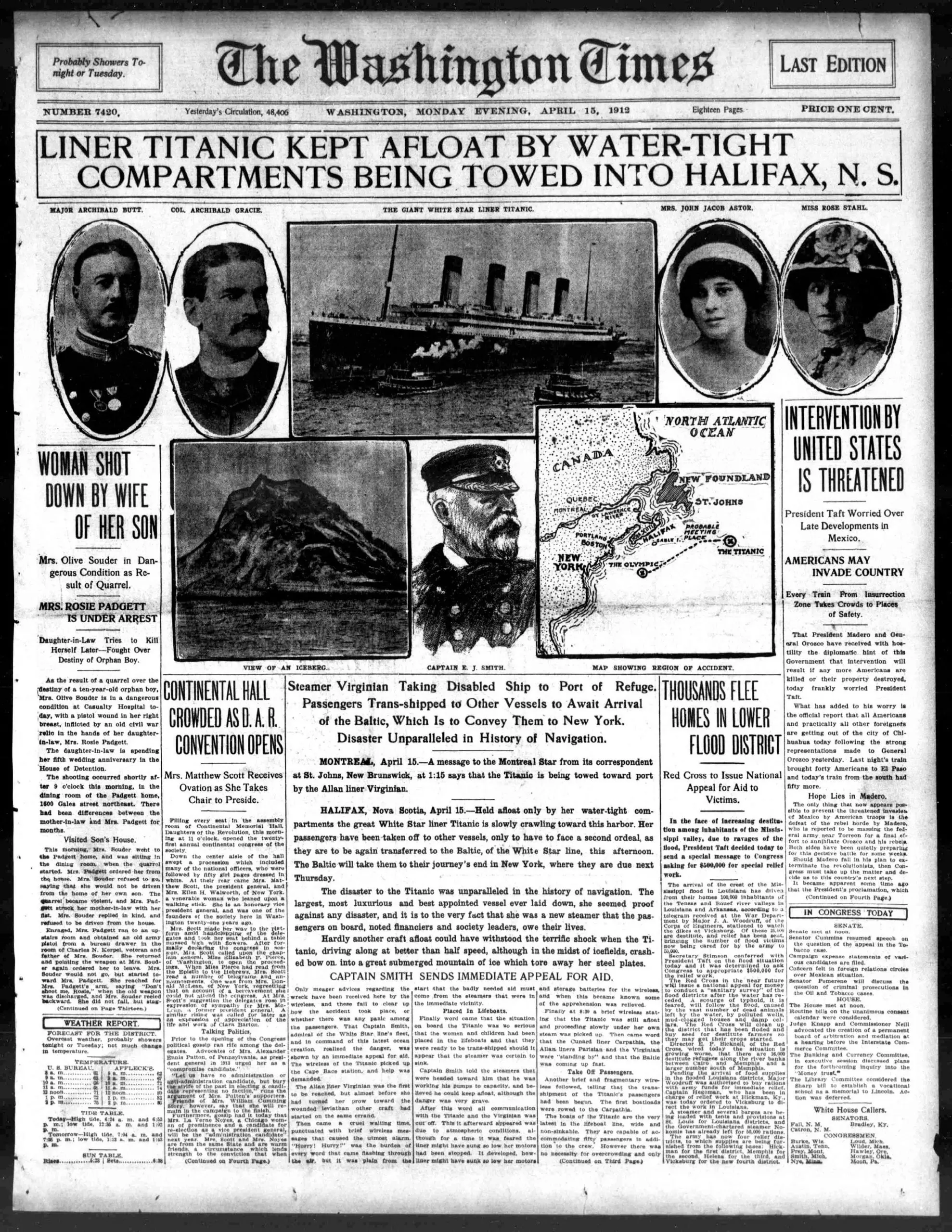
That was wrong. The Titanic had gone down at approximately 2:20 that morning with more than 1,500 people aboard. The news was still sorting itself out, and the evening paper went to press with what it had. Many Washingtonians went to bed that night thinking the passengers were probably going to be fine.
Washington had its own particular reason to dread what was coming. Major Archibald Butt, military aide to President Taft, and before him to Theodore Roosevelt, was aboard. Butt was enormously well-liked in the capital. A fixture at White House functions, the kind of man who seemed to know everyone in the city and everyone seemed to know in return.
Taft had sent him to Europe to rest after months of overwork. He boarded the Titanic on April 10th, along with his friend and companion, the artist Francis Millet. Neither of them made it off the ship. Butt’s body was never recovered.
In 1913, the city put up a fountain on the Ellipse, just south of the White House, in honor of both men. It’s still there today.
What Washington Was Reading in May 1912
By May, life had moved on. The pages of the Washington Times filled back up with the ordinary business of the capital.
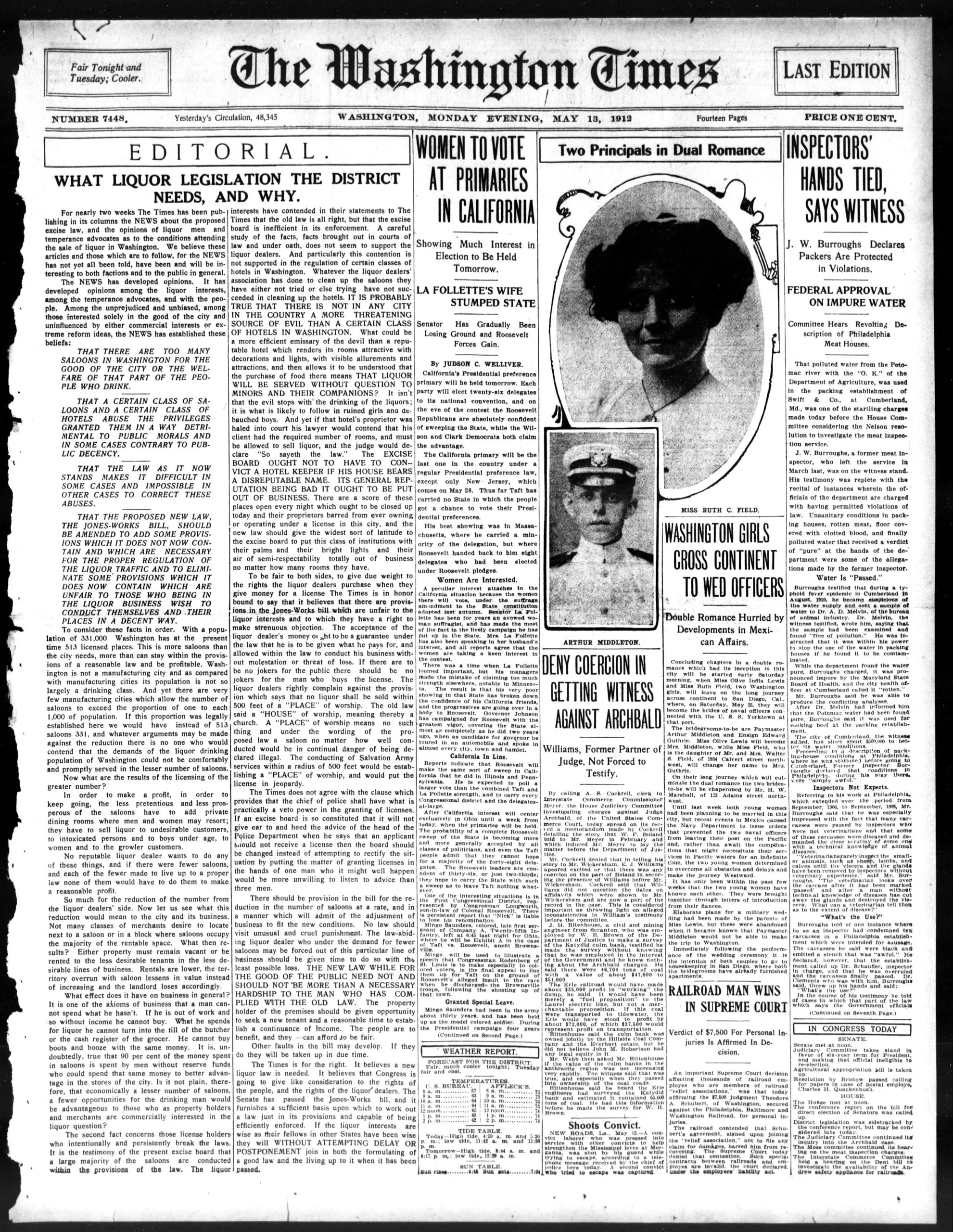
Looking at these front pages now is a bit like finding someone’s old mail. There are local court cases. There is the White House calendar. There’s the kind of story that gets a paragraph at the bottom of page one and is forgotten by Tuesday.
Two years of this. Then everything changed.
Austria Has Chosen War
June 28th, 1914. Archduke Franz Ferdinand of Austria-Hungary was shot and killed in Sarajevo by a Serbian nationalist. European newspapers went into a frenzy. American papers covered it, then mostly moved on. It was a long way away.
For thirty days, diplomats tried to walk it back. Austria-Hungary issued an ultimatum to Serbia on July 23rd with demands that were deliberately impossible to fully accept. Russia began mobilizing. The machinery of alliances that had been building for decades started grinding forward, and nothing anyone said could stop it.
Tuesday, July 28th, 1914. Washington picked up the evening paper.
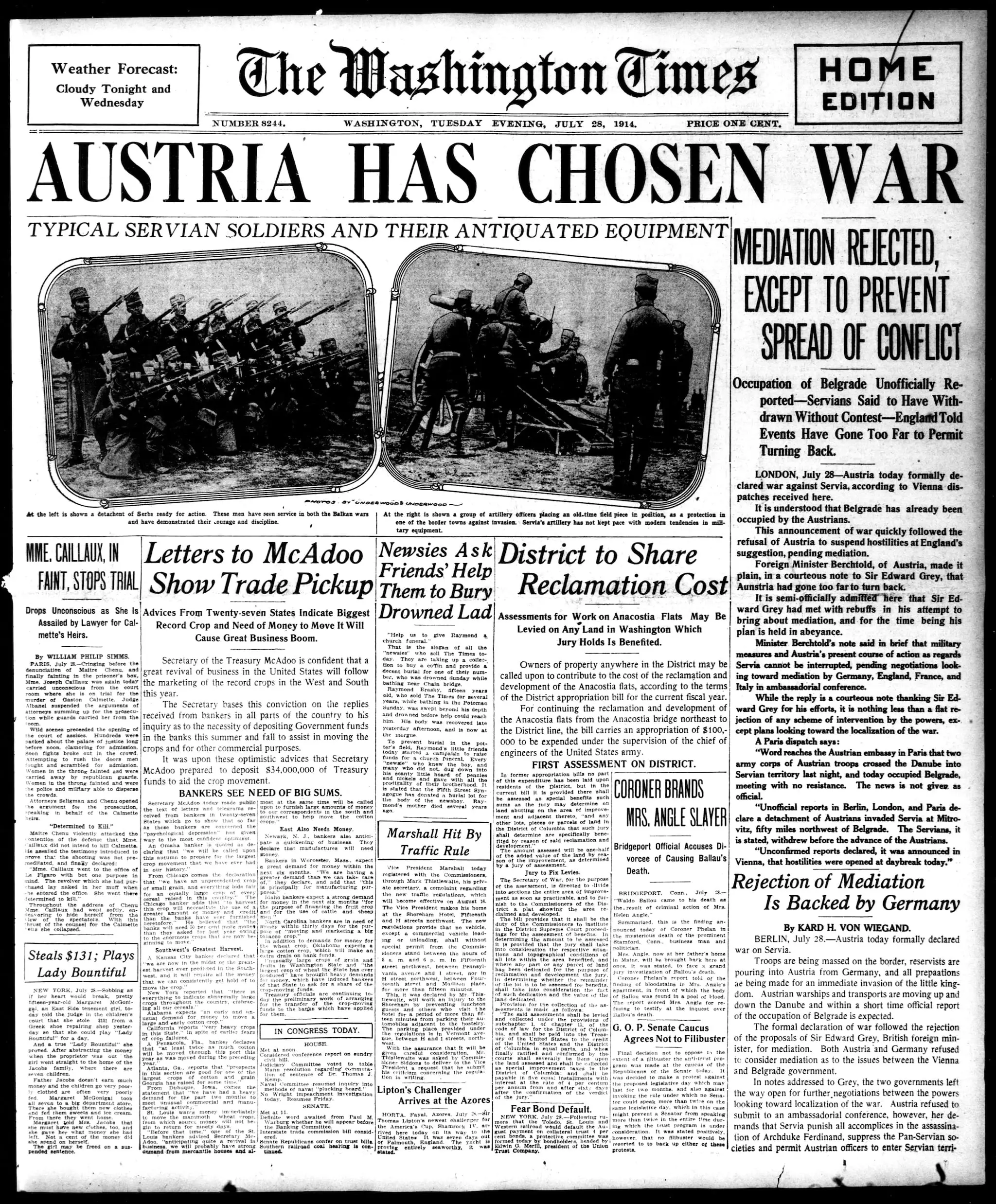
AUSTRIA HAS CHOSEN WAR.
Austria-Hungary’s declaration of war on Serbia that morning set off the chain reaction that the foreign ministries of Europe had feared. Germany declared war on Russia on August 1st. France and Germany declared war on each other on August 3rd. Britain declared war on Germany on August 4th. In roughly a week, most of Europe was at war.
Germany’s role in what came next played out in Washington’s own diplomatic corridors. We’ve written about the old German Embassy on Massachusetts Avenue, and how close to home the war’s diplomacy actually landed in this city.
The United States wasn’t in the fight yet. President Woodrow Wilson, who had won the 1912 election after Taft and Roosevelt split the Republican vote, declared American neutrality. Most of the country agreed. The war was happening over there. They’d keep reading about it in the paper.
It stayed over there for almost three more years.
Washington Goes to War
Congress declared war on Germany on April 6th, 1917. Washington changed almost overnight. Government agencies multiplied. Workers poured in from every state. The city’s boarding houses and apartment buildings filled past capacity. The National Mall sprouted temporary government structures that were supposed to come down quickly and didn’t.
The papers filled with different news. Bond drives. Casualty listings. Enlistment campaigns. A look at the colorized photos from 1918 shows you what the streets looked like when the country was fully in it.
And then there was this, from the Washington Herald on January 10th, 1918:
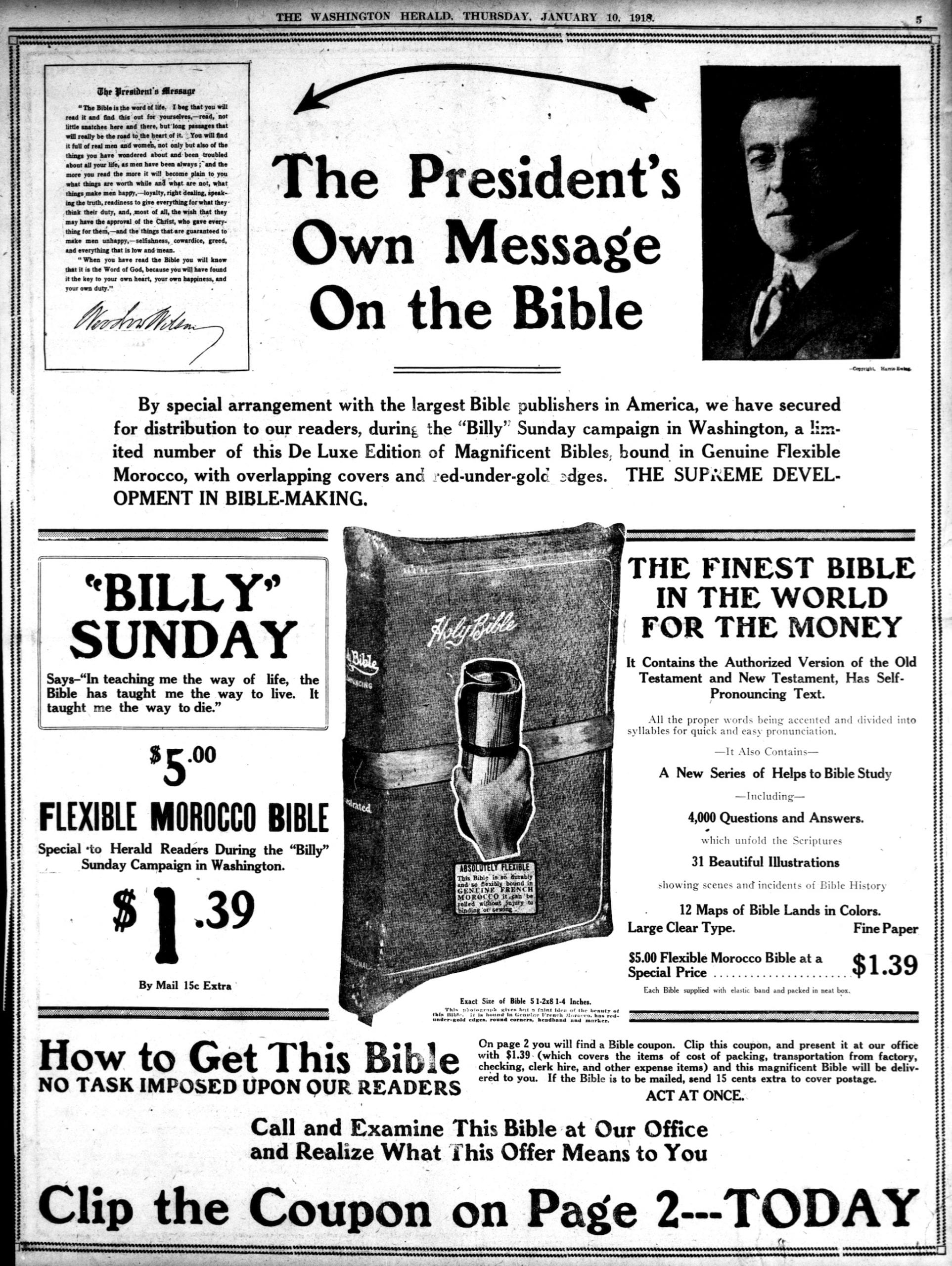
The previous June, President Wilson had written a message to accompany pocket New Testaments being sent to American soldiers by Bible societies. “The Bible is the word of life,” Wilson wrote. The message ran in papers and appeared in churches across the country.
Seeing it dressed up as a newspaper advertisement is a strange experience today. By January 1918, the religion and the war had become so fused in American public life that nobody blinked at it. There was no daylight between them.
The First Fourth of Peace
The armistice came on November 11th, 1918. Washington erupted. More than 100,000 people jammed the streets that day in what witnesses called the wildest celebration the city had ever seen.
By July 4th, 1919, the city was trying to absorb what it had just been through. The first Independence Day of peace brought enormous crowds to the base of the Washington Monument. Washington’s veterans received medals that day from the citizens of the District. An aviator circled low above the monument grounds while the crowd watched from below.
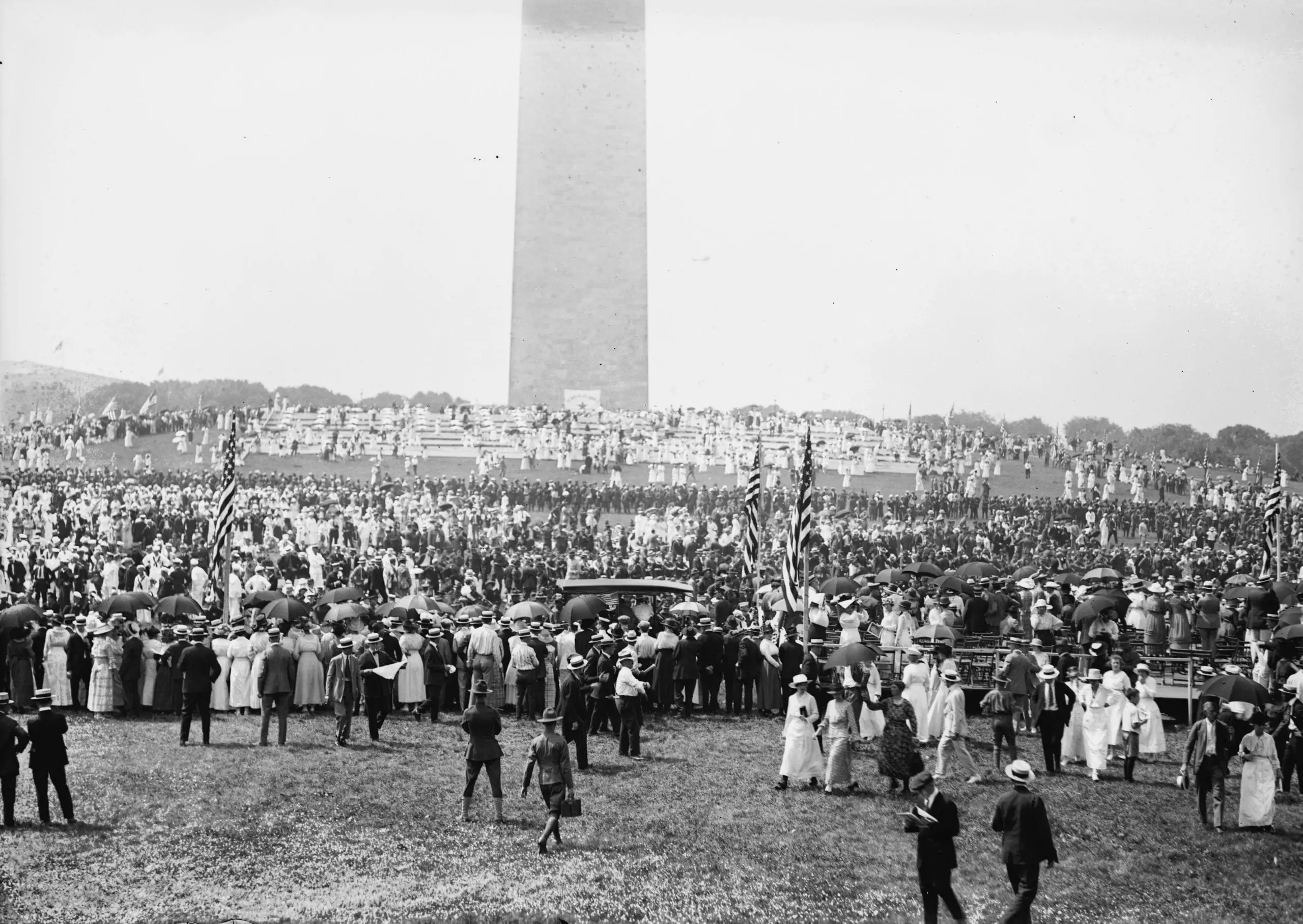
Seven years earlier, the biggest story in the Washington Times had been two men trying to talk their way into the White House. Somewhere between May 1912 and July 1919, the world had done something nobody expected it to do, and Washington had done it alongside everyone else.
The full run of the Washington Times is online, free to read, at the Library of Congress Chronicling America archive. Afternoon by afternoon, you can watch the city’s understanding of the world change in real time.
If you want to see what the Fourth of July parade down Pennsylvania Avenue looked like that same year, we’ve got that too.