
I lived at The Rotonda in the mid-90s, so this one’s personal.
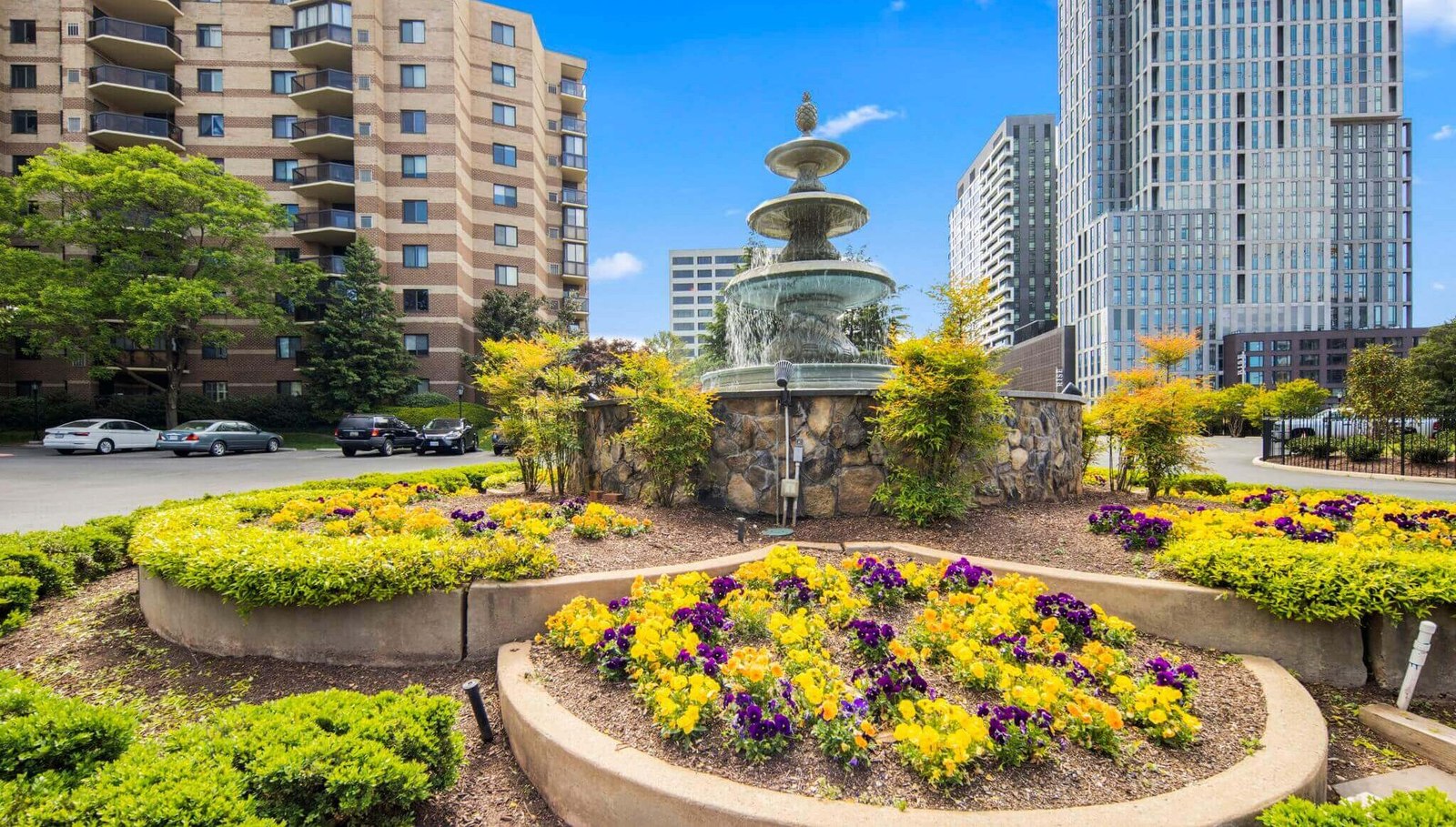
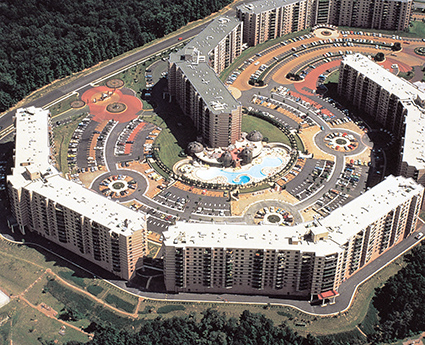
Five curved towers sit on 34 landscaped acres at the gridlocked heart of Tysons Corner, holding 1,168 condominiums and roughly 3,000 people who think their building is the most interesting thing in McLean.
In 1988, a Washington Post reporter named John Lancaster gave them their best line. He called The Rotonda “a rare island of community in a sea of commerce and construction.”
That sea hasn’t drained. And the man who built the island was the same Italian engineer who delivered the Watergate complex on the Potomac sixteen years earlier.
The Rotonda McLean, in three sentences
The Rotonda Condominiums sit at 8340-8380 Greensboro Drive in McLean, Virginia, on a 34-acre parcel a few blocks from the Tysons Metro station on the Silver Line. Five identical 10-story buildings, designed in graceful curves, ring a domed community center. Developer Giuseppe Cecchi’s IDI Group built the whole complex between 1977 and 1981, and 1,168 condos still trade there today.
The cooperative association office uses 8352 Greensboro Drive as the main address. There is a guarded front gate, a fountain, and a long curving drive. You cannot wander in.
Before there was a Tysons Corner, the land was woods
If you have only ever seen Tysons through a windshield, the 1953 aerial below is going to look like another county. Crops, scattered farmhouses, a thin grid of two-lane roads. The future Rotonda parcel is on the right edge, indistinguishable from any other patch of woods in Fairfax County.
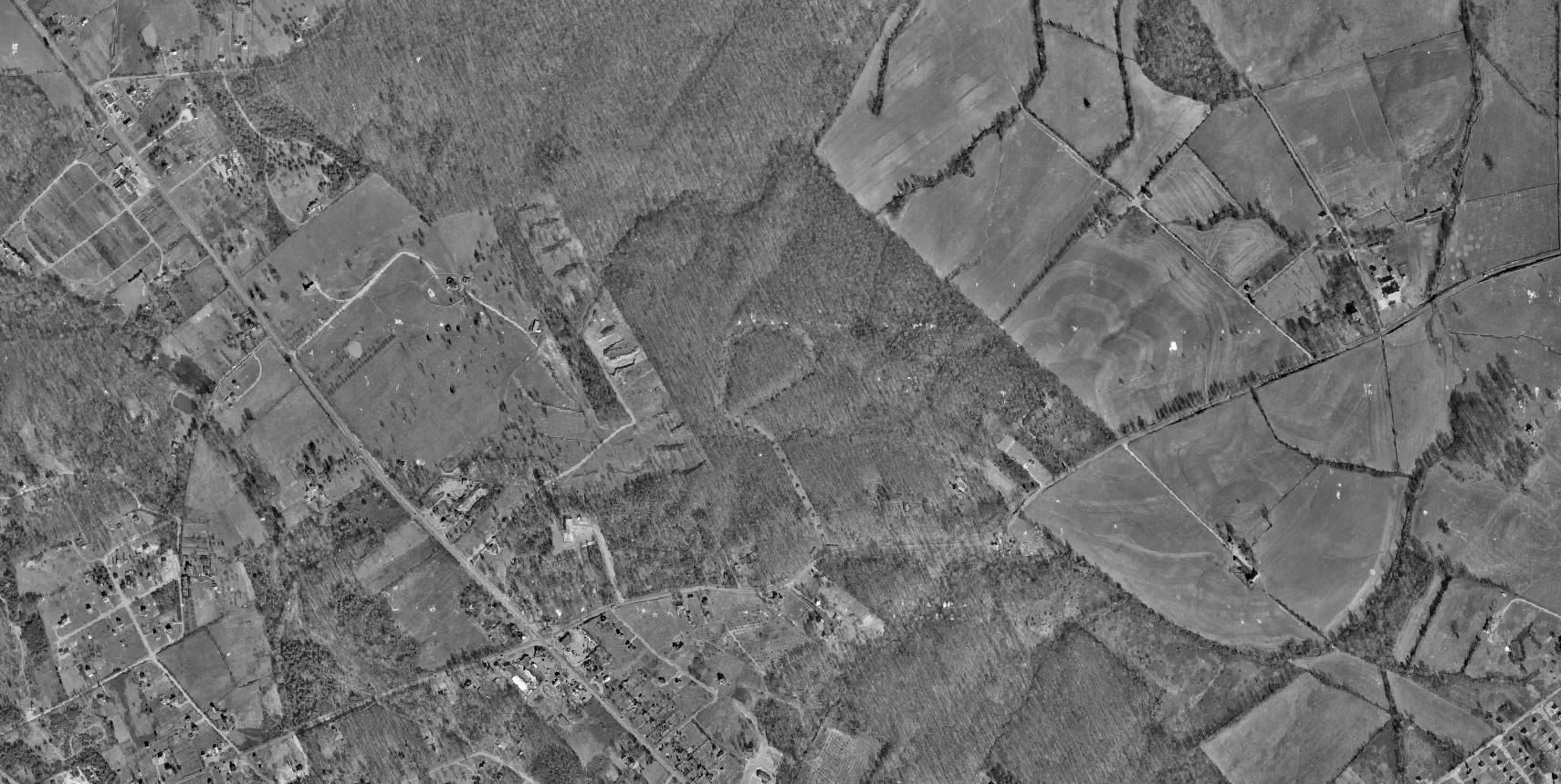
By 1960, things have moved a little. A new arterial cuts through, more parcels are cleared, and you can see the rough outline of what will become the intersection of Routes 7 and 123. But the parcel that will hold five circular towers is still a working landscape, not a building site.
Tysons Corner Center opened on July 25, 1968, with Hecht’s and Woodward & Lothrop and the dubious claim of being “the largest enclosed mall in the world.” We dug up a stack of old Tysons photos from this era a while back, and the throughline is the same: until the mall hit, this was a country crossroads. It was named after William Tyson, an actual 19th-century resident, not a developer’s marketing flourish.
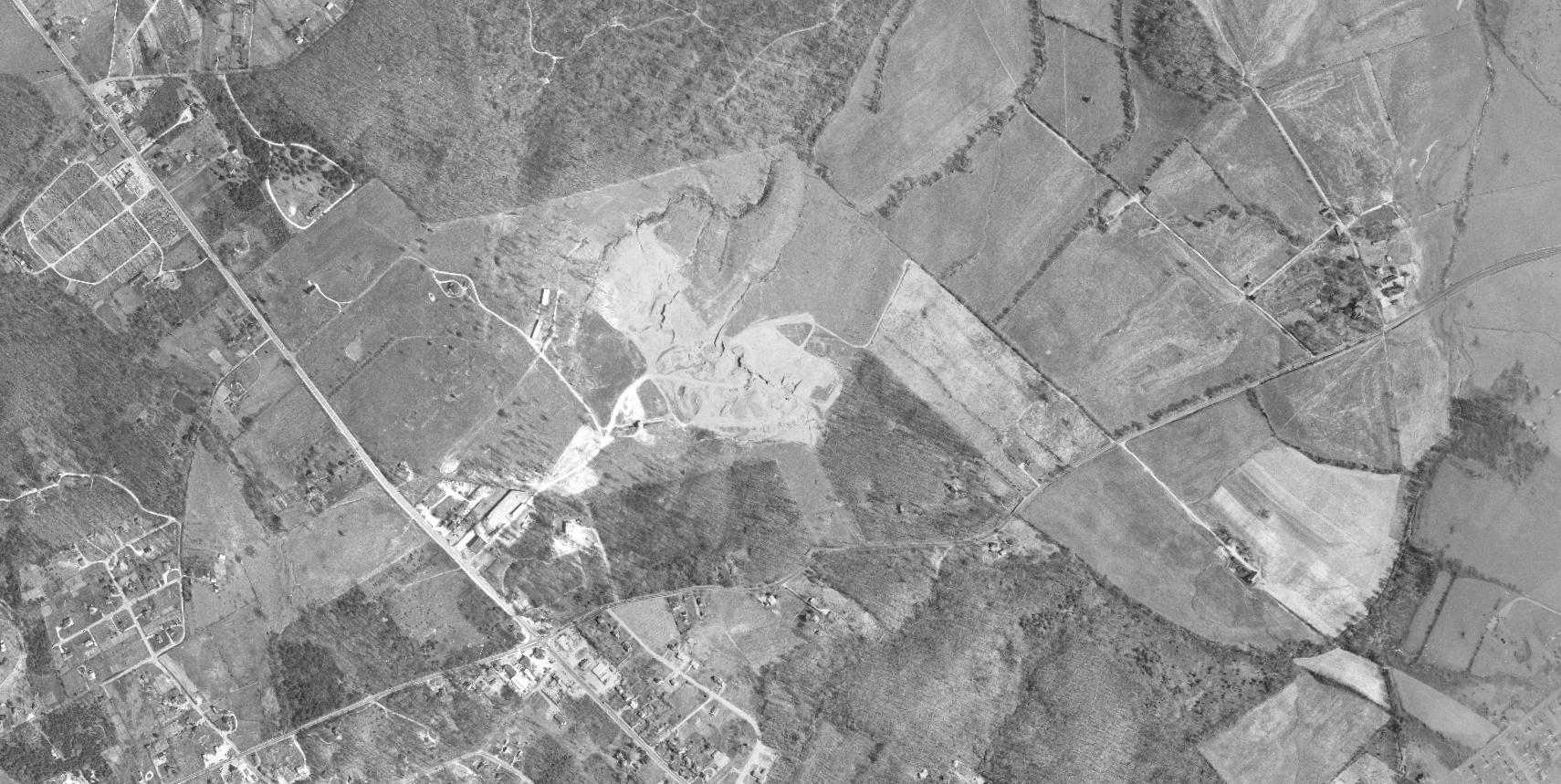
By 1972, the mall has been open four years and parking lots have started to multiply. The Rotonda parcel, though, is still tree cover. The land is sitting on the curb waiting to be picked up.
The Watergate builder turns to McLean
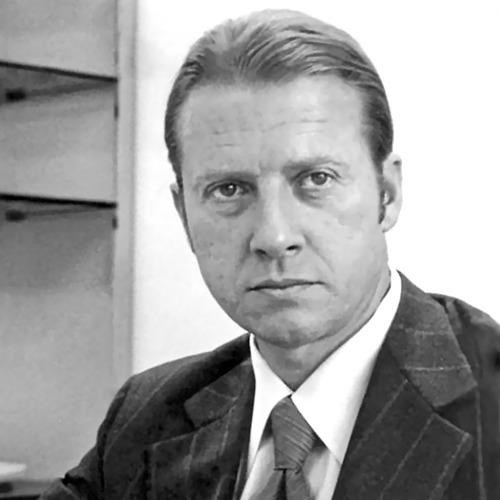
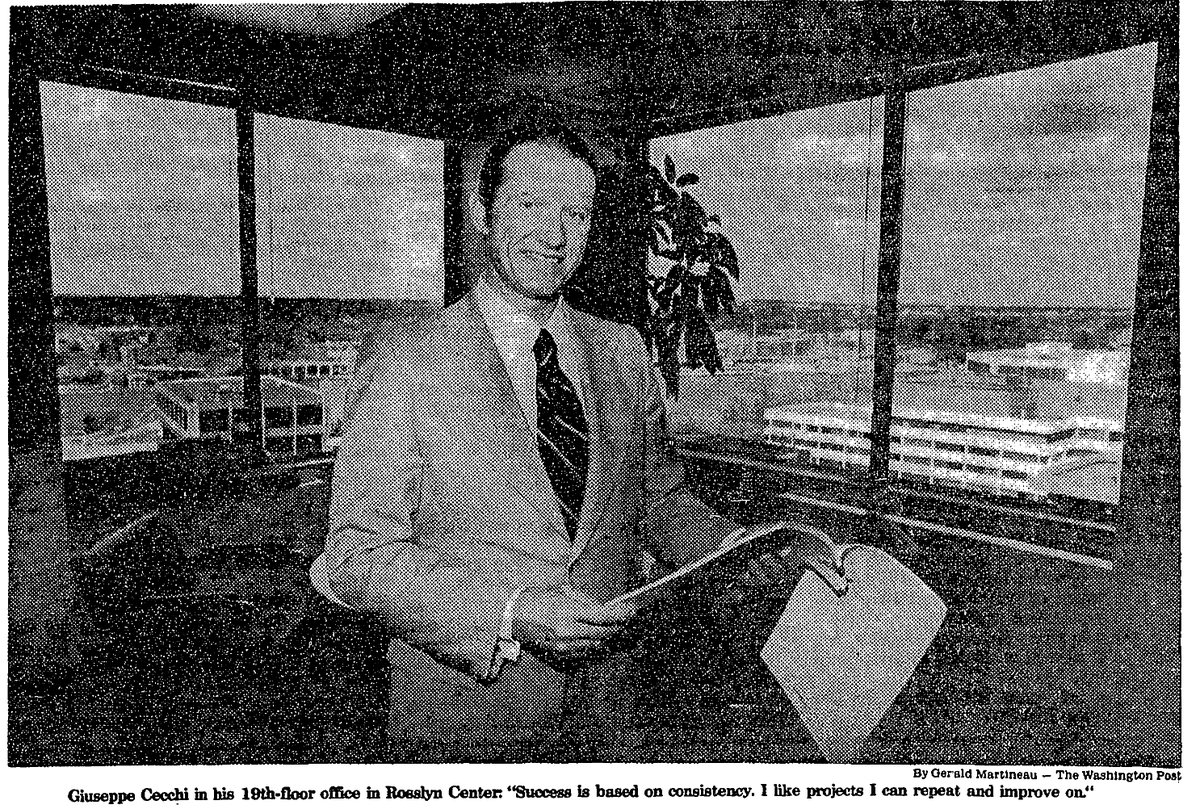
Giuseppe Cecchi was born in Milan in 1930, graduated from the Politecnico di Milano in 1955 with a master’s degree in engineering, and in 1959 left Italy to scout real estate for the firm Società Generale Immobiliare. By 1961 he was in Washington running the construction of what became the Watergate.
The Watergate complex opened in stages between 1965 and 1971, a few years before the burglary that gave it a different kind of fame. We covered the original 1962 height fight over the curved Italian-modernist towers Cecchi managed into existence on the Potomac. By the early 1970s he was looking for what to do next.
In June 1975, Cecchi gathered four colleagues, Aristide Onorati, Jesse Lee, Germana Storey, and Richard Grizzard, and formed International Developers, Inc. The new company’s pitch was that nobody in the DC area had yet built the kind of large, amenity-stuffed, condo-as-resort communities Cecchi had seen work overseas. McLean was where he tried it.
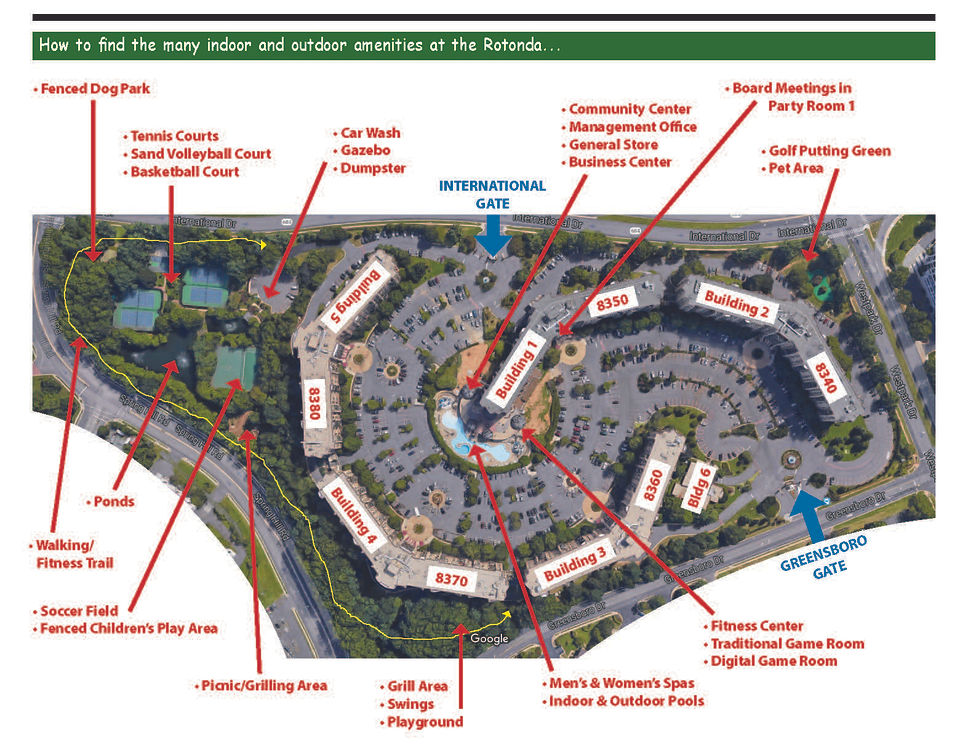
The site was a wooded parcel south of the Dulles Toll Road, a short walk from the mall. The pitch to buyers was a guarded gate, an indoor pool, six tennis courts, and a building that looked nothing like a brick garden apartment in Falls Church.
Five circles rising, 1972 to 1990
The clearest way to watch The Rotonda happen is from the air. Fairfax County’s GIS historical imagery preserves a flyover every few years, and the sequence below tracks the parcel from undisturbed woods through site clearing to the finished five-building crescent. Tap any image to expand it.
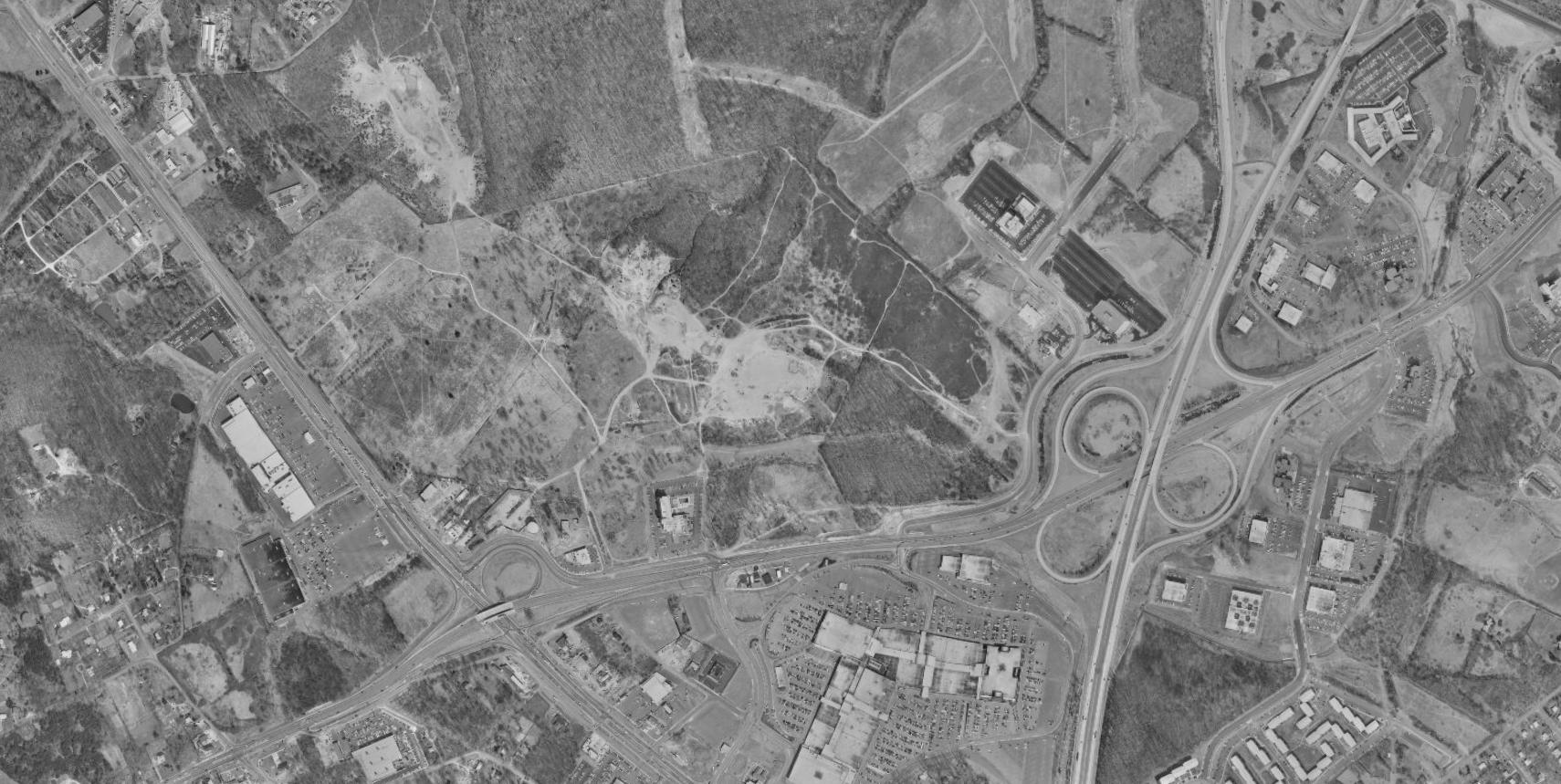
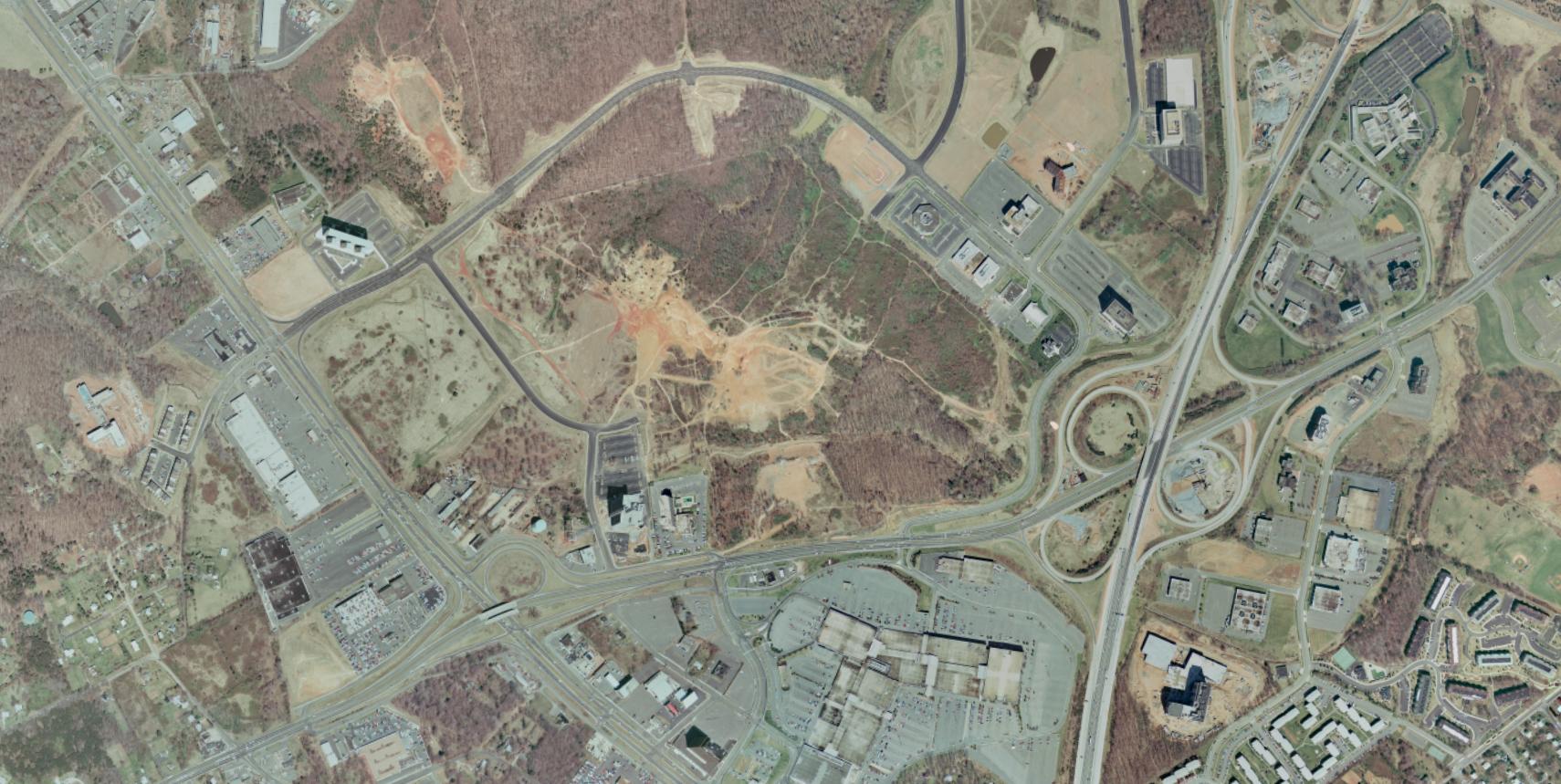
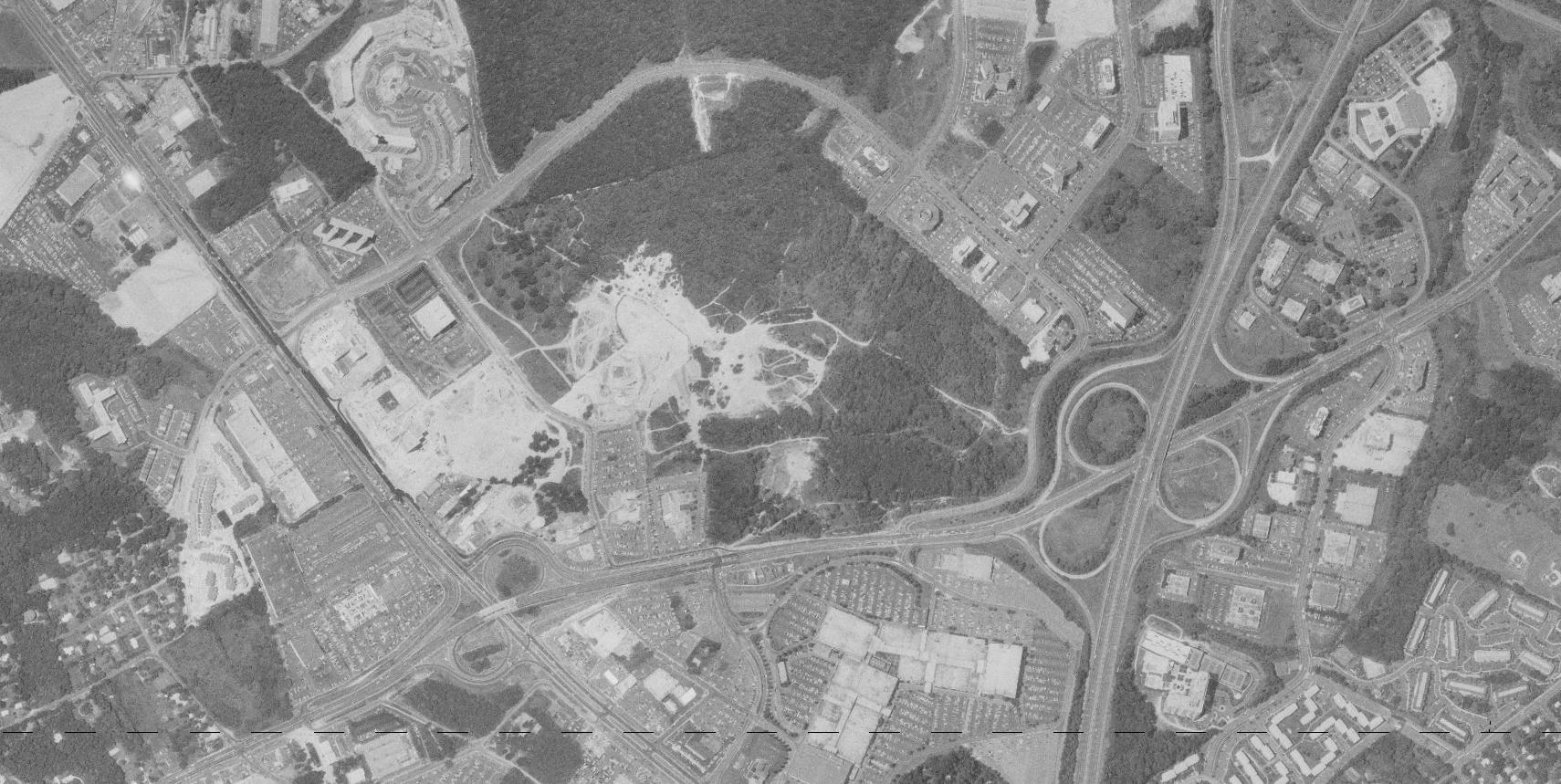
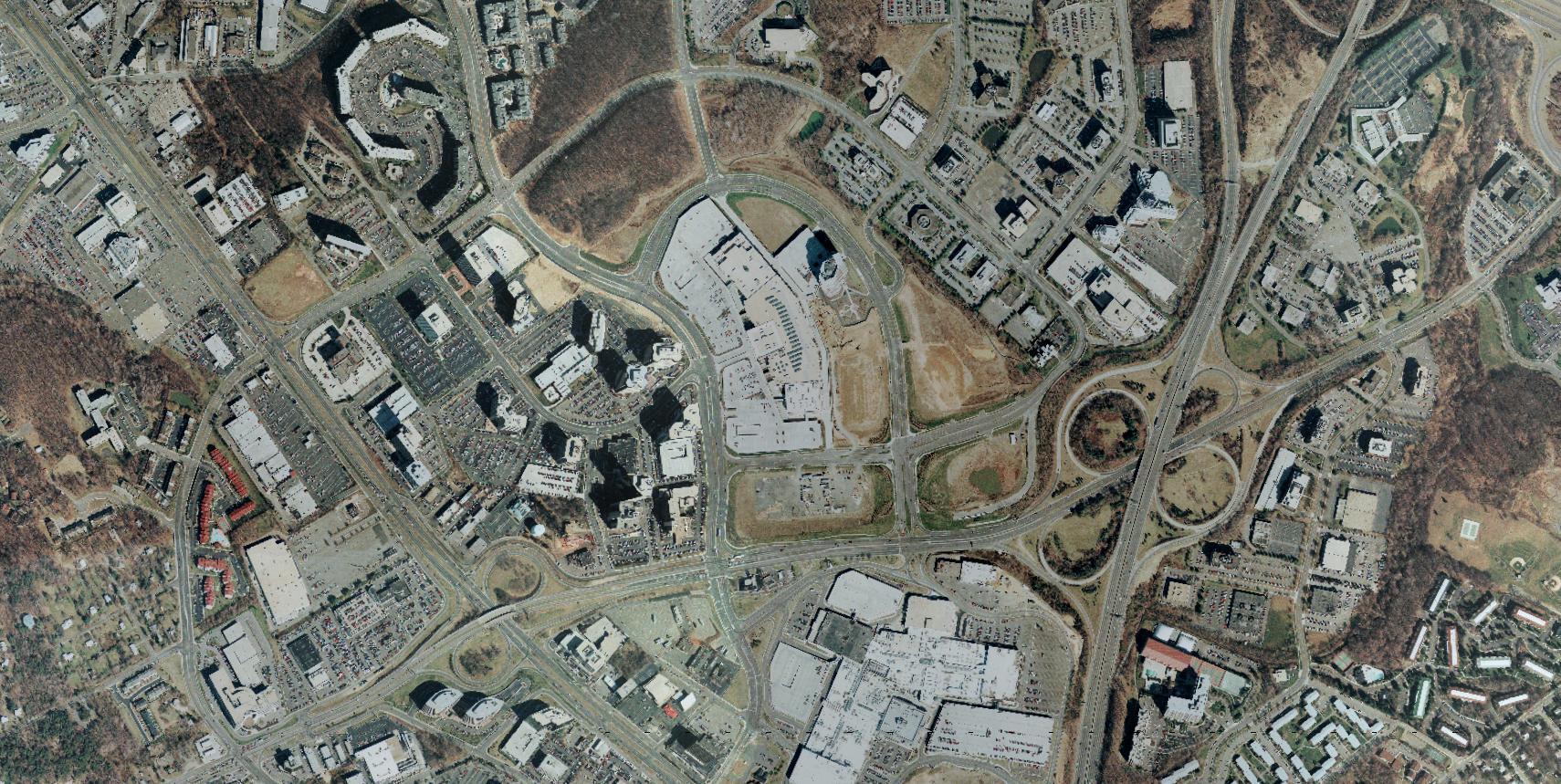
According to IDI’s own history, the company “completed The Rotonda in McLean” in 1980, finishing what it called a community of “1168 condominium homes within five 10-story buildings” with “resort-style amenities that were state-of-the-art.” Sale brochures for the early units priced one-bedrooms in the low $40,000s and three-bedrooms in the $80,000s.
The five buildings are not identical inside but their footprints are. Each is a circle of corridors wrapped around a central elevator core, with units fanning outward like spokes. The geometry is what gives Rotonda its name and the floor plans their oddly satisfying pie shapes.
“A rare island of community in a sea of commerce”
On July 9, 1988, the Washington Post ran a profile of The Rotonda by John Lancaster that residents have been quoting at each other for almost forty years. The set-up was simple. By 1988, Tysons was a verb for traffic, and Lancaster wanted to know who could possibly live inside the office-park maze. He went out there and found 3,000 people who liked it.
Most people think of Tysons Corner strictly as a commercial development, a place to shop, a place to work or a place to avoid, especially during rush hours. But does anybody actually live there?
Well, as a matter of fact, yes.
For many of the 3,000 residents of the Rotonda condominium development, the vast complex of asphalt and office towers at Tysons Corner in northern Fairfax County is often one of the first sights they see when they look out of their windows in the morning. But nobody is complaining.
John Lancaster, The Washington Post, July 9, 1988
A few paragraphs in, Lancaster dropped the line. “Situated just south of the Dulles Toll Road, the decade-old Rotonda is a rare island of community in a sea of commerce and construction.” That sentence is on a plaque in someone’s brain at Rotonda to this day.
The piece is full of small period details. The buildings had “strict rules” against skateboards and against hanging plants on balconies. The decade-old units were “originally sold for $40,000 to $80,000” and by 1988 were trading at “$110,000 and $300,000, in addition to average monthly condo fees of $200, excluding electricity.” Property values, Lancaster wrote, had appreciated 25 percent in the prior year alone.
The domelike community center was equipped, in Lancaster’s words, “like a luxury ocean liner, with weight room, snack bar, general store, beauty parlor, even indoor bowling lanes and a driving range.” Classes were offered in yoga and aerobics. Most of those rooms still exist; the bowling lanes do not.
And the residents Lancaster talked to had clearly already heard the question and decided they did not care. Judy Light, then president of the owners’ association, told him: “I have friends with houses. They spend their falls raking leaves, their winters pushing snow and their summers mowing grass. You don’t have any of that here.” Branson Marley, a retired Library of Congress division chief, was blunter: “I’d had enough of Harry Homeownership. I was tired of being the yard man.”
Goldie Hawn slept here
In 1982, Norman Jewison’s Best Friends hit theaters with Burt Reynolds and Goldie Hawn playing a Hollywood screenwriting couple who decide to elope and visit each other’s parents. Reynolds’s character, Richard Babson, has parents who live in McLean. The film shot the parents’ apartment scenes at The Rotonda.
On screen, Reynolds calls the building “the biggest condominium in Virginia, honey,” and Hawn’s character grows increasingly desperate to crack a window. The Rotonda’s strict no-screen, sealed-glass design becomes a comic engine. Residents, on the other hand, considered the cameo a flex.
Lancaster noted the joke in 1988. “Burt Reynolds’ parents do not really live there,” he wrote, “although his cinematic parents did in the 1982 comedy ‘Best Friends.'”
A lawsuit, a Cecchi empire, and 25 percent appreciation
The 1980s were not all sauna and tan lines. Lancaster noted in passing that the owners’ association had been “engaged in a long-running legal battle with Cecchi over allegations of faulty construction in some of the buildings and garages.” Cecchi won at the Fairfax Circuit Court level. The owners appealed to the Virginia Supreme Court.
That legal fight ran in parallel with Cecchi’s broader run. The Washington Post dubbed him “Condo King” in an April 19, 1981 feature by Sandra Boodman, sizing up an empire then valued at $300 million. By the time he died in April 2024 at 93, IDI’s published count was 28 residential communities, about 14,000 homes, 2.7 million square feet of office, 1,400 hotel rooms, and 2,400 acres of land development.
The Rotonda was the first of the resort-style condo communities Cecchi built under the IDI name. Porto Vecchio in Alexandria followed. Montebello in Alexandria came next. Then The Belvedere in Arlington. The five-circle Tysons community was the prototype.
The Rotonda today, with a Metro stop and a casino fight
In 2014, the Silver Line opened and the Tysons Metro station landed two blocks from the Rotonda’s front gate. The community fought a 2016 effort to put a casino in Tysons, ran a quiet multi-million-dollar renovation of its 2,000-square-foot community fitness center the same year, and replaced the carpet and lobby tile in all five towers in 2023.
One-bedroom units that sold for $40,000 in 1980 now trade in the high $300,000s. Three-bedrooms can clear $700,000. The condo fees, residents will tell you, are the price you pay for the 24-hour gate, the indoor pool, the sauna, and not having to be the yard man.
The amenity list at the central community center has held up too. Indoor and outdoor pools, six lit tennis courts, a basketball court, a putting green, a sand volleyball court, an off-leash dog park modeled on the Fairfax County version, and electric vehicle charging stations added in 2018. A gazebo overlooks two ponds at the back of the property. The fitness trail still runs through the woodland buffer that has been there since the trees grew back in the late 1980s.
The buildings themselves are still the same five circles Cecchi finished in 1981. The “graceful curves” line the HOA’s website uses today is the same one the original sales brochures used. The hanging-plants rule, last we checked, is still on the books.
About two of every five units are owned by people who do not live in them, a ratio Lancaster also noted in 1988. The rental population skews toward singles working in nearby office buildings and short-term contractors at the federal agencies clustered along the Dulles corridor. The owners’ association still publishes a 2026 condo fee schedule and runs an evening yoga class.
Why The Rotonda matters in Tysons history
The Rotonda is the first sign Tysons Corner was ever going to be more than a mall. The mall opened in 1968. The office towers came next. Cecchi’s five circles, finished in 1981, were the first time anyone seriously asked: can people live here?
Forty-five years later, with a Silver Line station next door and the casino fight behind it, the answer is still yes. The island held.
It rose in the same Fairfax County high-rise wave that produced a much darker story a few miles east at Bailey’s Crossroads: the Skyline Plaza Collapse.