On the morning of July 6, 1926, the Washington Post opened its front page with one of the best ledes the paper ever ran: “The east steps of the Capitol became a stage last night, and on them were unfolded the story of America.”
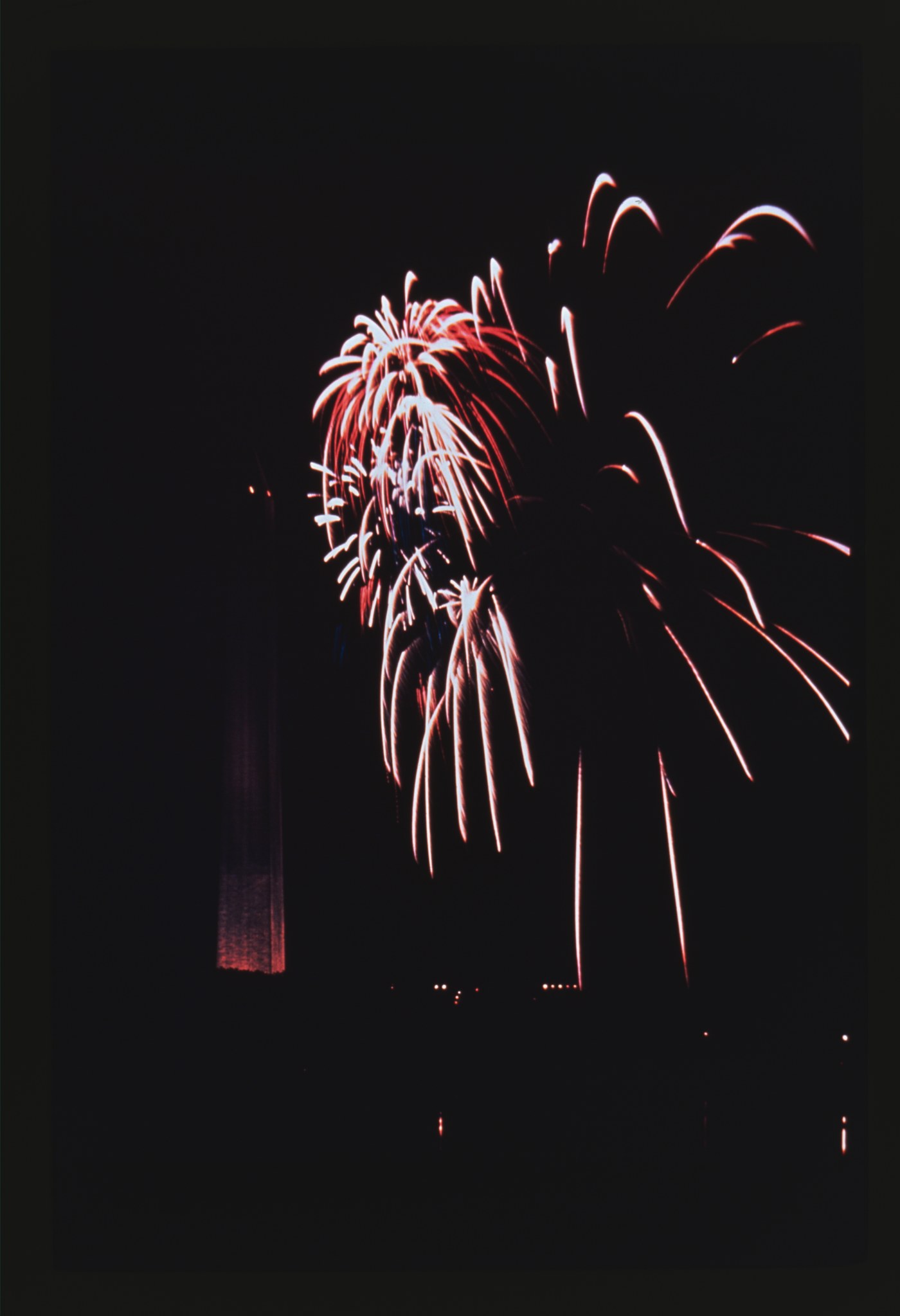
The night before, Washington had thrown itself a birthday party for the ages, marking the 150th anniversary of the Declaration of Independence. A cast of 1,000 performed on the Capitol steps before 30,000 people, while 50,000 more watched fireworks burst over the Washington Monument.
Now that America has reached 250, it’s worth looking back at how this city celebrated 150. Philadelphia got the world’s fair. Washington got something better: a party the city built for itself, block by block, from Petworth to Takoma Park.
The Fourth That Fell on a Sunday
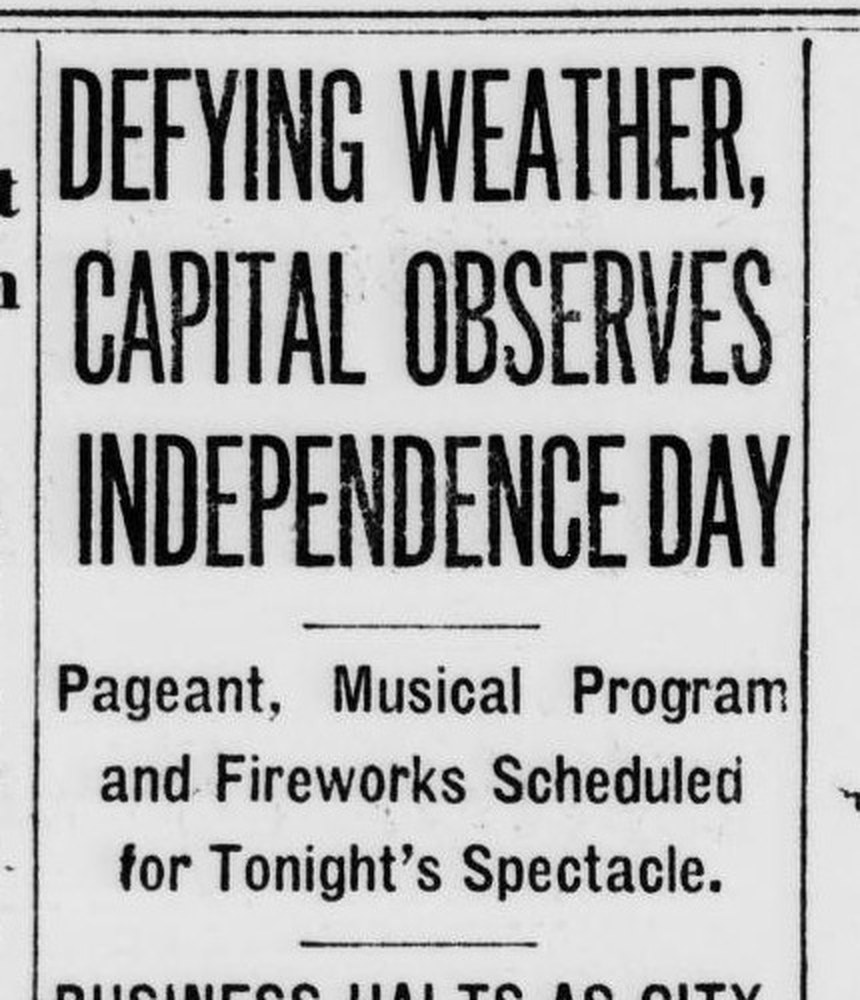
There was one wrinkle. July 4th, 1926 was a Sunday, so official Washington pushed the celebration to Monday, July 5th. Churches opened the observance with commemorative sermons, and the Post reported that holiday heat was expected to cause a “heavy exodus to resorts.”
It was also President Calvin Coolidge’s 54th birthday. He remains the only president born on the Fourth of July, and in 1926 his birthday landed squarely on the country’s sesquicentennial.
Coolidge celebrated like Coolidge. “On account of the drizzling rain the President spent his birthday anniversary yesterday in the seclusion of the White House, with the exception of his attending church in the morning,” the Post reported on July 5th.
The next morning, the president and Mrs. Coolidge took a special train to Philadelphia, where he addressed roughly 200,000 people at the Sesquicentennial Exposition. Before heading home, he walked across the brand-new Delaware River Bridge, opened just four days earlier, and helped plant a tree in Camden.
The date carried one more layer of history that year. It was the centennial of July 4th, 1826, the day Thomas Jefferson and John Adams both died, fifty years to the day after their Declaration was signed.
Philadelphia Had the Fair. Washington Had the Declaration.
Philadelphia’s exposition had an 80-foot Liberty Bell studded with 26,000 lights and a fairground the papers called the “Rainbow City.” But the actual Declaration of Independence spent America’s 150th birthday right here in Washington.
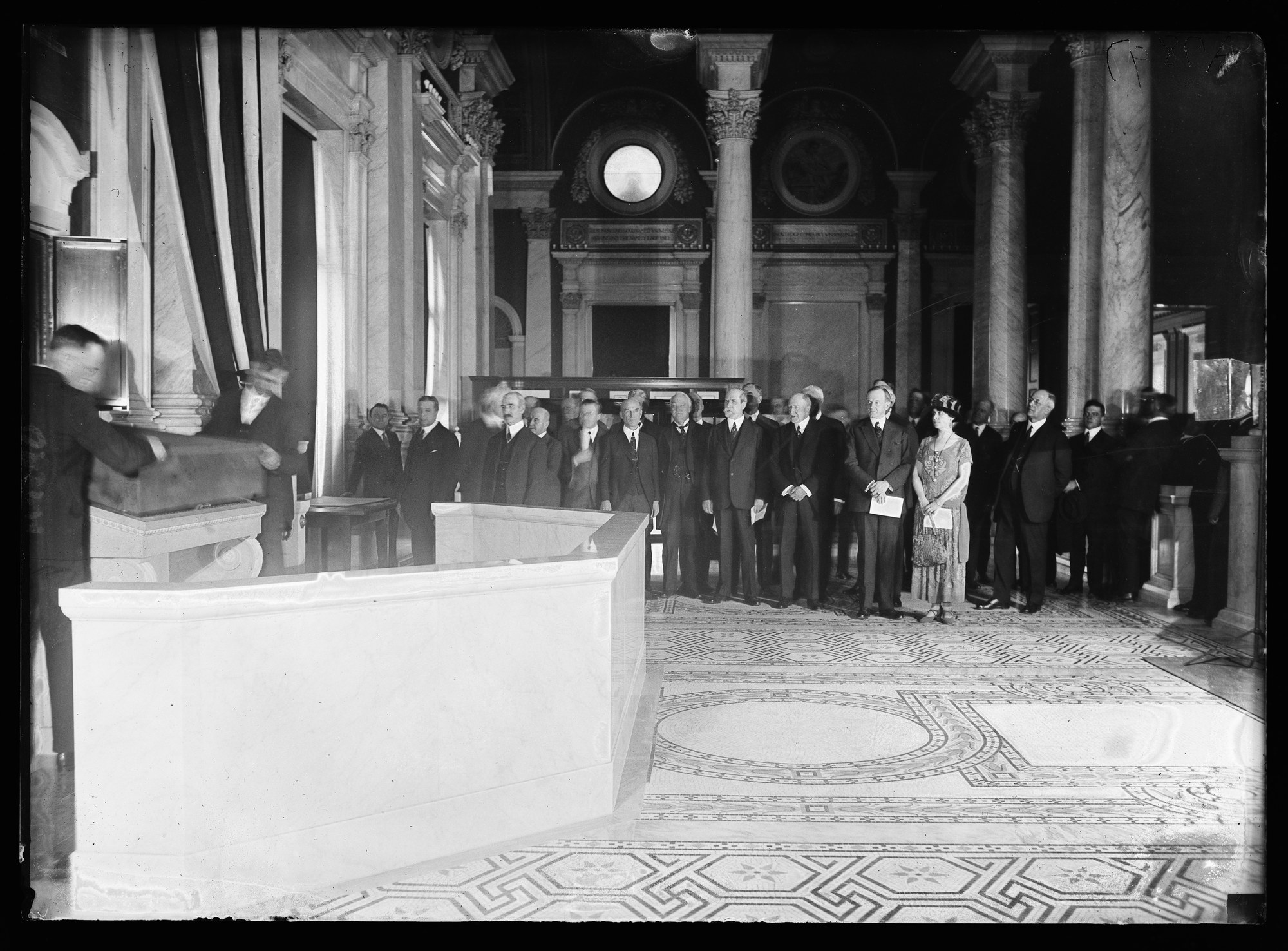
Since February 28th, 1924, the engrossed parchment had rested in a marble shrine in the Great Hall of the Library of Congress, dedicated in a ceremony attended by President and Mrs. Coolidge. It would not move to the National Archives until 1952.
A Party Paid for by Washingtonians
Nobody handed Washington a budget for any of this. The pageant and the fireworks were financed by popular subscription, with the fundraising committee headed by businessman Isaac Gans and United States Marshal Edgar C. Snyder.
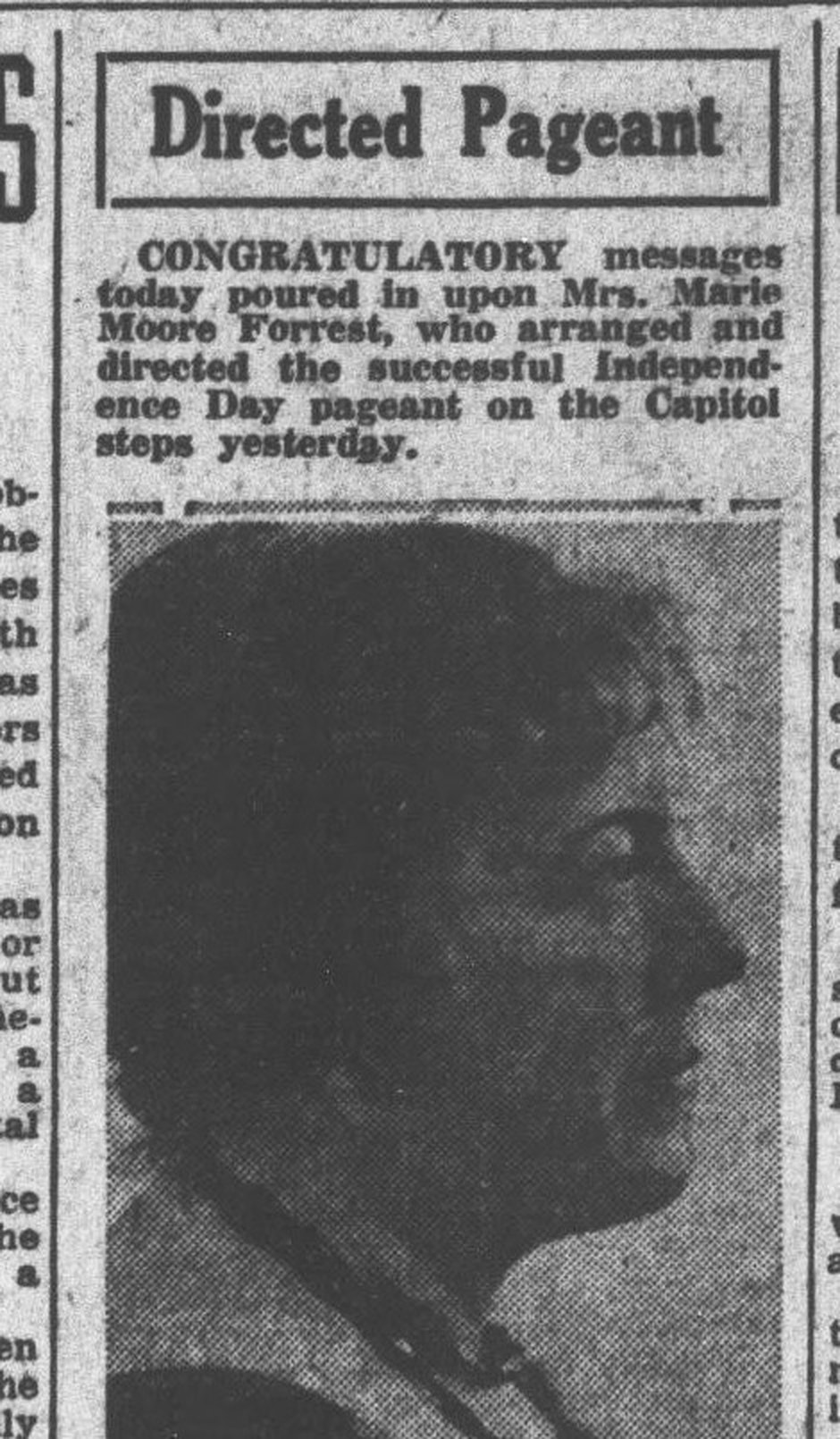
The pageant was produced by the District’s Community Center Department and directed by Mrs. Marie Moore Forrest, the city’s reigning pageant master. The Washington Times reported the next day that congratulatory messages “poured in” on her.
The Capitol Steps Become a Stage
Monday evening at 7:45, the United States Army Band and Marine Band, “harmoniously massed together,” opened the program under the alternate direction of Capt. W. J. Stannard and Taylor Branson.
The building behind them was part of the show. For the occasion, the Post reported, the Capitol would be “immersed in a flood of lights of vari-colored hues for the first time in its history.”
At 8:15, Engineer Commissioner J. Franklin Bell presented prizes to six schoolchildren who had won the Post’s Declaration of Independence essay contest. Among the winners the paper published that week was 13-year-old Betty C. Denham of 1324 Monroe Street NW, who took the $5 grand prize.
Then, at 9 o’clock, the pageant. A cast of 1,000 acted out the “Story of America” with the great dome as a backdrop. It opened with a dance of the primitive forest and an Indian scene performed by members of the Order of Red Men, and then history came pouring out of the wings:
Then, like ghosts, came Lief Ericson and his Vikings, Columbus and the Spaniards, the Cavaliers, the Pilgrims, the Puritans, Hendrik Hudson and the Dutch, Pere Marquette and the French, and William Penn and his Quakers.
George Washington and Thomas Jefferson strode out of the Rotunda to a bugle call and “a great cheer.” In the signing tableau, John Hancock announced over the loudspeakers that he would sign the Declaration so “his majesty” could read it without his “specs.”
When Abraham Lincoln emerged from the Rotunda, four aging veterans of the Grand Army of the Republic walked behind him, and the crowd answered with “a great wave of handclapping.”
One of the night’s biggest ovations went to a chorus of 500 voices from the Washington Federation of Colored Churches, drawn from “practically every colored church in the city” and led by Miss Virginia Williamson. In a rigidly segregated Washington, 30,000 people cheering that choir from the Capitol steps is a detail worth sitting with.
“No Taxation Without Representation”
The orator of the evening was Rep. Henry Riggs Rathbone of Illinois, and this is where longtime GoDC readers should sit up. Rathbone was born in Washington, the son of Major Henry Reed Rathbone and Clara Harris, the young couple sitting beside the Lincolns in the box at Ford’s Theatre on April 14th, 1865.
Rathbone told the crowd of America’s greatness, but declared there was one goal left to reach: “to become the moral leader of the world.” Then he turned to his hosts.
“Recalling that ‘no taxation without representation’ was the great battle cry of the revolution,” the Post reported, Rathbone made a stirring “appeal for national suffrage and national representation for the District of Columbia.”
Think about that. At the official celebration of the nation’s 150th birthday, on the steps of the Capitol itself, the keynote was a demand for DC voting rights. A full century later, with the White House and Congress once again reaching deep into how this city is run, Rathbone’s appeal reads like it could have been delivered this morning.
300 Shells Over the Monument
Across town, the Monument grounds were, in the Post’s words, “turned into a mock battlefield,” with a 35-minute “aerial bombardment” of 300 great shells. The whole show cost $500, roughly $9,000 in today’s dollars, under the direction of committee chairman E. C. Graham.
The Navy Band played for an hour beforehand at the Sylvan Theater under Charles Benter. At 9 o’clock the band struck up the national anthem, the first shells drew Old Glory in fire above the grounds, and a 13-shell salute to the president followed.
“President Coolidge undoubtedly heard it at the White House,” the Post noted, “although it could not be established last night whether the Coolidges witnessed the display.”
Then the Post’s reporter turned around to describe the crowd, and gave us one of our favorite paragraphs of 1920s Washington journalism:
There they were, flappers and their sheiks, knots of men and women, whole families, lying prone on the ground by thousands, protected from the damp grass by automobile seats, raincoats, newspapers, anything that could be improvised.
Spectators filled the Ellipse and every corner of Potomac Park. A large crowd gathered on Key Bridge and had to be “protected by police to prevent anyone falling into the river.” Cars jammed the park driveways in snarls the paper judged “as impossible to untangle as the Gordian knot itself.”
The set pieces included an American flag descending beneath a bright star and a Liberty Bell outlined in red, white and blue fire with “1776” written beneath it. The smoke grew so thick it blotted out the searchlight that played on the Monument from the roof of the Powhatan Hotel.
And the kids? “Excitement among the youngsters was at least as great as at a circus,” the Post wrote, though some of the smallest “could not stand it all” and dissolved into tears. Others staged miniature fireworks displays of their own at the edges of the grounds.
Meanwhile, in the Neighborhoods
The genius of 1926 was that the party wasn’t only downtown. Community celebrations ran all day across the city, and the Post’s coverage reads like a tour of Washington’s front porches.
Petworth
Petworth ran a parade of 16 floats mounted on automobiles down Georgia Avenue between Shepherd and Webster streets, under the auspices of the Petworth Citizens Association. First prize went to a “local builder” named Morris Cafritz, a name you may recognize, for his Liberty Bell float.
The Cafritz float was serious business. Valued at $1,000 and two weeks in the making, it carried a plaster Liberty Bell modeled from a photograph of the original and finished in bronze, six feet high on a platform measuring 24 by 16 feet, with four boys in Minute Men costume standing at the corners with muskets.
The Petworth Women’s Club took the organizations prize with a “Sesquicentennial of Signing of the Declaration of Independence” car. And in the neighborhood ball game at the Iowa Avenue playground that week, the Fremonts beat the Cardinals, 10 to 7.
Takoma Park
Takoma Park billed its celebration as the most elaborate in the section’s history: a 9 a.m. parade forming at Carroll and Park avenues, exercises at Piney Branch Road and Dahlia Street, and 14 tableaux depicting “the evolution of the immigrant.”
The speaker was Harry E. Hull, the United States Commissioner General of Immigration, just two years after the 1924 immigration act had cut the flow of newcomers to a trickle. Rain pushed the fireworks and tableaux to the following night, but they went off.
Michigan Park
In Michigan Park, several hundred residents “refused to let rain interfere.” More than 100 children paraded in costume from Twelfth and Upshur streets northeast to the athletic field at Michigan Avenue and Perry Street, led by a police escort and the Boys Independent Band.
There was a “salute of 21 bombs to the flag,” prizes for the prettiest and funniest costumes, and a closing sandlot game between the Crandall’s and the Kid Kellys, which the Post lovingly described as “two insect teams of the neighborhood.”
Wesley Heights
Brand-new Wesley Heights held the first Fourth of July celebration in its young life: a flag raising at 9 a.m., a baseball game pitting residents south of Klingle Street against those north of it, a children’s dress parade, a plate supper at the Community Club, fireworks at 8, and an informal dance to close out the night.
A Living President on a Half Dollar
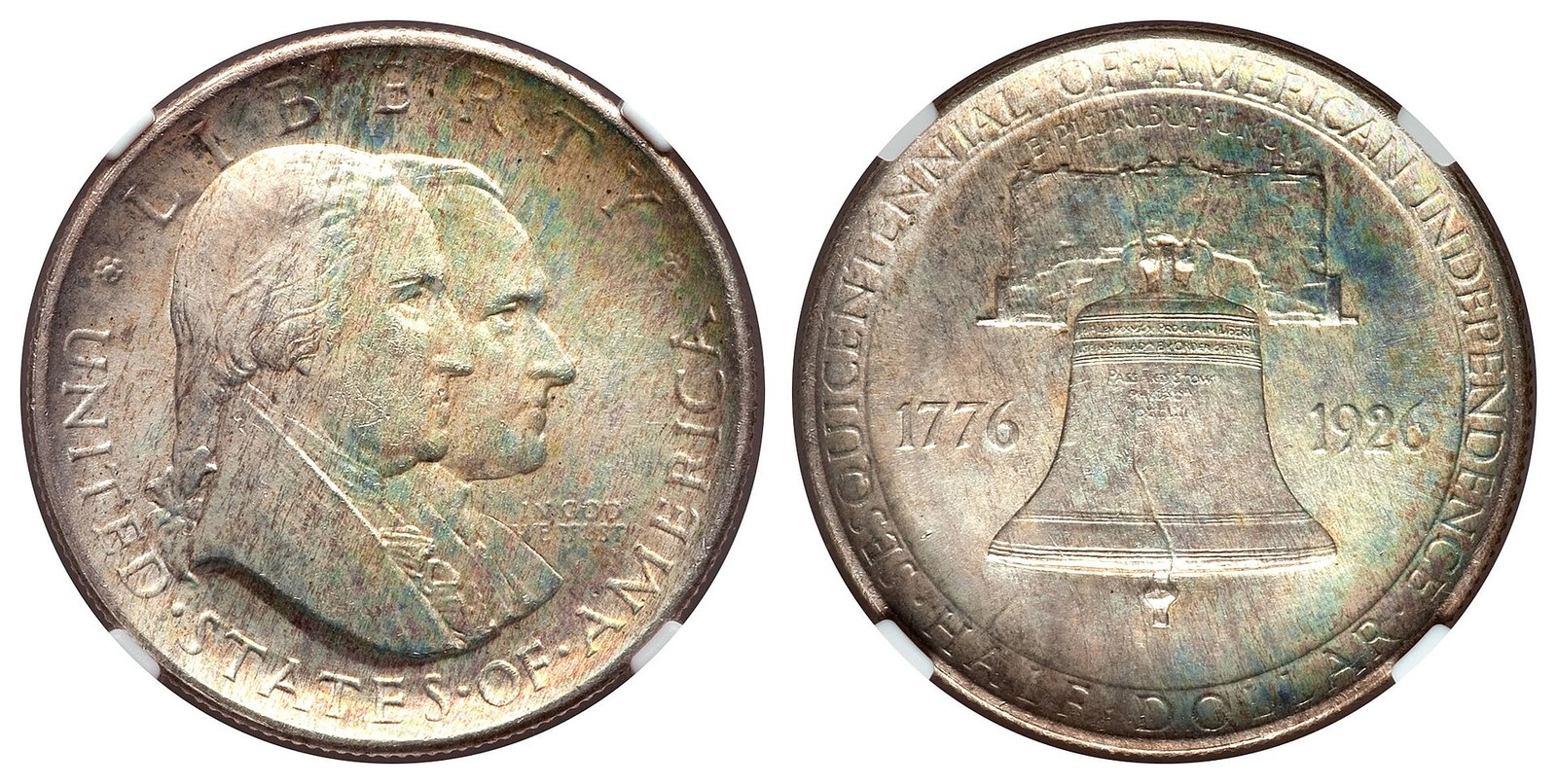
The sesquicentennial left behind one artifact you can still hold in your hand. The 1926 commemorative half dollar paired George Washington with Calvin Coolidge, the only time a living president has ever appeared on a United States coin.
The Party Rolled On
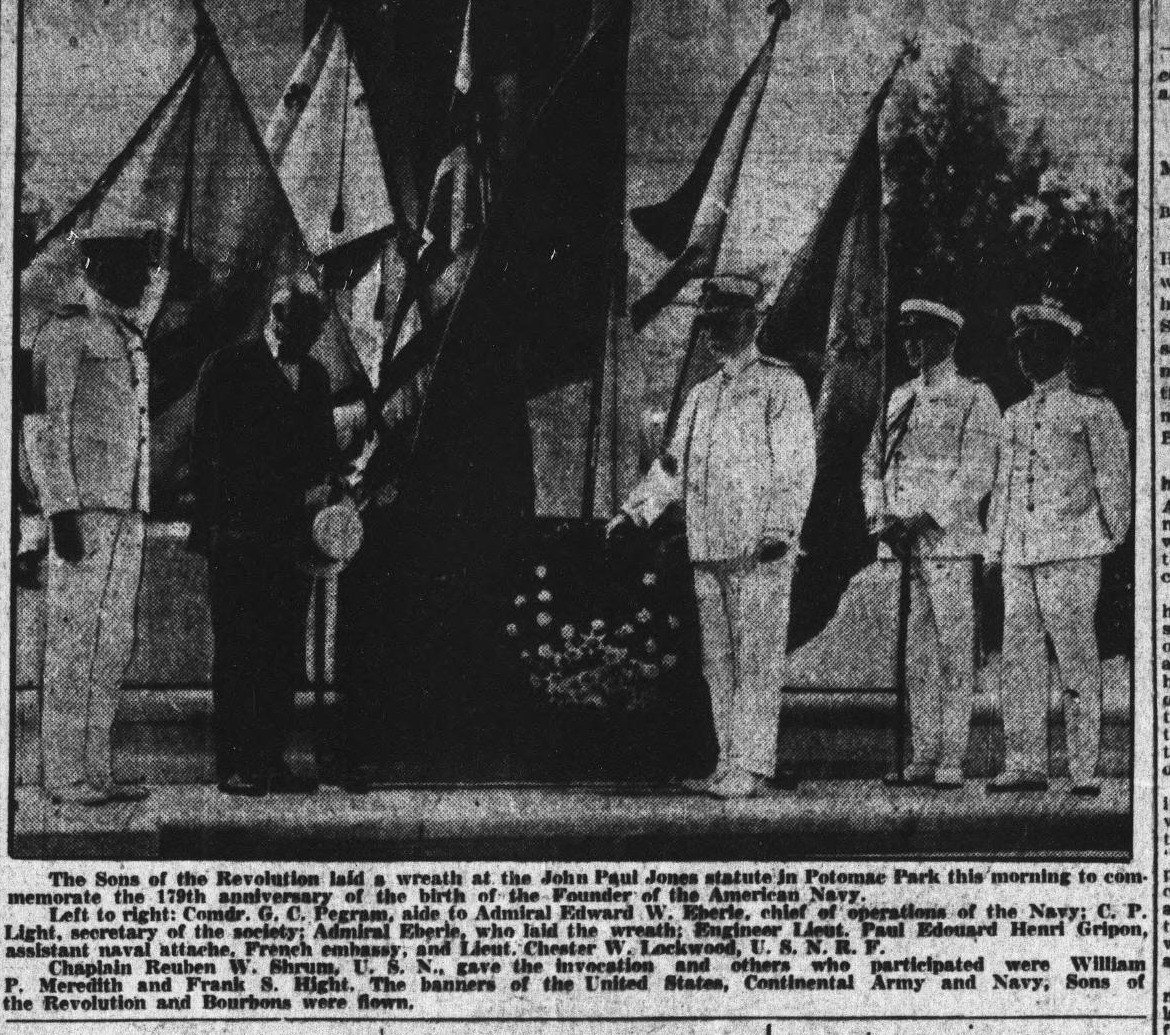
The celebrating didn’t quite stop on the 5th. The next morning, the Sons of the Revolution laid a wreath at the John Paul Jones statue in Potomac Park to mark the 179th birthday of the founder of the American Navy, with Admiral Edward W. Eberle, the chief of naval operations, among those saluting.
The Blue Plaid Coat
Our favorite trace of the whole week hides in the Evening Star’s lost and found column on July 6th.

“COAT – During pageant Capitol grounds, child’s blue plaid coat, with cape. Reward. Call Chastleton Hotel, Ora McNeill.”
Somewhere in that crowd of 30,000, while Washington and Jefferson strode out of the Rotunda, a child slipped out of a blue plaid coat and it vanished into the night. Whether it ever made its way back to Ora McNeill at the Chastleton, the papers never said.
If this scratched an itch, we’ve also covered the 1919 Fourth of July victory parade down Pennsylvania Avenue, and if the Rathbone name stopped you cold, our piece on the Petersen House in 1907 is worth your time. Happy 250th, Washington.