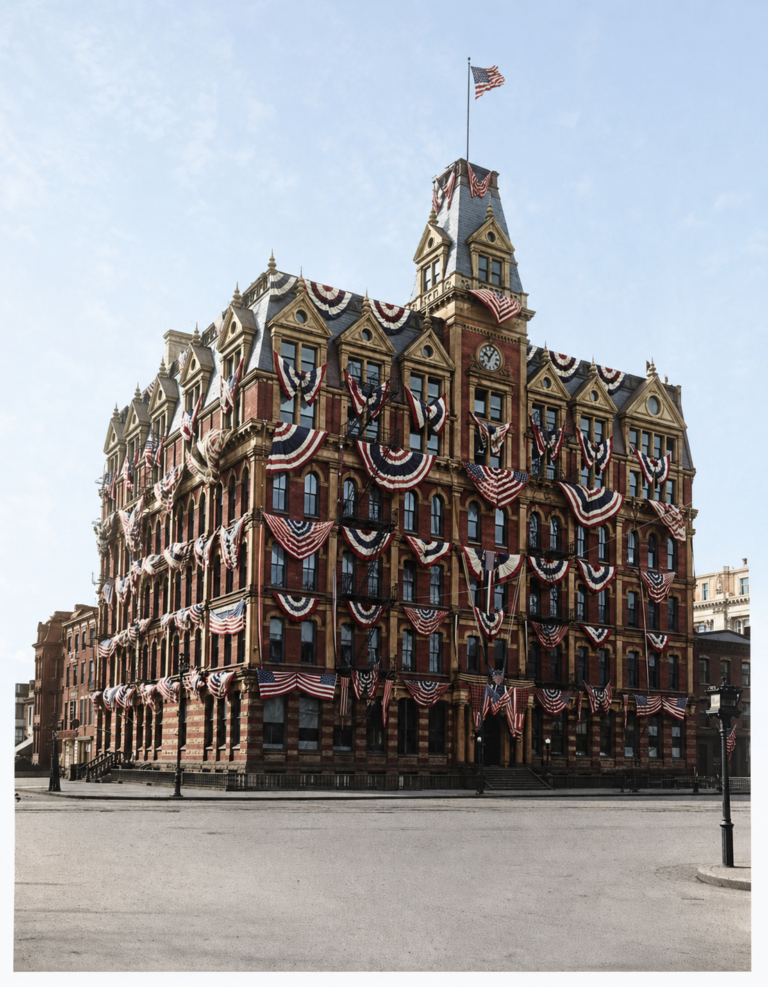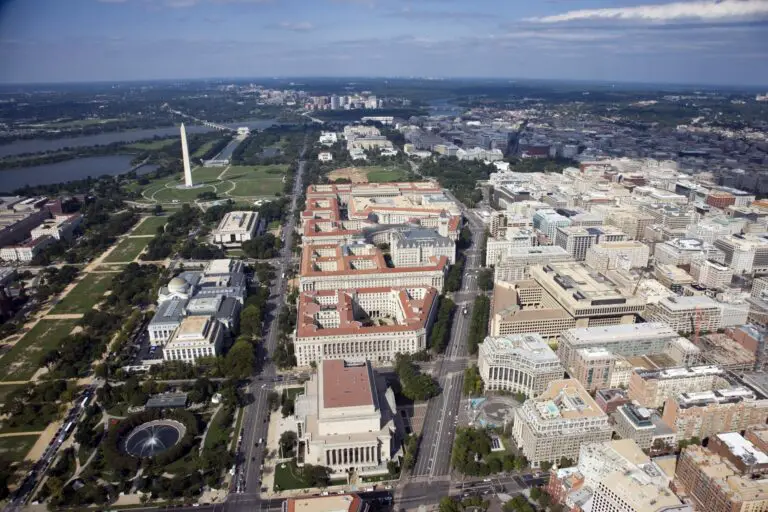

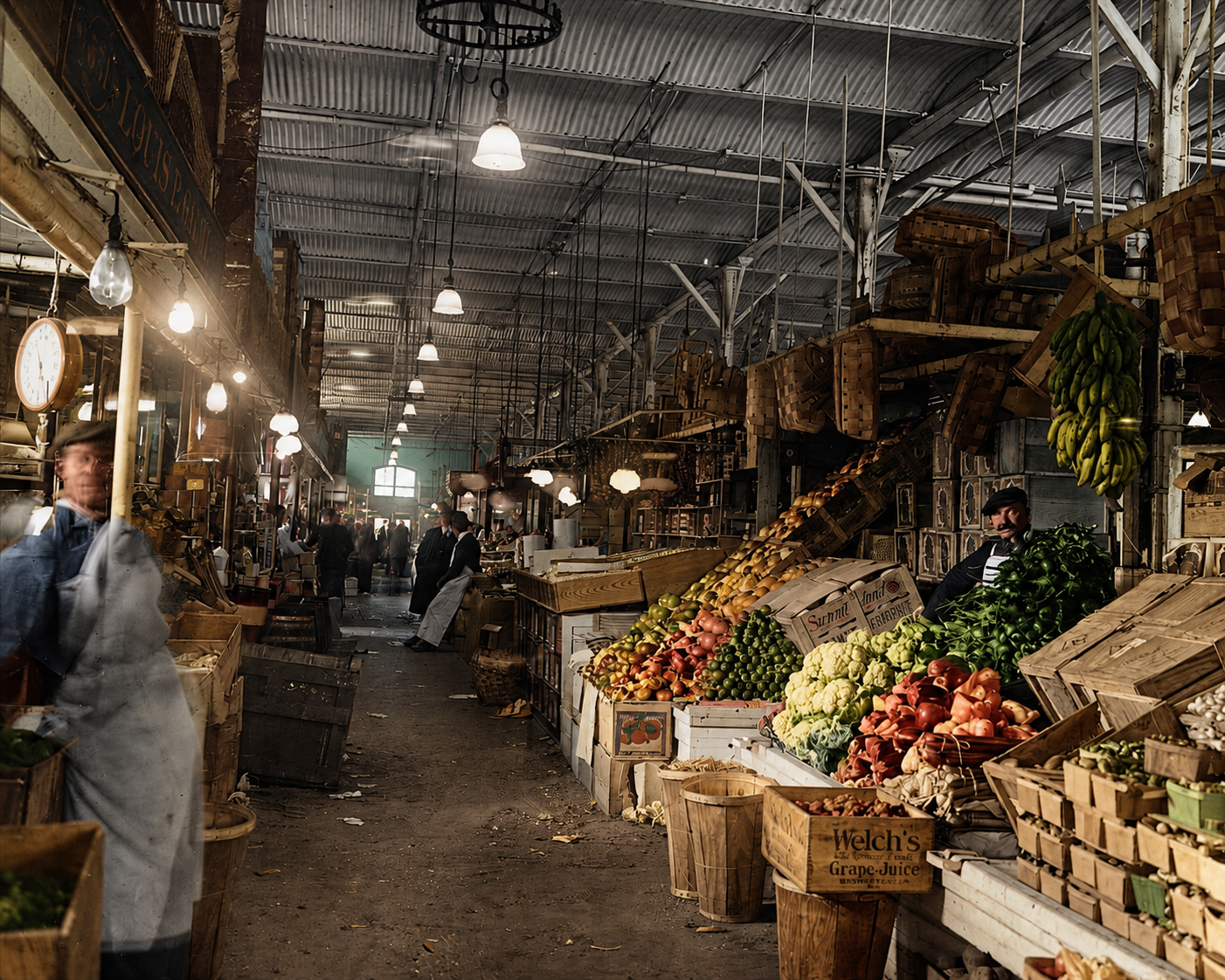
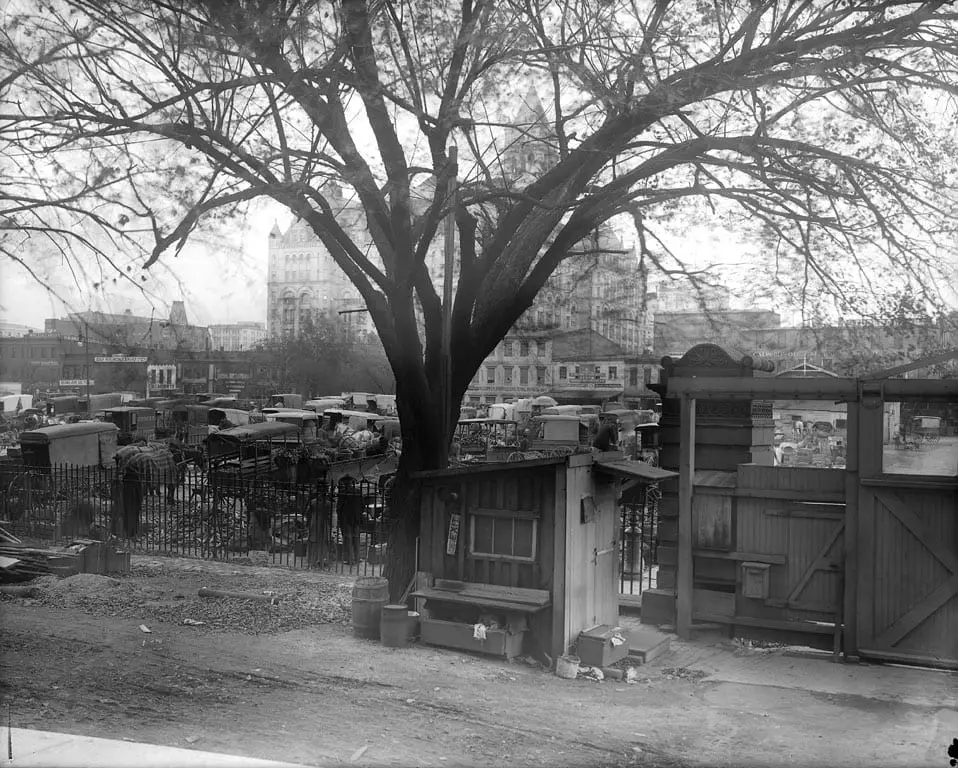
Before the National Archives occupied this stretch of Pennsylvania Avenue, Washingtonians came here to buy dinner. Center Market filled the block between 7th and 9th Streets, with B Street (now Constitution Avenue) along its southern edge. Adolph Cluss’s grand market hall opened in 1872 with 666 stalls, and the building came down in 1931 to make room for the Archives.
For more than a century, the site had brought together farmers, butchers, street vendors, and shoppers. The photographs show just how much activity once filled a block now occupied by a federal building.
The marsh market on the canal
In 1797, President George Washington designated two acres in the new federal city as a public marketplace. The market began operating in December 1801. On October 6, 1802, Mayor Robert Brent and the City Council formally established Center Market south of Pennsylvania Avenue between 7th and 9th Streets.
Section 5 of the ordinance warned that “no person shall sell or expose for sale in said market any unsound, blown, or unwholesome meat or articles of provision, under the penalty of five dollars for every offence.”
The block sat next to the Washington City Canal, which ran along what is now Constitution Avenue. The land was swampy and the nickname came naturally: Marsh Market. Early Washingtonians remembered hunting wild ducks in the wetlands and buying live fish directly out of the canal. Thomas Jefferson is said to have walked over from the President’s House to shop.
For its first decades, the market was a cluster of frame sheds and outdoor stalls. Slave traders also did business in and around it before Congress banned the District’s slave trade in 1850. Slavery itself continued in Washington until compensated emancipation in April 1862.
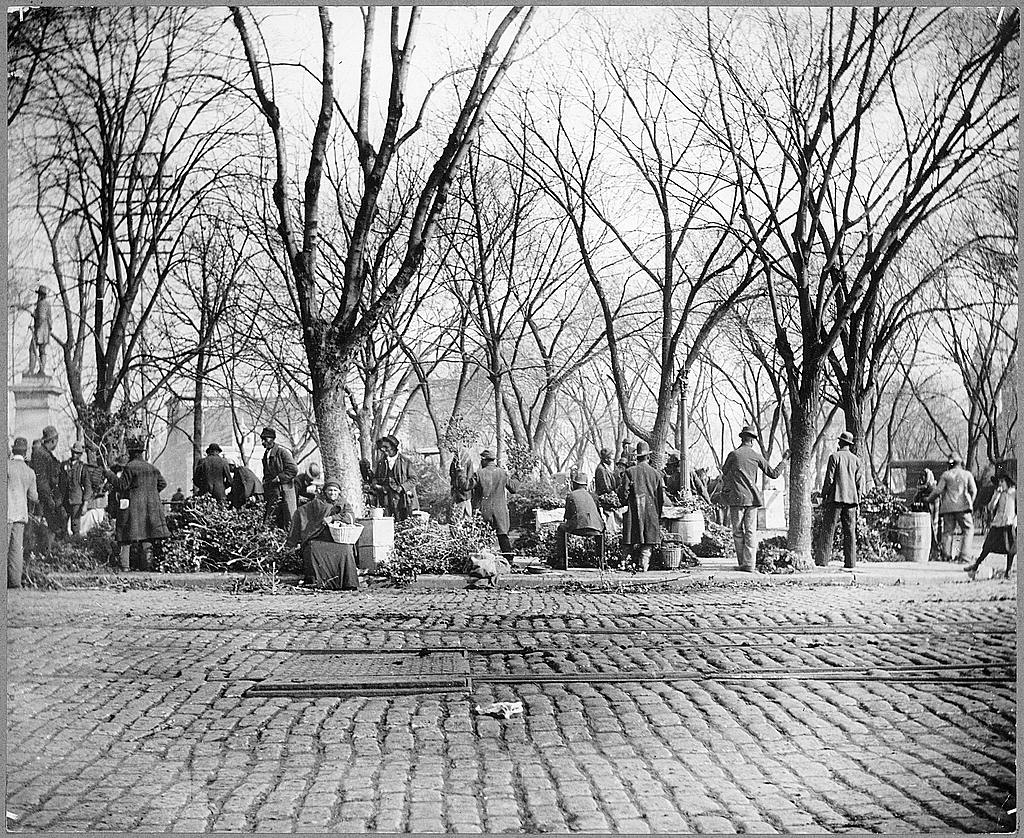
By 1850 the market was a hodgepodge of wooden sheds in one of the most prestigious locations in the country: a few blocks from the Capitol on one side, a few blocks from the White House on the other. By 1870 there were 700 vendors working out of it. Congress and the public agreed it was a health and safety hazard. Washington needed a real building.
The architect: Adolph Cluss, the Red Architect
The man Washington hired for the job is one of the strangest figures in American architecture. Adolph Cluss was born July 14, 1825, in Heilbronn in the Kingdom of Württemberg. He arrived in the United States in 1848 at age 23, and he did not arrive alone in spirit.
Cluss was a member of the Communist League and a close personal friend of Karl Marx. The two corresponded throughout the early 1850s. Friedrich Engels called Cluss “an invaluable agent.” Marx called him “one of our best and most talented men.”
In Washington, Cluss kept up that life for a few years. He helped found a gymnastics club for German immigrant workers. He wrote essays for the New York German-language papers Die Revolution and Die Reform. Then, slowly, he drifted out of revolutionary politics and into engineering. By the late 1850s he was working as a draftsman at the Navy Yard. He started his own architecture practice in 1862. By the time he retired in 1889 he had designed close to 90 buildings in Washington.
Some of his surviving buildings will be familiar even if his name is not. He designed Eastern Market on Capitol Hill, the Sumner School at 17th and M, and the Franklin School at 13th and K. His work also included the Smithsonian’s Arts and Industries Building and Calvary Baptist Church, along with other schools, government buildings, and homes.
His favorite material was red brick. That, plus the Marx friendship that everyone in the District eventually figured out, earned him the nickname the Red Architect. By the end of his life he was a confirmed Republican. He served as a City Engineer and Building Inspector for the D.C. Board of Public Works during the years Alexander Shepherd was paving the city. Cluss died July 24, 1905. Many of his schools and markets came down in the twentieth century, including Center Market.
The 1864 false start and the 1870 charter
Cluss actually designed Center Market twice. The first time, in 1863, Mayor Richard Wallach asked him and partner Joseph Wildrich von Kammerhueber to draw up a brick market on the same B Street site. They got the walls up.
In June 1864 the House of Representatives District Committee voted unanimously to stop the project on the grounds that Congress had never authorized the building. The whole House agreed, and the walls were torn down. Cluss had already shown what a modern market hall could look like in Washington, and the city wanted one. It just had to wait.
The second time was a private deal. On May 20, 1870, Congress incorporated the Washington Market Company. The first president was Henry D. Cooke, who would become governor of the District of Columbia. Former Mayor Matthew G. Emery succeeded him. The board included Alexander Shepherd, lobbyist Hallett Kilbourn, and Cluss’s old client John R. Elvans. The Market Company hired Cluss again. The congressional charter gave the project the authorization the earlier attempt had lacked.
In 1871 Cluss took a trip to study the newest American market halls in person. He came back and laid out a complex of three market wings around an open courtyard, with a separate main building to follow.
Opening day, July 1, 1872
The three wings opened for business on Monday, July 1, 1872. We know this because the butchers said so. On opening day, the Evening Star ran column after column of stall notices on page 2. B. F. Hunt informed his customers that he could be found “TO-DAY, July 1st, at Stalls 566, 467 and 568 in the New Center Market on the 7th street wing, fronting B street, with his usual best quality of Beef. For this special occasion he has procured a lot of superior Southdown Lambs.”
Geo. M. Oyster Jr. announced he would occupy Stalls 175, 176, and 177 in the B street wing near 7th, plus 490, 491, and 492 in the B street wing near 9th. E. I. Saulet was selling Philadelphia print butter twice a week out of Stall 343 “in the new Center Market, opposite 9th street entrance.”
A few days later the Star’s Weekly edition led its summary of the week with “the opening of the new market,” right alongside the opening of the Baltimore and Potomac Railroad. That is how big a deal this building was in 1872 Washington.
The building, in numbers
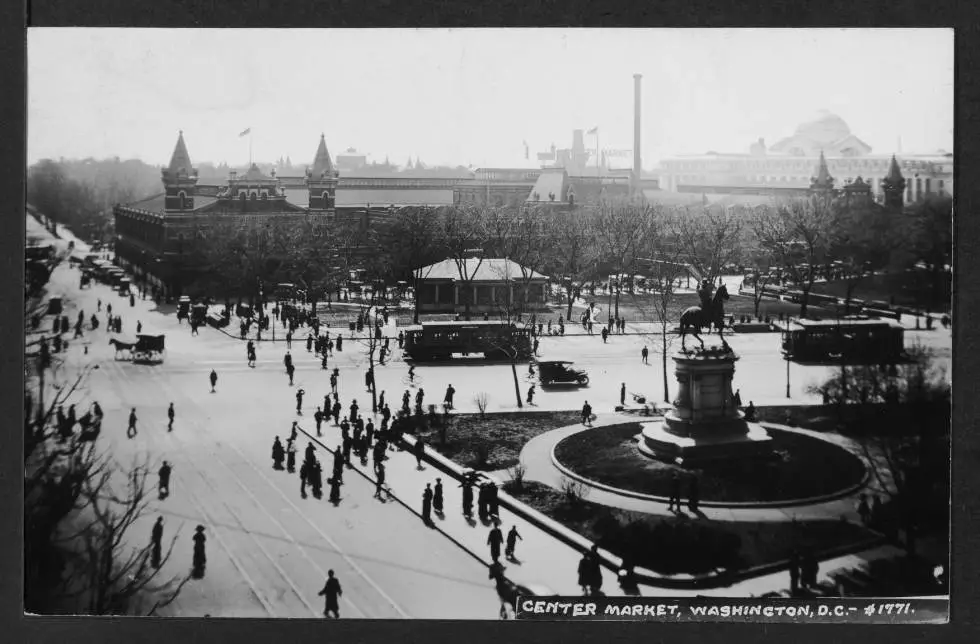
The plaque the Market Company posted in front of the building eventually listed every dimension and every facility. The 7th Street wing was 200 feet by 78 feet. The 9th Street wing was 200 feet by 78 feet. The long B Street wing connecting them, parallel to the canal, was 344 feet by 84 feet.
There were 666 numbered stalls inside, plus 34 iron booths under awnings, 100 farmer’s tables along the side walls, and 200 wagon spaces on the curbs. At full occupancy the market could hold a thousand sellers. Total floor space at completion: 57,500 square feet. That made it the largest market hall in the United States.
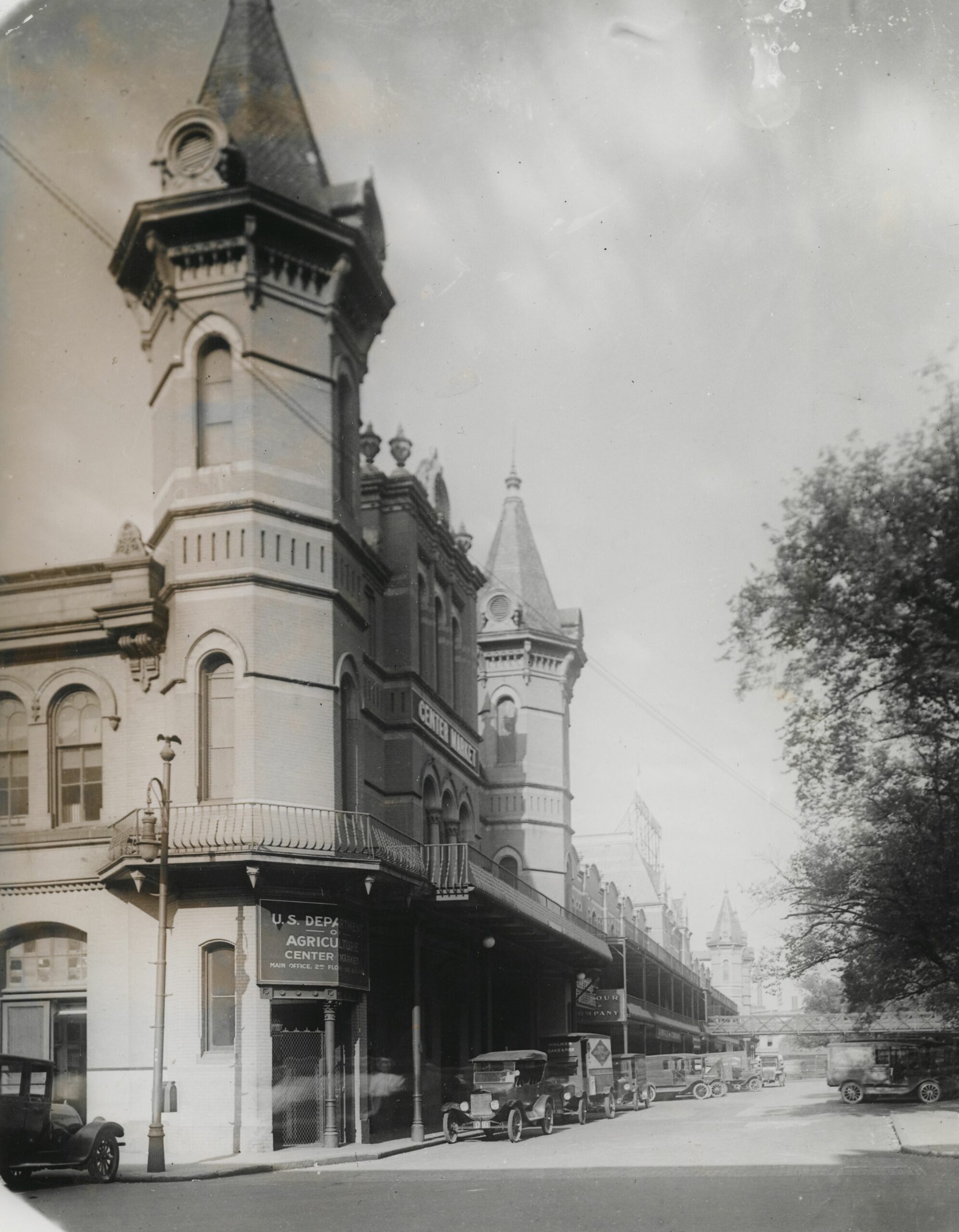
All three wings were two stories. The 7th Street and 9th Street wings were flanked by twin towers and entered under metal awnings. A canopy ran the entire length of B Street and 9th Street so the outdoor stalls had cover too. For a small fee, hucksters and farmers could pull up under the canopy and sell.
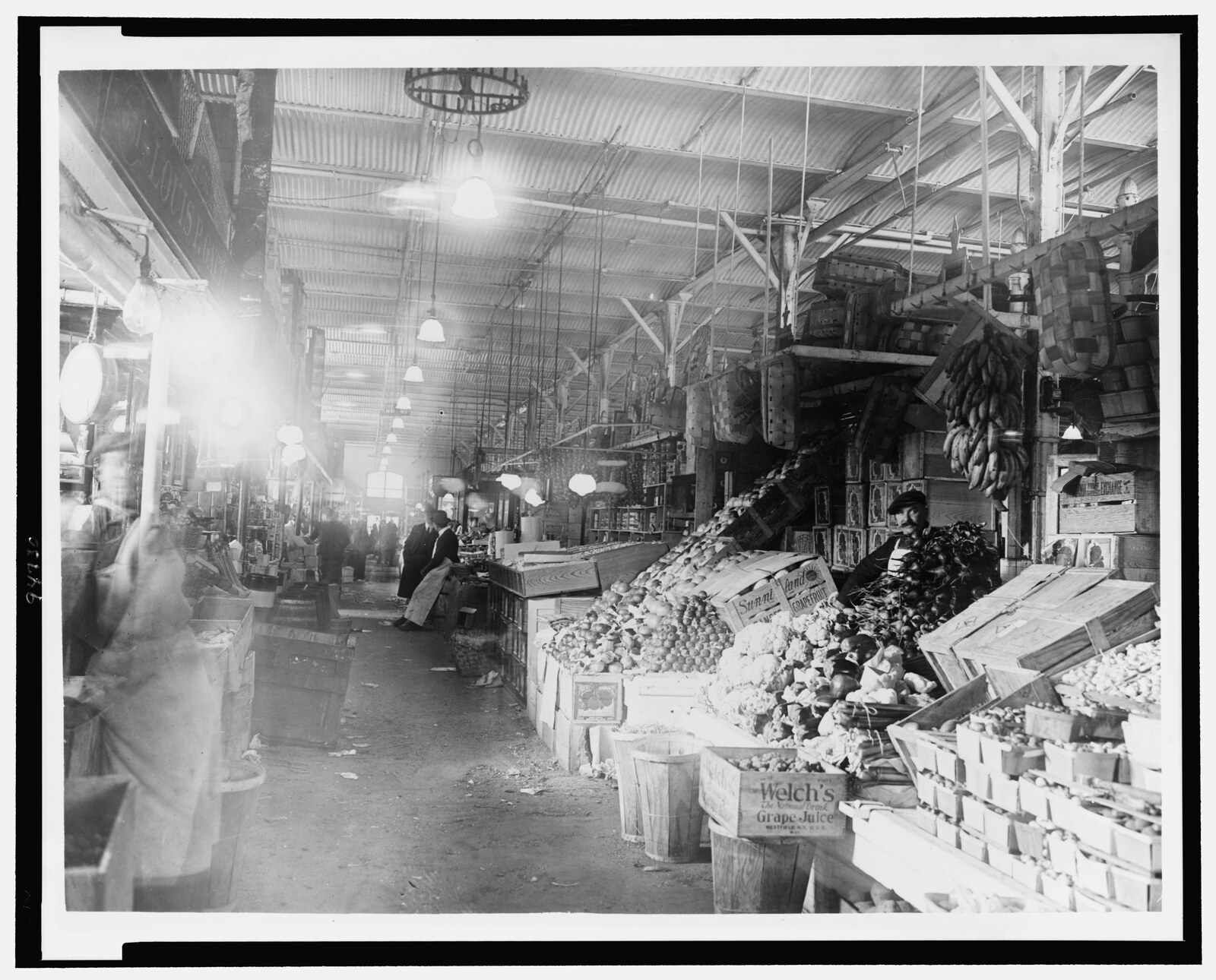
The market’s facilities grew more sophisticated over time. There were eight hydraulic elevators to move goods between the floors and the cold storage. There were six artesian wells yielding pure cold water for refrigeration. There were ventilated skylights. By 1888 there was a refrigeration plant with 400,000 cubic feet of cold rooms cooled by roughly ten miles of two-inch brine pipes, and there was electric light. A very tall chimney rose above the boiler room.
Cluss kept narrow alleys and driveways to a minimum so shoppers could walk through the market without dodging traffic. He was especially proud of the courtyard ice houses, which he called “indispensable appendages of a modern market in a southern climate.”
The 9th Street expansion and refrigeration
The separate main building, originally proposed as a hotel alongside the three market wings, was finished in 1878 as a row of twelve wholesale stores with a bank. In 1886 Cluss and his partner Paul Schulze designed the major expansion on 9th Street, a $75,000 project. By 1888, mechanical refrigeration made a practical difference during Washington’s summers, letting vendors keep perishable food cold in far greater quantities.
The cold storage also let the market work as a kind of public deep-freeze. There was a fur room where Washingtonians stored furs, carpets, rugs, and other garments through the summer to protect them from moths. There were rooms where families could pay to leave hams. For households without mechanical refrigeration, the market offered storage they could not provide at home.
Daily life in the market
Three D.C. streetcar lines converged on the market: the Washington and Georgetown, the Metropolitan, and the Anacostia and Potomac River. By the 1900s, automobiles parked at the curb alongside horse-drawn wagons. The market drew middle-class ladies, community leaders, businessmen, social reformers, hucksters, farmers from Maryland and Virginia, and street kids hawking gum and papers.
In April 1912, Lewis Hine photographed eleven-year-old celery vendor Gus Strateges at Center Market. Hine’s accompanying notes recorded that Gus, who lived at 212 Jackson Hall Alley, sold until 11 p.m. and returned Sunday morning to sell papers and gum. He had been in the country a year and a half.
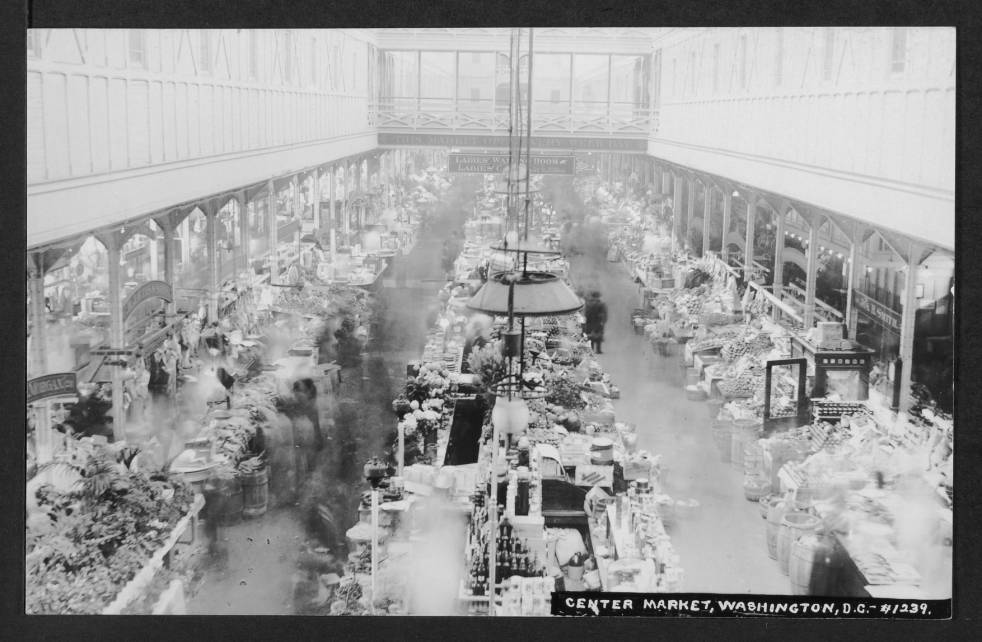
Inside were stalls selling meat, fish, vegetables, condiments, flowers, dried fruit, and baked goods. Louis P. Gatti had a fruit and vegetable stand, and an Armour and Company sign advertised the Chicago meatpacker’s presence. There was also a café and a Ladies’ Waiting Room, reached by elevator.
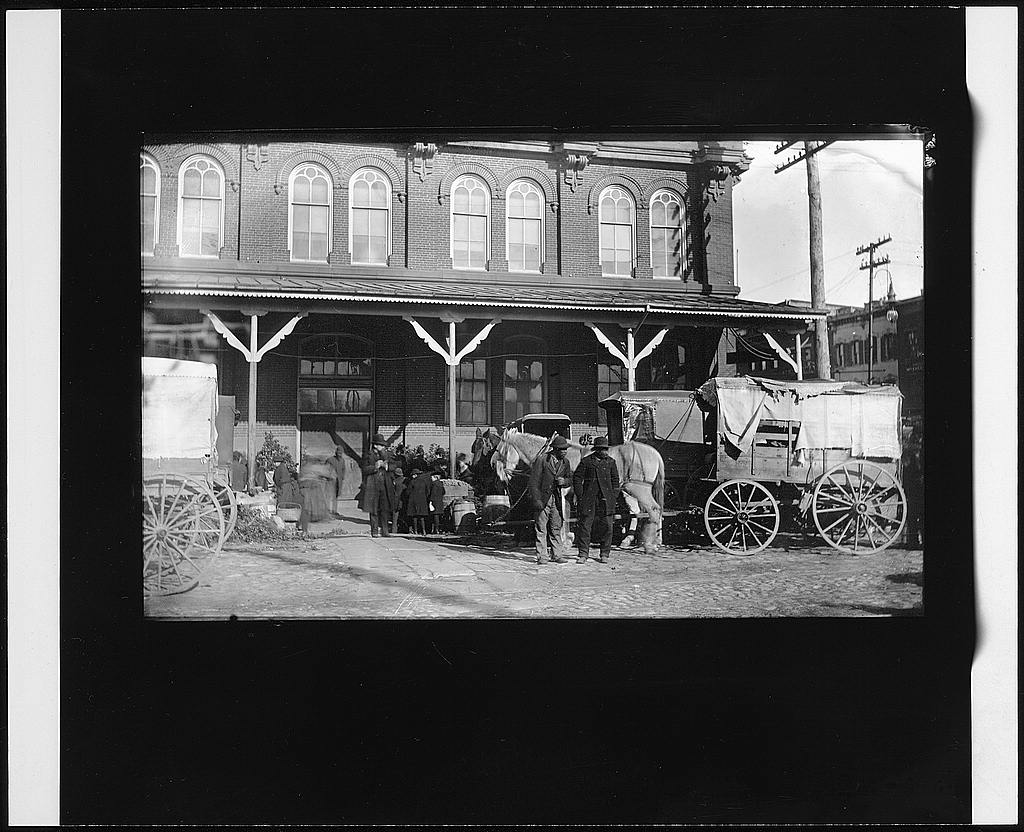
Outside, the curb stalls and wagon spaces were just as busy. Farmers brought produce into the city, and street vendors sold seasonal greens. A statue of Major General John A. Rawlins stood near the market before returning to Rawlins Park in 1931.
Why they tore it down
The rise of chain grocery stores changed the market’s place in Washington life. Customers had more places to shop close to home, though Center Market still drew crowds. The immediate threat, however, was the federal government’s plan for this part of Pennsylvania Avenue.
Those redevelopment plans grew out of the McMillan Plan. The Senate Park Commission, formed in 1901 and chaired by Senator James McMillan, published its plan for Washington’s monumental core in 1902. The plan called for a unified white-marble city of neoclassical museums and federal office buildings on the Mall and along Pennsylvania Avenue. Red-brick Victorian buildings, no matter how loved, did not fit the vision. The Old Post Office Pavilion also faced demolition as planners remade the area.
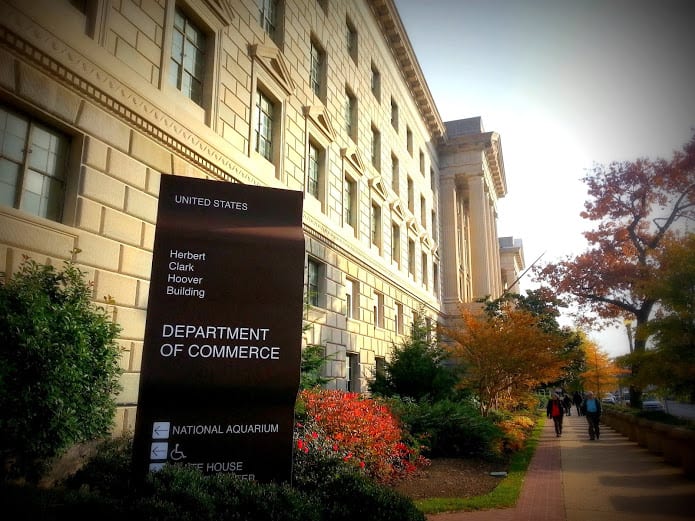
In 1921, the building returned to public ownership under the Department of Agriculture. By the late 1920s, the federal government was buying up the south side of Pennsylvania Avenue between 6th and 15th for what would become Federal Triangle. Center Market stood in the way.
Center Market closed for the last time on January 1, 1931. Many of the vendors moved a few blocks north to the old Northern Liberty Market at 5th and K, which inherited the “Center Market” name. The Cluss building was taken apart over the next several months.
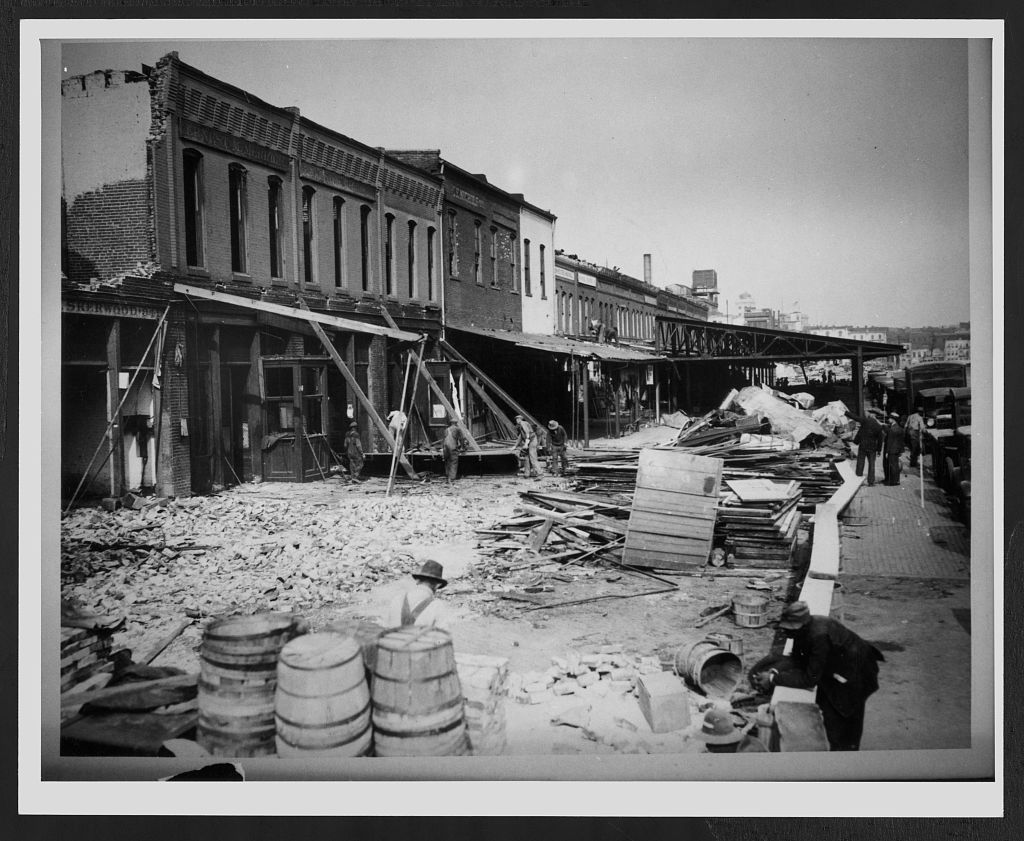
On May 17, 1931, the Sunday Star printed a eulogy:
The great focus of interest, the one-time social center, place of endless entertainment, is gone and can never be restored. Another generation will have no concept of the significance of the site on which they stand.
What replaced it
President Herbert Hoover laid the cornerstone of the National Archives Building on February 20, 1933. John Russell Pope designed the monumental replacement for Center Market at 700 Pennsylvania Avenue NW. Archives staff began moving into the unfinished building in 1935, and construction was completed in 1937.
The Declaration of Independence and the Constitution arrived in 1952, joining the Bill of Rights, which the Archives had received in 1938. The three documents became the central display in the rotunda. Where shoppers once bought beef and strawberries, visitors now come to see the country’s founding documents.
The neighborhood around Cluss’s market changed along with it. Federal buildings replaced the shops and market halls, and B Street became Constitution Avenue. Rawlins Park, with the statue that once stood near the market, is on E Street between 18th and 19th.
Center Market was one of several familiar buildings lost as Federal Triangle took shape. The Southern Railway Building came down in 1931 too. Cluss’s Eastern Market survives on Capitol Hill, but here on Pennsylvania Avenue, the photographs are what let us see the stalls, wagons, and crowds again.
We dug this one up with help from AI and checked it against the original records below. Here’s how we use AI.