
Stand at 16th and Crescent Place today and look across at 2400 16th Street NW. The building takes up most of the block. Seven stories of pale brick and terra cotta, wrought-iron balconies stepping down the wings, a plain center bay where a wilder roof once bristled with pavilions. It is now the Envoy Apartments, studios and one-bedrooms managed by Borger Management for the Feil Organization. In the morning the doorman is on the sidewalk. Runners cross into Meridian Hill Park.
The building has been living quietly at this address for a hundred and eight years, and for most of that time it was the fanciest apartment house in Washington.
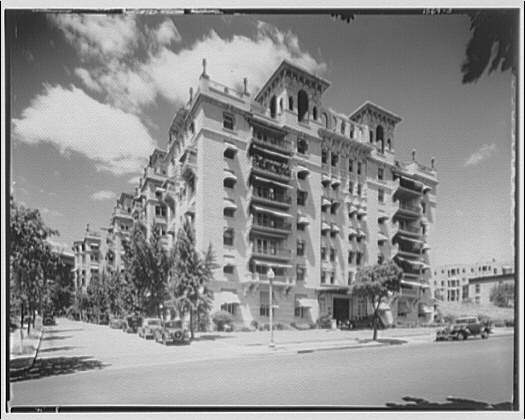
When it opened in 1918, it was called Meridian Mansions. Ten senators lived there at once. A cabinet member entertained on the roof. The founder of Czechoslovakia raised his country’s first flag from a window. A future Holiday Inn was sketched out at a table in the lobby restaurant. By the 1970s the elevators were broken, the ballrooms were gone, and the building was in receivership. It came back. It always seems to come back.
Here is how a single block of 16th Street NW carried all of that.
Mary Foote Henderson’s boulevard, and a doctor’s empty lot
The reason Meridian Mansions exists on Meridian Hill and not somewhere else is Mary Foote Henderson. Married to former Missouri senator John Brooks Henderson, she spent forty years trying to turn 16th Street into the grand ceremonial avenue Washington never quite got around to building. She wanted embassies, mansions, and gardens climbing the hill from downtown. She wanted, ideally, the president to move up there and give her a proper neighbor.
From her brownstone castle at 16th and Florida Avenue, she bought lots along 16th Street, hired the Beaux-Arts architect George Oakley Totten to design mansions for them, and then sold or rented the finished houses to diplomats and cabinet officers. That is how the French, Cuban, Egyptian, and half a dozen other legations arrived on 16th Street. It is why the site of what is now Meridian International Center just up Crescent Place became a diplomatic gathering point in the first place.
The land at 16th and Crescent, right across from what would become Meridian Hill Park, was one of the few big undeveloped lots she did not own. It belonged to Dr. Zachariah T. Sowers, a prominent local physician. In 1915, two Washington real estate developers named Edgar S. and William Kennedy worked out a swap with Sowers. The Kennedys had just finished a large apartment house in Mount Pleasant called the Argyle, on Park Road at Mount Pleasant Street. Sowers wanted the Argyle. The Kennedys wanted his 16th Street lot. They traded.
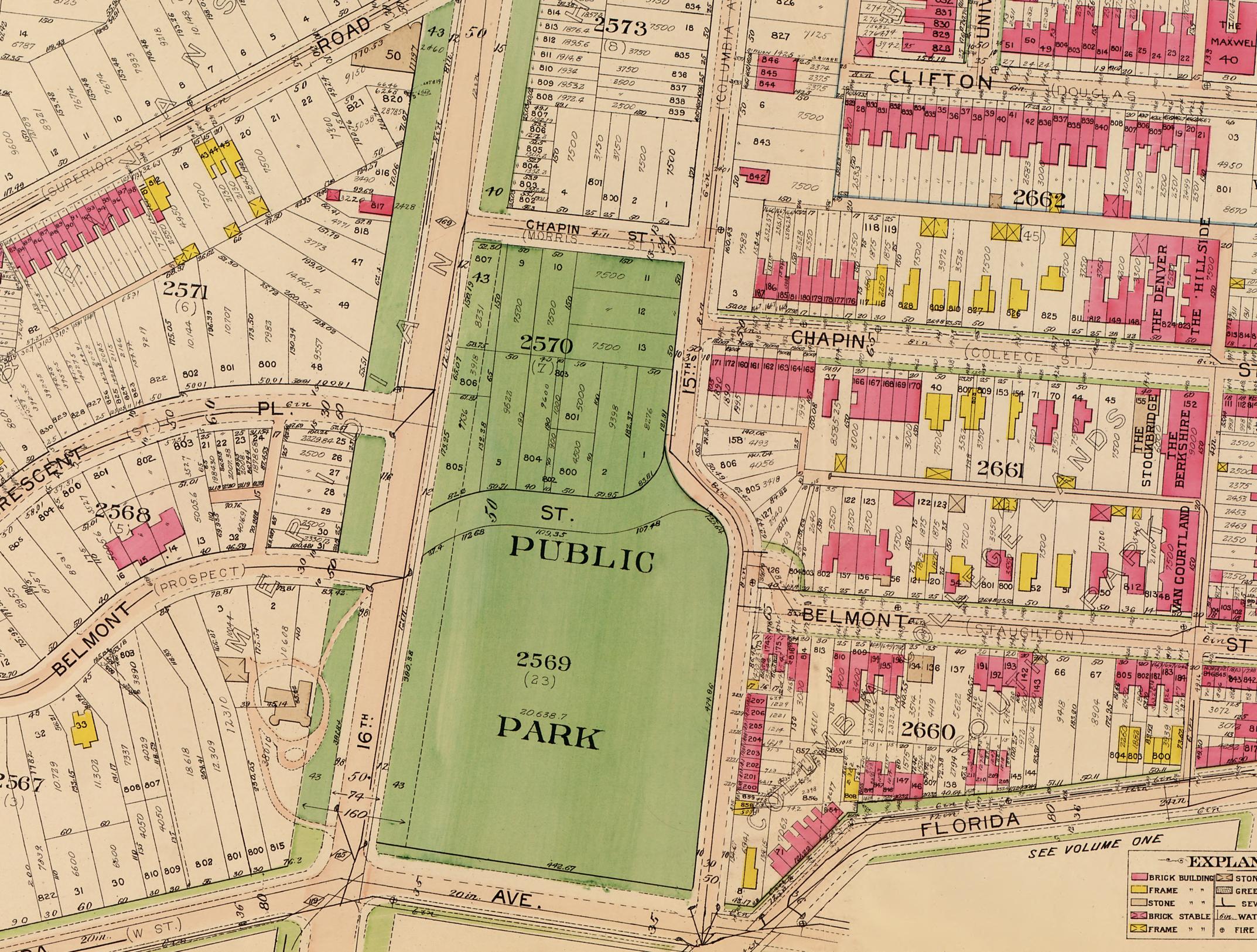
Henderson was not thrilled. According to architectural historian Kim Williams, she had spent years fighting off big apartment buildings on Meridian Hill because they broke the scale she was after. But when she saw the Kennedy project moving forward, she pivoted from opposition to influence. In a 1922 interview with columnist Mayme Ober Peak, she took some credit for the design.
The corporation which built it was certainly very decent. I was delighted at the opportunity of helping design an apartment house that could spread out instead of up, with ample facilities for sunlight and air. There wasn’t an apartment in Washington where an outdoor woman could live happily. I worked with Major Totten in designing the suites in ells, each with the sunroom opening on a loggia. There is also a water garden on the roof. Ten senators live there now, and their personal interest and influence are worth a good deal to us up here.
Mary Foote Henderson to Mayme Ober Peak, 1922
You can hear the calculation in that quote. She could not stop the building. But she could shape it, and the senators inside it were, in her framing, a policy asset.
Kennedy Bros., the Sonnemann trio, and the most expensive apartment house in the city
The Kennedys broke ground in July 1916. The finished building cost $950,000, which the newspapers of the day pointed out was the highest price ever paid for a Washington apartment house. Adjusted for a century of inflation, the number does not much matter. What matters is that the Kennedys and their architects were building at the ceiling of what the market could support.
The design was a collaboration. Alexander H. Sonnemann, a Maryland-born architect who had been Edgar Kennedy’s long-time working partner, drew the plans. Francis W. Fitzpatrick handled the elevations. Reginald W. Geare, the theater architect later associated with the disastrous 1922 collapse of the Knickerbocker Theatre, did the interior detailing. The result was seven stories of pale tan brick and terra cotta laid out in a loose Beaux-Arts vocabulary, with Italianate ornament, wrought-iron balconies, and a run of six roof pavilions that gave the top of the building a small city’s silhouette.
The apartment count came in at 190. Of those, 112 were efficiencies and one-bedrooms sized for stays of a week or a season, and 78 were two- and three-bedroom units for people who lived there full time. The two ends of that split were the point. Meridian Mansions was designed to house both the senator who came to Washington in December and left in June, and the diplomat’s family that stayed a decade.
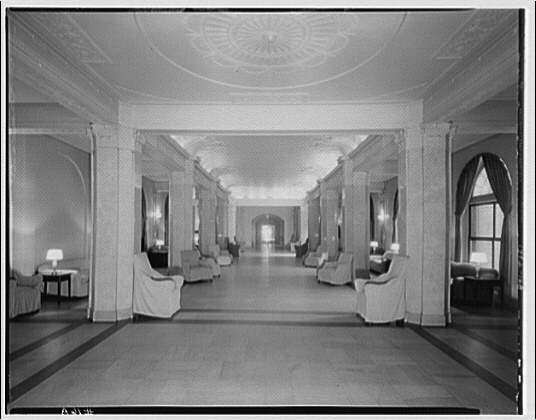
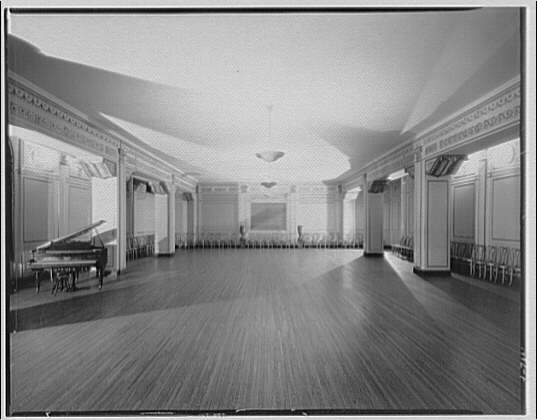
The amenities were the marketing pitch. When the Kennedys announced the building in 1916, the paper listed things that a modern apartment did not have. A central refrigerating plant that piped cold to every unit, so residents did not need to have blocks of ice delivered. Electrical connections for cooking alongside the gas. Roof gardens. A tennis court on top of the garage and power plant. A public dining room and two ballrooms downstairs. Marble columns in the lobby that are still there today.
The Senatorial Beehive
The building opened in 1918 and filled up fast. The Washington Post’s social columns from the first years read as a rolling roll call of the U.S. Senate. By 1921, the building was home to multiple senatorial families and the Embassy of Bolivia. Cabinet members from the Wilson, Harding, Coolidge, and Hoover administrations entertained there. Reporters started calling it the “Senatorial Beehive.”
A few of the residents and regulars, drawn from Post society columns of the 1920s and 1930s: Senator Arthur Capper of Kansas; Senator Pat Harrison of Mississippi; the Argentine ambassador, Honorio Pueyrredón; the Guatemalan minister and his wife; Sir Esme Howard, the British ambassador, as a guest of honor at a reception in May 1924; Dr. František Chvalkovský, then serving as Czechoslovakia’s minister.
Around them, the building’s public rooms turned over week by week. The Mississippi Society of Washington held its final meeting of the season at Meridian Mansions in March 1932, with Senator Harrison as the featured speaker. The New England States Society held a Maytime Dance there in May 1935.
None of that would land as a big deal in any single mention. The point is that mention after mention, month after month, the building was the address of record for a slice of Washington that ran the country and hosted the world.
October 18, 1918: Meridian Mansions and the founding of Czechoslovakia
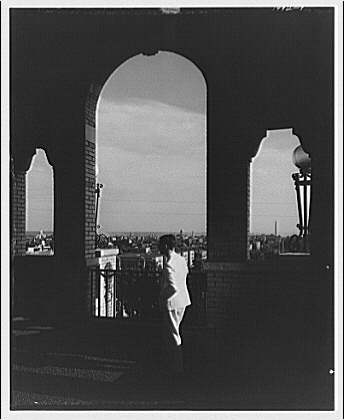
The building’s biggest historical hook has nothing to do with the U.S. Senate. Between July and November of 1918, Tomáš Garrigue Masaryk lived in an apartment at Meridian Mansions. Masaryk was in exile from what was still Austria-Hungary, running a lobbying campaign to persuade the Allied powers to recognize an independent Czechoslovak state. In September 1918, the United States officially recognized the Czechoslovak National Council as a de facto belligerent government. On October 18, 1918, Masaryk released the Washington Declaration of Independence for the future republic.
That same day, the first flag of independent Czechoslovakia was unfurled from a window at Meridian Mansions. The building’s National Register nomination cites the moment. The historians at DC Preservation describe the founding of Czechoslovakia as having “occurred here.”
A nation was declared, in effect, out of a Washington apartment across the street from an unfinished Italian Renaissance park.
Masaryk went home to Prague and became the country’s first president. The apartment at 2400 16th Street went back to being an apartment.
Hotel 2400, the height fight, and a Holiday Inn footnote
Ownership of Meridian Mansions changed hands a couple of times between 1936 and 1960. Through part of that stretch, the building did business as Hotel 2400, run at one point by a proprietor named Frank M. Perper.
The National Register nomination notes that in the late 1930s, Perper and a guest at the hotel began sketching plans for a national network of franchised roadside hotels that they proposed to call Holiday Inns. The idea did not launch at 2400 16th Street. Kemmons Wilson gets the credit for the Holiday Inn brand that opened in Memphis in 1952. But if the nomination is right, the concept was worked out at a table in a Washington apartment hotel more than a decade before it hit the road.
The 1940s brought a fight over the top of the building. Rules dating from the 1910 Height of Buildings Act barred human habitation above the legal building height. The rooftop penthouse at Meridian Mansions had grown into a luxury residence, and the District pointed out that it was, technically, illegal to live in. The dispute dragged for years. It ended in 1952, when Congress passed and President Harry Truman signed a bill allowing the penthouse to be used as office space, so long as no one slept up there.
By the late 1950s the building was in trouble. The owners were fighting insolvency, tax liens, and court judgments. At one point the maids and handymen staged a sit-down over unpaid wages. Along the way the building integrated. By 1960, Meridian Mansions was one of the few apartment houses in Washington that welcomed Black residents, and the newly independent African states housed diplomats and staff there.
The rename, the riots, and the long slide
In 1963, the six rooftop pavilions and the lamp standards that gave the building its castle silhouette were pulled off during a repair campaign. In 1964, the whole property was rebranded as The Envoy. The new name gestured at the diplomatic community that was, by then, its main tenant base.
A messy 1960s purchase attempt is worth a paragraph. Adam Clayton Powell Jr., the Harlem congressman, was involved in a plan to buy the Envoy and convert it into housing for elderly Black residents. It ran into opposition from neighborhood groups and from diplomatic tenants tied to Meridian House and the World Bank, and it was dropped.
After the April 1968 riots, the Envoy was pressed into service as temporary housing for families displaced by the fires along 14th and 7th Streets. That is worth pausing on. A building purpose-built to house senators became, for a summer, a shelter for people whose homes had burned. Both uses fit inside the same lobby.
The 1970s were rough. Rent strikes, foreclosure, and an eventual stretch of vacancy. James Goode, in Best Addresses, would later remember the Envoy from that period as one of the “truly great apartment houses in the nation’s capital,” but the description carried the past tense that great neglected buildings usually get.
The 1979 renovation and what got lost
The building was rescued by a “total renovation” that began in 1979 and finished around 1981. The rescue kept the marble-columned lobby, the ornamental molding, the wrought-iron balconies with their cast-iron cartouches, and the terra cotta ornament on the facade. It did not keep everything.
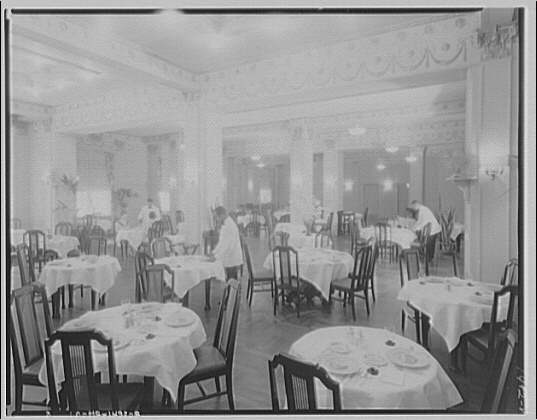
The two ballrooms were gone. The public dining room, where waiters had once carried plates past the mirrored columns you can see in the Horydczak photographs at the Library of Congress, was cut. The six rooftop pavilions that had already come off in 1963 were not put back. What had been an apartment hotel with hotel-scale public rooms became a straight rental building where residents’ lives happened inside their own front doors.
On December 9, 1982, the District added Meridian Mansions to the DC Inventory of Historic Sites. On July 28, 1983, it went on the National Register of Historic Places under reference number 83001417. In 1988, the Smithsonian’s James Goode included it in Best Addresses, his encyclopedia of Washington’s grand apartment houses, alongside the other survivors of that era like the Lombardy Apartments at 20th and Pennsylvania, which had gone up a decade later and eventually reinvented itself as a boutique hotel.
The Envoy in 2026
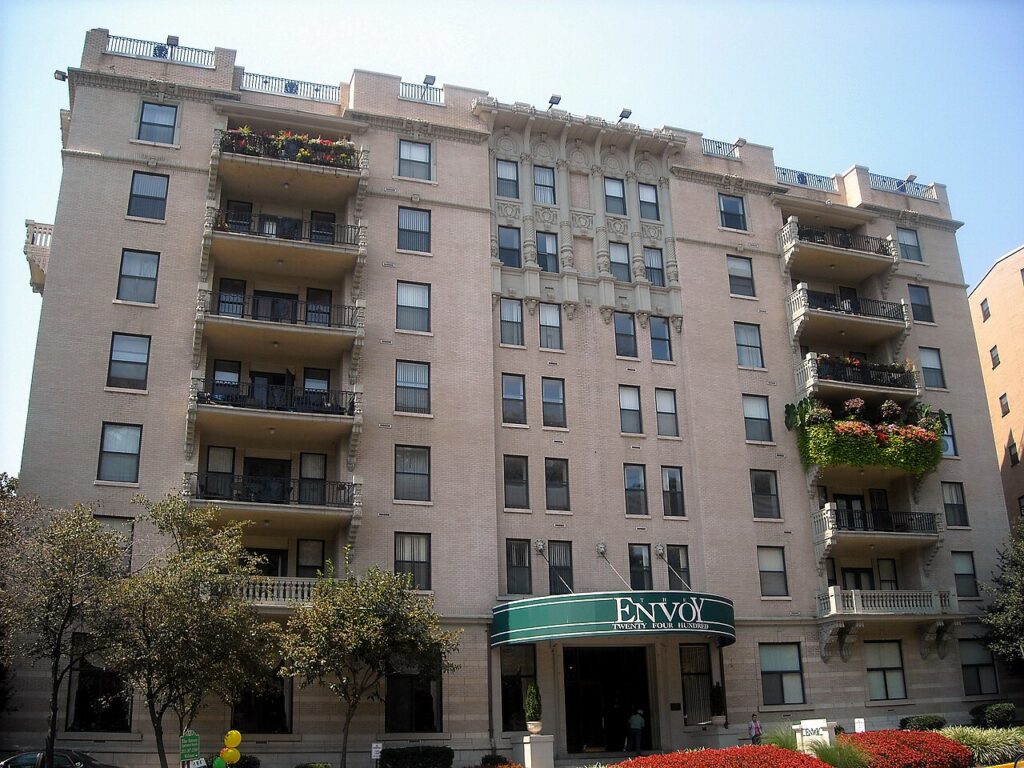
Back at 16th and Crescent Place today. The lobby is still marble. The ornament is still terra cotta. The exterior cast-iron cartouches, the ones the building’s original balconies were built around, are still there. The Feil Organization, a New York real estate family, owns the building. Borger Management runs the day-to-day. Studios rent for a little under $1,700 and one-bedrooms push past $2,600. There is a fitness center on site and a rooftop clubhouse where a “water garden” once sat.
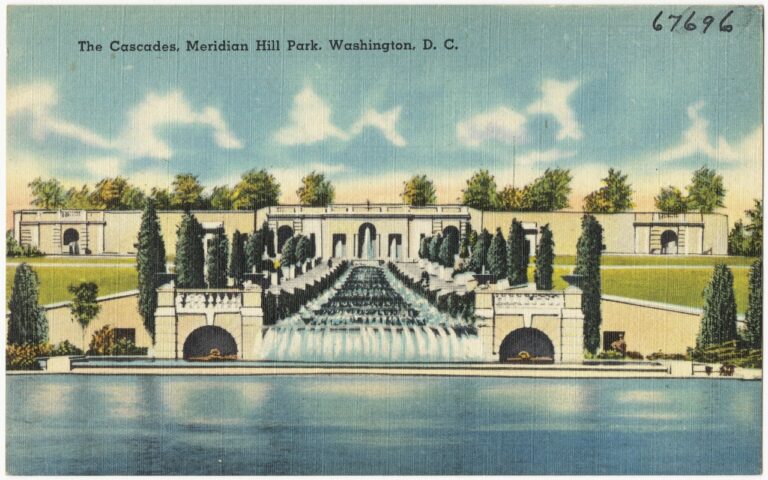
Across the street, Meridian Hill Park still holds its Sunday afternoon drum circle. Runners come up the cascading fountain. The park itself is worth its own read, and we have written one. If you want more of 16th Street’s long attempt to become a boulevard, see the MacVeagh house, the Warder Mansion, or the Northumberland Apartments over on New Hampshire Avenue for another Kennedy-era luxury address.
The apartments inside the Envoy are ordinary apartments. Somebody moves in this week and gets a set of keys and a Wi-Fi password and probably does not think much about it. That is the way great old buildings tend to end up, when they are lucky. Not as museums. As addresses.
We dug this one up with help from AI and checked it against the original records below. Here’s how we use AI.