
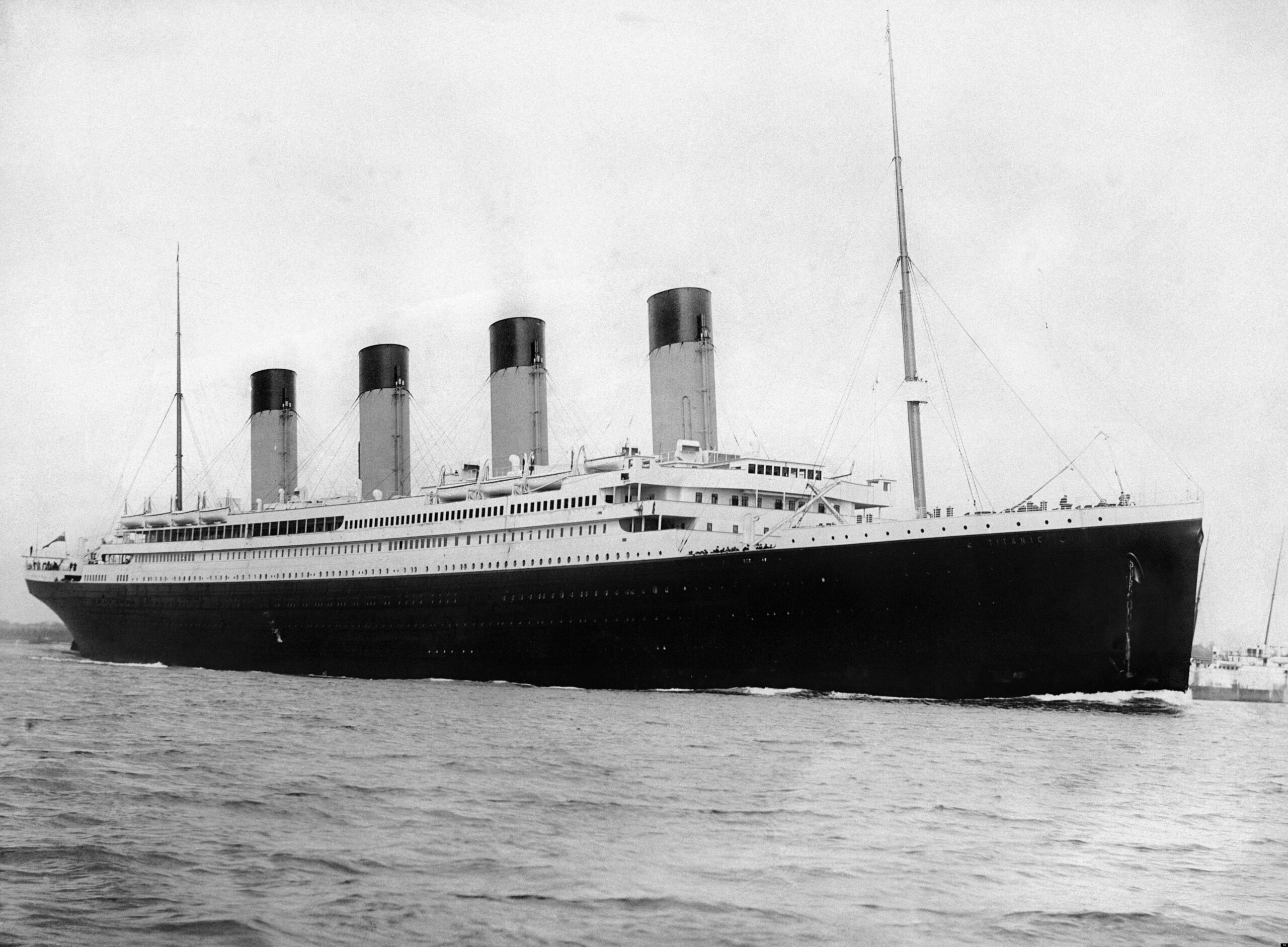
Somewhere in the Atlantic, six weeks before the Titanic sank, Archibald Butt sat down and wrote a letter. He was already at sea, already on his way to Europe for a rest he badly needed. He wrote to President Taft’s secretary with one request: book his return passage on the maiden voyage of the most celebrated ocean liner ever built. “I want to come back by the Titanic.”
Archibald Willingham Butt, known to everyone in Washington as Archie, was the military aide to presidents Roosevelt and Taft. He was fiercely loyal to both men, and by 1912, with Roosevelt running against Taft, that loyalty was tearing him apart. To the same White House where a British aviator had landed a biplane just two years earlier, Butt reported each morning as though nothing was wrong.
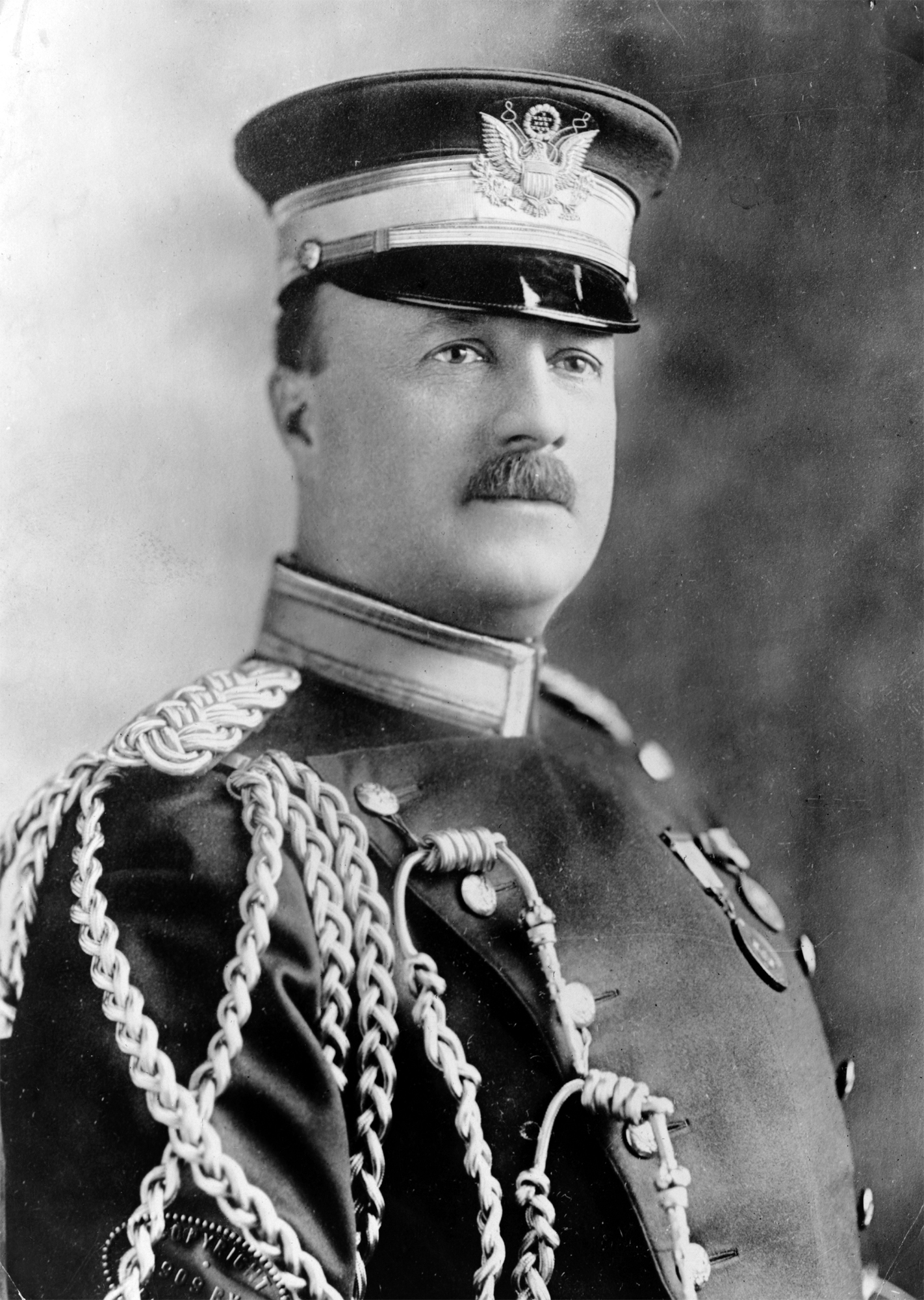
Caught Between Two Presidents
Under great stress, partly attributed to his grueling schedule as Taft’s presidential aide, his health was deteriorating. He had lost twenty pounds on a grinding 28-state campaign trip in the fall of 1911. Two days after Roosevelt announced he would challenge Taft for the Republican nomination, Butt wrote to his sister-in-law: “If I am to go through this frightful summer, I must have a rest now.”
Major Butt would frequently serve as Taft’s golfing companion or join him on walks near the White House for exercise. The President was quite fond of his aide and had the highest opinion of the major, making it difficult to go for an extended period of time without his assistance.
The chief trait of Archie Butt’s character was loyalty to his ideals, his cloth, and his friends. His character was a simple one in the sense that he was incapable of intrigue or insincerity. He was gentle and considerate to every one, high and low. He never lost, under any conditions, his sense of proper regard for what he considered the respect due to constituted authority.
William H. Taft
Butt’s role ran deeper than most people knew. When Helen Taft suffered a stroke in May 1909, he quietly stepped in to handle some of her ceremonial duties as First Lady. He was not just an aide. He was part of the family.
The Trip to Europe
Butt’s close friend, the painter and muralist Frank Millet, had been watching him deteriorate. Millet pressured him to come to Rome for a rest, and when Butt balked, Millet went directly to the president. One friend described the scene to the Washington Post:
Millet noticed that Major Butt was looking paler than usual and generally run down. He announced to us his determination that Major Butt should return with him to Rome for a little rest… Major Butt was requested to ask for leave so that he might make the trip, but he would not do so. Millet then went to the President and made the request that he urge Major Butt to go along.
The president demurred, but eventually relented and granted Butt an extended leave of absence to recuperate. In early March, Butt set sail for Europe with his travel companion, Millet. The upcoming departure was reported in the Washington Post on March 1st, 1912.
“I have not had a leave of absense [sic] since I entered the army,” Maj. Archibald Butt, personal aid to President Taft, declared last night after he had been granted leave to make a trip to Europe. “I have not been well since I contracted toxine poisoning while on a Western trip with the President last fall, but my real trouble is that I need rest.”
Maj. Butt was granted leave of a month and 24 days by the War Department with permission to go beyond the seas. With Frank Mallet [sic] a member of the fine art commission and head of the American Academy of Arts at Tome, he will sail at 11 o’clock tomorrow morning from Hoboken on the steamship Berlin, of the North German Lloyd line, for Naples.
He will also go to Genoa, and probably to Rome and Paris. The President’s aid has several relatives living on the continent, and a brother, Edward H. Butt, in England. These relatives have planned a small family reunion at Paris, and Maj. Butt announced that he hoped to attend.
Maj. Butt laughingly denied his rest trip is to prepare him for a strenuous political campaign. “I do not know that President Taft is planning any strenuous campaign trips,” he said, “but if he does, I shall be prepared to accompany him wherever he may go.”
“I should have taken this rest before, but I wanted to be at the White House during the winter season. The season now is over, and there is very little going on there officially. Consequently, I could best be spared at this time.”
Maj. Butt will return by way of Naples about Easter Monday. During his absense no one will be detailed specially to perform his duties, but all of the younger aids [sic] at the White House will have an opportunity to fill the position.
Those who saw him in Europe reported he was mostly downcast and apprehensive. Marian Longstreth Thayer, a Philadelphia socialite who would later board the Titanic herself, observed that Butt “did not know how he was going to stand the rushing life he was returning to.” His mood reportedly lifted only as he left London for Southampton.
Boarding the Titanic
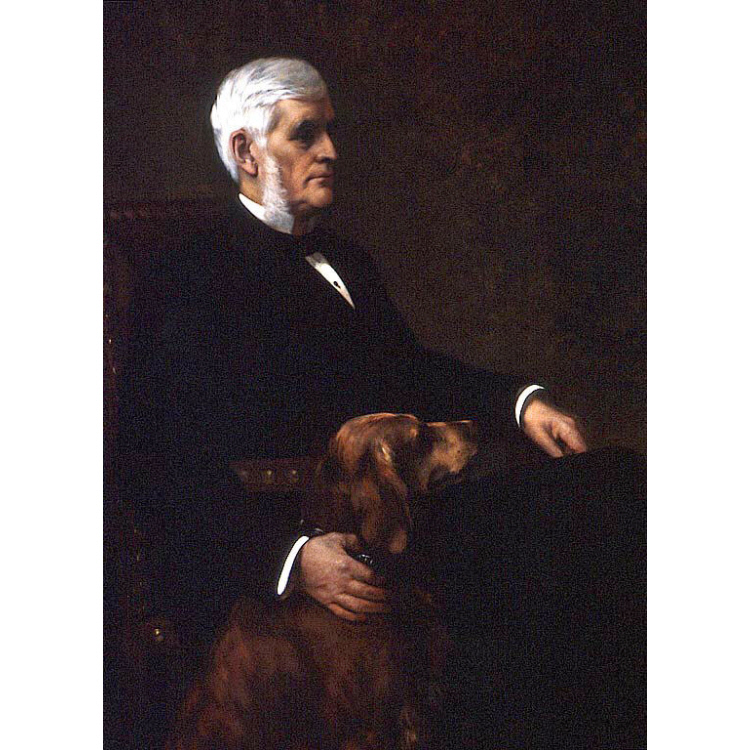
Millet had his own reasons to get home. As Vice Chairman of the American Commission of Fine Arts, he was returning to Washington to help finalize the designs for the Lincoln Memorial. He would not make that meeting.
“No Damon and Pythias friendship could have been closer than the friendship of Maj. Butt and Millet,” said Mr. Waltrous, “The two kept quarters together and were inseparable when both were in Washington. They lived near the Metropolitan Club, Butt being, as is well known, a bachelor, and Mr. Millet’s family being quartered at his home in England.”
The address was 2000 G Street NW, steps from the Metropolitan Club and a short walk to the White House where Butt reported each morning.
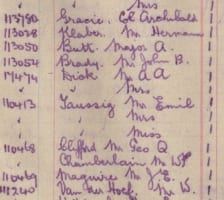
On April 10th, 1912, Major Butt boarded a train at King’s Cross station in London, bound for Titanic’s berth in Southampton. He arrived early that morning and boarded the ship at 9 a.m. with first class ticket number 113050.
Titanic departed from Southampton around noon and set out for the 77-mile journey across the English Channel to France. She arrived at Cherbourg early that evening, set to take on 274 more passengers (24 fortunate souls had the final destination of France and disembarked). Frank Millet was reunited with his companion Butt as he boarded the ship with ticket number 13509 and the two settled in for their transatlantic journey home.
The ship weighed anchor around 8 p.m. and steamed to her final port, Queenstown, Ireland. This would be Titanic’s last stop before heading out across the Atlantic Ocean.
The Final Night
The first few days of the voyage were uneventful, with Butt and Millet enjoying the luxurious accommodations of the massive ship. On the last night before the iceberg, Butt was among the honored guests at the captain’s dinner. But instead of enjoying it, he spent the evening in a corner talking through his anxieties about the coming election with Marian Thayer. He was not a man at rest.
Four days into the voyage, the Titanic struck an iceberg on the starboard side and so began the tragic end for the ship and 1,514 unlucky passengers.
There were numerous sensationalized accounts of Major Butt’s whereabouts and actions in the final hours of the sinking. The press ran stories of him ushering women and children into lifeboats, threatening to shoot any man who tried to take their place. One of those stories had him personally saving a woman named Young. She wrote to Taft afterward. She had not seen him at all that night.
The last verified sighting of Archibald was the account of Archibald Gracie, who testified shortly after the accident to a Senate Commerce subcommittee, chaired by Senator William A. Smith of Michigan. The hearings were initially held at the Waldorf-Astoria in New York, but were later moved back to Washington, to the new caucus room of the Russell Senate Office Building (the first hearing ever held in that room).
Just prior to this time I had passed through A deck, or perhaps it was about this same time. Just about the time we were ordered to take the boats, I passed through the A deck, going from the stern toward the bow. I saw four gentlemen all alone in the smoking room, whom I recognized as Mr. Millet, Mr. Moore, and Mr. Butt, and a fourth gentleman was there with them whom I did no know, but who I afterwards ascertained to have been Mr. Ryerson. They seemed to be absolutely intent upon what they were doing, and disregarding anything about what was going on on the decks outside.
The Sinking
After the sinking, Millet’s body was recovered by the crew of the MacKay Bennett. He was still wearing a light overcoat, black pants and gray jacket, dressed in formal evening clothes. In his pockets were a gold watch and chain with the initials “F.D.M.” engraved in it, glasses, two gold studs, a silver tablet, a pocketbook and £2 10s in gold and 8s in silver.
Archibald Butt went down with the ship and his body was never recovered.

Taft Waits Through the Night
On the night of April 15th, President Taft stayed up late at the White House waiting for word. The news came in fragments. On April 16th, a report arrived saying Millet had been saved. There was still nothing on Butt. The newly digitized Taft Papers at the Library of Congress document his grief in the days that followed.
By April 17th, the Baltimore Sun reported that Taft had given up hope. “Deep sorrow is felt at the White House and through all Washington that knew Major Butt,” the paper wrote. “All social functions at the Executive Mansion have been canceled, and the President’s family feels the loss almost as keenly as though one of the immediate members were dead.”
Washington was absorbing its losses that spring. It was not the only sudden death to shake the city that season.
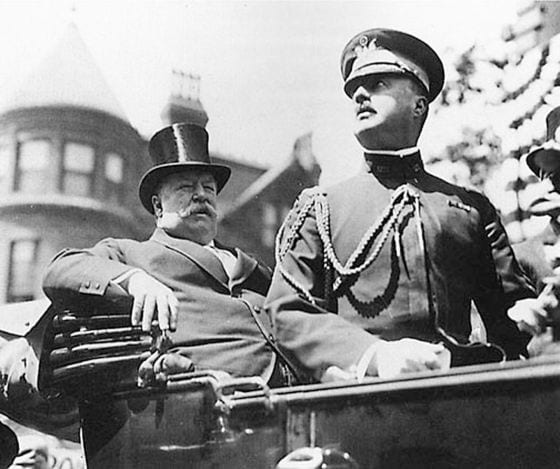
Augusta, Georgia: May 2nd, 1912
One of many tributes to the deceased presidential aide-de-camp was held in the major’s hometown of Augusta, Georgia on May 2nd. The visibly distraught and mourning president paid tribute to his fallen aide in front of a large local crowd.
The President was visibly affected by the tributes paid to Maj. Butt. There were tears in his eyes as he called up memories of the man who was his aid [sic] ever since he entered the White House, and who had traveled thousands of miles with him.
Mr. Taft made only a short address, but he came near breaking down twice.
“Never did I know how much he was to me until he was dead,” said the President. “Lacking nothing of self-respect and giving up nothing he owed to himself, he conducted himself with a singleness of purpose and to the happiness and comfort of the President, who was his chief. To many fine qualities he added loyalty, and when he became one of my family he was as a son or a brother.”
Mr. Taft told how he met Maj. Butt, first in the Philippines and later as aid to President Roosevelt. He dwelt on Maj. Butt’s devotion to Mr. Roosevelt and himself.
“It has always seemed to me,” said the President, “that Archie never married because he loved his mother so. The greatest sorrow of his life was when she left him.”
Mr. Taft concluded with a word more as to Maj. Butt’s spirit of self-sacrifice.
“Self-sacrifice,” he said, “had become part of his nature. If Archie could have selected his time to die he would have taken the one God gave him.”
At another memorial service, Taft wept so openly he had to be led from the podium.
The Fountain on the Ellipse
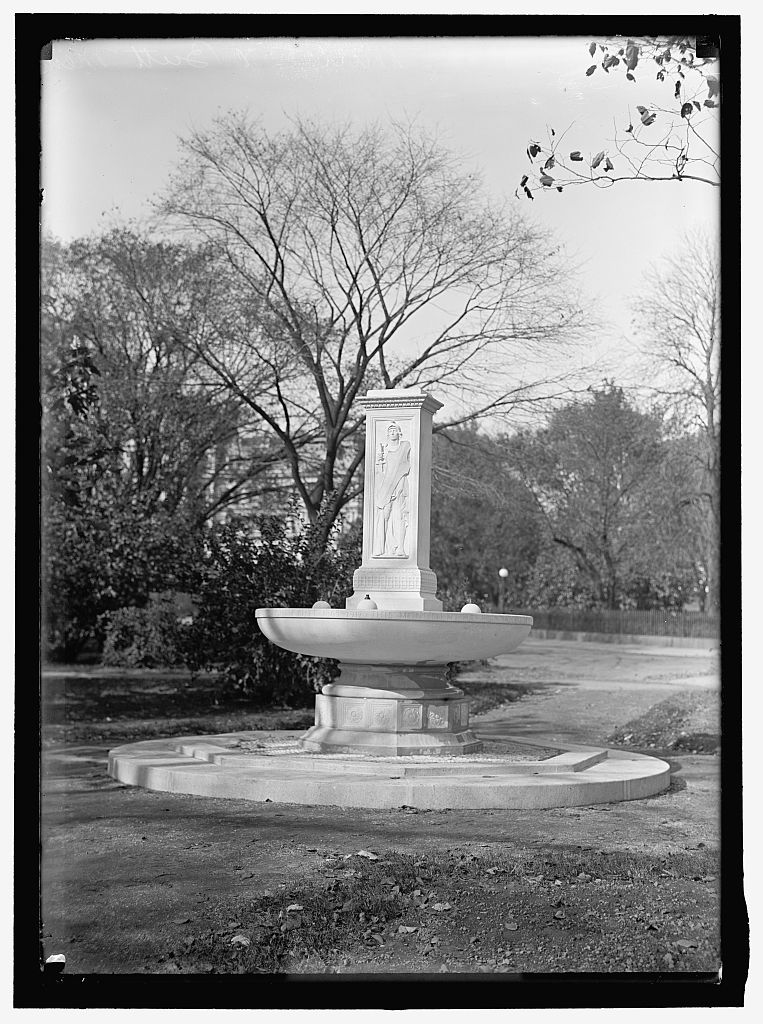
In 1913, friends of Archibald Butt and Francis Millet raised enough money and, with the authorization of Congress, erected a fountain to honor the companions. The Butt-Millet Memorial Fountain still stands today on the Ellipse, south of the White House, sculpted by Daniel Chester French.
The fountain carries the two men in stone. On the south face, a military figure with sword and shield for Butt. On the north face, an artist with palette and brush for Millet. Between them, Tennessee marble and a granite column that has stood through every administration since.
The dedication on October 25th, 1913 happened without ceremony. Taft had lost the election to Woodrow Wilson the year before. Neither of Butt’s friends was president anymore. There was no one left to stand at the podium. The fountain is maintained today by the National Park Service.
THIS MONUMENT HAS BEEN ERECTED BY THEIR FRIENDS WITH
THE SANCTION OF CONGRESS IN MEMORY OF
FRANCIS DAVIS MILLET 1846–1912 AND
ARCHIBALD WILLIAM BUTT 1865–1912.
Two years to the day after the Titanic sank, in April 1914, Taft returned to Augusta and dedicated the Archie Butt Memorial Bridge in the city where Butt was born.
Is it possible to find an address for the house where Butt & Millet lived together? the best i’ve been able to find is just “20th & G NW” i’m sure it’s long gone- i’m just curious about it!
I believe it was 2000 G st
Concerning Mr. Butt….did his ass drown?