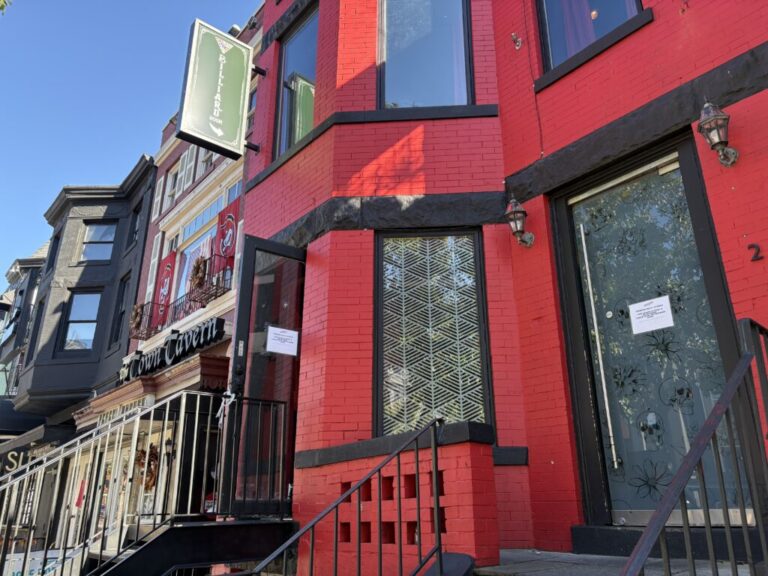

Walk up to 2440 18th Street NW today and you knock on a steel door and give a code word through the grate. The place inside is Code Red, a Prohibition-era themed speakeasy with low light and jazz playlists. It is the third tenant of this narrow Adams Morgan storefront in the last decade, and the polish is deliberate. But the room behind the steel door was, for fifty-three years, the loudest and least polished bar on the block.
This is the story of 2440 18th Street. Mostly it is the story of Millie and Al’s, the roadhouse-dressed corner bar that anchored this stretch from 1963 to April 2016. The building is older than that. So is the neighborhood. So is the drink.
The block before it had a bar
The 2400 block of 18th Street NW is a commercial strip that filled in with the streetcar. The Washington Heights Historic District, designated in 2006, covers 347 contributing buildings dating from 1891 to 1950. Electric streetcars ran up 18th Street starting in 1892 and along Columbia Road starting in 1896. Row houses filled the side streets. Two-story commercial buildings with shops on the ground floor filled the avenue.
This block ran with that pattern. A few doors south of 2440 stands Dan’s Cafe at 2315, in a 1911 building that has been a dive bar since the 1960s. Next to it, 2321 held the Blue Room lounge, then Bill Thomas’s Bourbon, and today Death Punch.
Two doors up, 2325 was the home and headquarters of D.G.S. founder William Hornstein a hundred years ago before it became Columbia Station and eventually Shanklin Hall. Across at 2327, the storefront known now as Heaven and Hell was the first DC headquarters of the Black Panther Party in December 1969.
Point being, this row of storefronts has been holding the neighborhood’s public life for over a century. 2440 is a small piece of it. The upstairs stayed residential. The downstairs had the door on the sidewalk. When Barbra Shapiro, who ran the bar in its later decades, described the era before Adams Morgan got its name, she reached for one detail: this block was where the first Toys R Us, the first Peoples Drug, the first Dart Drug, and Gartenhaus Furs got their starts. Ordinary stores. Then, gradually, drinking places.
Before Millie and Al’s, there was Bobbie’s
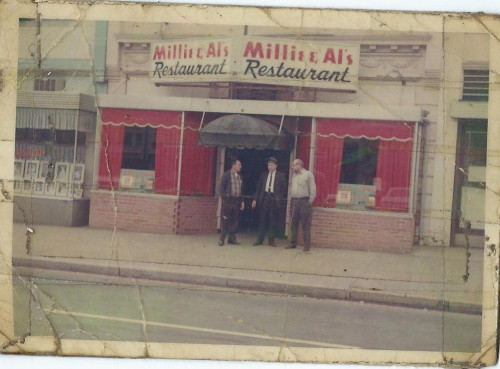
The tenant at 2440 immediately before Millie and Al’s was Ballance’s Columbian Restaurant, known to everyone on the block as Bobbie’s. It served the working neighborhood before the yuppies arrived and before the salsa restaurants came in on Columbia Road.
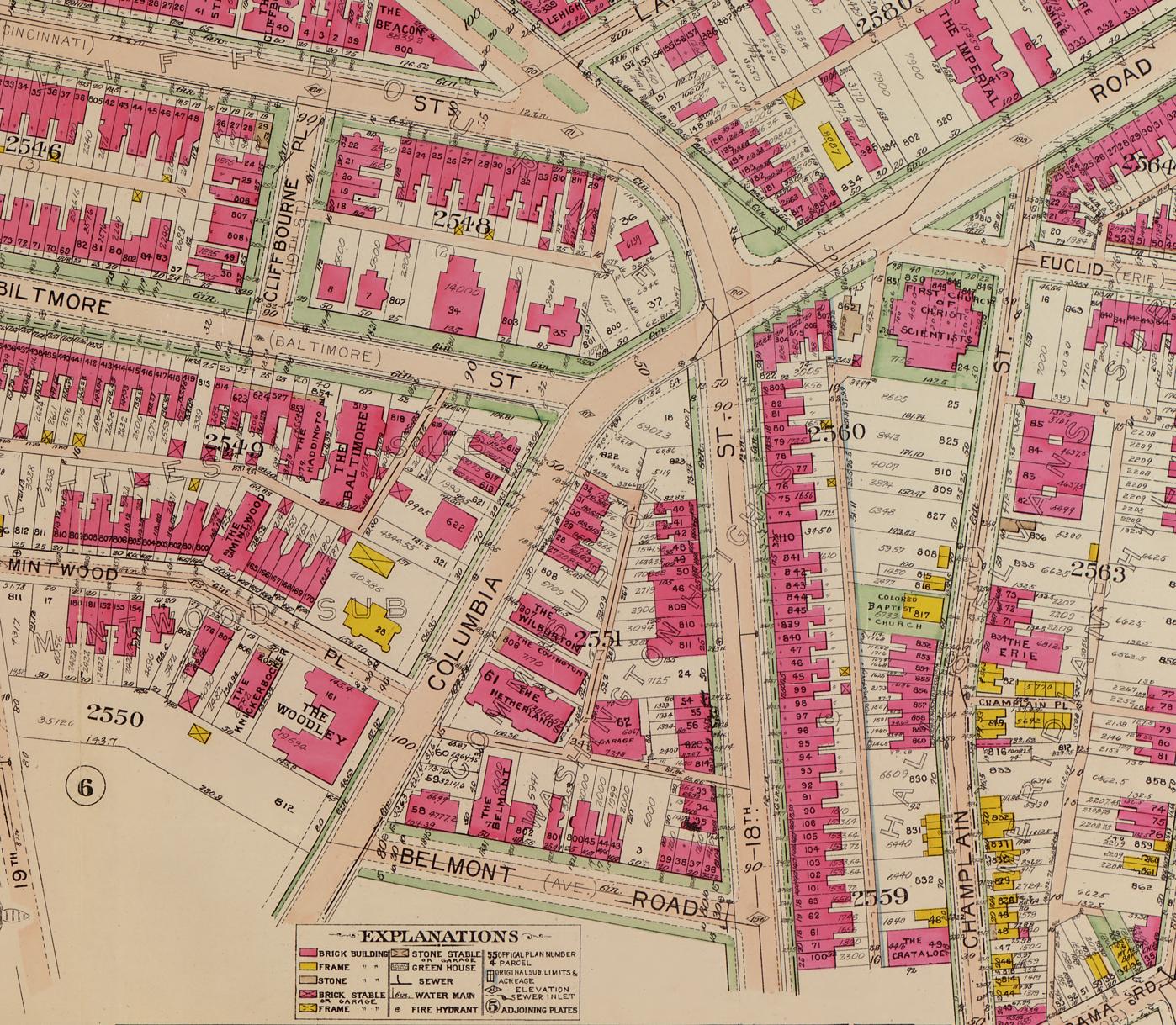
You can find the block on G.W. Baist’s 1913 real estate atlas of Washington. The plate above is Volume 3, Plate 7. Belmont Road runs east to west along the bottom. Columbia Road cuts diagonally across the top. The elongated block between them, labeled 2551, has apartment buildings named The Wilburton, The Netherland, and The Belmont along the west side and a strip of small brick storefronts along its east frontage on 18th Street. One of those small brick rectangles is the storefront that would, fifty years later, be renamed Millie and Al’s.
In 1963 a forty-three-year-old salesman named Al Shapiro walked in there once too often. Al had grown up in the Bronx and settled in Washington. Bobbie’s was his after-work spot. When he heard the owner was selling, he bought the place. He kept the layout. He kept the kitchen. He renamed it Millie and Al’s, after a bartender named Millie who worked there and whom he had fallen for.
Millie was Al’s girlfriend, not his wife. She had, in the words of Al’s daughter Barbra, “a great steady following.” That was the bar’s opening asset: her regulars followed her when the sign changed. Millie died of cancer in the early 1970s. Al kept the name. Fifty years later people still asked at the bar who Millie was, and the answer, mostly, was that she was tough, that Barbra had met her once at twelve or thirteen, and that no one had ever bothered to write down more than that.
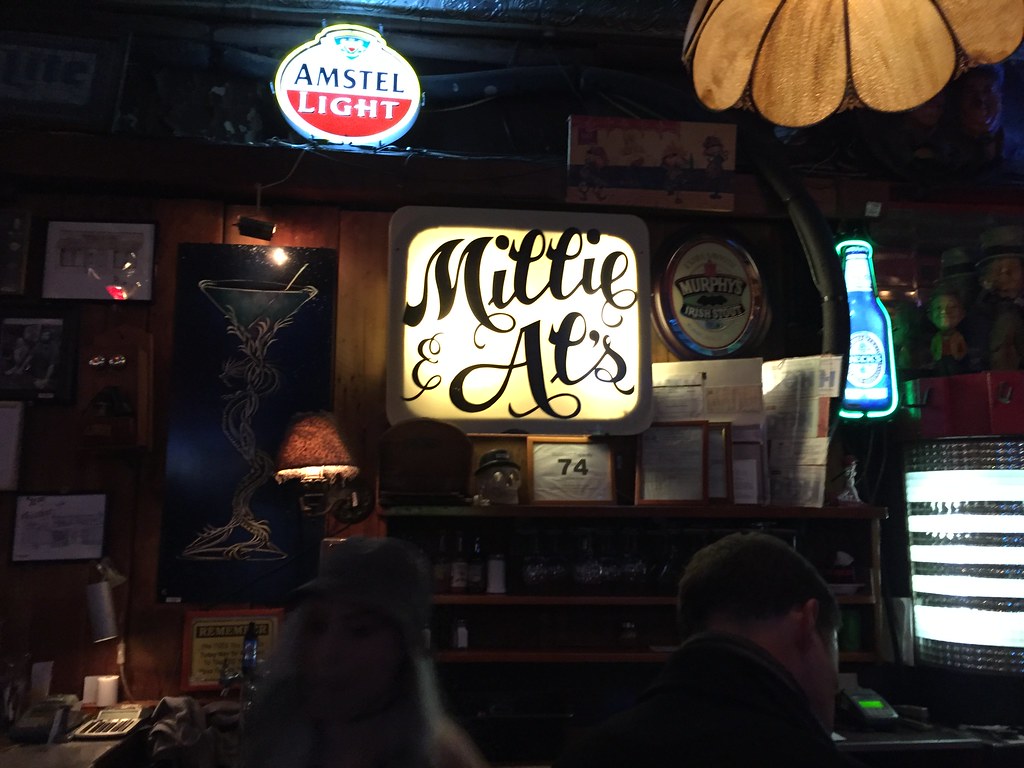
What the joint was like
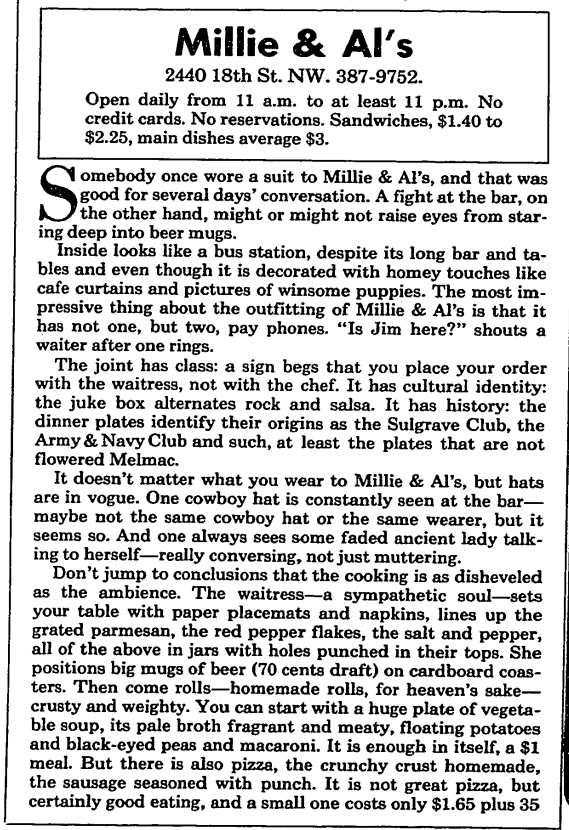
In October 1978 the Washington Post Magazine‘s Phyllis Richman came by and wrote a review that has aged into something better than a review. It reads like a field report from a working-class corner of a city that no longer exists.
Somebody once wore a suit to Millie & Al’s, and that was good for several days’ conversation. A fight at the bar, on the other hand, might or might not raise eyes from staring deep into beer mugs.
Phyllis Richman, The Washington Post Magazine, October 29, 1978
Richman described the interior as looking “like a bus station” despite the long wooden bar, the tables, the cafe curtains, and pictures of winsome puppies. She noted the two pay phones, the jukebox alternating rock and salsa, and dinner plates borrowed from the Sulgrave Club and the Army & Navy Club. Draft beer cost seventy cents. A big plate of vegetable soup was a dollar. Homemade pizza was $1.65 with an extra thirty-five cents for toppings. A chewy sirloin steak was $4.
One cowboy hat was constantly at the bar, though Richman couldn’t tell whether it was the same hat or the same wearer. A sign begged patrons to place their orders with the waitress and not with the chef. She wrote that after a five-dollar meal, the chef came out to greet the guests, “just like in France.”
Adams Morgan grew up around the bar
When Al bought Bobbie’s, the neighborhood barely had the name yet. “Adams-Morgan” as a designation had come out of the 1955 school-integration campaign that yoked the mostly-Black Morgan Elementary to the mostly-white Adams Elementary. The name attached to the streets slowly.
Barbra Shapiro, writing for the fiftieth anniversary in 2013, described the years around her father’s purchase in blunt terms. This area was once nicknamed “Little Harlem.” You could not walk the sidewalks without fear. Then came 1968 and the riots. Then came what she called “a little Havana,” a stretch that pulled in Salvadoran and Cuban immigrants, and, sometimes, gangsters who could drink until they were blinded and did not want to leave a drop of beer when Al called last call.
Al was small and thin. Barbra described him leaping up to hit or throw out troublemakers. They did not resist. Whether from respect or fear, Al always won. He never boasted about it. It was Al defending his turf.
Then the yuppies arrived. Restaurants and bars opened so fast on Columbia Road and 18th Street that the city eventually declared a moratorium on new liquor licenses. Millie and Al’s, which had been the lone bar on its block for a long stretch, was suddenly surrounded. Regulars stayed loyal.
Jell-o shots and a dancing skeleton
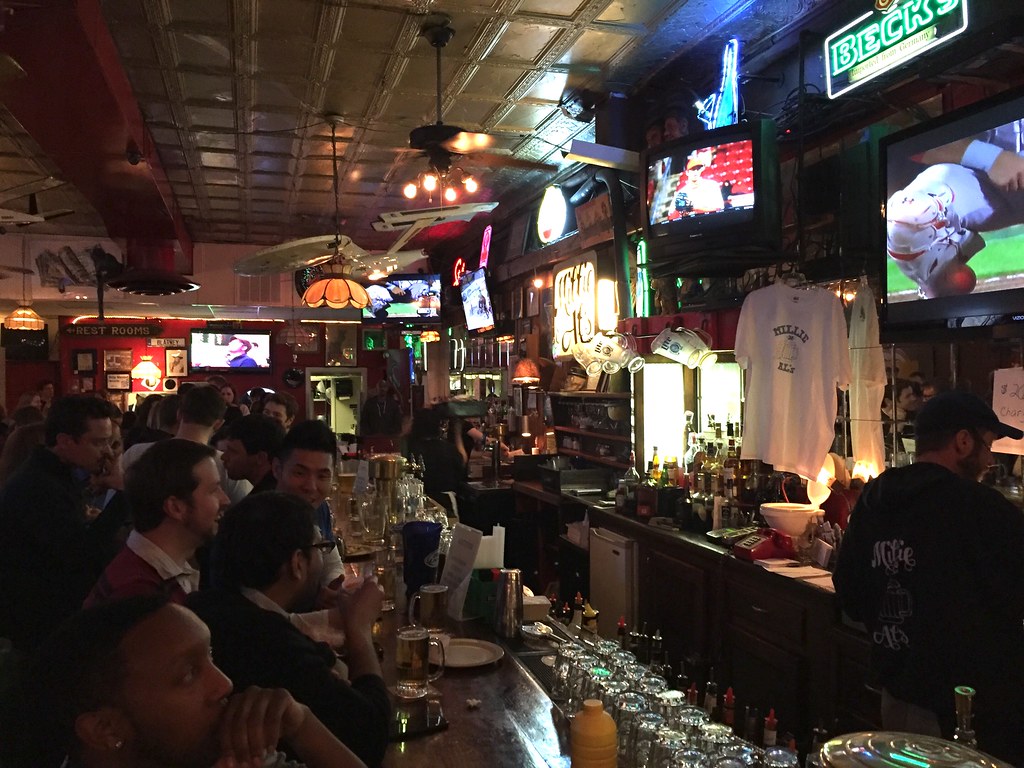
The single most cited detail about Millie and Al’s, more famous than any menu item, was the Jell-o shot. Al’s son, Barbra’s brother, started making them in the early 1990s. Later that decade Barbra installed a flashing red light and a small animatronic dancing skeleton to signal a fresh batch. The skeleton did its jig every thirty minutes. When the light came on, people screamed.
Sold for a dollar a plastic cup, the shots became the bar’s mascot. A t-shirt read “I met your mother at Millie & Al’s.” That t-shirt was not a joke. When Washington City Paper collected love stories from the bar in the closing weeks, readers wrote in with meet-cutes, first dates, and full marriages that traced back to the small dance floor and the pizza kitchen.
This picture is from the Wednesday night my future husband and I drunkenly made out for the first time right next to the jukebox. That was back when you could still smoke in there.
Beth Ambrosio, submitted to Washington City Paper, February 2016
Wednesday nights ran $1 pint specials. A Natty Boh or a Bud Light cost $1.50 on ordinary nights. The bathrooms were legendarily tiny. Barbra Shapiro argued this was a feature rather than a bug: the line for the men’s room and the women’s room forced strangers into conversation, and by the time they came back downstairs they had made friends.
A last toast to Al
Al Shapiro died of cancer in 1996 at seventy-six. The Washington Post ran a piece on May 21 that year titled “A Last Toast to Al.” The oncologist who treated him had been a regular during medical school. So had several of the nurses.
Barbra Shapiro had grown up in the bar as a kid, then gone off to work at an engineering firm and in real estate. She joined the business in the early 1990s. When Al died the siblings talked about selling. She stayed.
I just felt I couldn’t let go of it. I wasn’t sure I enjoyed running it so much as it felt like giving up a piece of the family.
Barbra Shapiro, Washington City Paper, May 2013
She ran it for another twenty years. In 2007 an ABC News Nightline crew shot a segment called “Searching for Mr. Right Now” at the bar. In May 2013 the fiftieth anniversary bash priced drinks by the decade. Six to seven p.m. was 1963 pricing. Seven to eight was the 1970s. Two new shots debuted: “Big Al” and “Who Was Millie?” The Millie question was answered with a shrug and a shot.
The building goes up for sale
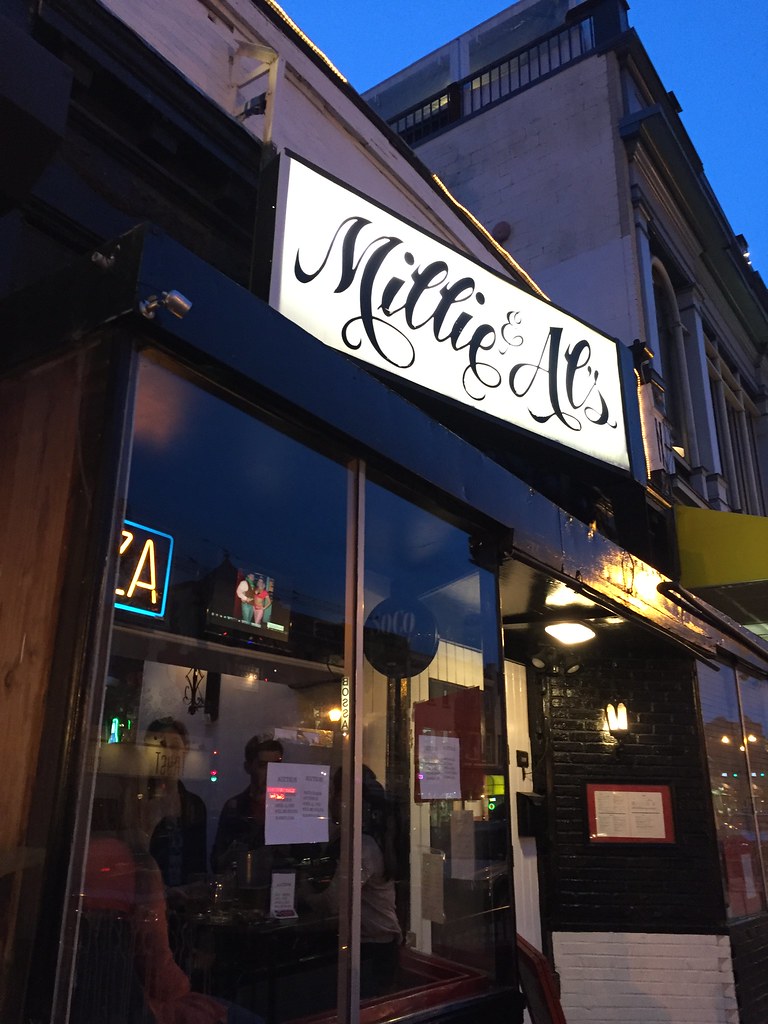
In December 2015 the building at 2440 18th Street went on the market. In mid-March 2016 a reader tipped PoPville that price tags had appeared on the signs, pictures, and mementos inside the bar. The bartender confirmed the end was coming.
On March 24 the Washington Business Journal and DCist reported that April 7 would be the final night. On April 3 the bar held an auction. The dancing skeleton was among the big-ticket items. A public document search showed that a new limited-liability company, 2440 18th LLC, had been registered with the District on March 7. The registered owner was David Mazza, a co-founder of Taylor Gourmet who had stepped away from that chain in 2015. The purchase, the reporting stressed, had no connection to hoagies.
April 7, 2016 was a Thursday. Millie and Al’s opened at 4 p.m., an hour and a half earlier than usual. It closed for good just after last call. It had been open for fifty-three years.
What replaced it
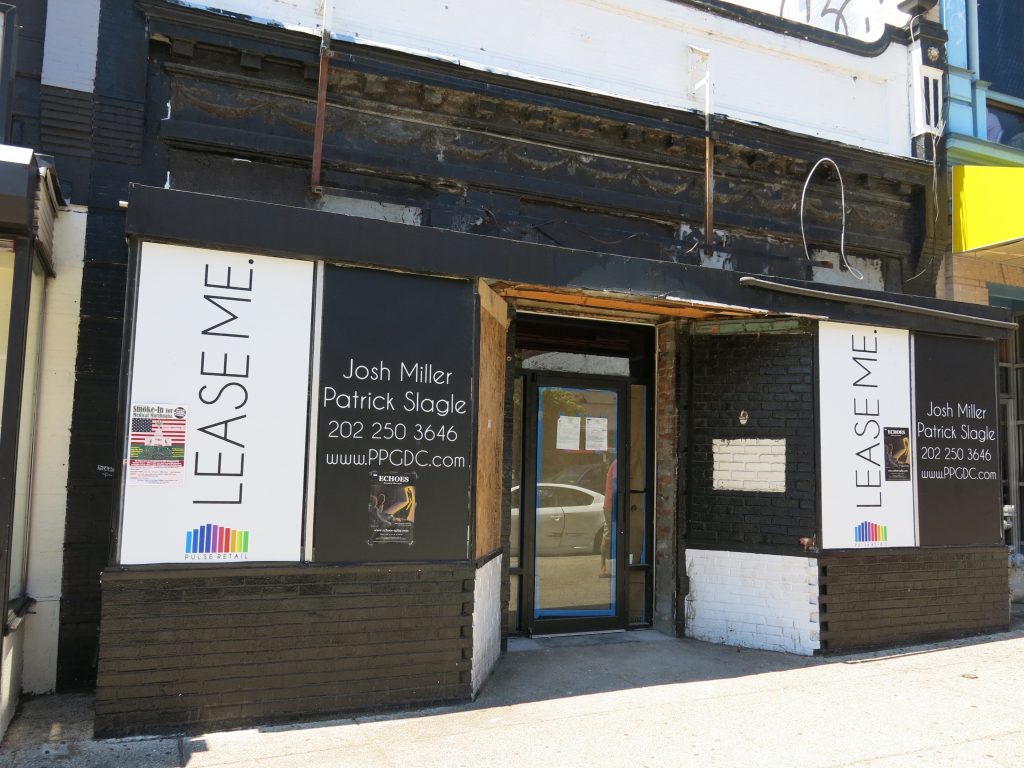
The space sat quiet for over a year. By summer 2017 signage appeared for Bom, a Korean-style fried chicken and Asian fusion restaurant with an occupancy of seventy-five. Bom’s liquor license application was public. Its soft opening happened in December 2017. The tin ceiling stayed. The old wooden bar was reworked. Bom closed in the spring of 2022 after roughly four and a half years.
In its place came Code Red, the current tenant. Code Red is styled as a speakeasy from a script Millie and Al’s would have laughed at: knock on the steel door, give the code word through the grate, sit at low light with a jazzy playlist and a menu of small plates. The room is fine. It is not the same room.
Standing on the sidewalk in 2026
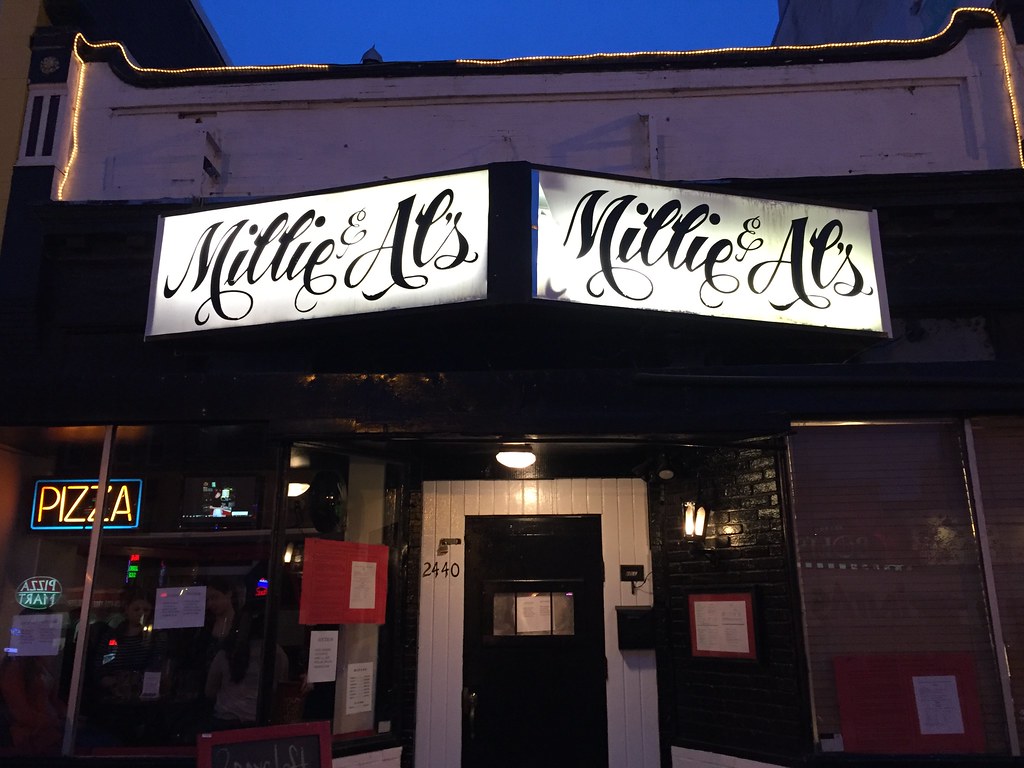
The signs are gone. The lit script that read Millie & Al’s in cursive script above the sidewalk was sold at auction, along with the skeleton. The pizza neon is gone. The pay phones, if they lasted that long, are gone. The regulars, some of them, are gone.
What is left is the building. Same width, same door position, same address plate reading 2440 above it. If you know what to look for, you can still trace the seam where the old signboard hung. What is left is also a paper trail: the WaPo review from 1978, the closing coverage from 2016, and hundreds of Flickr photos taken during that final week by people who knew the door was about to close for good.
The strip of 18th Street that runs from Kalorama Road to Columbia Road is still a going-out block. Some of its bars, like Dan’s Cafe, still feel like the old neighborhood. Some of them feel like this year. Millie and Al’s was, for a very long time, the one that felt like every year it had ever been open at once. Fifty-three years of the same wooden bar, the same tin ceiling, and, after 1963, the same girlfriend’s name on the front.
We dug this one up with help from AI and checked it against the original records below. Here’s how we use AI.