
Before it was Heaven and Hell, before it was Moonlight, before it was an Eritrean-Italian restaurant called Isola Verde, the three-story rowhouse at 2327 18th Street NW had a quieter address book. The most consequential entry on that list is not the bar. In December 1969, an Oakland-trained organizer named Jim Williams walked into the storefront, paid the rent, and turned the building into the first headquarters of the Black Panther Party in Washington, DC.
That fact is documented in a 1970 Panther flyer that explicitly names the address, in independent secondary scholarship, and by the building’s current operator, who tells her own customers about it. It is also, almost certainly, the most surprising thing about 2327 18th Street that any of the tens of thousands of people who have crowded the sidewalk in front of this building for a Saturday night in Adams Morgan have ever heard.
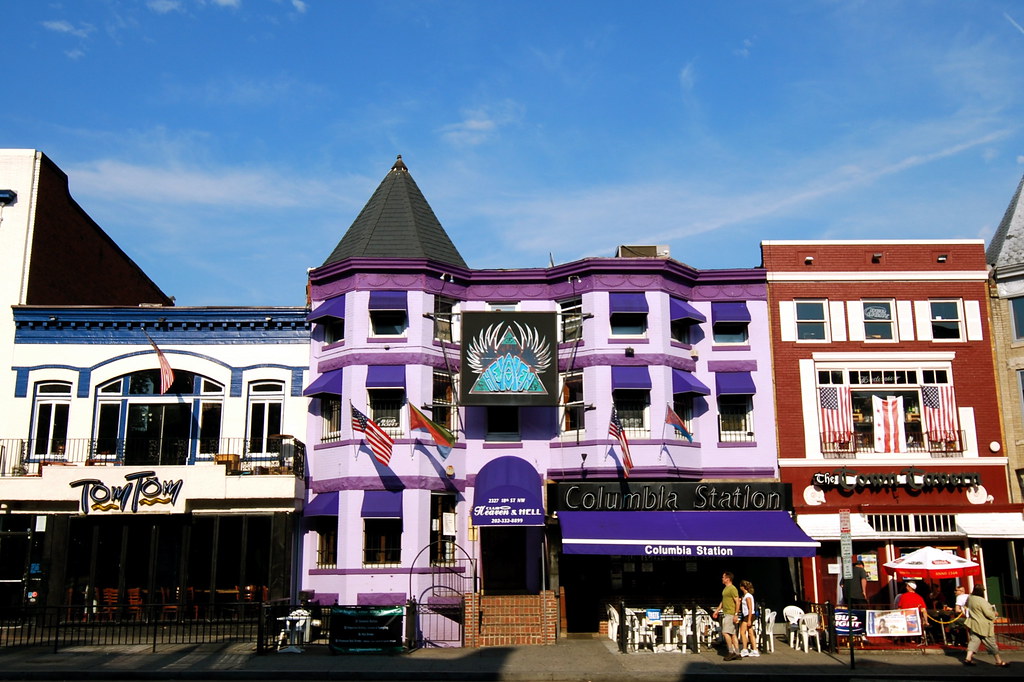
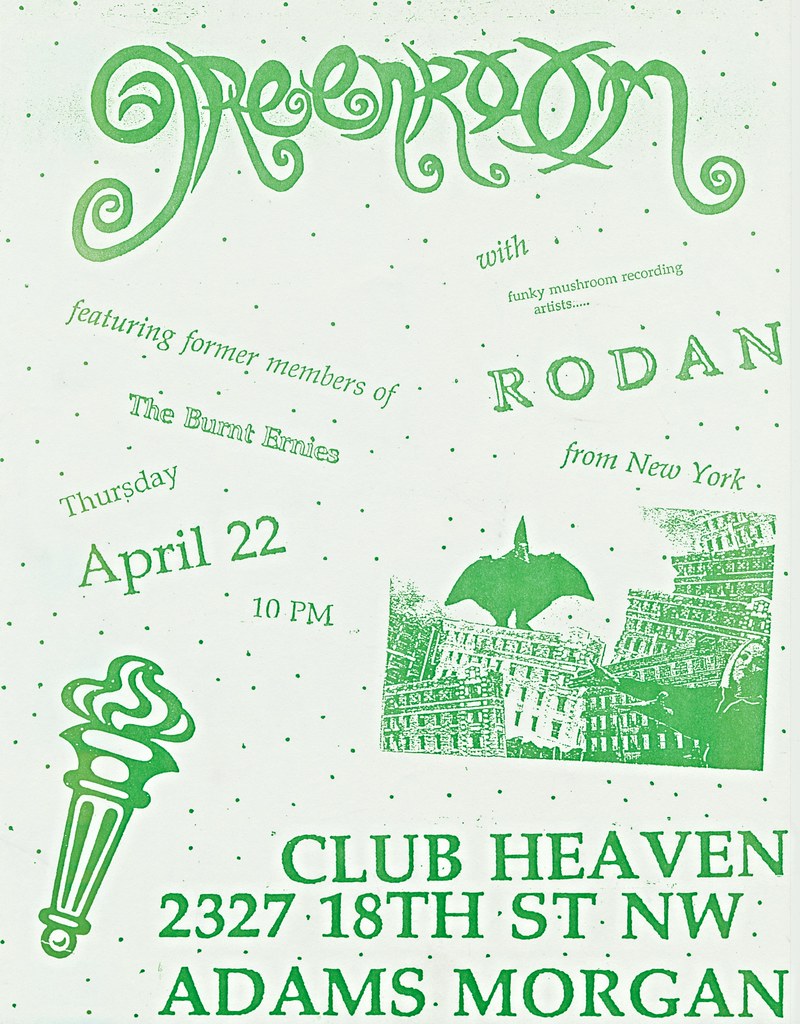
2327 18th has been a rowhouse, a storefront, a Panther office, an Eritrean-Italian restaurant with a dance club upstairs and a basement bar downstairs, the dual-floor nightlife institution Heaven and Hell from June 1991 to 2023, and now Moonlight DC. Three of those chapters are well documented. The earliest and the pre-1991 in-between years are gappy. This is the building biography we can responsibly write.
The 1920 rowhouse on a streetcar block
2327 sits on the east side of 18th Street between Belmont Road and Kalorama Road, in the middle of what was platted in February 1888 as the Commissioners’ Subdivision of Washington Heights. Today this is the heart of Adams Morgan, home to survivors like the cash-only dive Dan’s Cafe a few doors down. In 1888 it was raw land owned by a “complex web of heirs, successors, purchasers, and creditors” that an Equity Court survey team had been ordered to subdivide.
The block did not fill in fast. According to the 2012 Washington Heights Historic District nomination brochure prepared by EHT Traceries for the DC Historic Preservation Office, gas and water service arrived in 1889, asphalt paving followed, and the first building permit in Washington Heights was issued in 1891 for a three-story brick dwelling at 1862 Wyoming Avenue. The 1893 Permanent Highway Act briefly froze the lot market. Only after the amended Highway Act of 1898 did construction surge. By 1903, more than 118 buildings had gone up in the subdivision, as shown on the 1903 Sanborn map of Kalorama and Washington Heights.
What changed everything was the streetcar. In 1890 the Rock Creek Railway pushed an electric line up the steep grade of 18th Street that horse-drawn cars had never been able to climb. Two years later the line was running daily, and by 1896 the Metropolitan extended a second route up Columbia Road. The 2300 block of 18th became, almost overnight, a primary commercial corridor.
2327 itself, per DC Office of Tax and Revenue records reflected in commercial real estate listings for the property, was built in 1920. That puts it on the back end of the Washington Heights residential build-out and at the front end of the rowhouse-to-storefront conversion wave that the WHHD brochure documents block by block. “Many of the rowhouses along 18th Street and Columbia Road were soon transformed for retail use,” the brochure notes. “Projecting bays with expansive storefront windows at street level were added to entice patrons.” The three-story volume that would later stack Heaven, an Eritrean-Italian restaurant, and Hell on top of one another is exactly the geometry that produces.
Who occupied 2327 between its 1920 construction and the late 1960s does not surface cleanly in open-source records. The Washington Heights HD nomination documents specific 2300-block neighbors in the 1930 census: a German upholsterer at 2341, an Armenian rug maker at 2409, a Cuban embassy employee renting at 2413, a Russian upholsterer running a shop out of his home at 2431. That is the demographic and commercial texture of the block 2327 was sitting on. The address itself goes mostly quiet in the open archive between Prohibition and the Panthers, with one neighborhood-level exception worth flagging: on August 3rd, 1928, prohibition agents raided the Ambassador Oyster House at 2106 Eighteenth Street, two blocks south. The pattern of dual-function storefront-and-speakeasy commercial spaces on this stretch of 18th Street is the right context for what 2327 was probably doing at the time.
December 1969: The Black Panthers move in
By the end of 1969, the Black Panther Party was under siege almost everywhere it had organized. Chairman Fred Hampton had been killed in his bed in Chicago on December 4th. The national leadership was either under indictment, in prison, or in exile. The FBI’s COINTELPRO program had infiltrated chapters from coast to coast. Huey Newton and the Central Committee had ordered offices to consolidate into the heart of Black neighborhoods to make them harder to isolate at night.
DC had not had an official chapter yet. A 1967 attempt by Robert Rippy, a UPO employee, had been rejected by Oakland on the grounds that Rippy’s group lacked sufficient self-defense training and political education. By late 1969, Oakland reversed course. They sent Jim Williams, a Panther organizer, to Washington in December with instructions to set up a Panther support group called the National Committee to Combat Fascism, or NCCF.
Williams rented a storefront at 2327 18th Street NW. The choice of Adams Morgan was deliberate. The neighborhood by 1969 was the most racially and ethnically mixed commercial corridor north of downtown, anchored by the Adams-Morgan Better Neighborhood Conference that had organized across the color line since 1955 to integrate the elementary schools two blocks west. Around the corner on California Street, former Howard architecture student Colin “Topper” Carew and painter Lloyd McNeill were running the New Thing Art and Architecture Center, a Black arts collective that the DC Office of Planning’s 2023 Black Power historic context identifies as one of the anchors of Black cultural organizing in Adams Morgan in this period.
From the 2327 office, per the Washington Area Spark archival narrative built from Washington Post coverage and Panther-newspaper sourcing, Williams began the slow work of building a chapter. He sold the Black Panther newspaper. He screened Panther films at local colleges and high schools. He recruited members to the NCCF. He worked alongside a coalition called the Coalition Against Racism and Fascism, which held a memorial rally at All Souls Unitarian Church at 16th and Harvard to protest Hampton’s killing in Chicago.
By the spring of 1970, the chapter was visible enough to draw federal attention. A flyer circulated in late April or early May called on white sympathizers to come down to the office in person and provide a buffer against a feared police raid:
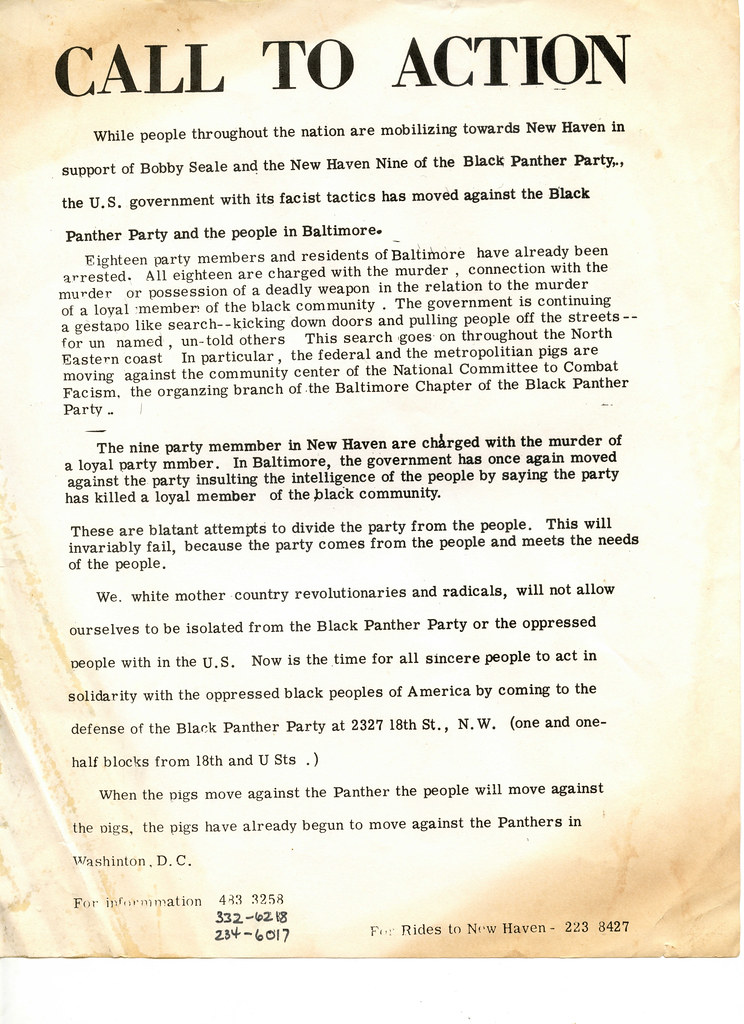
The exact text, from the body of the flyer: “Now is the time for all sincere people to act in solidarity with the oppressed black peoples of America by coming to the defense of the Black Panther Party at 2327 18th St., N.W. (one and one-half blocks from 18th and U Sts.)” That is a contemporary primary source, in print, naming the office by address. White supporters did sit out front for several days as a human buffer until the immediate threat subsided, per the Washington Area Spark account.
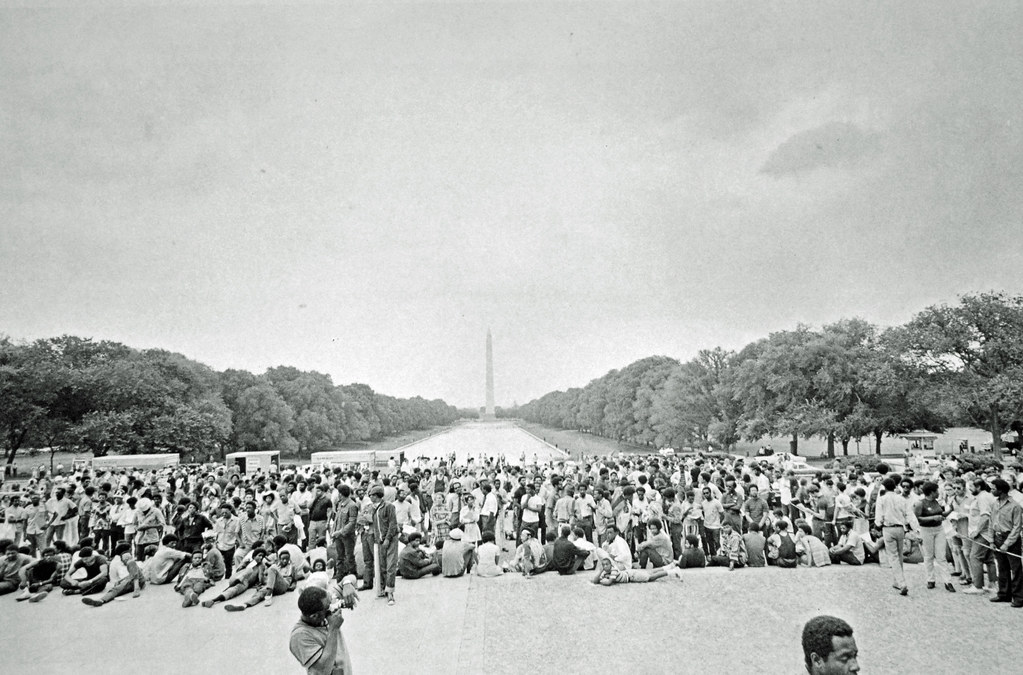
On June 19, 1970, on the steps of the Lincoln Memorial, the NCCF was upgraded to a full DC chapter of the Black Panther Party. The announcement coincided with a Panther rally for the Revolutionary People’s Constitutional Convention that drew about 1,000 people, including Panther delegations from across the country. The chapter’s first headquarters address, the one on every recruiting flier and every newspaper sale that summer, was 2327 18th Street NW.
By late summer the chapter had grown beyond the 2327 storefront. Williams took over a separate building at 1932 17th Street NW, eight blocks to the southeast, and converted it into a Black Panther Community Center. Two weeks after that 17th Street community center opened, DC police raided it. Just before 10:00 pm on July 4th, 1970, officers arrived at 1932 17th, broke down the front door after a brief street-corner confrontation, fought their way inside, and seized three rifles, a shotgun, a pistol, papers, and cash. Twenty Panthers and supporters were arrested. Three children were taken into custody, two of them injured by police. A crowd of more than 200 neighborhood residents gathered outside the precinct house until the Panthers were released. The city later dropped every charge from the raid.
2327 18th Street, the storefront where the DC chapter had actually started, was no longer the headquarters address by late 1970. By 1972, the chapter relocated its main operations across the river to a People’s Free Health Clinic in the basement of the Johenning Baptist Center on 9th Street SE in Anacostia. The Panthers ran a free bus program for families visiting incarcerated relatives at Lorton, an Angela Davis People’s Free Food Program food bank, and free rides for the elderly to the bank on the first of each month. The DC chapter formally dissolved in the spring of 1974.
The first DC headquarters of the Black Panther Party operated out of 2327 18th Street NW for roughly six months. The Washington Area Spark archive, which assembled the chapter’s full history in 2012 from contemporary press coverage and Panther internal documents, summarized the building inventory plainly: “The main buildings utilized by the Panthers still stand: 2327 18th Street NW (first Panther HQ) is occupied in 2012 by Club Heaven & Hell.”
The gap years: 1972 to 1990
Adams Morgan in the 1970s and 1980s is one of the better-mythologized periods in DC neighborhood history, but the run of specific tenants at 2327 18th Street through those two decades does not surface cleanly in open-source records. The Cuban, Salvadoran, and Ethiopian commercial corridor that the neighborhood became was filling in around this address through the late 1970s and 1980s, with the Adams-Morgan Day festival running annually from 1978 onward and 18th Street establishing itself as the city’s primary Latin American commercial strip.
By spring 1991, the building had been taken over by an Eritrean-born restaurateur named Muhari Woldemarian, who installed an Eritrean-Italian fusion restaurant called Isola Verde on the ground floor. Above and below it, he opened two bars.
June 1991: Heaven, Hell, and the ABC board
The Washington Post’s Richard Harrington filed the first review of the new venue on June 7th, 1991, under the headline “Heaven, Hell for Odd Souls.” The setup at opening:
Ground floor: Isola Verde, the Eritrean-Italian restaurant, where Woldemarian ran an unusual fusion menu.
Upstairs: Heaven. “In the front room lined with funky old sofas and easy chairs, patrons drink and chat while TV monitors play reruns of the old ‘Batman’ series. The walls are adorned with big, colorful abstract paintings by Mike Walberg, who is also manager of the club. A recent graduate of UDC’s arts program, Walberg gave himself an exhibition as a graduation gift. In the adjoining room, DJ Tommy Berard (‘Psycho Tommy’) dances with himself to his propulsive sequencing of Ride, Jesus Jones and Cop Shoot Cop. In back, there’s an outdoor patio with a bold mural of angels, gods and clouds. And the breeze is truly heavenly.”
Basement: Hell. Designed by Al Jirikowic, who Harrington describes as the actual creative force behind the basement bar before he left after “tragic business differences with Woldemariam.” Harrington’s description: “the sort of funkily postapocalyptic-industrial, art-directed, low-key hangout you can find on every corner in New York’s East Village. Hell’s denizens hunch over eccentrically shaped copper-encrusted cocktail tables and at the bar, which features a dense mural combining images of Santeria, voodoo and Catholic iconography, including the Four Horsemen of the Apocalypse, Hieronymus Bosch and a bartender’s sign that says ‘The Devil is IN.'”
One detail from the 1991 review that anyone who lived through the Heaven and Hell era will appreciate: Hell could not legally be called Hell. Woldemarian had applied to the DC Alcoholic Beverage Control Board to license the basement under the name. The board said no. “So Hell is merely an official nickname,” Harrington noted. Every license, every regulatory filing, every ABRA hearing transcript that followed for thirty years called the venue something else. The building’s regulatory identity through the entire Heaven and Hell era was always officially Green Island Café d/b/a Heaven and Hell. The ABC board’s 1991 ruling stuck.
“Welcome to Heaven,” Harrington quoted Woldemarian saying to the room. “If you don’t like it, go to Hell.”
Jirikowic, banished from his own basement, moved a few blocks south to 1725 Columbia Road and opened a successor bar called Chaos in the spaces above the Asmara Ethiopian restaurant. Harrington’s verdict in 1991: “Improving on the design of his impressive Hell, Jirikowic’s Chaos has burnished metals, silvered bas-reliefs and devotional altars and a window front affording an aerial view of mesmerizingly chaotic Columbia Road street life.”
Three decades, one owner, one address
Heaven and Hell operated continuously from June 1991 through 2023 under the same ownership. Woldemarian was, per the 1991 review, the operator at opening. The DCist coverage of the bar’s 2019 ABRA hearing identifies the owner as “Mehari Woldemariam,” a slightly Americanized spelling of the same name. He had also taken over the building next door at 2325 18th, which he rented, and was running Columbia Station, the only consistent live jazz venue on 18th Street, out of it.
Columbia Station, between roughly 1998 and 2020, was the place to find a midnight house piano trio in Adams Morgan. The jam sessions ran six nights a week. Pianist Peter Edelman led them. Saxophonist Knud Jensen, now 78 and playing bebop on a soprano recorder because medical issues forced him off the horn, was a regular. “Jazz greats such as Butch Warren, Fred Foss, Ted Efantis, Lawrence Wheatley and more set up shop beneath its signature wide French windows, thrown open to the night, proselytizing bop to the tipsy Adams Morgan passersby,” wrote Shannon Gunn in a 2023 CapitalBop profile.
In October 2019, Heaven and Hell came before the DC Alcohol Beverage Regulation Administration for a hearing that produced the largest fine and longest suspension in the agency’s history to that point. ABRA hit the bar with a $90,000 fine and a 90-day liquor license suspension, beginning November 1st and running through January 29th, 2020.
The fine consolidated two separate incidents. The first, on August 17th, 2018, was a security violation. ABRA investigators arrived to find two men sitting at a table on the sidewalk in front of the bar, drinking beers, and collecting a cover charge to let people in. The men were not on the Heaven and Hell payroll. They worked for an event promoter who had booked the room that night, and the bar had effectively rented out its operating license.
The second incident, in November 2018, was the one that made local TV news. A customer ordered a Long Island iced tea. The man behind the bar, Woldemariam himself, mixed the drink using a yellow cleaning fluid the staff called “Yellow Death” instead of sour mix. The customer drank some, realized something was wrong, and Woldemariam called 911. The customer survived.
“It was a mistake,” Woldemariam told Fox 5. “Why should I have somebody poisoned? The customer comes to pay me and I’ve been in this business for the longest time in Adams Morgan.” Police passed the case to ABRA. The hearing transcript, available in full on the ABRA website, includes Chairperson Donovan Anderson’s now-quoted-everywhere observation: “I remember the first time you came across here, I had some difficulty in pronouncing your name. I’m too comfortable in pronouncing your name. That tells me that you are coming in front of me too often and I don’t like that.”
The 90-day suspension ran out at the end of January 2020. Heaven and Hell paid the fine and reopened on January 30th. Three weeks later, the world locked down for COVID.
When Columbia Station moved next door
Early in 2020, in the same weeks Heaven and Hell was completing its suspension, the rent at Columbia Station next door went up. Woldemariam had been renting 2325, not owning it. Faced with a rent he could no longer carry on the jazz operation, he closed Columbia Station and walked the whole thing one storefront north into his own building at 2327. By this point Isola Verde was long gone from the ground floor.
He renamed the ground floor Green Island Café. He installed a new sound system and new lighting. Peter Edelman came back to lead the jam sessions. Knud Jensen kept playing. The same bebop, the same musicians, the same French windows thrown open to 18th Street, now sandwiched between Heaven upstairs and Hell downstairs. Green Island was, per DCist’s later reporting, one of the first jazz rooms in DC to reopen after the COVID shutdown.
For about three years, the building ran as three venues with three names under one owner. The dance kids did not always realize the jazz was there. The jazz musicians did not particularly care whether the dance kids were there. The building absorbed both.
2023: Moonlight
About six months before the September 2023 CapitalBop profile, a young promoter named Sabela Behun approached Woldemariam with a takeover proposal. Behun, who goes by Bela, wanted to consolidate all three floors under a single brand and reorient the venue toward a younger, later, more music-driven crowd. Woldemariam was ready to retire after 32 years at 2327 18th. He took the deal.
Behun rebranded Heaven, Green Island, and Hell as a single venue called Moonlight DC. A new sign went up beside the old “Live Jazz” marquee out front. The interior got fresh paint and re-upholstered seating. The jazz programming stayed put on the ground floor. Edelman keeps leading the jam sessions Wednesday through Sunday. The room is open until 2 AM.
When CapitalBop asked Behun what made the space special, she did not lead with the bar history. “The building used to be a Black Panther meeting house,” she told Shannon Gunn, “and we want it to be the best after-party jazz at the end of the night.” That is operator-to-historian transmission of the building’s deepest identity, across five decades and four owners, in a single sentence.
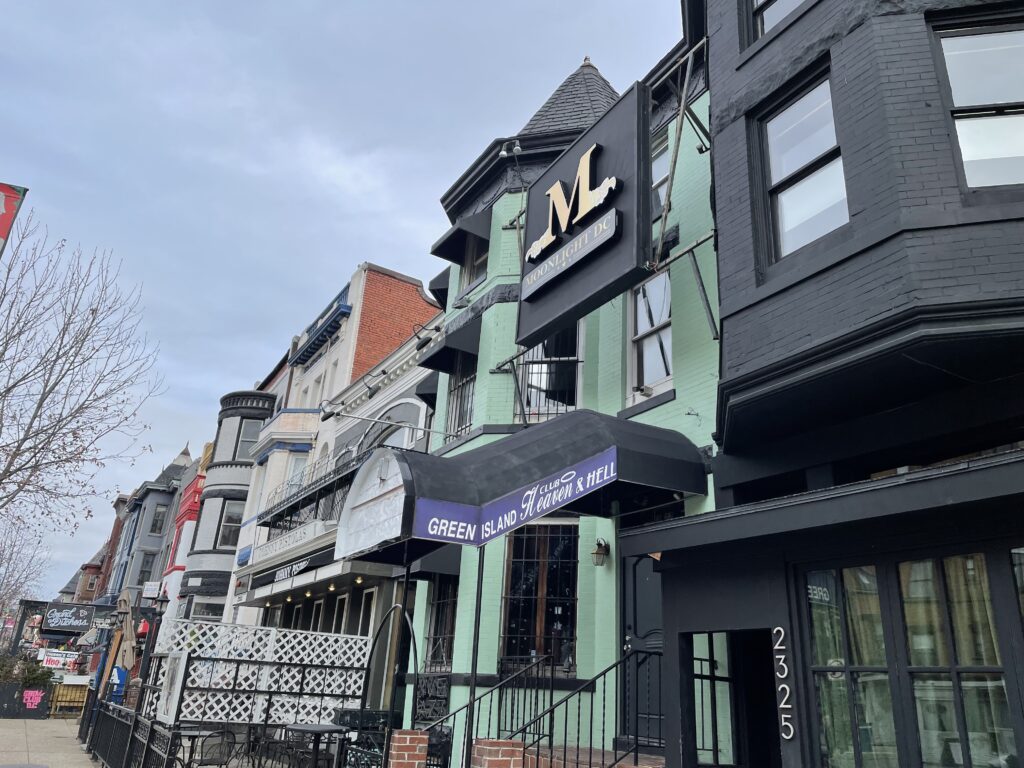
In February 2025, per PoPville’s coverage, some of the original Heaven and Hell signage returned to the building, now operating as decorative nostalgia branding alongside the Moonlight identity. The building has also been repainted: the purple-and-pink facade that defined the Heaven and Hell era is now a softer mint green. If you walk past today, you can read both names on the facade.
What’s there now
Three levels, one owner, one operator, one brand on paper. Moonlight DC, anchored by jazz on the ground floor and late-night dance programming above and below. Bela Behun runs it. Mehari Woldemariam owns the building. The Yelp page still answers to “Club Heaven and Hell.” Google Maps lists the address under both names.
The building is a contributing structure to the Washington Heights Historic District, designated by the DC Historic Preservation Review Board in 2006 with a period of significance running 1891 to 1950. That designation gives 2327 the same procedural review protection as every other rowhouse-turned-storefront on the 2300 block of 18th Street. The 1920 facade, the projecting commercial bay added sometime in the rowhouse-conversion era, the three-story volume with the corner turret, all of it is what the district was designated to preserve.
Six chapters in one building. A 1920 rowhouse on a streetcar corridor. A series of storefronts and small restaurants through Prohibition and the postwar decades. The first DC headquarters of the Black Panther Party, late 1969 through summer 1970. Two decades of Adams Morgan commercial flux that ran quiet in the records. Three decades of Heaven and Hell with a jazz room next door, then briefly inside. And, since 2023, Moonlight DC operating on the same three floors that have stacked dance, music, and the slow grind of urban commerce on top of one another for more than a century.
The signage out front says Heaven and Hell. The newer sign next to it says Moonlight. Both are right. Neither one captures the most consequential thing this building has ever been.