

Adams Morgan is named after two elementary schools. One was white and one was Black, they sat about a block apart, and in May 1955 their two principals decided their neighborhoods had to start working together.
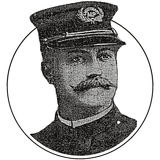
Florence N. Cornell ran the all-white John Quincy Adams School. Bernice Brown ran the all-Black Morgan School. The group they started was called the Adams-Morgan Better Neighborhood Conference, and its name outlived everything else about it.
Here’s how two school names became the name of one of Washington’s best-known neighborhoods.
The Morgan School and the Adams School
The Morgan School stood at the corner of California and Champlain Streets NW, at what is now 2200 Champlain Street, on the rise above 18th Street where the Marie Reed school and recreation center sits today. It was built for white children.
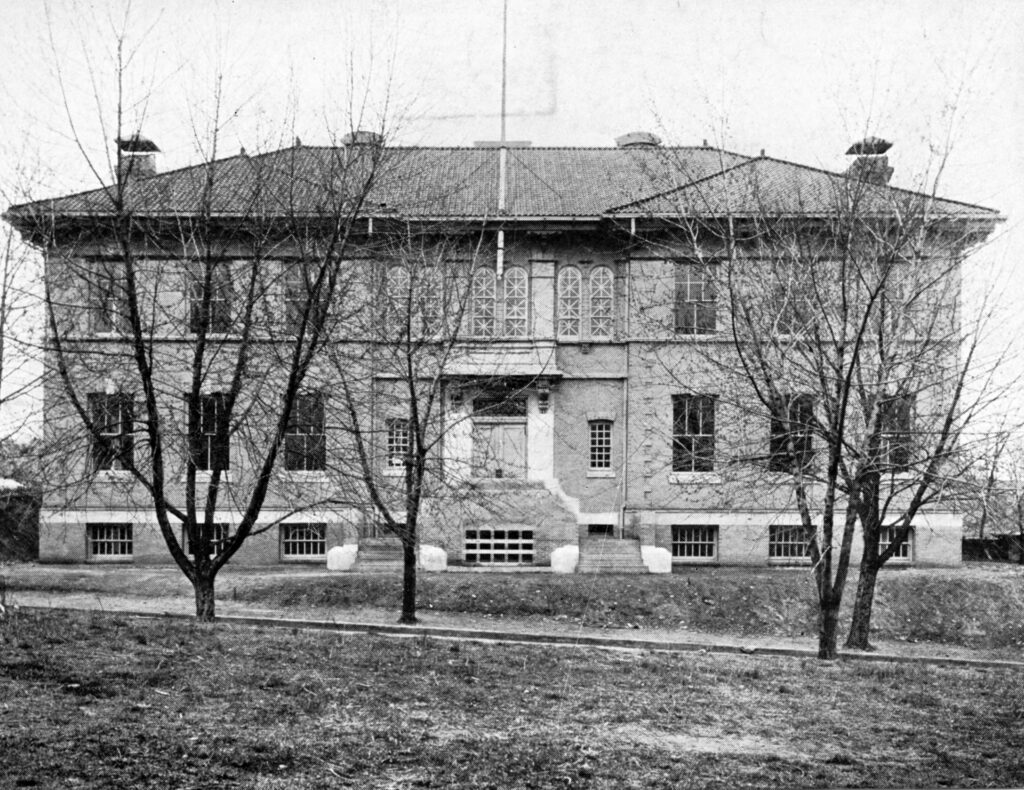
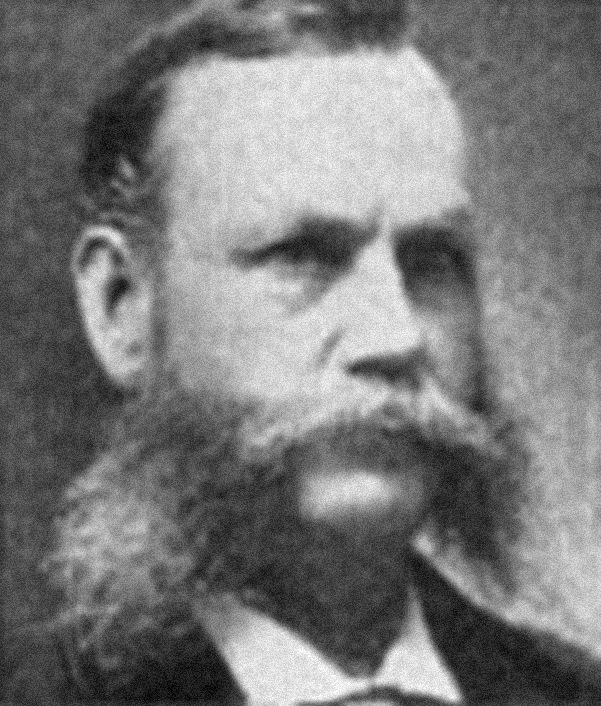
The school carried the name of Thomas P. Morgan, an Alexandria native born in 1821 who collected civic titles like few Washingtonians of his day. He sat on the Board of Fire Commissioners from 1873 to 1878, ran the Metropolitan Police from February 1878 to November 1879, and then served as one of the District’s three commissioners from 1879 to 1883.
By the late 1920s the white schools in the area were badly crowded, so the city built a new one on a steep hillside at Columbia Road and 19th Street.
According to the Evening Star on January 5th, 1930, the new building had 26 major rooms, an assembly hall and space for a cafeteria. Municipal architect Albert L. Harris stacked it so that the front sat a full story above the street while the playground sat two stories higher, on top of the hill out back. School officials called it “one of the system’s handsomest structures.”
It took its name from an older Adams School at 17th and R Streets, which the city was finally closing after years of complaints.
The new Adams School opened at 9 o’clock on Monday morning, January 6th, 1930, and the white children of the Morgan School moved in. The Star spelled out what came next for the old building:
At the same time the Morgan School will become a colored elementary school and the transfer of its present pupils tomorrow will enable the District repair shop to make renovation.
The city gave Morgan an eight-room addition and an assembly hall, nearly doubling its space, and reopened it for Black children.
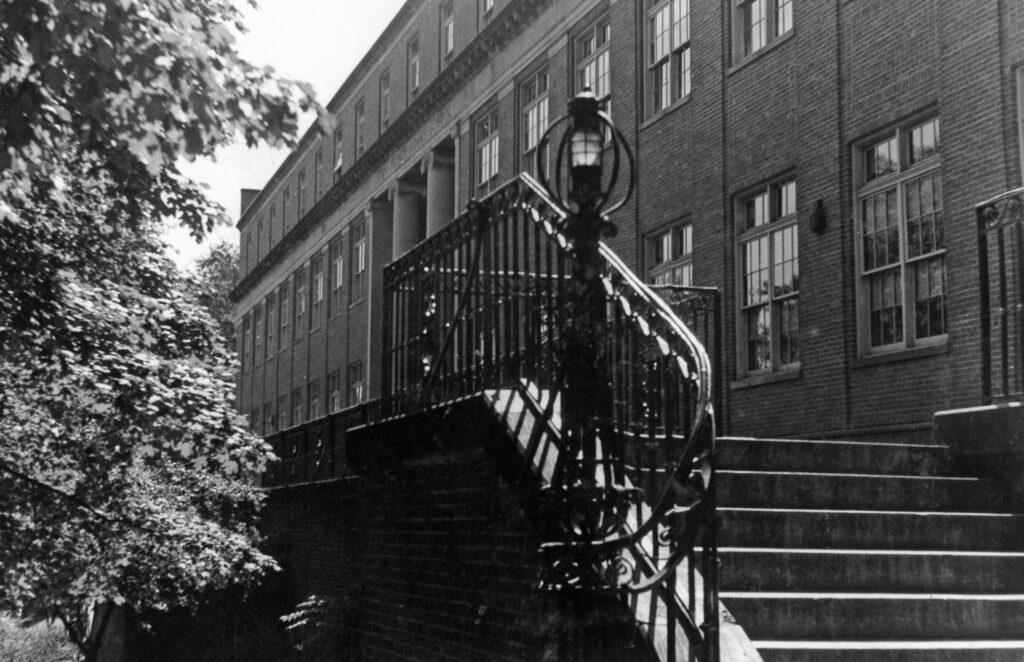
So by 1930 two segregated elementary schools sat about a block apart on the slope below Columbia Road. Adams was brand new and white. Morgan was older, enlarged and Black.
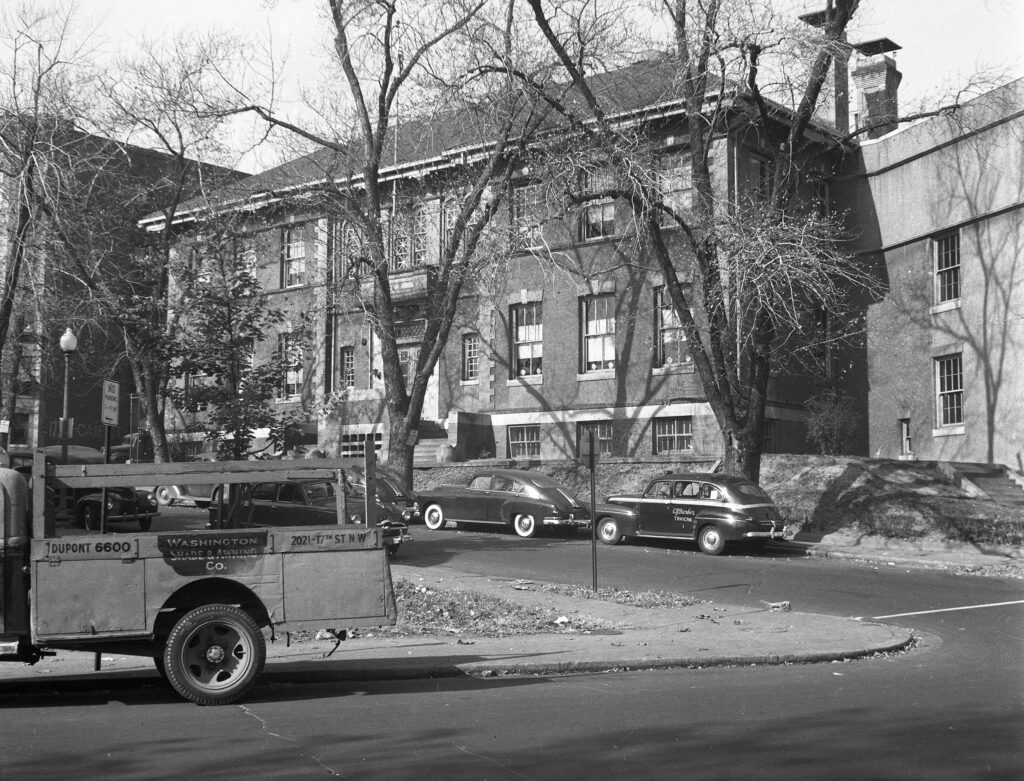
That arrangement held for twenty-four years.

What Brown didn’t do
You probably know that on May 17th, 1954, the Supreme Court’s ruling in Brown v. Board of Education struck down school segregation. What you might not know is that Brown didn’t reach Washington. It rested on the Fourteenth Amendment, which restricts the states, and the District isn’t a state.
Washington’s schools were integrated by a companion case decided the same day, Bolling v. Sharpe. Spottswood Bolling and other Black children had been turned away from the new, all-white John Philip Sousa Junior High in Anacostia on September 11th, 1950. Chief Justice Earl Warren reached the same result through the Fifth Amendment, writing that segregating District schools was “an arbitrary deprivation of their liberty.”
The District didn’t stall. On September 13th, 1954, its public schools opened on a partially integrated basis, about four months after the ruling.
White families left fast. White enrollment in the city’s public schools fell about 30 percent in the two years after Bolling, and by 1965 white students made up only about 10 percent of the system. Parents moved to the suburbs or switched to private schools.
On paper, Adams and Morgan were now open to every child in the neighborhood. In practice the neighborhood was changing around them, and nobody had a plan for what came next.
Two principals, May 1955
Florence Newell Cornell had been principal of Adams since 1934. Born in South Dakota, she trained at the old Chicago Teachers College, earned degrees from George Washington University and the University of Maryland, and came to Washington in 1918. She taught at Wheatley Elementary starting in 1921 and ran a string of schools before Adams. In 1951 she also took over the Oyster School.
By the mid-1950s she was seeing problems in her classrooms that teaching alone couldn’t fix. The Washington Post and Times Herald explained it on April 16th, 1959:
Mrs. Cornell first became aware of the need for community renovation when, as principal of the Adams Elementary School, she came into contact with the problems a new type of child was presenting to her teaching staff. Bernice Brown, principal of the nearby Morgan Elementary School, shared this concern.
Together and with the help of the neighborhood’s churches, business groups and individuals they initiated the Adams-Morgan Better Neighborhood Conference in May, 1955. Mrs. Cornell became its chairman.
Getting white and Black residents into the same room was a bigger deal than it sounds. When the Washington Post looked back on June 24th, 2001, it noted that residents had been represented by either the all-white Kalorama Citizens Association or the all-Black Midway Civic Association, and that the D.C. Federation of Citizens Associations had threatened to revoke Kalorama’s charter “if blacks were accepted as members.”
The new conference took both schools’ names because it was built on both schools. Adams, hyphen, Morgan.
“An attack on blight”
The conference’s big public debut came on Sunday, October 21st, 1956, on page B4 of the Washington Post and Times Herald. Reporter Wes Barthelmes opened with this:
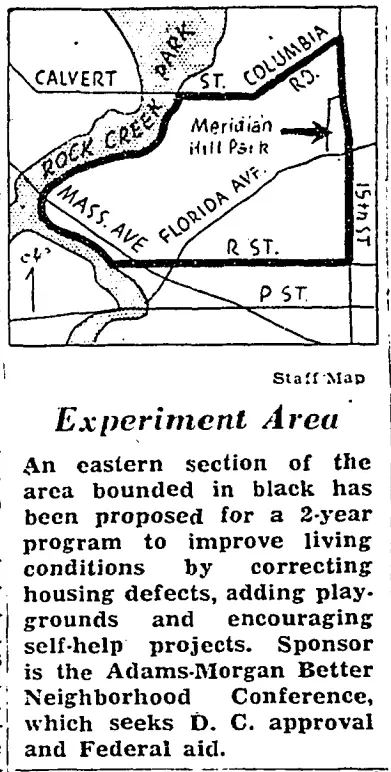
An unusual program, first of its kind in Washington, is being mapped to roll back deterioration in a Northwest neighborhood, housing perhaps 30,000 persons. The cooperative venture, cutting across racial lines, is an attempt to couple energy of residents, resources of the District government, and Federal funds into an attack on blight that has not yet become irreparable.
Sponsor of the “stitch-in-time-saves nine” program is the Adams-Morgan Better Neighborhood Conference. Members are citizens and school, civic and church organizations in the area.
The Post drew the area as bounded by Rock Creek Park, Calvert Street and Columbia Road, and 15th and R Streets, and it spelled out where the name came from: “The group takes its name from the Adams and Morgan Elementary Schools.” Members included both principals, their PTAs, the Midway Civic Association, the Kalorama Neighborhood Council and the Friends Meeting. Dean Richard M. Bray of American University had agreed to run the project.
Cornell, quoted as conference president, put the stakes plainly:
We feel that this can be a very significant project for Washington, not only because of the aim of physical rehabilitation, but also the important matter of getting people to work together in a common cause.
A little over two weeks later the conference took its case to the District Urban Renewal Council, asking for federal money under the Housing Act of 1954 for a “demonstration project.” The Evening Star on November 8th, 1956, described the area as “a once high-grade residential area” of about 25,000 people, and quoted Cornell’s pitch about the “galloping blight” there:
We believe that the fact that both white and colored citizens of this area are working together to improve this neighborhood, plus the fact that they have an initial start in organization to encourage citizens to make the community a better place in which to live, warrants selecting this area for the demonstration.
It took two more years, but it worked. In October 1957 the conference received a trust fund that started Hollyday House, a neighborhood center. In October 1958 the District commissioners signed a contract with American University to bring in a professional staff, and the Adams-Morgan Demonstration Project was under way.
“Merely shifting the emphasis”
Cornell retired from Adams and Oyster in June 1959. The Washington Post and Times Herald profiled her on June 9th, 1959, and reported that she had given four years of her spare time to the group that “sparked the $200,000 Adams-Morgan demonstration project in a 40-block Northwest area.”
She had watched the neighborhood change from her office. From 1934 to 1936, the paper noted, Adams had a pupil named John Eisenhower, son of the future president. Back then, every pupil in some of her classes scored above average on intelligence tests. By 1959, she said, some children had “never heard the simplest nursery rhymes, never have had their parents read to them or take them anywhere.” She had seen a family of eight living in a single room.
So she wasn’t really retiring. She planned to work full time as a volunteer for the conference she had founded:
I am merely shifting the emphasis of my work from the school to the community.
That April the League of Women Voters had honored her for her “initiative and outstanding leadership.” Florence Cornell died on August 6th, 1985, at 92. Her Washington Post obituary called her “an organizer and past president of the Adams-Morgan Better Neighborhood Conference and an originator of the Adams-Morgan Demonstration Project.”
By then the name had long since stuck to the neighborhood itself. The first Adams Morgan Day festival took over 18th Street in September 1978, and nobody had to ask what “Adams Morgan” meant.
The hyphen comes off
For decades the name was spelled Adams-Morgan, and the Washington Post kept the hyphen until 2001. On June 24th, 2001, a Post copy editor named Chris Hopfensperger explained that editors had been “blitzed with e-mails from neighborhood activists” protesting the hyphen, and that the paper was dropping it.
One of those letters came from local historian Josh Gibson, who later co-wrote a history of the neighborhood. He argued that “it would be unfair to make Morgan a subsidiary of Adams, as a hyphen would do.”
The Post’s own explanation saw it differently. It argued the hyphen had meant something all along:
Which means the hyphen is a larger political statement than it is a grammatical one. For decades the hyphen has tied together the two names as well as the neighborhood’s racial factions.
Either way, Adams Morgan became two words.
What’s there now
The Adams building still stands at 2020 19th Street NW. In 2007 it merged with the Oyster School to form the Oyster-Adams Bilingual School, a dual-language English and Spanish program. Fittingly, Florence Cornell had run both schools at once back in the 1950s. The Adams campus now serves the upper grades.
The old Morgan building came down in the 1970s. In its place, the Marie H. Reed Community Learning Center opened in 1977. It’s named for Bishop Marie H. Reed, who led the community school board that took charge of Morgan in the late 1960s.
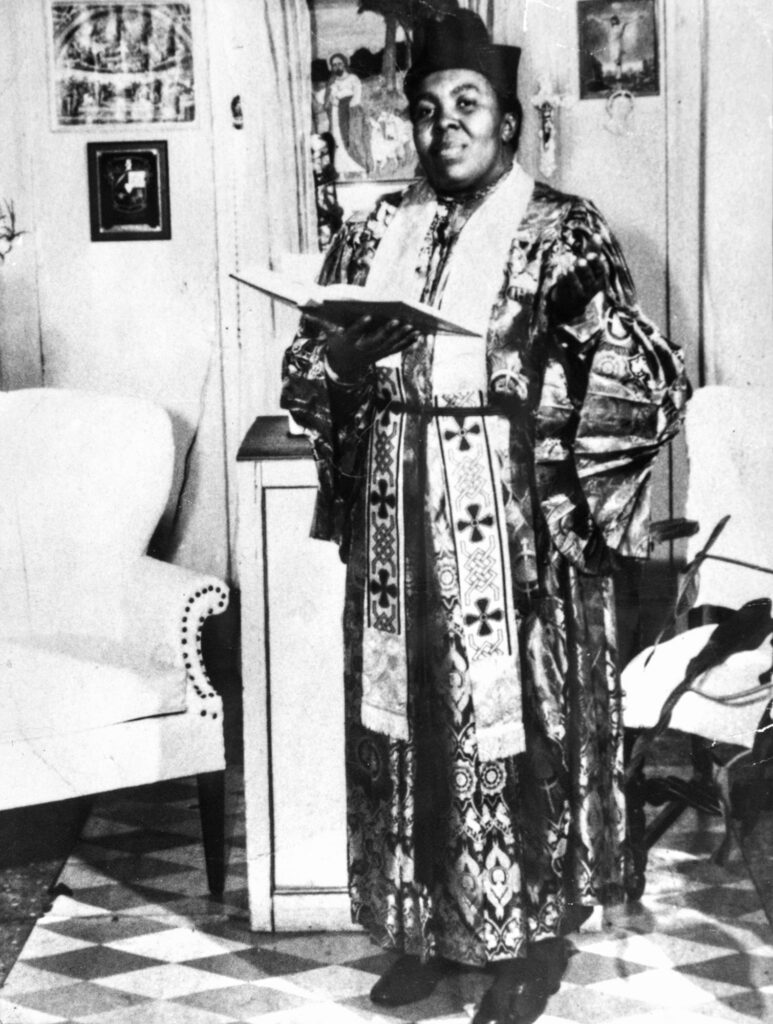
Stand near 18th and California on a weekday afternoon and you’ll see kids heading home from Reed in one direction and from Adams in the other. The two schools are still about a block apart.

I lived in Adams Morgan in the early 2000s, near 17th and Kalorama, in a full one-bedroom that rented for $1,000 a month. The big building on that corner sat empty back then. It had been a roller rink, which is a story for another day.
Today it’s a Harris Teeter, where you can grab a good six-pack on the way home. A parking garage at the same intersection was being turned into condos.
My beer run back then was the liquor store at Champlain and Kalorama, where the clerk worked behind thick plexiglass. The best I ever got there was an expired six-pack of Sam Adams. As it happens, Samuel Adams was a second cousin of John Quincy Adams’s father.
I had no idea the name on every street sign around me came from two school principals who decided their neighbors should meet.
The schools never merged. The neighborhood did, and the schools gave it a name.
Lost Washington stories, in your inbox.
The newest story, plus a few from the archive.
Free. Unsubscribe anytime.
We use AI to help research, write and edit stories across our sites. Here’s how we use AI.Suggest a correction