
At 2:08 p.m. on July 12, 1957, a small Bell H-13J Sioux lifted off the White House South Lawn with President Dwight D. Eisenhower strapped into the right rear seat. Ike was the first American president to fly by helicopter, and the whole thing was cover for a Cold War nuclear evacuation drill.
The exercise had a name. Operation Alert 1957 was that year’s rehearsal for a Soviet strike on Washington. Federal officials scrambled to relocation sites. The president, this time, was going to leave by air.
By 1956, Soviet nuclear capability had reached the point where evacuating the president by motorcade was no longer a serious plan. Ike’s chief pilot and Air Force aide, Colonel William Draper, went shopping for a helicopter.
The Secret Service had opinions. Helicopters had been in military service since 1944, but the agency had barred the president from ever climbing into one except in case of emergency. Draper won the debate. The Cold War was the emergency.
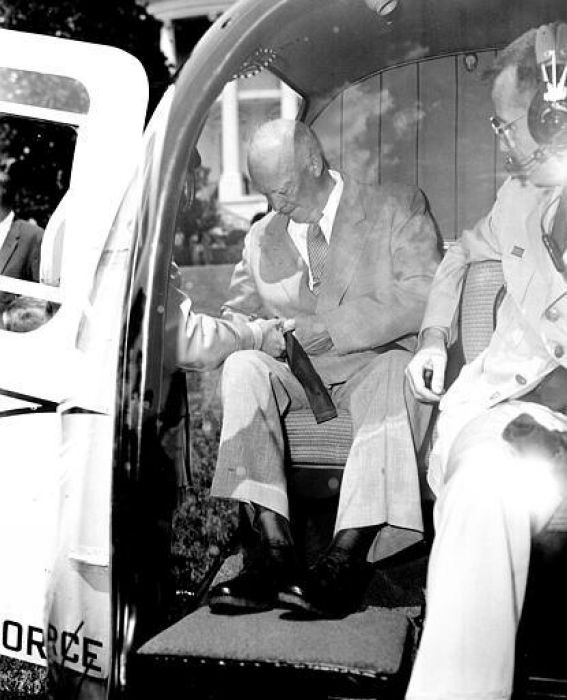
The pilot: Major Joseph E. Barrett, USAF
The man at the stick was Major Joseph E. Barrett, an Air Force pilot with the kind of resume the Secret Service could sign off on. He’d flown B-17 Flying Fortresses over Europe in World War II. During the Korean War, he’d carried out a helicopter rescue 70 miles behind enemy lines, and been awarded the Silver Star for it.
Barrett had already put a helicopter on the South Lawn once, six weeks earlier. On May 31, 1957, he brought a Bell down onto the grass as a proof-of-concept landing test.
It wasn’t the first rotary-wing aircraft to touch down there either. In 1931, James Ray landed a Pitcairn-Cierva PCA-2 autogiro on the South Lawn as part of an award ceremony. In 1911, Harry Atwood had put a Wright Model B airplane down on the grounds.
The helicopter: a $40,000 Bell Ranger with a tinted bubble
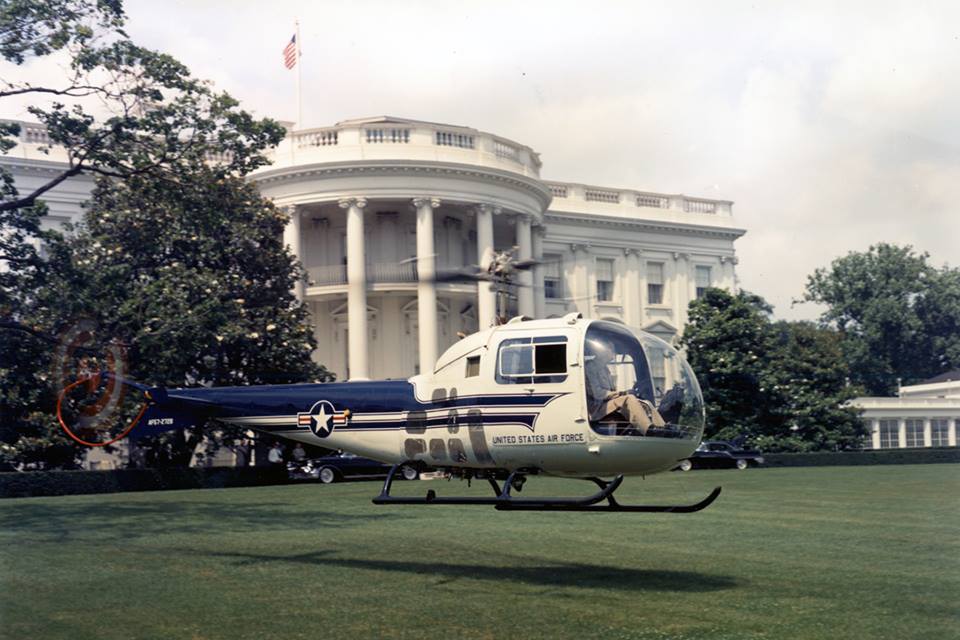
The aircraft that carried Eisenhower was Bell H-13J-BF Sioux, serial number 57-2729, a militarized version of the civilian Bell Model 47J Ranger. Bell delivered it, along with a sister ship (57-2728), to the Air Force at Wright-Patterson AFB on March 29, 1957.
The Secret Service picked the Ranger because it was safe, not because it was fancy. It could carry only two passengers with any comfort, had a top speed of about 100 miles per hour, and a range of 150 miles. Larger, faster Sikorsky and Vertol models were on the table. All were bypassed for the little Bell.
Roger Connor, curator at the Smithsonian’s National Air and Space Museum, wrote up the reasoning in a 2010 piece on the H-13J:
Its base purchase price of $40,000 and low operating costs made it one of the most economical helicopters in its class, but most importantly, it had an outstanding safety record and was the most reliable design available. As part of the Model 47 series (the first civil certificated helicopter in the world), it had a decade of operational use behind its design.
Bell made a handful of presidential tweaks. All-metal rotor blades in place of the standard wood ones. A dark-blue tinted Plexiglas bubble to cut the sun’s magnifying-glass effect on the cabin. A special armrest and footrest for Ike in the right rear seat. And a rotor brake, so the president could climb out faster without ducking under a slow-spinning blade.
The flight itself
At 2:08 p.m., Barrett lifted off with the president behind him and James Rowley, chief of the White House Secret Service detail, in the seat next to Ike. A second Bell H-13J followed with Major General Howard Snyder, Ike’s personal physician, and a second Secret Service agent aboard.
The pair climbed to 500 to 700 feet and headed north to what the White House was calling an “undisclosed evacuation site.” The site was Camp David, the presidential retreat in the Catoctin Mountains, 62 miles from the South Lawn.
Ike wasn’t the only one flying that day. Six larger helicopters landed on the Ellipse to airlift twenty key staffers and pool reporters: tandem-rotor Vertol H-21s from the Air Force and Army, a Marine Corps HUS-1 Sikorsky, and an obsolescent Air Force H-19. Naval personnel improvised an air traffic control station on the South Lawn to keep them from hitting each other.
The bigger helicopters were also faster. They arrived at Camp David well before the president did. Virgil Olson, who later became the first official Marine Corps presidential helicopter pilot, told the Smithsonian what that landing looked like:
The other larger and faster helicopters supporting Operation Alert, which had departed after the H-13J, arrived several minutes before the small [and slower] Bell. When the president arrived, he was sweating from an uncomfortable ride and annoyed to find us on the ground, with the engines of our helicopter already off and cooled down.
Ike spent the night at Camp David, drove to Gettysburg with family the next day, and flew back to Washington in the same H-13J on Monday morning with another Camp David stopover.
The Sikorsky wins the job
Ike’s next helicopter flight came on September 6, 1957, and this time he climbed into a Marine Sikorsky HUS-1. It seated twelve passengers in relative comfort, didn’t cook them under a bubble, and Eisenhower found it a vast improvement over the H-13J.
He told Draper to switch aircraft. The Air Force was out of the presidential helicopter business. Not wanting to play favorites between the Marine Corps and the Army (both of which flew the Sikorsky), Ike alternated between the two services’ executive flight detachments. That tradition held until President Ford eliminated the Army’s detachment as a cost-cutting move in 1976.
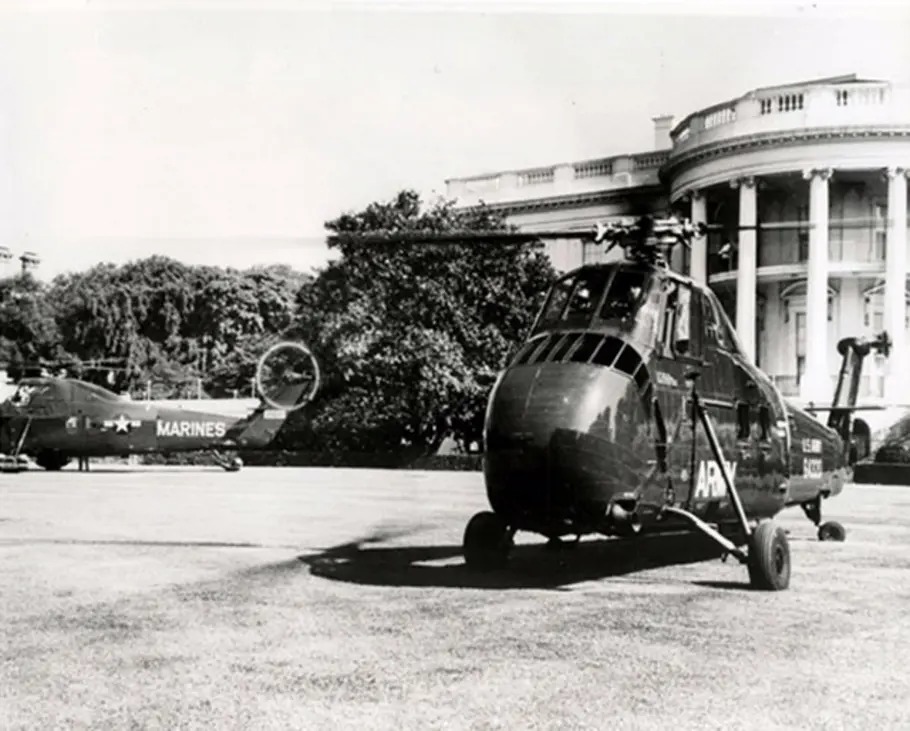
The Marine Corps unit that grew out of this arrangement was HMX-1, standing up its Executive Flight Detachment in that same 1957 window. HMX-1 still flies the president today. The call sign, of course, is Marine One.
You can go see the helicopter
Both Bell H-13Js survived their careers. The pair stayed on presidential duty until 1962, then were redesignated UH-13J and used for VIP transportation until 1967.
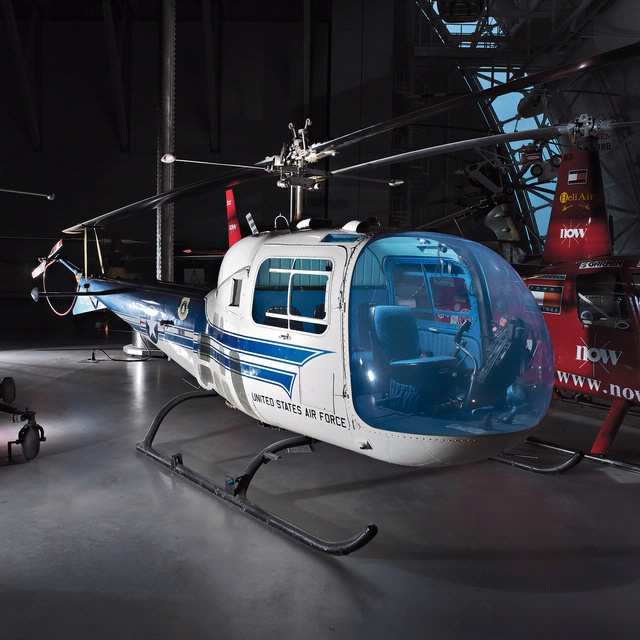
Serial 57-2729, the aircraft that lifted Ike off the South Lawn on July 12, 1957, is on display at the Steven F. Udvar-Hazy Center of the Smithsonian’s National Air and Space Museum in Chantilly, Virginia. Its sister ship, 57-2728, sits at the National Museum of the U.S. Air Force at Wright-Patterson AFB in Ohio, alongside Ike’s Lockheed VC-121E Constellation, Columbine III.
If you’re curious about other times an aircraft has come down on the White House lawn, we’ve written about the two times someone landed a stolen aircraft on the South Lawn. Both landings were considerably less well planned than Ike’s. And if you want to see how presidents got around before helicopters and Air Force One, our topic page tracks a lot of the earlier presidential travel history.
Here is a short newsreel of the July 1957 South Lawn landing tests:
We dug this one up with help from AI and checked it against the original records below. Here’s how we use AI.