
James wrote in after reading our story on Heaven and Hell, the purple building at 2327 18th Street NW that was once the first DC headquarters of the Black Panther Party. He had a different memory of that block. He used to hang out a few doors south, at 2321, back when it was a lounge called the Blue Room.
So this one is for James. The building at 2321 18th Street NW has its own stacked history. A Blue Room lounge, a serious whiskey bar called Bourbon, and the skull-themed bar that sits there today.
Dig back far enough and it was something quieter: a rented rowhouse where people simply lived. Here is the building biography we can actually document.
Same block, same bones
2321 sits in the heart of Adams Morgan, on the east side of 18th Street NW, a few doors south of Heaven and Hell. Keep walking and you hit Dan’s Cafe, the cash-only dive at 2315 that has outlasted almost everything else on the strip. It is part of the Washington Heights Historic District, the same designation that protects the rest of the row.
The block was platted in February 1888 as part of the Commissioners’ Subdivision of Washington Heights. For a few years it stayed mostly raw land.
What changed everything was the streetcar. In 1890 the Rock Creek Railway pushed an electric line up the steep grade of 18th Street that horse-drawn cars had never managed to climb. The 2300 block became a commercial corridor almost overnight.
The rowhouses along this stretch were converted for retail, with projecting bay windows added at street level to pull in customers. That bay-window geometry is exactly what 2321 still has today.
Before the bars, a place to live
For the first half of the 20th century, 2321 was not a bar at all. It was a place to live.
On January 9th, 1936, the Evening Star ran a small classified for the address. The wording is wonderfully specific:
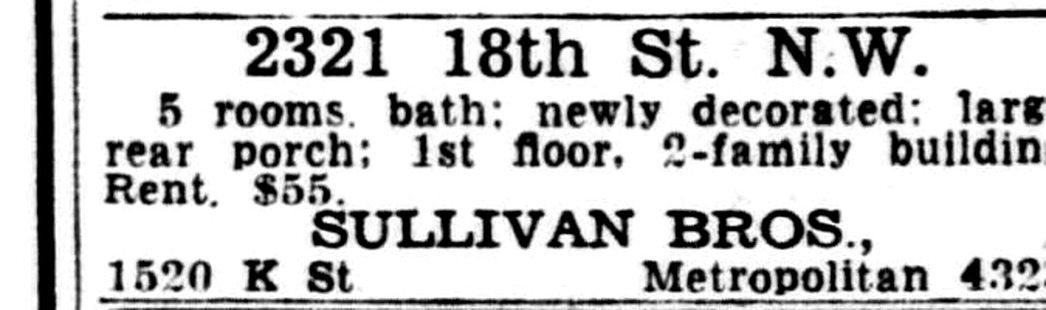
Five rooms and a bath, a large rear porch, first floor of a two-family building, fifty-five dollars a month. This was a rented home, not a nightspot.
People lived their whole lives here. On August 6th, 1946, the Evening Star carried a death notice for Anna Loretta Addison, “nee Mahorney,” who had died “at her residence, 2321 18th st. n.w.” She was the widow of James S. Addison and the mother of two daughters, Flora Angela Addison and Rita Gibbons.
What 2321 did through the postwar decades does not surface cleanly in the open record. Like its neighbors up the row, it goes quiet in the archive until 18th Street’s nightlife finally reached it.
The Blue Room
The Blue Room opened in late 1999, and for a while almost nobody knew. The Washington Post’s Eric Brace caught up with it in a January 4th, 2002 nightlife column titled, fittingly, “Mellow Tones in the Blue Room.”
Co-owner Frank Jolley told Brace the place had deliberately never advertised or handed out fliers, trusting word of mouth to bring the right crowd. It worked.
Despite the name, the room was not blue. Brace described a lovely space of two-story exposed brick, with couches to sink into and a bar that pointedly stocked no Budweiser and no Jagermeister.
The DJs played downtempo and experimental electronic music, never house, never straight dance music. Video screens flickered silent indie films, “Run Lola Run” and animation and shorts, throughout the night.
Sunday was the signature night: a set called “Filler,” run by four DJs including William Alberque and Richard Chartier. Tuesday was the industry night, when bartenders from Dragonfly and the Eighteenth Street Lounge came by and Jolley spun records himself.
That is the place James remembers. And one detail from the 2002 article matters for everything that came next: Jolley’s partner in the Blue Room was a man named Bill Thomas.
Bourbon: a whiskey bar before whiskey was cool
Here is the part the listings miss. Bourbon did not replace the Blue Room so much as grow out of it.
By the mid-2000s, the same building had a first-floor whiskey bar called Bourbon, run by that Blue Room co-owner, Bill Thomas. In April 2006, Thomas closed the lounge upstairs to make room for it.
The Blue Room “did brisk business,” the Post reported at the time, but Thomas wanted to “expand” Bourbon into the rest of the building. So the lounge held one last party and closed for good.
Bourbon came early to the whiskey wave. It poured hundreds of American whiskeys at a time when, as its own team later put it, “whiskey wasn’t yet the trend.” The goal was a neighborhood bar, a whiskey lover’s home.
Thomas would go on to open Jack Rose Dining Saloon a few blocks south on 18th Street in 2011 and stock it with one of the largest whiskey collections in the country. But Bourbon, in the old Blue Room building, came first.
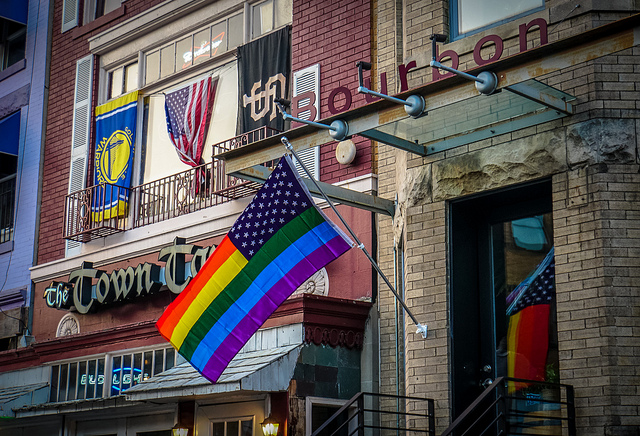
Bourbon lasted twelve years. On October 25th, 2018, owner James P. Woods announced on Facebook that the bar was closing:
After 12 years in one of the city’s great neighborhoods, Adams Morgan, Bourbon has decided to close our doors. The goal was to be a relaxed, easy-going bar, with great music and an even greater staff, to be the neighborhood bar, a whiskey lover’s home at a time when whiskey wasn’t yet the trend. We succeeded.
Woods credited the staff, and pointedly “Bill Thomas’s staff in the years before me.” Bourbon briefly reopened a few weeks later, but the long whiskey-bar run on this corner was effectively over.
What’s there now
Today 2321 18th Street is painted fire-engine red and operates as Death Punch, a multi-level bar with a very different personality from the quiet whiskey room it replaced.
Death Punch leans into a punch-and-cocktail theme with skulls etched on the windows. There are pool tables and outdoor ping pong on the lower levels, and live bands and DJs up top.
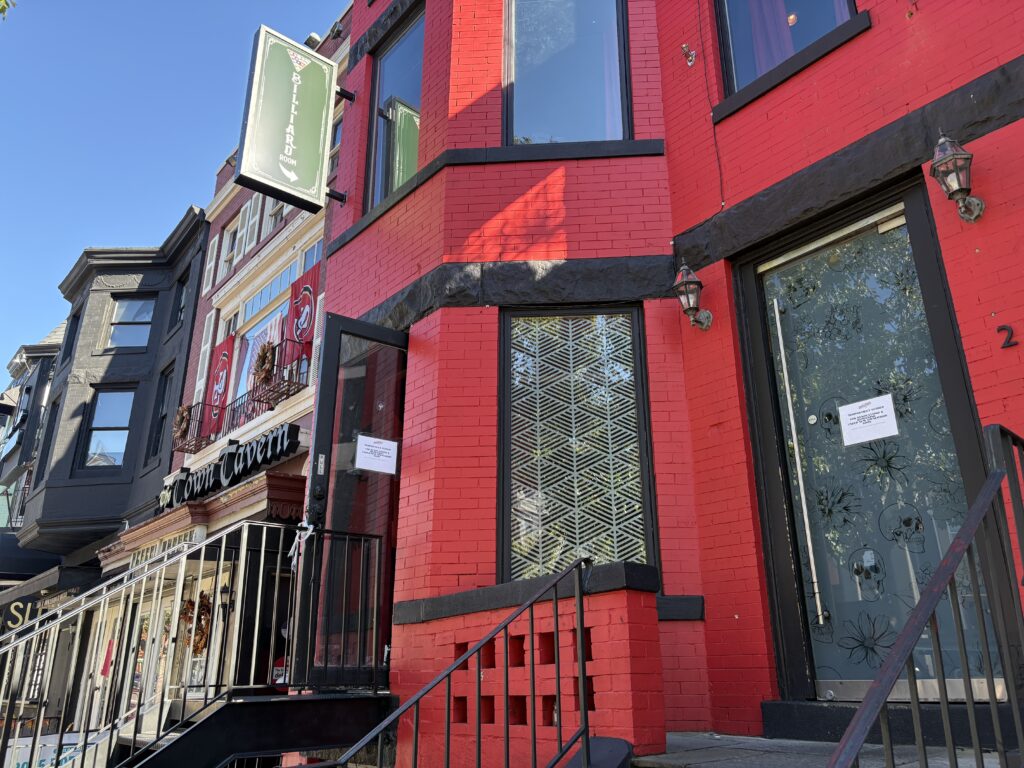
In November 2025, Death Punch closed temporarily for renovation and announced it would reopen under new ownership. The building, in other words, is between chapters again.
Walk this stretch of 18th Street and you can read the same pattern over and over. A rowhouse from the streetcar era, rented out as flats, then converted to a storefront and handed from one bar to the next as Adams Morgan reinvented itself decade by decade.
Heaven and Hell up the row gets the headline, and it earned it. But 2321 has quietly done the same thing for just as long. For James, it will always be the Blue Room.