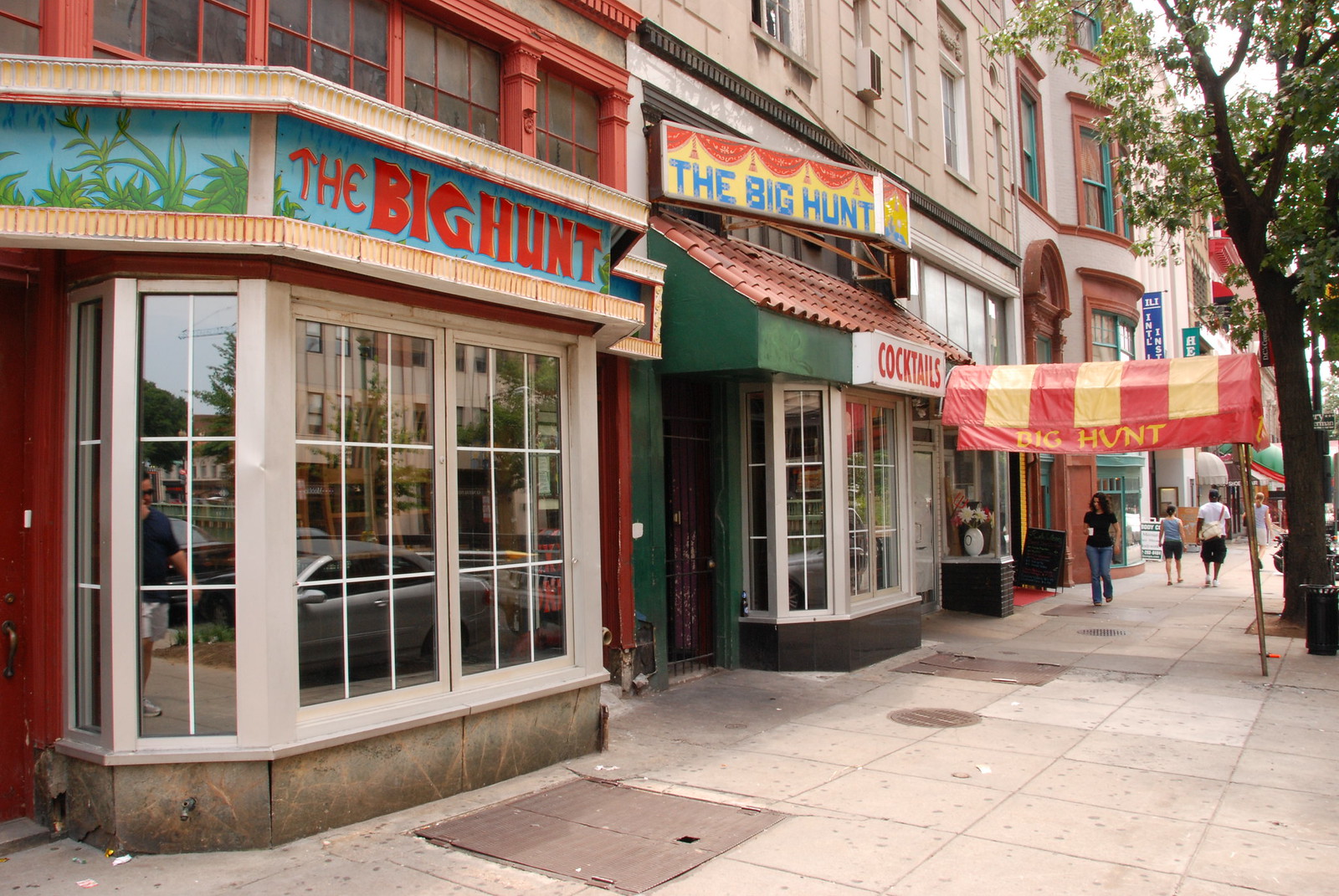
The Big Hunt opened in 1992 inside a three-story storefront at 1345 Connecticut Avenue NW, ran for 28 years as one of Dupont Circle’s most loved and most polarizing dive bars, and gave up its lease for good on October 31, 2020. Founder Joe Englert was dead within four months of the pandemic shutdown. The building owner had died a few weeks before COVID hit. By the time the closure was confirmed publicly in February 2021, the staff already knew it was not coming back.
What the safari signage and the jungle murals never advertised was the building itself. The two-address storefront at 1345 and 1347 Connecticut was built in 1928, right at the peak of the avenue’s transformation from a row of late-Victorian mansions into what the Dupont Circle Historic District nomination later called “the Fifth Avenue of Washington.” The Big Hunt’s wild interior lived inside a quiet 96-year-old commercial building that long predated the bar and now outlives it.
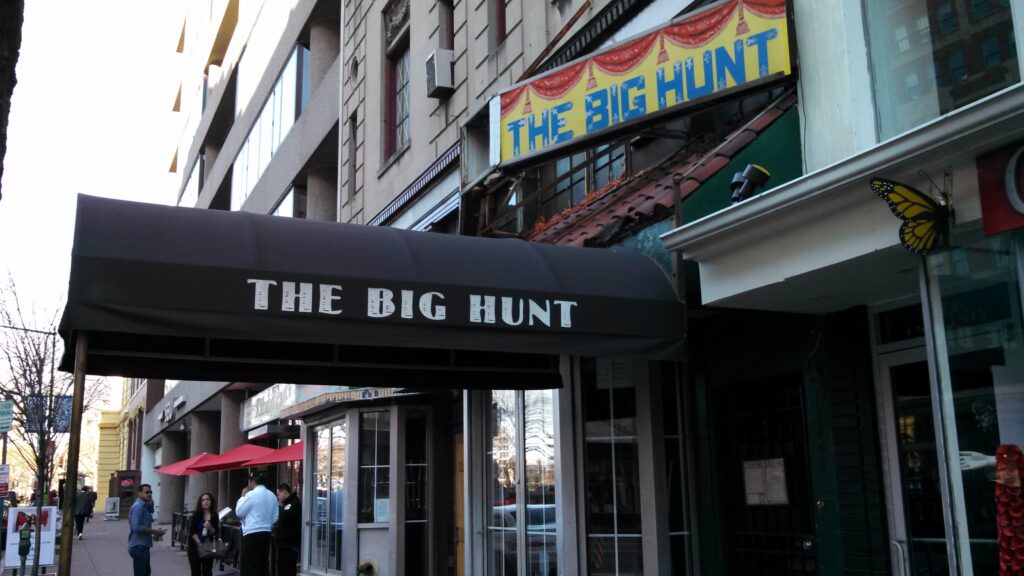
1345 Connecticut Avenue NW Was Built in 1928
The block of Connecticut between Dupont Circle and N Street was one of the last on the avenue to flip from residential to commercial. By the late 1920s the mansions that had defined Dupont since the 1880s were being demolished or refaced, and the avenue was filling with low-scale storefronts, banks, dress shops, and restaurants. The 1984 Dupont Circle Historic District boundary expansion documents the broader pattern: “commercial growth between the beginning of this century and the Depression turned Connecticut Avenue from a primarily residential street into the ‘Fifth Avenue of Washington.'”
The building at 1345-1347 Connecticut Avenue NW went up in 1928. The 2019 commercial leasing listing described it as a three-story storefront retail building with two address numbers, parcels 0137-0820 and 0137-0821, and roughly 9,174 square feet of gross leasable area on a 3,595 square foot lot. The ground floor was always commercial. The two upper floors were built as apartments and remained so, even at the end, with three residential units across the two address numbers.
Across the street, the much taller and more famous Dupont Circle Building went up in 1931, designed by Mihran Mesrobian, the Armenian-born architect who also designed the Hay-Adams. The Big Hunt’s home and the Dupont Circle Building are essentially siblings, both born in the same three-year window that finished the avenue’s commercial conversion. One got an architect with a name. The other got a developer’s standard storefront block. Both ended up on the same Historic District inventory.
A Cafe, a Western Union Office, a Dive: The Tenants Before the Hunt
The 1345 Connecticut storefront had been a working address for 64 years before Joe Englert ever walked in.
By 1941 it was Rector’s Cafe, a Connecticut Avenue chophouse caught in the Washington Post for the first of several robberies. “Two yeggmen forced a porter to admit them to Rector’s Cafe, 1345 Connecticut Avenue Northwest, early yesterday, smashed open the safe with hammers and chisels, and escaped with $200,” the paper reported on June 19, 1941. Two years later thieves hit the same safe for $650 in an Easter weekend job. By 1953 Rector’s was on a Page 15 list of seven downtown businesses cracked in a single night.
The restaurant was a fixture. During WWII the Office of Price Administration suspended Rector’s for OPA meat-rationing violations along with three other downtown cafes. On January 2, 1960, the dining-room ceiling collapsed on two customers in mid-meal. The Washington Post ran it as a feature: “Ceiling Fall Hurts Diners In Cafe Here.” “Two customers of Rector’s Restaurant, 1345 Connecticut ave. nw., were slightly injured yesterday when a portion of the dining room ceiling collapsed.”
By the late 1960s the storefront had become a Western Union office. On May 7, 1969 it became the scene of a front-page Washington Post story. A Third Precinct officer, Paul J. Grasso, was inside the office questioning a Western Union delivery boy about a $3 theft from a women’s service club around the corner. The two wrestled for the officer’s service revolver. The gun fired five times. Three bullets went into Grasso’s leg. One lodged in a wall. One went out the open door of 1345 Connecticut and killed a passerby on the sidewalk.
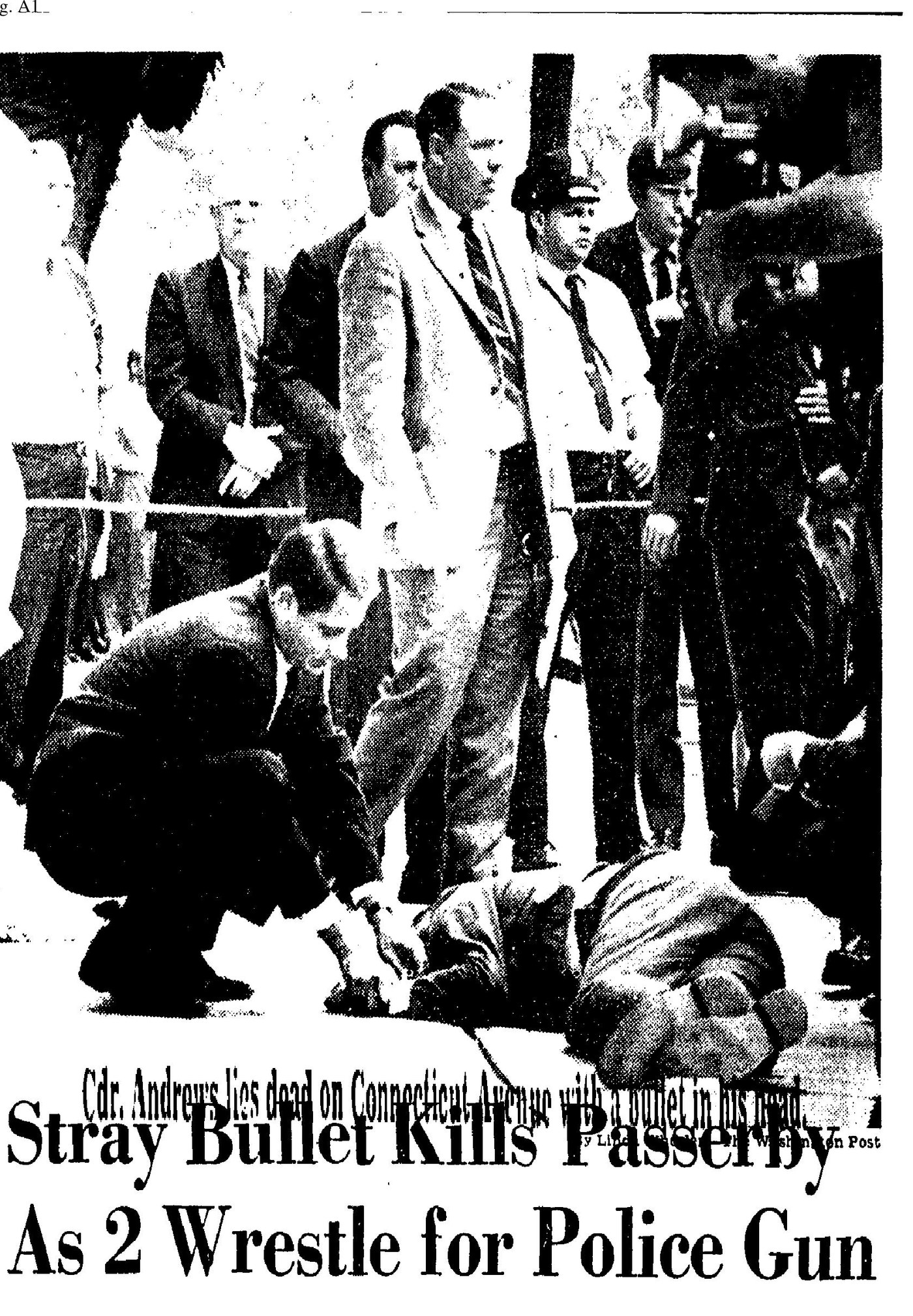
The man killed was Coast Guard Cdr. Warren D. Andrews, 40, of Fairfax, a father of six on his way to lunch. President Nixon’s wife Pat was at the Washington Club a block away when sirens started converging on Connecticut Avenue; her motorcade detoured back to the White House to avoid the chaos. “A Bullet Links 2 Vastly Different Lives,” the Post wrote in a follow-up ten days later, naming the Western Union office at 1345 Connecticut as the delivery boy’s home base. He was indicted that August.
By the late 1980s the storefront was a dive called the Dupont Villa. We know it was there because Englert kept much of it.
Washington is short on comfortable old bars, but now there’s a new one. The Big Hunt, 1345 Connecticut Ave. NW, may not be old, but it feels so. Much has been saved from the old Dupont Villa, even the low prices.
Phyllis Richman, Washington Post, June 25, 1993
That is from Phyllis Richman, the Post‘s chief restaurant critic, reviewing the bar a year into its run. The Big Hunt didn’t gut the space. It put a hunting theme on top of a Dupont Villa that already had the low ceilings, the booths, the basement, and the kind of crowd that drank there because nobody else cared about the menu.
Joe Englert Opened the Big Hunt in 1992
Joe Englert was in his early 30s when he opened The Big Hunt. He had moved to DC from Pennsylvania in 1984 to write for the Pentagon’s newspaper and started in nightlife in the late 1980s with Club Random, a dance club he ran in an upstairs room at Danker’s, a then-steakhouse near the Warner Theatre. The Washington Post in a March 1989 review called Club Random a “ranch house rec room” and noted its eclectic music.
From there Englert moved at full speed. Andalusian Dog, Crow Bar, 15 Minutes, the Insect Club, State of the Union, Zig Zag Cafe, Capitol Lounge, DC9, Lucky Bar, Politiki, H Street Country Club, Rock and Roll Hotel, Granville Moore’s, Trusty’s Full Service, Reliable Tavern, Truxton Inn. He had a hand in about 30 bars and restaurants across the District over three decades.
The Big Hunt was one of his earliest themed concepts. Washingtonian, in its August 21, 2020 obituary feature “9 Ways Joe Englert Changed the DC Bar Scene,” put it this way:
Sure, there were plenty of low-key taverns back in the ’80s and ’90s. But Englert thrived on cooking up concepts that could conservatively be described as off-the-wall.
His method was magpie. DC9 co-owner Bill Spieler told Washingtonian that Englert spent years buying random kitsch at yard sales and storing it in warehouses. “It might take two to five years after collecting enough, and then he’d be like, ‘OK, time to make a club with all this stuff.'”
For The Big Hunt the through-line was, in Richman’s words, “whimsical 3-D posters and a hunting theme,” the kind of decor you might find in a 1950s motel cocktail lounge that had been let to drift. The execution was largely the work of artist Lee Wheeler, the longtime collaborator who carried out Englert’s design ideas across many of the bars.
The DCist obituary on August 24, 2020 captured the inventory: “the heads of past presidents on the wall to the decorative rib cage of the whale from Jonah and the Whale, all of which are a testament to Englert’s unique, and at times chaotic, taste in bars.” Tribal masks stared down from upper walls. A man’s arm dangled from a dragon’s jaw. Taxidermy hung above the booths. Tiki torches flanked the front entrance under a striped, almost circus-tent awning.
Per DCRA records cited by Barred in DC at the time of the closure, Englert was still personally listed as involved with the ownership entity for The Big Hunt at the end. That was unusual. He had spun out most of his bars to younger partners over the years, but the Hunt was one of the few he never quite handed off.
Four Bars, 22 Taps, and a Hidden Patio
The bar sprawled. Barred in DC, reviewing the place in April 2013, observed:
Although I’ve been to the Hunt countless times, I finally realized on a recent weekend visit how big this bar really is. There are 4 different bars to order drinks from and about 8 different seating areas, though oftentimes on weekdays only one bar is open, and the rest of the establishment is off-limits.
You entered under the awning, through the right door, into a main first-floor room with a long bar to the left and a row of low-slung red booths to the right. Past the bar, a passage opened into a mirror-image second first-floor room with its own bar. Both rooms had a back seating area that felt slightly separated, which is how you got the eight zones in one floor.
Two staircases ran up to the second floor, one on each half of the building. One side had a skee-ball room with a few machines and seating. The other had a smaller bar, the kind of bar where you could actually have a conversation, plus barstools and standing rails.
Behind the second-floor bar, a door and a short staircase led to the hidden patio: a deck for maybe 25 people, walled in by the neighboring office buildings into a kind of courtyard. Barred in DC called it the “hidden gem of the Big Hunt” and noted that even people who hated everything else about the place could not bring themselves to dislike the patio.
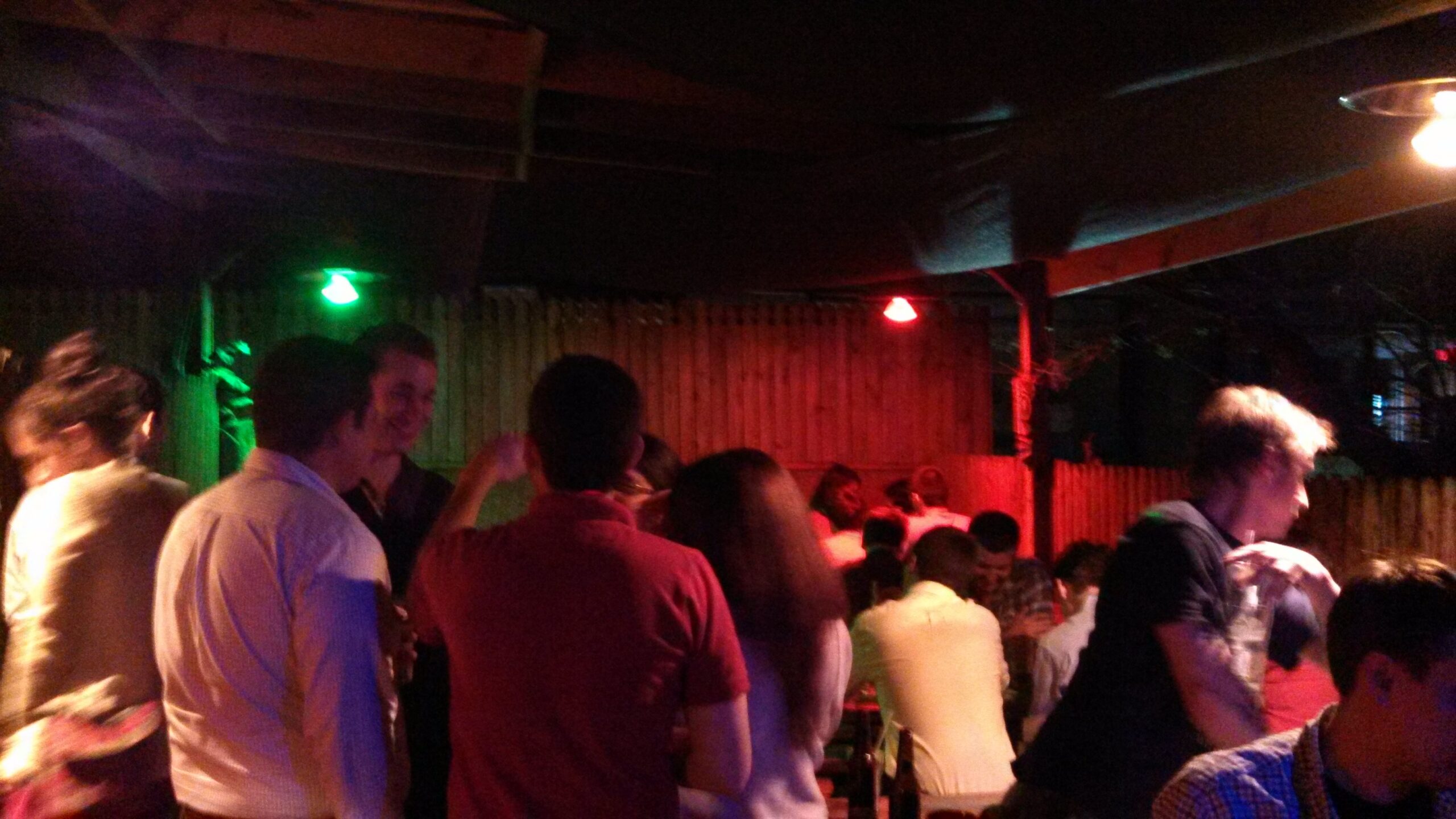
The Washington Post kept noticing the patio across the 2000s. Eve Zibart put it on a 2005 city-wide guide to “Air Fare: A Guide to Rooftop Dining.” Fritz Hahn looped back to it in his 2008 summer-heat column “Can’t Beat the Heat? Join It.” For a courtyard nobody could see from Connecticut Avenue, it kept showing up.
The beer list was the real reason regulars came. Richman, in that 1993 review, locked the opening tap count at 22 beers, “from Pilsner Urquell to Zeke’s Bathtub Bock,” with rotating local selections including “three by Dominion, one Wild Goose and the newly delicious Olde Heurich.”
By the early 2010s the Hunt was running about 31 taps, including a constantly rotating selection of craft and Belgian beers years before craft beer became a normal restaurant amenity. The Facebook page in 2020 described it as “one of DC’s oldest beer bars” that had been “serving quality craft beers on draft since long before the craft movement became mainstream.” That was the boast and it was also basically accurate. Tuesday wing night was 15 cents a wing.
The Brickskeller, the original Dupont basement beer mecca a few blocks away, gets more historical attention. The Big Hunt was its scruffier, longer-lived cousin. The Brickskeller closed in 2010. The Big Hunt kept going another decade.
The Basement Was the Comedy Room
Down was where the bar got weird. The basement bar, in red light, with a stage and a low ceiling, had what Barred in DC called “a vaguely devilish theme.” Through the 1990s and early 2000s the room ran live music, DJs, and burlesque. The Washington Post caught a snapshot of the music programming on New Year’s Eve 1998. Eric Brace, the paper’s nightlife reporter, listed it in his “Bye Bayou, Hello 1999!” roundup:
THE BIG HUNT: The Hula Monsters (Hawaiian rockabilly swing), Burglar (funk) and DJ Neville Chamberlain. $65 ticket includes open bar, buffet and door prizes.
In its second life the basement became something more specific. Around 2013, Underground Comedy, the independent DC comedy production company founded by Sean Joyce, began running standup nights in the red-lit room downstairs. Over the next seven years Joyce and his producers built it into their anchor space, running multiple shows a week. They eventually dubbed the room “Hell’s Kitchen” in nod to the basement’s satanic dress-up.
National-tier comics started using the basement as a workshop room. Michael Che ran six shows at The Big Hunt the week of his Netflix special taping in 2016. WTOP reported in February 2017 that Louis C.K. surprise-dropped onto an Underground Comedy set at The Big Hunt the week of his DAR Constitution Hall taping. Rory Scovel also worked material there before a special.
The basement was not glamorous. The point was that the basement was not glamorous. It was a small room with a stage, no separation between performer and audience, no green room, and crucially no expectation that the show had to work. That is exactly the kind of room comics need to develop material. Almost none of the audience knew that the room they were squeezed into to watch a free standup show was part of one of the most active live comedy operations in the country at the time.
February 2020 to October 2020: A Bad Year
The closure had multiple causes stacked on top of each other.
Mary Gerachis, who had owned the building at 1345-1347 Connecticut Avenue, died in February 2020 at age 89, per Barred in DC’s reporting at the time. The Hunt’s lease ran out October 31, 2020. With the building owner gone, lease negotiations had to run through her heirs and estate while DC bars were operating at reduced capacity or were shut down entirely under pandemic restrictions.
On July 13, 2020, four months into the pandemic, the bar posted on Facebook: “As soon as it is safe and economically viable, The Big Hunt will reopen. Please follow our social feeds to stay abreast of any developments. As soon as we know, you’ll all know!” That was the last public statement they ever made.
Joe Englert died on August 20, 2020, age 59, from complications of a recent surgery. He had been the founder, an unusually still-engaged owner, and the institutional memory of a bar that had run for 28 years. He was gone with two months left on the lease.
The lease formally terminated on October 31, 2020. Barred in DC broke the story on December 18, 2020, noting that the buildings, nearly 10,000 square feet of commercial and residential space, were now being marketed at roughly $7.5 million for sale or about $26,000 a month triple net for lease. That was already a 25 percent reduction from the original asking price. On January 6, 2021, the owner emailed staff to say they could stop holding their breath. The Big Hunt was not reopening.
On February 12, 2021, PoPville confirmed it publicly with a photo of the dreaded “Permanently Closed” sticker on the door. The bar’s website was already down. The phone was disconnected. The Facebook page was still up, with the last post a tribute to Joe Englert.
The Ghost on Connecticut Avenue, 2021 to 2025
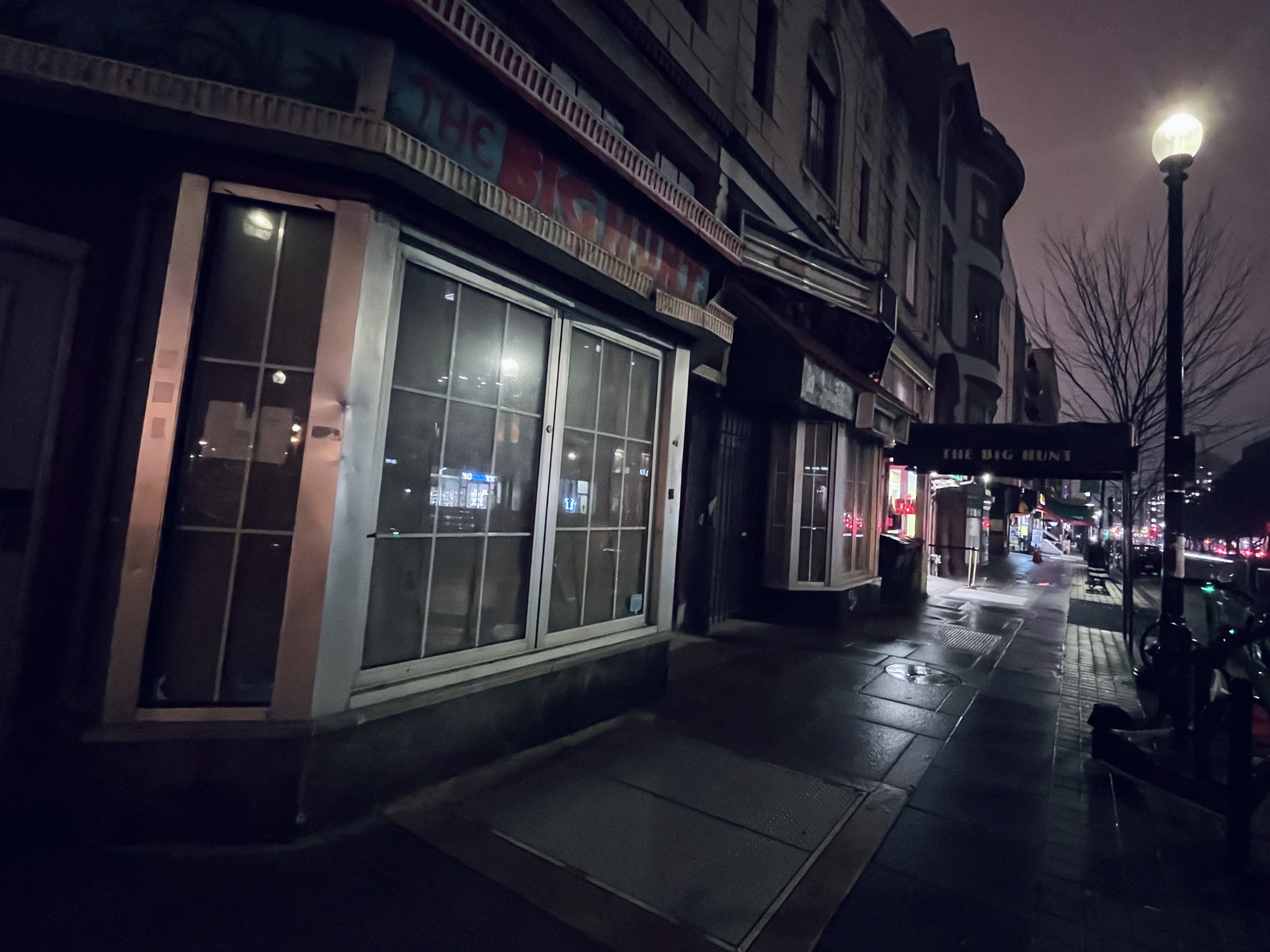
The building sat empty for almost five years. In January 2023, the writer and photographer Joe Flood walked past and described what was left:
Yet, like a ghost, it lingers on Connecticut Avenue, their unlit sign facing the busy street. Peer in the window and it looks the same, though battered and neglected, almost as if you could wipe down the counters and start serving beer again.
The unlit Big Hunt sign stayed in place for years. Mazu King’s painted downspout artwork at the corner of the building was replaced in April 2021. PoPville ran a “Final Farewell” post in March 2024 when the last of the exterior signage finally came down for the slow renovation that followed.
Wok and Roll Bar and Lounge, a karaoke concept, applied for a liquor license at the space in September 2023. The build-out took the better part of two years. PoPville posted a sneak peek inside the gutted space in June 2025. Signage went up in October 2025. As of late 2025 they were hiring.
The 1928 storefront is still there. Rector’s is gone. Western Union is gone. The Dupont Villa is gone. The Hunt is gone. A karaoke bar moves in next.
The 1300 Block of Connecticut, Then and Now
The Big Hunt sat in the middle of what was, through the 2000s, a small dense cluster of mid-priced Dupont bars. Madhatter at 1319 Connecticut. Lucky Bar, another Englert property, at 1221 Connecticut just south of the circle. Buffalo Billiards a block over at 1330 19th Street NW. The Fox and Hounds on 17th Street. The bus stop right out front fed reliable foot traffic at every shift change of the day. None of these were destination bars. Together they were what Dupont nightlife was, particularly for the office workers in the surrounding buildings on weekdays.
Most of them are gone now. Buffalo Billiards closed in August 2019 after 25 years. The Fox and Hounds hung on until November 2025. Joe Flood’s “ghost” framing for The Big Hunt could be applied to the whole cluster. The DC bar economy that produced these places, defined by big-footprint storefronts on Connecticut Avenue with cheap office-worker happy hours, has largely moved east to 14th Street and H Street NE, the latter of which Englert himself basically invented as a nightlife strip in the mid-2000s.
What Connecticut Avenue did in the 1920s, when 1345 was built, was concentrate retail in a way the avenue had never seen before. A 1921 ad pitched the avenue as the city’s premier shopping district. Connecticut got its first wave of national chain stores in those same years. The buildings that made that possible were exactly the kind of 1928 storefront that became The Big Hunt 64 years later. They are still standing. The retail mix inside them is on its third or fourth major reshuffle since.
What People Remember
The Hunt was a polarizing place. Some hated the décor and the meat-market crowd on weekends. Some loved the beer list, the patio, the basement, and the regulars who treated it like a Cheers. Joe Flood, who knew the place for years, summed it up in his 2023 ghost-post:
It was a grungy, 90s-era place decked in a fake safari motif, with jungle murals painted on the walls and tiki torches. Sprawling over multiple levels, it had a basement with a low ceiling where I once went to an epic Halloween party. Another time, I got dragged down there to see burlesque, one of those happy chaotic moments you’d find at the Big Hunt. It was not slick, it was not polished, it was wonderful.
Washingtonian, in the 2020 farewell feature for Englert, named The Big Hunt alongside Capitol Lounge, Truxton Inn, and Reliable Tavern as the Englert bars that became real neighborhood gathering places, the ones that were “many a loyal customer’s ‘local.'” Englert’s longtime business partner Matt Weiss put it this way to Washingtonian:
You went to those places because you knew you were going to run into people you knew, because you knew the bartender, because it had a very Cheers-like atmosphere. You didn’t go, “Oh that’s the best food” or “that’s the coolest thing I’ve ever seen.” It’s just like, “This is a fun, funky place where I can get down with the crowd.” And I think that was really his genius.
The 1928 storefront outlived all of it. Rector’s filled it for 20 years. Western Union for at least a few. The Dupont Villa for who knows how long. The Big Hunt for 28. A karaoke bar moves in next. The block keeps going.