
Erol Onaran arrives in the United States in 1960 with sixteen dollars in his pocket, and a quarter century later he runs the largest privately owned videocassette rental chain in the country.
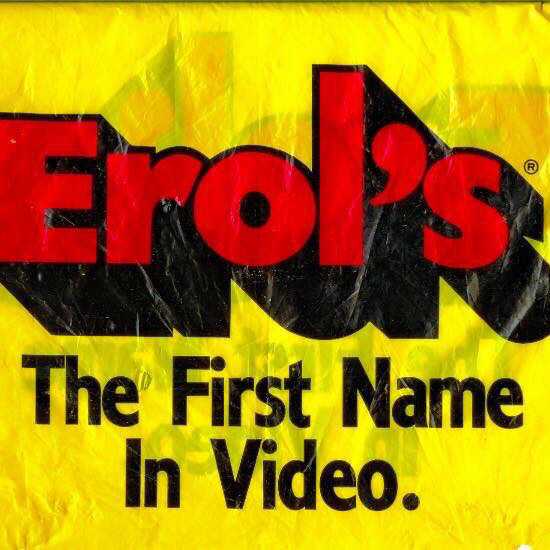
The chain is Erol’s Video Club. If you grew up in the DC area in the 1980s, the red-on-yellow Erol’s logo is wallpaper. It is on your parents’ membership card, on the bag the tapes come home in, on the awning of the storefront tucked into every other strip mall from Falls Church to Beltsville. It is on the box of The Goonies you have rewound until the tracking line at the bottom of the screen turns into static.
By the time Blockbuster shows up to buy the company in 1990, Erol’s has 208 stores in five states plus the District. It is the third-largest video chain in America, and at its peak it touches roughly 250 locations.
Then it disappears almost overnight. The signs come down, Blockbuster goes up, and the chain that defined movie night in the Washington area for ten years is essentially a footnote within eighteen months. This is the long version of that story.
Who was Erol Onaran?
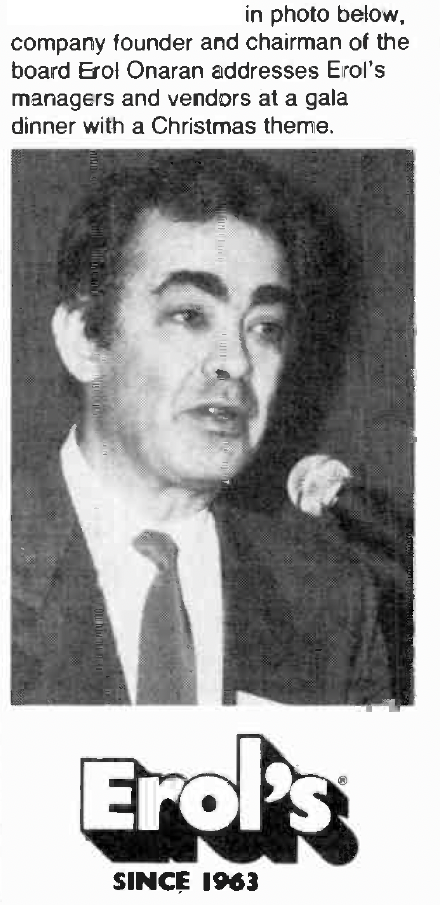
Erol Onaran is a Turkish radio and television repairman. He sells a profitable Istanbul-era shop in 1960 and books passage to America with thirty-two dollars to his name. He spends half of it in Rome. He arrives in the United States with sixteen dollars.
His first jobs are repair bench work, first at Fulford’s Television, then at German Hi-Fi. He is, by his own telling, ambitious in a way that gets him fired. In 1963 he and his friend Yilmaz Turker open their own small TV repair shop in Georgetown and call it Erol’s. They sell black-and-white Zeniths. Then color sets. They try washers and dryers and stereos.
The repair business is steady and the retail side grows slowly. For seventeen years this is what Erol’s is: a tidy independent TV shop with a handful of locations and a Turkish immigrant proprietor who comes to work in a sport shirt and never wears a tie.
What changes everything is the videocassette.
How Erol’s Video Club started
By 1980 the home VCR is a real product. Sony’s Betamax has been on the market since 1975 and the cheaper VHS format is catching up. The question facing every appliance dealer in America is whether there is any money in renting tapes, or whether customers will simply buy them. Movies on tape cost around a hundred dollars apiece. Onaran is skeptical. He explains it years later in The Washington Post:
I sold a few movies at first, but I never believed that people would pay $100 for a movie. Most other people started renting movies a year before I did. I didn’t want to go into it because I was not sure it was legal. When I saw everyone else doing it, I didn’t see anything wrong with me doing it.
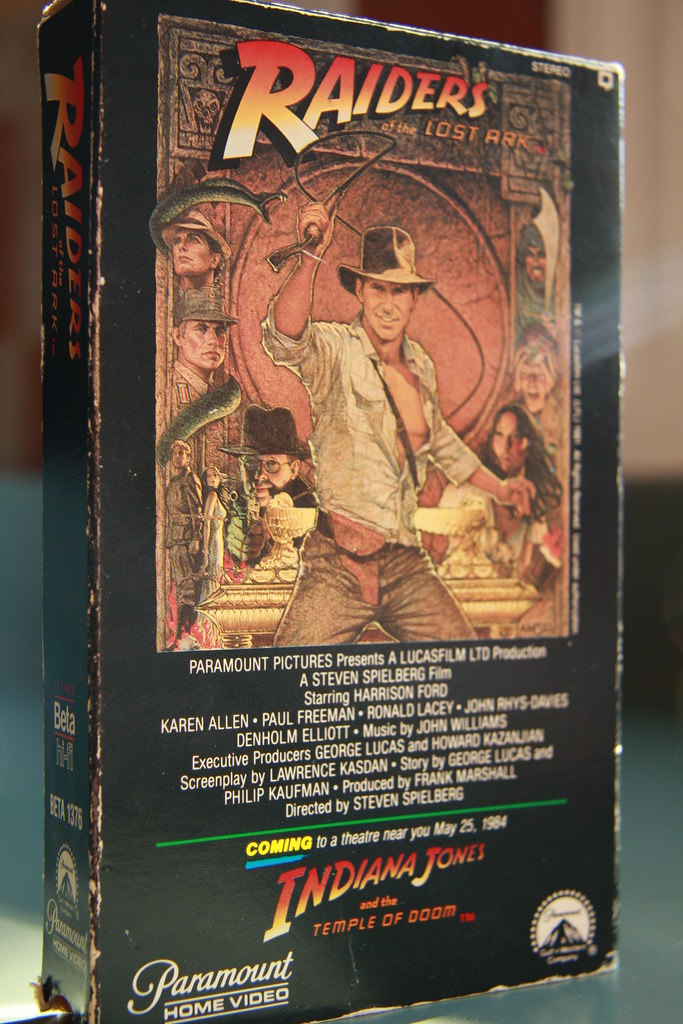
He visits a store in Baltimore that is renting tapes from a wall display. The model is obviously working. In 1980 he sets up the first Erol’s video club inside the manager’s office of the Arlington TV store. It is essentially a side hustle bolted onto a TV shop. Customers join the club, pay a small annual fee, and rent tapes off a small shelf.
It detonates. By 1982 there are seven Erol’s stores. By the summer of 1984 there are twenty-eight, with eighteen hundred film titles and more than a hundred thousand members. The Washington Post‘s Caroline Mayer profiles Onaran on July 1, 1984, under the headline “Erol’s Video-Rental King Made ‘The American Dream’ His Own.” She describes him then as the undisputed king of local rentals. His closest competitor, The Video Place, has eight stores.
The thing he is selling, more than any specific movie, is convenience. Mayer’s piece opens with a scene that locates the whole business inside a single Friday night problem:
It’s six o’clock on a Friday night. You have a date for the movies. But the only new ones playing are “Hardbodies,” “Piranha II,” “Making the Grade” and “The Clones of Bruce Lee.” What can you do?
The answer, for the next decade in the Washington area, is Erol’s.
The Erol’s Video Club model: deep catalog, bar codes, a real club
Three things make Erol’s structurally different from the chain that eventually eats it.
First, the catalog is wide. Mayer notes seventeen genre categories in 1984, including drama, adventure, science fiction, classics, foreign films, martial arts, westerns, and a small Turkish section. The store carries more than a thousand titles per location and three thousand new tapes arrive at the Springfield headquarters every day. The pitch is not “every Hollywood release,” it is “everything.” Onaran’s stated goal is to highlight what he calls “truly enjoyable movies that fall through the home-video cracks due to lack of Hollywood exposure during those films’ theatrical runs.”
Second, the checkout is computerized. While almost every other video store in 1984 still works the same way the corner pharmacy does, Erol’s runs on bar codes. Onaran writes the software himself in the mornings before he comes into work. Each member’s card carries a bar code. Each tape sits in a custom Erol’s-built plastic box stamped with another bar code. A clerk waves a light pen across both and the transaction takes seconds. He explains the architecture to The Washington Post on August 26, 1985, in a follow-up piece by Mayer titled “Erol’s Founder Earns Title of ‘Video King.'”
Hardware is not profitable. Renting movies is more profitable. It is a lot easier to duplicate video-rental stores. It’s like McDonald’s. Once you set one up, it is easier to do more.
A new store costs around $400,000 to build out in 1985 dollars. Onaran sets them up the way a fast-food operator sets up locations, with standard floor plans, standard inventory, and the same computerized membership database across the chain. By August 1985 he runs sixty-three stores, two thousand employees, and roughly eighty million dollars in annual revenue.
Third, Erol’s behaves like an actual club, not just a brand. Members get monthly newsletters featuring upcoming theatrical releases. There is a Discovery Club for movie buffs that meets inside the stores. There is outreach to college film departments. In 1986 the company closes every store in the chain for one day and invites all four hundred thousand of its members to a family outing at Kings Dominion in Richmond.
Read that again. A retailer with four hundred thousand members shuts the doors and rents an amusement park. That is the kind of thing a regional business does when it still genuinely thinks of its customers as members.
The Springfield HQ and the marketing machine
Erol’s corporate headquarters sits inside a remodeled warehouse at 7921 Woodruff Court in Springfield, Virginia. The company moves in at the end of 1984. By the next summer it has already outgrown the space. The Springfield building is where the three thousand daily tapes get duplicated, labeled, bar coded, and shipped to stores. It is also where the company runs an advertising budget of roughly six million dollars a year, almost all of it local broadcast and newspaper.
The advertising is loud enough that Onaran’s competitors blame him for inventing the local video rental market. Tom Ray, then president of the local chapter of the Video Software Dealers Association, tells the Post: “Erol’s is a real positive force in our market. A lot of other companies have learned a lot from him.” Less generously, Sam Totah of Video-to-Go puts it this way as his own chain goes under in 1985: “Erol’s has become to the video-rental business what Frigidaire once was to the refrigerator business. It’s a tough row to hoe against them.”
Onaran’s stated business goal in 1985 is plain: “Our goals are very simple. We want our business to double every year.” He nearly hits it. By 1990 the chain has grown into Baltimore, Philadelphia, Norfolk, Richmond, Cleveland, Chicago, and as far down as Raleigh.
Why Erol’s sold to Blockbuster for $40 million in 1990
The end happens fast. Blockbuster enters the Washington market in early 1989, less than two years before the sale. The Florida-based chain is publicly traded, capital-rich, and built for national scale. It opens stores aggressively in the same shopping centers Erol’s already occupies. The competition reverses the dynamic Onaran has been using against smaller rivals for years.
On November 20, 1990, Erol’s Inc. agrees to be acquired by Blockbuster Entertainment Corp. for forty million dollars. The deal is bigger in announcement than in cash because not all of the consideration is paid in cash. At the time of the sale Erol’s has 208 stores in five states and the District. It is the country’s third-largest video rental chain. Mark Potts breaks the story in The Washington Post the next day:
Erol’s Inc., which over the past decade has become synonymous with videotape rentals in the Washington area, agreed yesterday to be taken over by its largest competitor, national video giant Blockbuster Entertainment Corp., bringing one of the toughest local retailing battles in memory to a dramatic end.
Blockbuster, which arrived in the Washington market less than two years ago to challenge Erol’s, said it agreed to acquire the Springfield-based company for $40 million, although Erol’s owner Erol Onaran will get less than that because not all of the payment is in cash.
Over the next few months, most Erol’s stores will become Blockbuster locations and others will close. Erol’s membership cards also will be converted to Blockbuster memberships, company officials said, and the stores will operate under Blockbuster’s basic rental policy of $3 for three nights.
The grandson of Erol Onaran, writing to PoPville about the family in 2011, framed it more bluntly: by the late 1980s, “a family-run business was unable to compete with the big, public chains. Facing mounting losses and dwindling market share, we sold the company to Blockbuster in the early 90’s.”
Within months the signs change. Membership cards roll over. The deep Erol’s catalog gets reshaped around the new-release-heavy Blockbuster model. The thing the company was actually good at, the long tail of foreign and back-catalog titles, mostly disappears with it.
Whatever happened to Erol’s?
The video chain ends in 1990, but the company does not. The Onaran family keeps the original TV repair shop and a small computer business under the Erol’s name. By the mid 1990s Erol Onaran is watching the early commercial internet the same way he watched videocassettes in 1980, with skepticism that flips into action.
In 1995 the family launches Erol’s Internet. The company is run day to day by Erol’s son Orhan Onaran out of the same Springfield headquarters at 7921 Woodruff Court. The pitch is simple and radical for the time: unlimited dial-up access for a flat monthly fee, while AOL and most national competitors still bill by the hour.
At one point Erol’s offers a five-year contract for just over three hundred dollars, which works out to well under twenty dollars a month. Local technical support and a real phone number, run by people in Northern Virginia, do the rest. The service signs up hundreds of thousands of East Coast subscribers within a couple of years.
In January 1998 Erol’s Internet is sold to RCN for $83.5 million. That is more than twice what Blockbuster paid for the entire video chain. The brand gets folded into RCN’s Starpower service and eventually disappears. The Springfield repair shop hangs on a few more years.
Erol Onaran dies on October 25, 2005, at age seventy-one. The last storefront, a small TV-VCR-computer shop in Springfield, closes shortly afterward. The chain that once shut down all of its stores so it could rent Kings Dominion for its members is essentially gone within a generation of the founder’s death.
The Erol’s ghost sign on Barracks Row
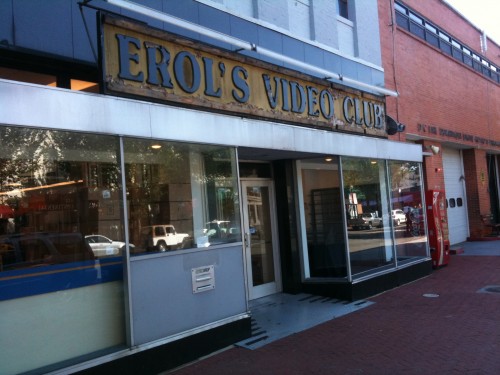
The most telling Erol’s artifact in the District is on Barracks Row. In late August 2011 the last Blockbuster in DC closes at 514 8th Street SE. The Blockbuster sign comes down promptly. Underneath it, intact and weathered, is the original Erol’s Video Club sign that the Blockbuster signage had been bolted over since the 1991 conversion.
For three weeks of summer 2011, before the storefront becomes a Jos. A. Bank, you could stand on 8th Street SE and read the old name. PoPville ran the photo on July 19, 2011, and a few days later published a long note from the founder’s grandson about how the family thought about the chain.
The image is everything you need to know about what happened to local DC retail in the 1990s. The new chain covers over the old chain without removing it. The old name is still there, just hidden under the new logo, waiting to be noticed when the sign company finally pulls the bolts.
If you want to hear what Erol’s actually sounded like on a Washington TV set, here is one of the chain’s own spots from 1984.
Why Erol’s still matters in DC
Two reasons.
One, Erol’s is the canonical DC area example of the immigrant-built family business that becomes a regional category leader and then loses to a publicly traded national chain in the span of about ten years. The story repeats across a lot of categories in 1980s and 1990s Washington. Erol’s just happens to be the one almost every adult who grew up in the area can describe from memory.
Two, Erol’s quietly invented things that the rest of retail copied. Bar code rental tracking. Flat-rate unlimited internet. The membership newsletter as a content channel. The annual member appreciation outing. The deep back catalog as a differentiator against new-release-heavy competition. Every one of those ideas is now standard. Erol’s was running them at scale in Northern Virginia thirty years ago, with a Turkish immigrant writing the inventory software in the mornings before he came in for his 1 p.m. start at the Springfield warehouse.
That is the empire before Blockbuster, and it is the reason the red-on-yellow logo still does work in this town whenever someone old enough to remember it walks past 514 8th Street SE.