
Twice in twenty years, someone climbed into a stolen aircraft and put it down on the White House lawn. Both times, the president wasn’t home.
Most people remember the Air Florida crash into the 14th Street Bridge in 1982. Almost nobody remembers the two times someone actually landed on the South Lawn, less than a hundred yards from the executive mansion, and forced the Secret Service to rewrite the rulebook on White House airspace.
The first time, in 1974, was a 20-year-old Army private flying a stolen Bell UH-1 Huey, who hovered six minutes over the South Lawn, flew off to buzz a Maryland doughnut shop, and came back to land under 300 rounds of shotgun and submachine gun fire. The second time, in 1994, was a depressed truck driver in a stolen Cessna 150 who came in at treetop level at 1:49 in the morning and ended up against the south wall of the White House, two stories below the bedroom where the Clintons would have been sleeping. Except they weren’t there either.
Here’s how it happened, twice.
Who was Robert Preston and why did he steal a helicopter?
Private First Class Robert Kenneth Preston was 20 years old in February 1974, stationed at Fort Meade as a helicopter mechanic, and angry about it. He had enlisted in the Army in 1972 to fly Hueys in Vietnam as a “dustoff” pilot evacuating wounded soldiers. He washed out of helicopter training at Fort Wolters, Texas, because of a deficiency in the instrument phase. The Army had a surplus of qualified helicopter pilots by then thanks to the Vietnam drawdown, so there was no second chance. Bound by his four-year enlistment, Preston was sent to Maryland to fix the aircraft other people got to fly.
Shortly after midnight on February 17, 1974, Preston left Blob’s Park, a dance hall in nearby Jessup, downhearted about his career and a failed relationship. He drove back to Tipton Field, the Army airfield south of Fort Meade where thirty fueled Bell UH-1B Hueys sat ready for the Reserve and National Guard units that trained there. The field was unguarded. He parked his green Chevy Nova in an unauthorized spot, walked over to helicopter serial number 62-1920, climbed in, and ran the preflight checklist.
“I just walked out, prepared the aircraft for flight, started it, and took off,” Preston told Air & Space magazine years later. “I was really surprised. I thought there would be somebody out there.”
He lifted off without turning on the anti-collision lights and without making the standard radio calls. A controller in the Tipton tower spotted him and called the Maryland State Police. Preston buzzed the restaurant he had just left, briefly touched down in a field where investigators later found his Army hat, and decided to follow the lights of the Baltimore-Washington Parkway twenty miles southwest into Washington.
Hovering over the White House South Lawn
D.C. police first spotted the stolen Huey hovering between the Lincoln Memorial and the Capitol. Flight over that part of the National Mall was strictly prohibited, but in 1974 the rule wasn’t physically enforced. There were no surface-to-air missiles around Washington until after 9/11. There was a radar system. That was about it.
Preston spent about five minutes hovering a couple of feet above the floodlit grounds of the Washington Monument. He told the military court later that the lit Monument drew him in “like a moth to the candlelight.” Then he turned the helicopter east toward the Capitol, followed Pennsylvania Avenue back west, and came up on what he described to investigators as “a big black spot” in the middle of a sea of lights. That was the White House.
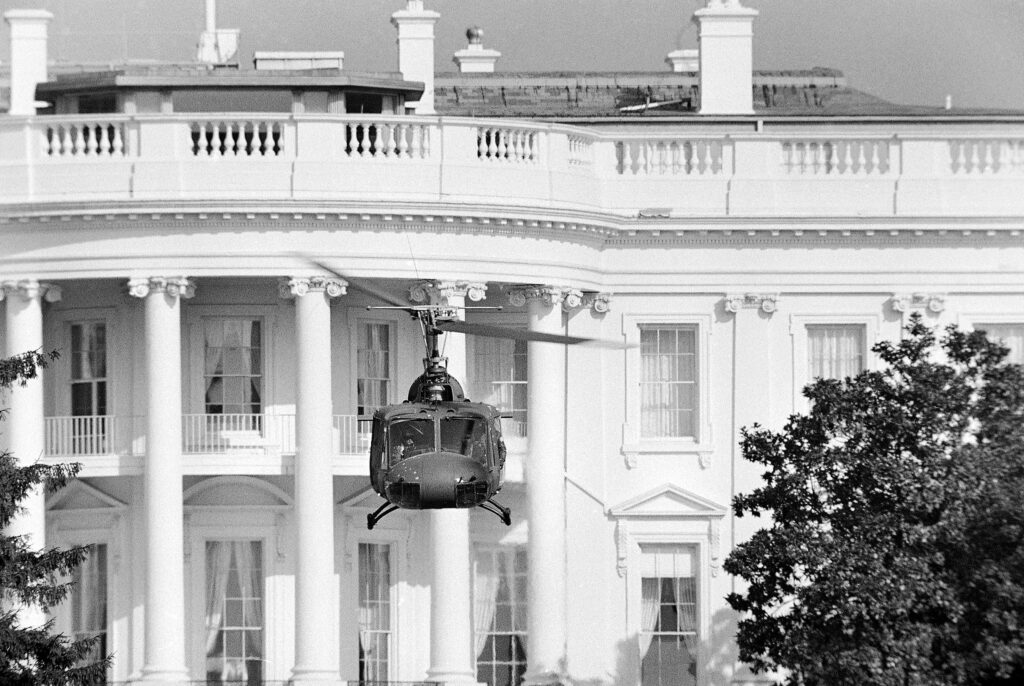
Inside the White House Executive Office control center, Secret Service watch commander Henry S. Kulbaski had just been told by phone that an Army helicopter was stolen and headed for restricted airspace. Service policy at the time was to fire on aerial intruders, but the standing order on when to do so was vague, especially if buckshot in the air might hurt bystanders. Kulbaski tried his superiors. Nobody picked up.
Preston brought the Huey down over the South Lawn and waited. He hovered low. He briefly set down. He hovered some more. “Everybody just stood around looking,” Preston later said in court. “If they weren’t going to do nothing I was going to leave.” After about ten minutes on the lawn, he lifted off, banked north, and flew back toward Maryland.
Kulbaski, watching the helicopter retreat, gave the order. If it came back, shoot it down.
The Maryland chase, the doughnut shop, and dogfight tactics
At 12:56 a.m. an air traffic controller at National Airport saw the blip on his radarscope, realized it was the stolen Huey, and called the Metropolitan Police. MPD scrambled an old Bell 47 helicopter that was too slow to keep up. Baltimore-Washington International picked up the track when Preston re-entered Maryland airspace, and the Maryland State Police dispatched two Bell 206 JetRangers to intercept.
What followed, around the Maryland suburbs in the dark, was a low-altitude helicopter pursuit. Preston forced one police cruiser off the road by executing a head-on pass inches above its roof. He briefly hovered over a doughnut shop where, he later told investigators, he had planned to land and turn himself in, but couldn’t find a clear spot. He passed over BWI Airport. He shook one of the JetRangers using what the troopers themselves later described as “modern dogfight tactics,” flying along the Parkway at speeds ranging from 60 to 120 knots, sometimes “only inches above car-top level.”
Maryland State Trooper Donald Sewell, a decorated Vietnam combat pilot flying the surviving JetRanger, told the Smithsonian years afterward how hard it was to keep visual contact:
It was very hard to keep track of him, so Louis and I were both in constant aggravation trying to keep an eye on him to know where the hell he was going. He flew at erratic speeds ranging from 60 to 120 knots, and altitudes sometimes only inches above car-top level.
Preston later told the military court he had decided his only way out was to give himself up to President Richard Nixon in person. He picked up the Parkway again and turned the Huey southwest, back to the White House.
Three hundred rounds on the South Lawn
The Huey came in over the South Lawn just before 2 a.m., barely clearing the steel picket fence around the grounds. According to one of the trooper pilots chasing him, Preston was so close to the mansion he “could have driven right in the front door.”
Floodlights snapped on. The Executive Protective Service opened fire with shotguns and submachine guns. Bullets punched half-dollar-sized holes through the Huey’s aluminum skin. Buckshot hit Preston in the foot. The helicopter veered left, bounced on one skid and then the other, and Preston regained control and put it down on the South Lawn about 100 yards from the executive mansion.
Some 300 rounds were fired. Five hit Preston. The wounds were superficial.
He opened the cockpit door, rolled out underneath the helicopter, and started running toward the White House before Secret Service agents tackled him. Handcuffed, he was taken to Walter Reed Army Medical Center, where wire-service reporters described him arriving with a smile, “laughing like hell.”
President Nixon was traveling in Florida, six months from resigning the presidency over Watergate. First Lady Pat Nixon was in Indianapolis visiting their daughter Julie, who was sick. Nobody in the residence was harmed because nobody in the residence was there.
The Huey itself, serial 62-1920, turned out to be flightworthy. The next morning, in front of TV cameras from every network, Army personnel flew it off the South Lawn and back to Tipton Field. It was repaired and returned to service. Today it sits, unmarked and quiet, on the static display lot at Joint Base Willow Grove in Pennsylvania. Nothing on it acknowledges what it did.
What happened to Robert Preston
Preston was initially charged with unlawful entry onto White House grounds, a federal misdemeanor with a $100 fine and a six-month maximum. His attorneys negotiated to drop the civil charges in exchange for a military court-martial, where prosecutors then piled on attempted murder charges, one for Nixon and one for each of the trooper pilots Preston had buzzed.
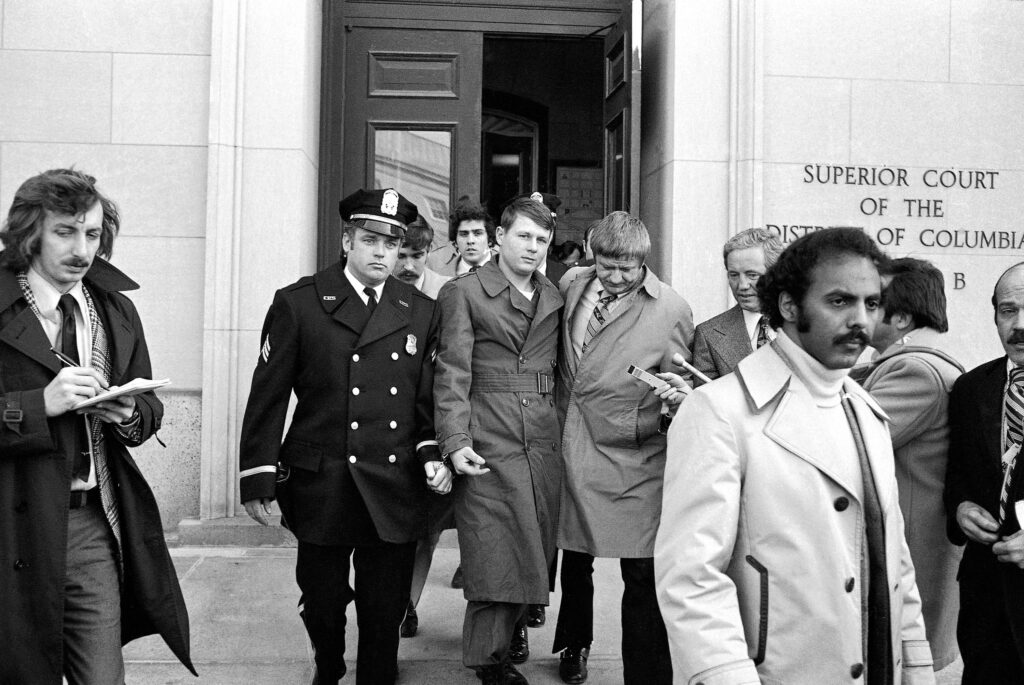
Preston pled guilty to wrongful appropriation and breach of the peace. He was sentenced to one year and a $2,400 fine, about $15,700 in today’s money. With time served and a credit for the court-martial, he ended up doing two months at Fort Riley, Kansas, and received a general discharge for unsuitability. After his release he moved to Washington state, married in 1982, raised his wife’s two daughters, and lived quietly. He died of cancer on July 21, 2009, in Ephrata, Washington. He was 55.
The Secret Service made one substantive change after Preston’s flight. They slightly expanded the restricted airspace around the White House. That was it. Twenty years later, that decision would matter.
How did a Cessna get to the White House lawn in 1994?
The second time was sadder, and quieter, and the man flying the airplane wanted to die.
Frank Eugene Corder was 38 years old in September 1994. He was a truck driver from Aberdeen, Maryland, born in nearby Perry Point. He had enlisted in the Army out of high school in 1974, trained as a mechanic at Fort Knox and Fort Carson, and been honorably discharged in 1975 as a private first class. After the Army he worked freight at BWI Airport until he was fired in early 1993. He had a 1993 arrest for theft, another that fall for drug dealing, and a 90-day stint at a drug rehab facility. He was on his third marriage. His wife Lydia had left him three weeks earlier, taking his focus with her. He was living at Keyser’s Motel in Aberdeen, drinking heavily, smoking crack cocaine, and, according to friends, increasingly fixated on the idea of dying by flying a small plane into the White House.
There was no political motive. Corder had no quarrel with Bill Clinton. Investigators concluded later that he was inspired in part by Mathias Rust, the West German teenager who flew a Cessna 172 from Helsinki and landed it in Red Square in 1987. Corder wanted a spectacular exit, not a coup.
On the evening of September 11, 1994, Corder drove to Harford County Airport in Churchville, Maryland, a small general-aviation field about 20 miles northeast of Baltimore. Security at the airfield, owned by a group of about 35 private members, was minimal. The Cessna 150L he picked, registration N1405Q, was tethered at the end of a row of single-engine planes far from the road. He cut the rope, started the engine, and lifted off.
1:49 a.m. and the Jackson Magnolia
Corder flew south, over Baltimore, then down toward Washington. National Airport’s radar picked up an unidentified low-altitude track several minutes before impact, but the information didn’t make its way to the Secret Service. The airspace warning system that had been “slightly expanded” after Preston’s flight was, in practice, a phone tree, and at 1:45 in the morning the right people did not answer the phone.
An eyewitness on the National Mall named Adolphus Roberts described the last minute of the flight to UPI. The red-and-white Cessna passed near the Washington Monument with its engine apparently shut off and only its wingtip lights on. It glided in silence. Roberts watched it bank left toward the White House and drop.
It just kept coming down and falling. Then it disappeared between two trees. I heard a large boom. There was no fire, no nothing.
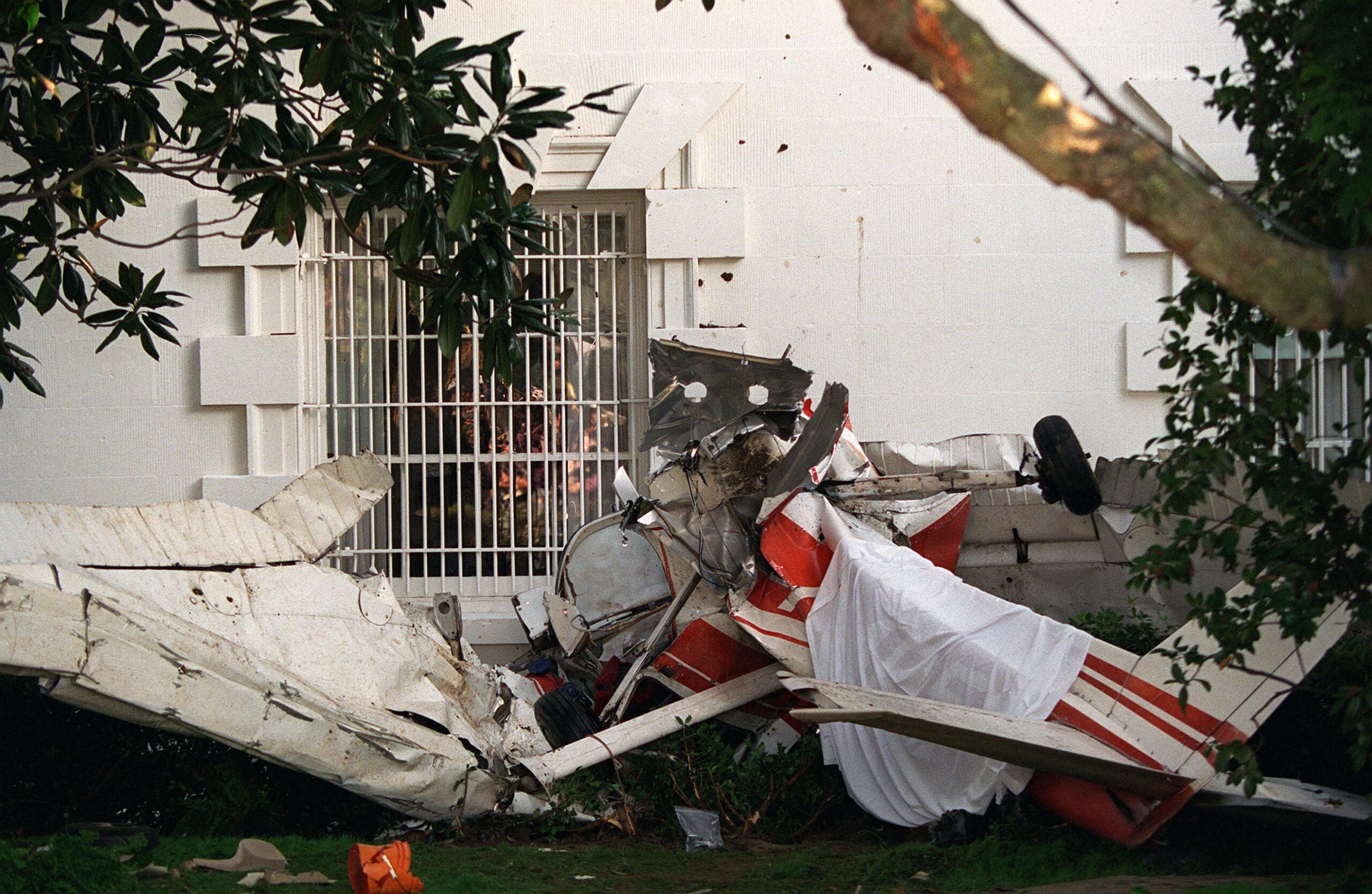
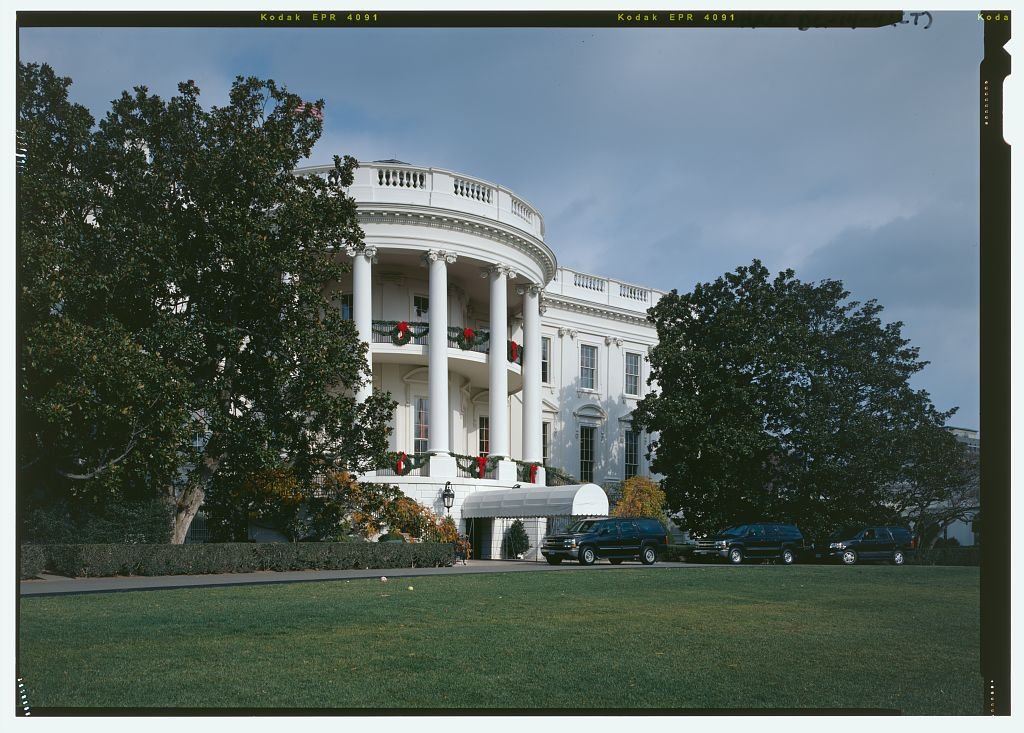
At 1:49 a.m., the Cessna hit the South Lawn at a shallow angle, tore long gouges in the grass, sheared off branches of the Andrew Jackson Magnolia (planted in 1837, when Jackson was still in office), and slid to a stop against the south wall of the White House, just below the second-floor windows of the residence and a few feet from the White House physician’s office. One window cracked. A bush was knocked over. Fuel pooled on the grass. There was no fire.
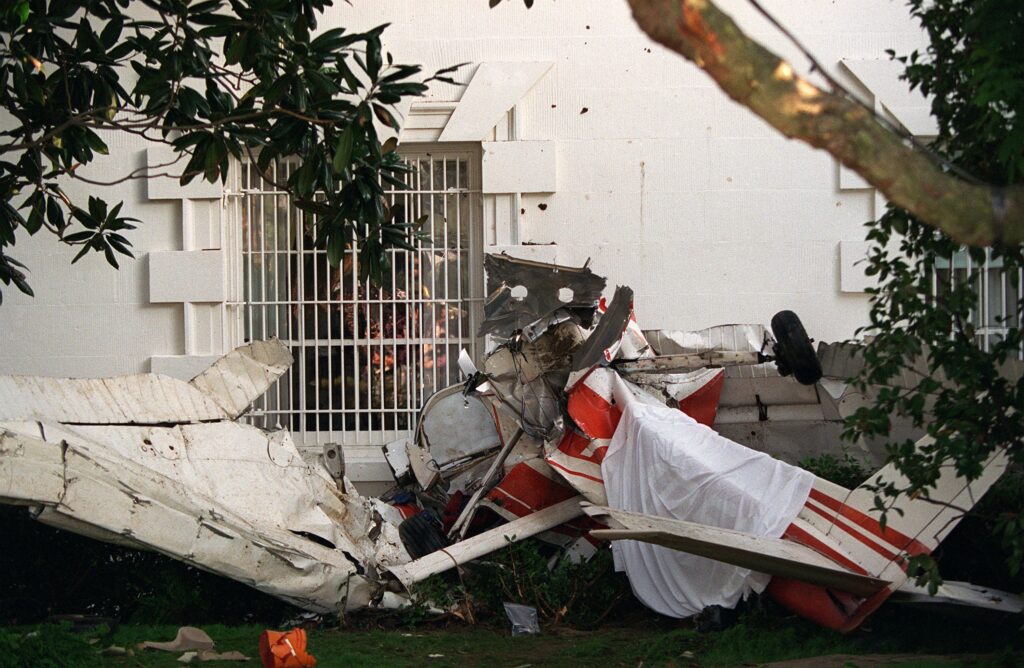
The next morning UPI carried Treasury Department spokesman Carl Meyer’s terse account of how surprised the duty agents had been:
Meyer said the red-and-white Cessna 150 was not spotted by security personnel until “it was coming in” and they had no time to do anything but “run for cover.” But he maintained that immediately after the 1:49 a.m. EDT crash, they sprang into action with an extensive search of the wreckage for explosives or hazardous devices, including weapons.
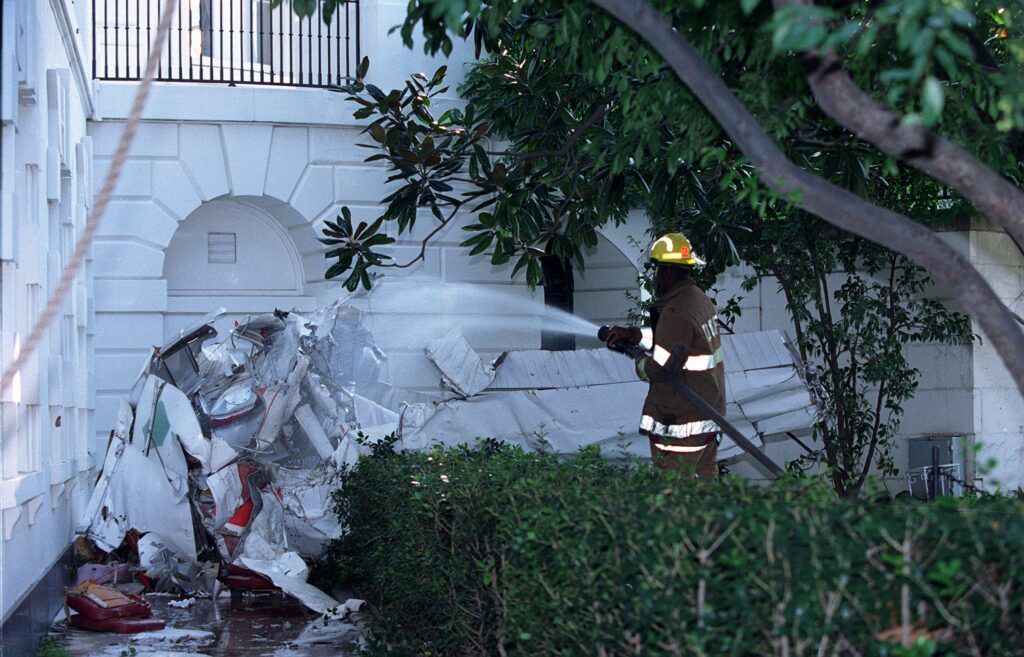
Corder was the only fatality. His body was removed at about 4:45 a.m. and the wreckage was trucked away to a nearby Air Force base. By dawn, President Clinton, dressed in his jogging clothes, was at the crash site looking at the damage to the magnolia.
The Clintons were at Blair House
Here’s the part nobody remembers. The Cessna came to rest against the south wall of the executive mansion, roughly two stories below the bedroom where Bill and Hillary Clinton would normally have been asleep. They weren’t in the building. They were across Pennsylvania Avenue at Blair House while contractors repaired faulty ductwork in the residence. Clinton was awakened by chief of staff Leon Panetta at 2:35 a.m. at the guest house. He didn’t see the crash site until daylight.
The Blair House detail is what makes the Corder crash strange to read about now. Forty-four years earlier, on November 1, 1950, the same building had been the target of two Puerto Rican nationalists who tried to shoot their way in to assassinate President Harry Truman, who was living there while the White House was gutted for renovation. Officer Leslie Coffelt died defending the entrance, the only White House Police officer ever killed in the line of duty defending a president. (We wrote up the 1950 attack on Blair House in detail.) Twice now, the president of the United States has been spared an assault on his home because he happened to be sleeping in the spare house across the street.
And then there was the joke. CIA Director James Woolsey had spent his entire tenure unable to get a face-to-face meeting with Bill Clinton. In the weeks after Corder’s crash, the White House staff joke about the dead pilot ran like this: “That must be Woolsey still trying to get an appointment.” Woolsey himself eventually started telling the joke. He resigned at the end of December 1994, never having had a one-on-one with the president he served under.
The 1995 White House Security Review
The Corder crash, more than the Preston flight, is the one that changed how Washington protects its airspace. Treasury Secretary Lloyd Bentsen, who oversaw the Secret Service in 1994, ordered an immediate 90-day review of White House security under Treasury Undersecretary Ronald Noble. That work expanded into the formal Public Report of the White House Security Review, published in May 1995. The review’s authors went back through every aerial intrusion attempt going back decades, including Preston’s, and recommended structural changes to airspace monitoring, communications between FAA radar centers and the Secret Service, and the use of physical denial measures around the building.
The most visible product of the review was the closing of Pennsylvania Avenue in front of the White House to vehicle traffic, which happened in May 1995 after the Oklahoma City bombing on April 19. The less visible products were better radar handoffs and tighter rules of engagement for aerial intruders. Surface-to-air missile batteries did not appear on the National Mall until after the September 11, 2001, attacks, but the regulatory architecture that made them possible was assembled in 1994 and 1995, with the Cessna sitting against the south wall of the White House as Exhibit A.
(The other Washington aviation event almost everyone remembers, the Air Florida Flight 90 crash into the 14th Street Bridge in January 1982, was a different category of disaster. Air Florida killed 78 people on a commercial flight in a blizzard. The Preston and Corder breaches killed nobody in the building, raised no civilian casualties, and changed the rules anyway.)
What’s on the South Lawn now
Today the South Lawn is sealed by a layered defense system that did not exist before 1994. Restricted airspace is enforced not by a phone tree but by NORAD’s National Capital Region Coordination Center, with civilian air traffic radar from Reagan National and Dulles plus dedicated military assets. Aerial intruders are routinely tracked, hailed, and, if necessary, intercepted by armed F-16s out of Joint Base Andrews. The Park Service has periodically had to debate whether to remove the Jackson Magnolia, which by the 2010s was rotting from old wounds, the 1994 Cessna strike included. Helicopters do still land on the South Lawn. They belong to the President of the United States.
The Bell UH-1 that Preston put down on the South Lawn at 2 a.m. on February 17, 1974, was one. The Cessna 150 that came to rest against the south wall at 1:49 a.m. on September 12, 1994, was the other. After twenty years, two presidents, and one resigned director of the CIA, the score is still two.