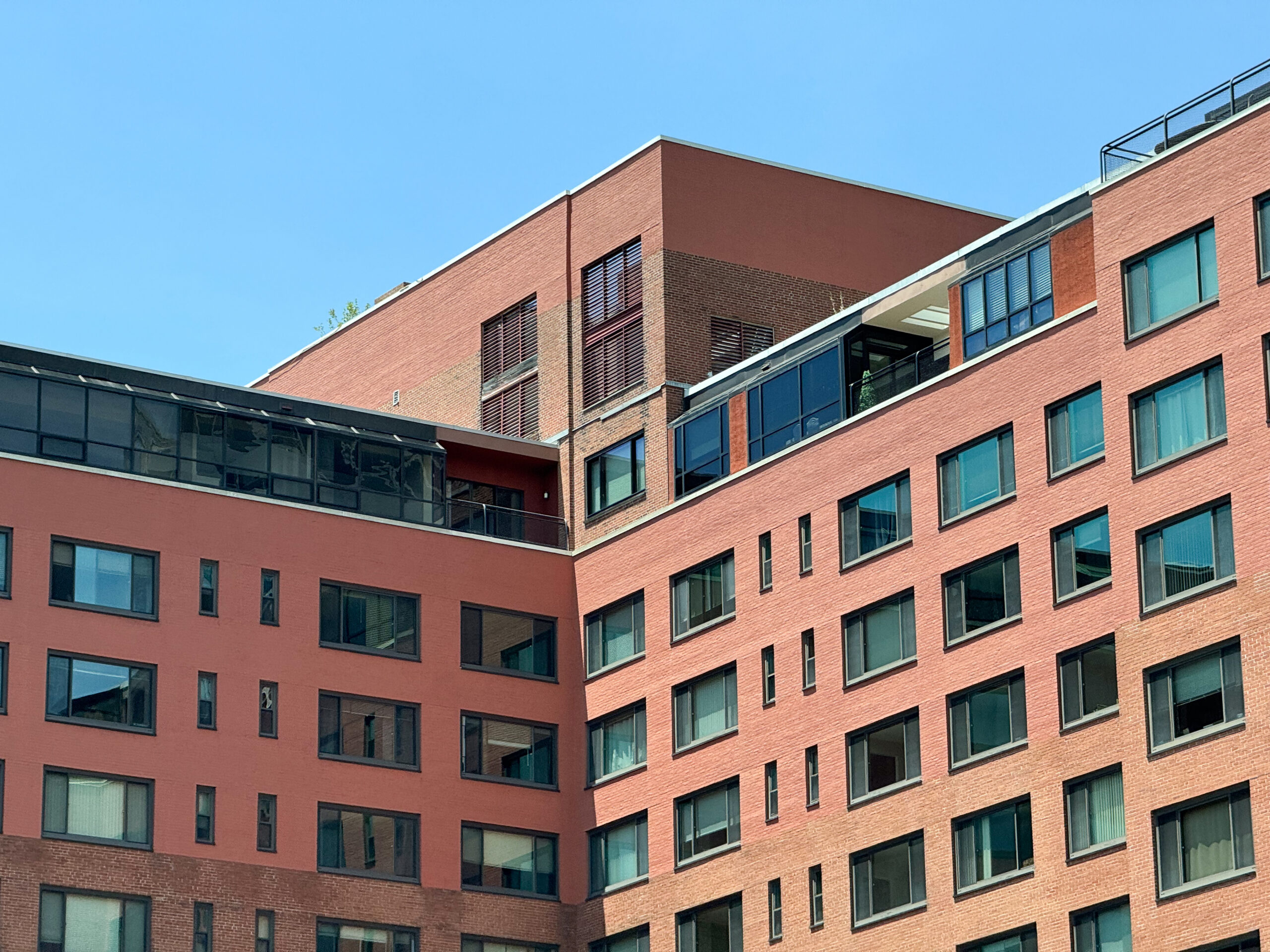
Here is one of the strangest facts in all of Northern Virginia real estate. If you own a home at River Place in Rosslyn, you do not own the ground it sits on. And in 2052, the clock runs out.
That is not a typo. The four brick towers between Route 50 and Wilson Boulevard sit on land their owners only lease. When that lease expires, the land and every building on it revert to the landlord. The roughly 1,720 units could, in theory, become someone else’s to demolish.
It is why a condo with a Potomac view inside the complex can sell for under $200,000 in a county where the average home tops $800,000. The deal of a lifetime, with an expiration date.
The 1953 lease that started the countdown
The arithmetic is brutal in its simplicity. In 1953, a 99-year ground lease was signed on the 13-acre triangle of Rosslyn land. Ninety-nine years from 1953 lands you in 2052.
When the lease is up, “we get the property back,” including the building, Stanley Westreich, a partner in the firm that then owned the land, told the Washington Post in 1982. “All they are buying is a right to live in the building until then.”
Today the land underneath belongs to Monday Properties, the biggest landlord in Rosslyn. The firm’s founder is Anthony Westreich, son of the same Stanley Westreich quoted above.
The Westreichs have been on this ground a long time. Stanley moved to Rosslyn in 1959, when his family held a stake in the area’s only federal housing project, which was Arlington Towers itself. He went on to build much of modern Rosslyn, the glass towers that now ring the old brick complex. They went up over an older Rosslyn of car lots and supper clubs, among them Tom Sarris’ Orleans House, the New Orleans steakhouse that fed the neighborhood for decades. His son’s firm became the neighborhood’s largest property owner.
So the lease Stanley described in 1982 will fall to the company his son built. No one has put a public price on the 13 acres, but it sits among the most valuable land in the region. Monday’s Rosslyn office portfolio alone has changed hands for more than a billion dollars.
When River Place was Arlington Towers
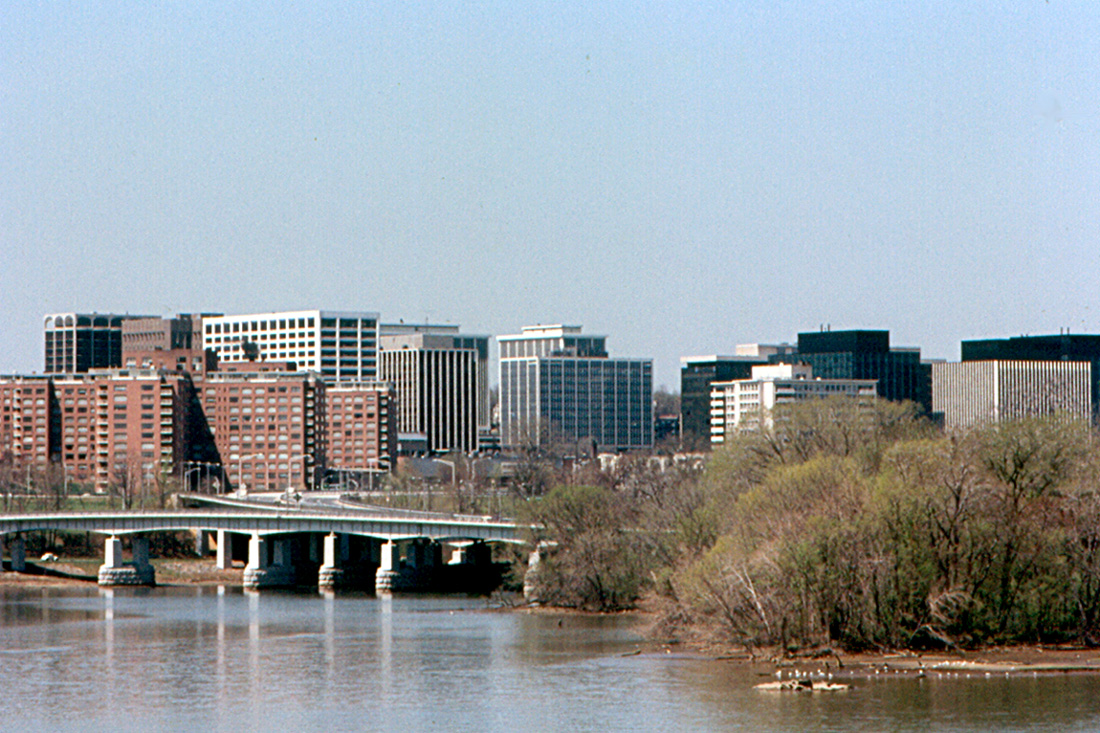
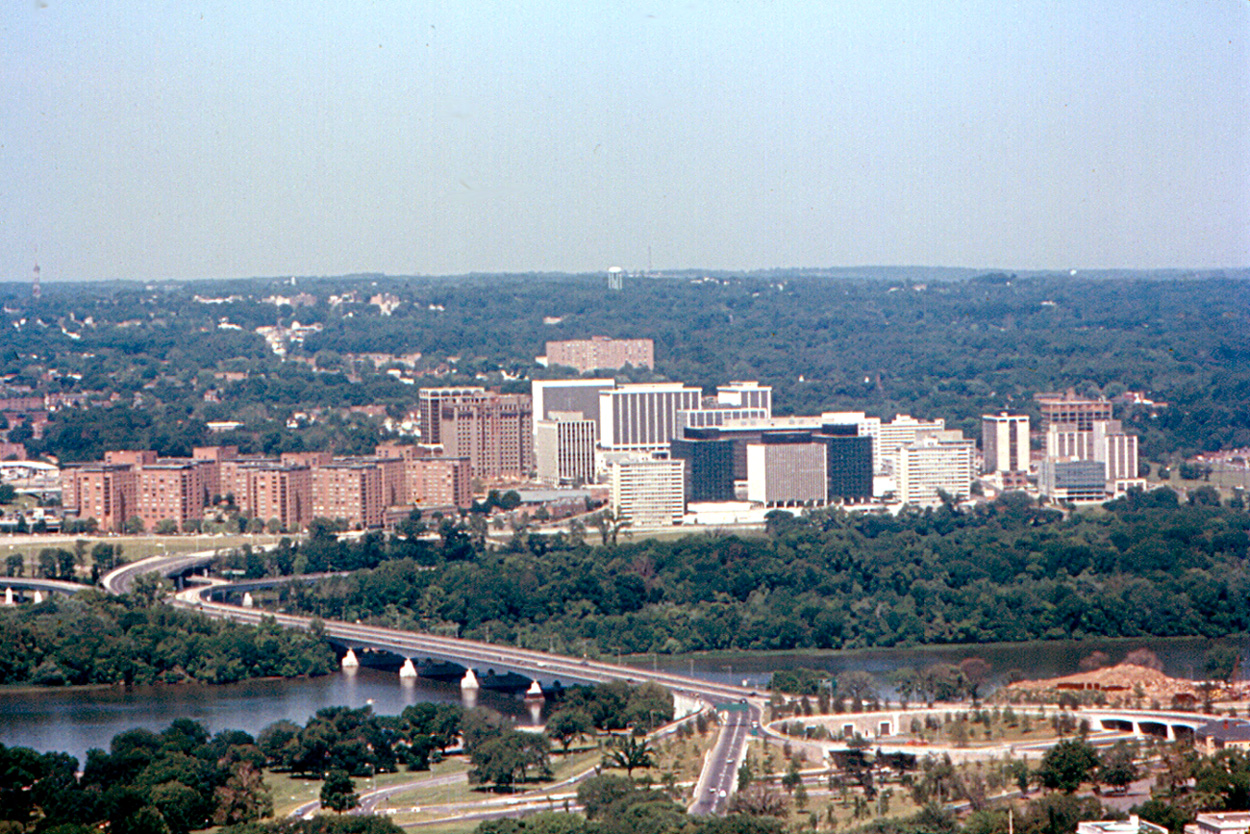
River Place was not always River Place. It opened in 1955 as Arlington Towers, a four-building, 1,650-unit complex that the Post later called one of the first high-rise apartment developments in all of Northern Virginia.
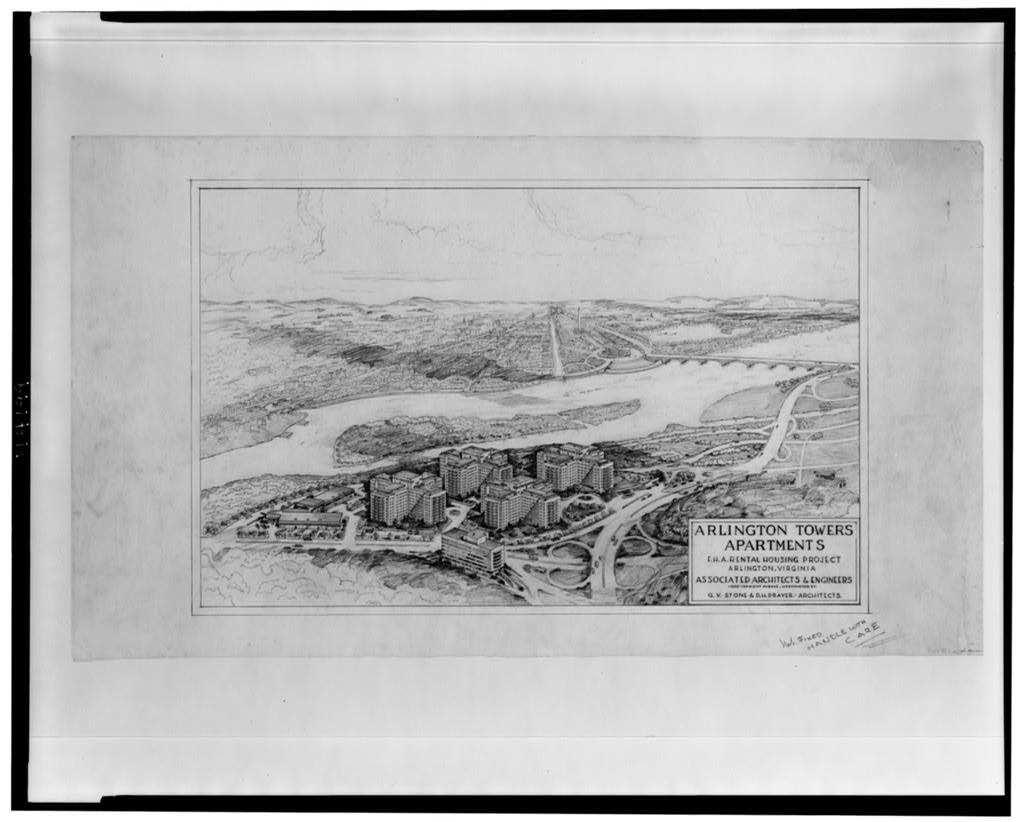
It started on the drawing board in 1954 as an FHA-insured rental project, the kind of big, federally backed apartment scheme that reshaped postwar America. The architects, G.V. Stone and B.H. Dreyer, drew a bird’s-eye view of brick towers stepping down toward the Potomac, the Washington Monument floating across the river. It turned out to be a remarkably accurate picture of what got built.
That was a bold thing to build in 1955 Rosslyn. The neighborhood was not the glass-and-steel canyon you see today. It was pawn shops, used-car lots, cheap bars, and the occasional peep show, a slummy stretch of riverfront that respectable Arlington tried not to think about. The skyscrapers did not arrive until the 1960s. Arlington Towers got there first.
The diplomats trained in the garage
Now for the part almost nobody knows.
When the State Department needed somewhere to train its new diplomats in the 1950s, it turned to Rosslyn. And for a stretch, the Foreign Service Institute, the school that prepares American envoys for the world, operated out of the garage of Arlington Towers.
We are not making this up. Stephen Low, who would later run the FSI from 1982 to 1987, remembered exactly where his own career began.
My training at FSI started off in an apartment building, then moved to the “garage” of Arlington Towers. Then for 25 years we were in the Rosslyn high rise where we spent a significant amount of time waiting for elevators.
So the men and women who would go on to staff embassies from Moscow to Manila learned their trade, at least for a while, in a converted parking garage under a Rosslyn apartment block. Low called the later Rosslyn quarters “simply unsatisfactory.” The FSI did not get its proper campus, at Arlington Hall, until 1993.
The 1981 conversion fight
Fast-forward to 1981. A Washington firm led by brothers Gary and Scott Nordheimer bought the aging complex and moved to convert it, renaming it River Place.
They made it a cooperative rather than a condominium for a very specific reason. A condo conversion required the landowner’s consent, and the landowner would only agree in exchange for a steep increase on the ground lease. A co-op needed no such blessing. So a co-op it became.
The sales pitch leaned hard into the glamour. Full-page ads showed crowds of smiling young singles marching across Memorial Bridge with their belongings, over the line that “Washington’s most successful single men and women will be moving out of town.” Efficiencies started at $29,550. One-bedrooms ran $46,650.
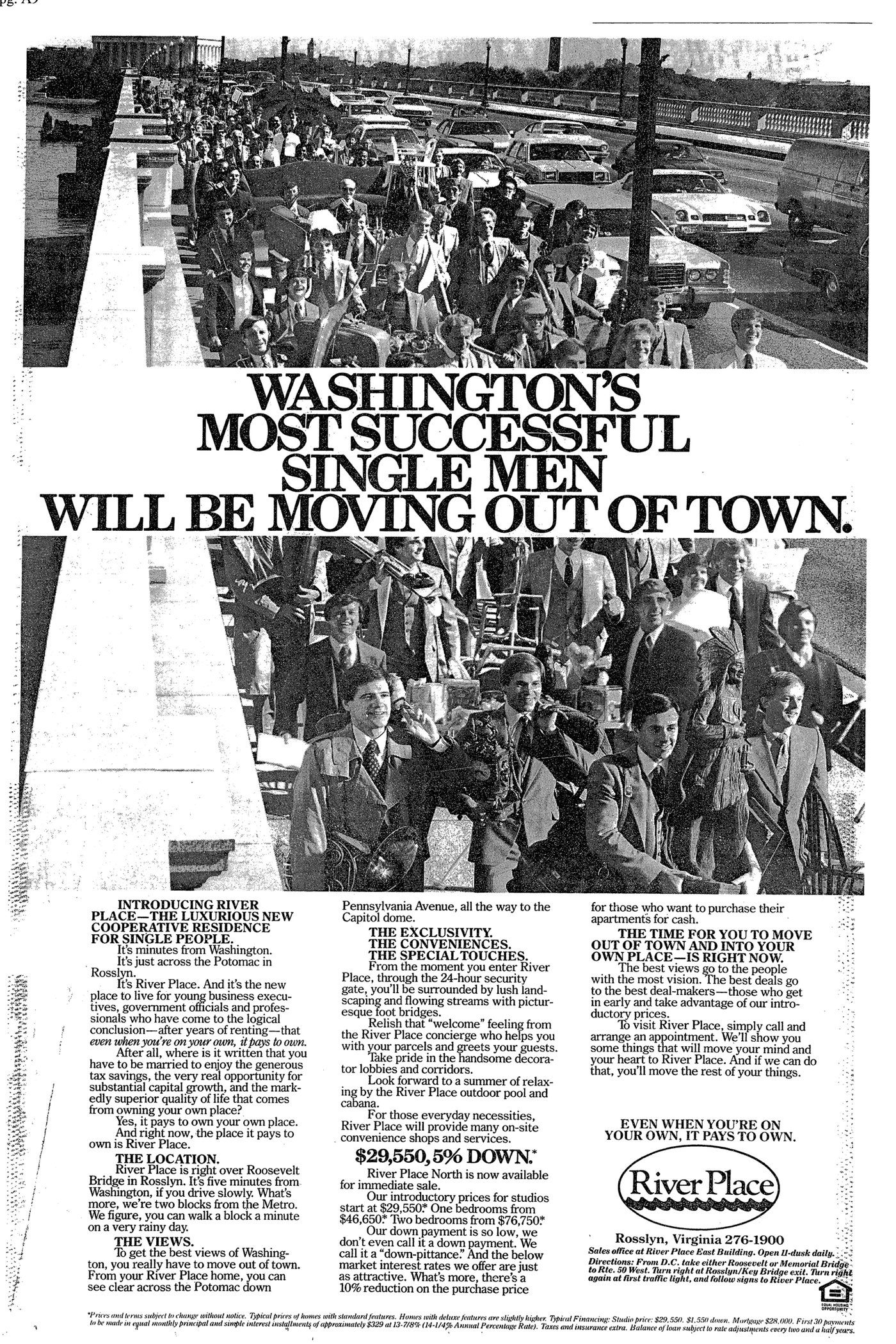
What the ads did not mention was the ground lease.
Tenants noticed. Many were older or moderate-income renters facing eviction or a sudden, impossible choice to buy. Wallace Witkowski, who lived on the 11th floor, pointed out that his one-bedroom rented for $425 a month but would cost $1,300 a month to own. The Arlington County Board passed a resolution in January 1982 citing “grave concerns” over how residents were being treated.
Developer Gary Nordheimer was philosophical about the looming deadline. “First, none of us are going to be here in 72 years,” he reasoned.
The ballpark that almost replaced it
River Place came startlingly close to disappearing once already, and not in 2052.
In 2003, Northern Virginia was fighting Washington and Portland for the Montreal Expos, the team that would become the Nationals. The Virginia Baseball Stadium Authority drew up a short list of stadium sites, and one of them was River Place.
The plan would have dropped a major-league ballpark onto the four-building complex on Arlington Boulevard, right at the base of the USA Today towers next door, with a clear view of the monuments across the river. Buying out the apartments would have run around $200 million, making it the priciest option on the board at roughly $610 million.
The Washington Times reported that the Rosslyn site was abandoned for cost reasons. The Expos arrived in Washington as the Nationals in 2005 and opened Nationals Park in Southeast in 2008. River Place, and its residents, stayed put.
What happens now
He was right about himself. He was wrong that nobody would have to worry about it.
The people buying into River Place today are buying into that countdown. With fewer than 30 years left on the lease, banks have grown wary. Lenders want 25 to 40 percent down and charge interest a point above normal, because a 30-year mortgage now outlives the land it is secured against.
Not everyone is rattled. James Marandi first moved into River Place as a student in 1982, the very year of those splashy ads, and bought his first unit two years later. Today he heads the River Place Owners Association, and he still calls the complex a jewel, its interiors fully updated even if the brick looks a little historic next to Rosslyn’s glass.
Still, he admits the question hangs over the place. “We are not necessarily nervous yet. Thirty years is a long way away,” he told ARLnow in 2022. “But we do realize that the lease expires and something has to be done.”
So what actually happens in 2052? A few things could. Monday Properties could extend the lease. It could buy out the co-op owners before the clock runs out. Or it could sell the 13 acres to another developer, who would then decide whether River Place stands or falls.
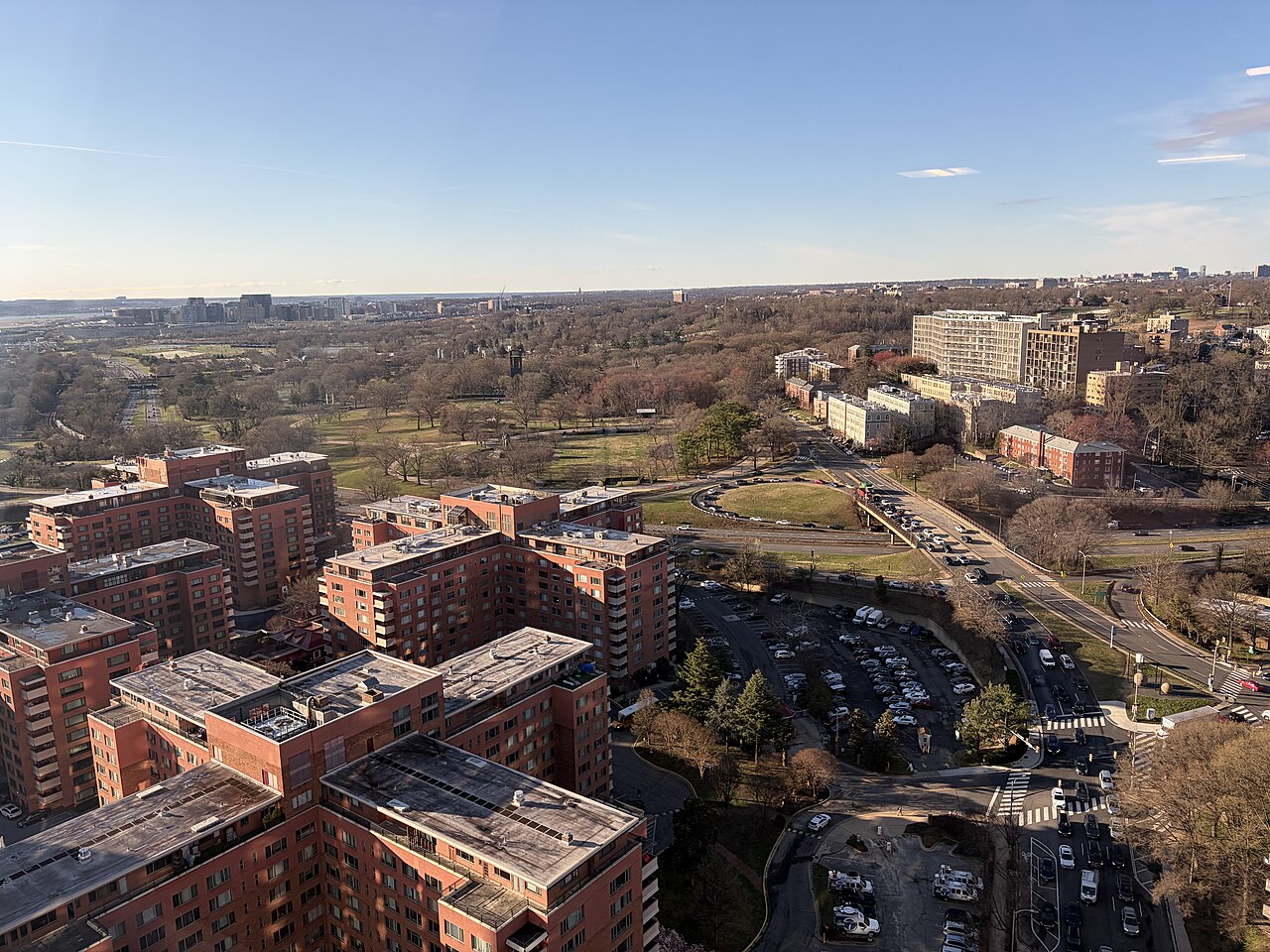
That is the paradox of River Place. The same ticking clock that makes the units some of the cheapest real estate in Arlington is the thing that makes them so hard to finance. An oasis of affordability, sitting on borrowed time, on some of the most valuable land in Rosslyn.
The brick towers have graced Rosslyn’s skyline for seven decades. Whether they reach a full century is a question only 2052 will answer. If you like this corner of Arlington, the same vanished Rosslyn turns up in our stories on Dead Man’s Hollow and the grand Key Bridge entryway that was never built.