
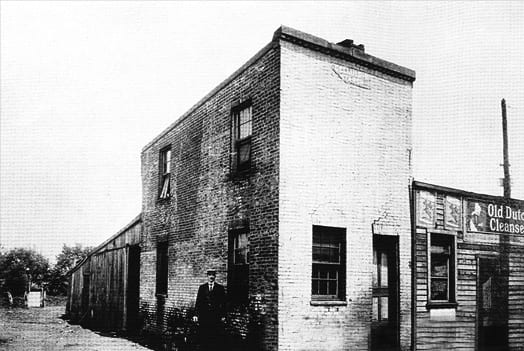
There was once a ravine just west of Rosslyn where bodies turned up often enough that people simply called it Dead Man’s Hollow. Murders, suicides, robberies. It was not a place you wanted to be after dark.
Rosslyn and Arlington were not always the glass office towers you see today. In the late 19th and early 20th century, the Virginia side of the river was a rough place, and the hollow was the roughest stretch of all.
People kept asking where it actually was. The Washington Post answered that in a piece from July 30, 1895, under the perfect headline “A Place of Mysteries.”
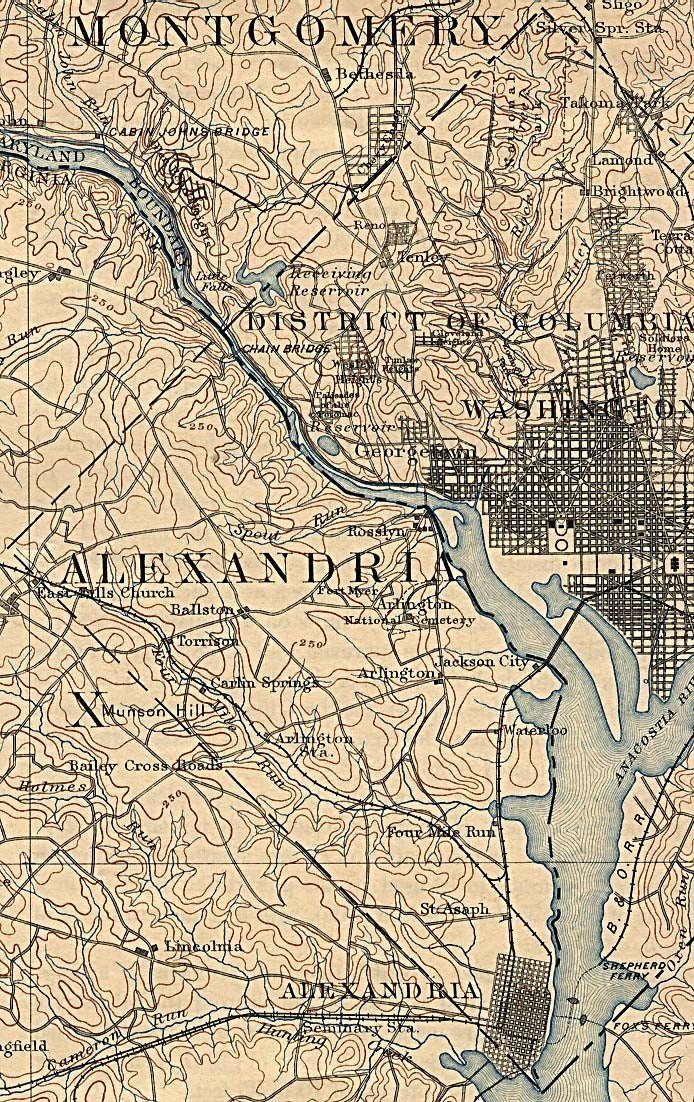
No locality in the vicinity of Washington can boast of so many mysteries as “Dead Man’s Hollow.” It begins just beyond Rosslyn, where Spout Run crosses the river road to Falls Church, and is about a mile in length, being a tortuous ravine, through which the little stream runs on its way to the river. But for the terror-inspiring history of the hollow, the drive would be romantic and picturesque. As it is, however, many hesitate to go that way even in the daytime, unless in company, while at night only the bravest men run the gauntlet of bad men and weird shapes popularly supposed to be met with there.
So that settles the long-running guess. The hollow began at the wooded draw west of Rosslyn near Spout Run, along what is now Lee Highway, and ran roughly a mile down toward the Potomac.
For many Virginia farmers, the hollow was not optional. You had to pass through it coming home from selling produce in the District, your pockets full of cash from the week’s sales.
It was dangerous enough that men often traveled through in armed convoys just to guard their earnings. Below is an account of one killing there, printed in The Washington Post on July 25, 1906.
… Fred Miles, colored, thirty-two years old, of Halls Hill, Va., was killed by being struck on the head with a rock, breaking his neck. His body was found early yesterday morning by a passer-by, who notified Deputy Sheriff Collins, of Alexandria County. The body was taken to the morgue, where an inquest will be held to-day. Yesterday afternoon, on evidence furnished by Prosecuting Attorney Mackey, William Tenner, colored, thirty-five years old, of Georgetown, and Bernard Evans, also colored, thirty-three years old, of Halls Hill, Va., were arrested on suspicion of being connected with the death of Miles. They were taken to the Alexandria County jail, where they will be held pending the result of the inquest. According to Attorney Mackey, Tenner and Evans were the last persons seen with Miles on Monday night. The three men were seen near the brewery, at Rosslyn, fighting, when Mackey rode by, shortly after 7 o’clock. They stopped when they saw him and pretended they were fooling. Later they dispersed. That was the last time Miles was seen alive. Tenner and Evans deny all knowledge of the crime. They say they were not in the vicinity of the Hollow after dark.
Hall’s Hill, where Fred Miles lived, is now known as High View Park, one of Arlington’s historic African-American neighborhoods.
The same article traced the hollow’s grim back catalog, and explained how it got its name.
Dead Man’s Hollow, where the crime was committed, has in the last fifteen years been the scene of more bloody affairs than any other spot in Alexandria County. Ensconced between two high hills on the Falls Church turnpike, on the main road to Fairfax Court House, it presents a forbidding appearance to the wayfarer after dark. The hills, rising from the road, are covered by deep gloomy woods, and rank vegetation that shut off all light of the sun in the day and the moon and stars at night. The name originated fifteen years ago when a man named Cunningham was found on an October morning lying in the heart of the hollow with his throat cut from ear to ear. Cunningham had been to Rosslyn the night before and stayed late. He was known to have considerable money in his pockets, and it is supposed he was followed and, after being murdered, robbed of his valuables. … Robberies innumerable have taken place in the Hollow. Eight years ago, William McClure, a wealthy citizen of Halls Hill, while riding through late at night, was held up by unidentified colored men, and after being shot twice in the right side, was robbed of $100. McClure had been to a lumber yard in Washington to pay a bill, and while there flashed a large sum of money. He was followed and held up. Two years ago, a colored girl, a servant in the family of Prosecuting Attorney Mackey, was accosted in the Hollow when returning to her employer’s residence late at night, and stabbed eighteen times by a colored man. She was left for dead, but revived several hours after being stabbed. Staggering to Mr. Mackey’s, she told her story. Mackey, mounting his horse, went to the scene and caught the colored man before he had time to escape. He was identified and sentenced to two years in the penitentiary.
The McClure robbery nearly ended in a lynching. The Baltimore Sun reported at the time that an armed party had surrounded the woods where the suspect was thought to be hiding, intending to lynch him “if he can be found.” He was never caught.
Crandal Mackey and the 1904 Raid on Rosslyn
Look at the name in that 1906 article. Prosecuting Attorney Mackey, the man who jumped on his horse and ran down the girl’s attacker, was Crandal Mackey, and he is the most famous lawman in Arlington history.
Mackey was a Spanish-American War captain and a DC lawyer who lived on a hill just west of Rosslyn. In 1903 the Good Citizens’ League of Alexandria County recruited him to run for Commonwealth’s Attorney with one job in mind: clean up Rosslyn and Dead Man’s Hollow. He won the 1904 election by two votes.
Then he did something nobody expected.
On a day in May 1904, Mackey gathered about a dozen men near the Long Bridge, swore them in as deputies, and handed out axes, guns, and sledgehammers. They rode the trolley across the river into Rosslyn and went to work.
They smashed their way through the saloons and gambling halls, splintering furniture and roulette wheels, breaking every bottle they could find, and destroying the paintings they judged obscene.
The raid netted only six arrests. It did not matter.
It put every gambling den and brothel in Rosslyn and nearby Jackson City on notice, and the vice district never fully recovered. Arlington later named a park after Mackey on the very block where he had swung an axe through the gambling houses.
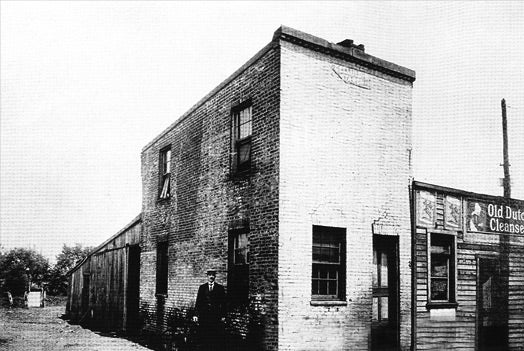
Mackey could clear out the saloons. The hollow was harder to fix.
WETA’s Boundary Stones blog turned up a recollection from Frank Ball, a young Mackey supporter who would later become Commonwealth’s Attorney himself. Decades on, he still remembered the place with a shudder.
Some committed suicide, some were killed by the gamblers and liquor people, some got in fights and a little bit of everything happened. I would not have gone up Dead Man’s Hollow after dark for all the money in the world.
The Hollow Kept Taking Victims
As the law tightened and the woods gave way to roads and houses, the bodies stopped turning up. But the hollow found a new way to hurt people. Cars.
In August 1912, Mackey himself drove into Dead Man’s Hollow after another driver’s headlights blinded him. He fractured his shoulder. His wife and two daughters were shaken up but survived.
There is a dark irony in that. The man who tamed Rosslyn nearly died in the one stretch of road he could never quite tame.
By 1923, Arlington County had stopped worrying about the hollow’s ghosts and gone practical, lining the nearby highway with a heavy wooden fence and a row of danger signs to keep cars from skidding into the ravine.
Rosslyn itself stayed a hard, working-class town long after the killings stopped.
So the next time you head west out of Rosslyn on Lee Highway, down that hill toward Spout Run, think about how lucky you are. A hundred years ago, on foot and after dark, that stretch might have been your last trip.
If you like the rougher side of old Northern Virginia, read our story about the night a saloon brawl in Alexandria ended in gunfire.
Good stuff!
how did you determine to place “Dead Man’s Hollow” at Spout Run?
(I don’t see a reference to how the location was pinpointed).
Hold on… the last part is incredible! She was stabbed 18 times, and the perp only got 2 years in the pen. WTF
That’s the only reasonably sized hill I know of close to and leaving Rosslyn going west.
Wasn’t it a hollow between Hall’s Hill and another hill leaving Rosslyn?
I remember that even in 1959 or 1960 Rosslyn was a place of disrepute. I remember when gypsies would seasonally arrive in Rosslyn and read palms. Once a buddy and I (I was probably about 12 at the time) went into one of their places to see about having our palms read & we heard all these sounds of men and women in the behind their curtains. At the time in 1959 I had no idea what was going on. It’s very apparent now it was a whorehouse. We boys didn’t feel good about being there and left. A rough neighborhood even at that time.
Not sure how accurate this is, but this suggests closer to Rosslyn: “Just as the friction between the two groups seemed headed to physical confrontation, the parade lurched forward towards its terminus at Dead Man’s Hollow. The Klansmen turned back to Lee Highway passing Dead Man’s Hollow, which was a notorious hideout of highwaymen and killers located roughly at the base of the Key Bridge Marriott’s parking garage.”
http://ourredneckpast.wordpress.com/
Thanks for citing my blog. I’ve read in a few places that it was basically the current site of the Marriott’s garage. I think Crandall Mackey’s house overlooked it.
See Page 10 here, which was one of my sources. By the way, I love your blog. http://arlingtonva.s3.amazonaws.com/wp-content/uploads/sites/7/sites/31/2014/02/NC_RadnerFtMyerHts_Plan.pdf
I was under the impression it was farther east. Closer to where Quinn St. hits Lee Highway