
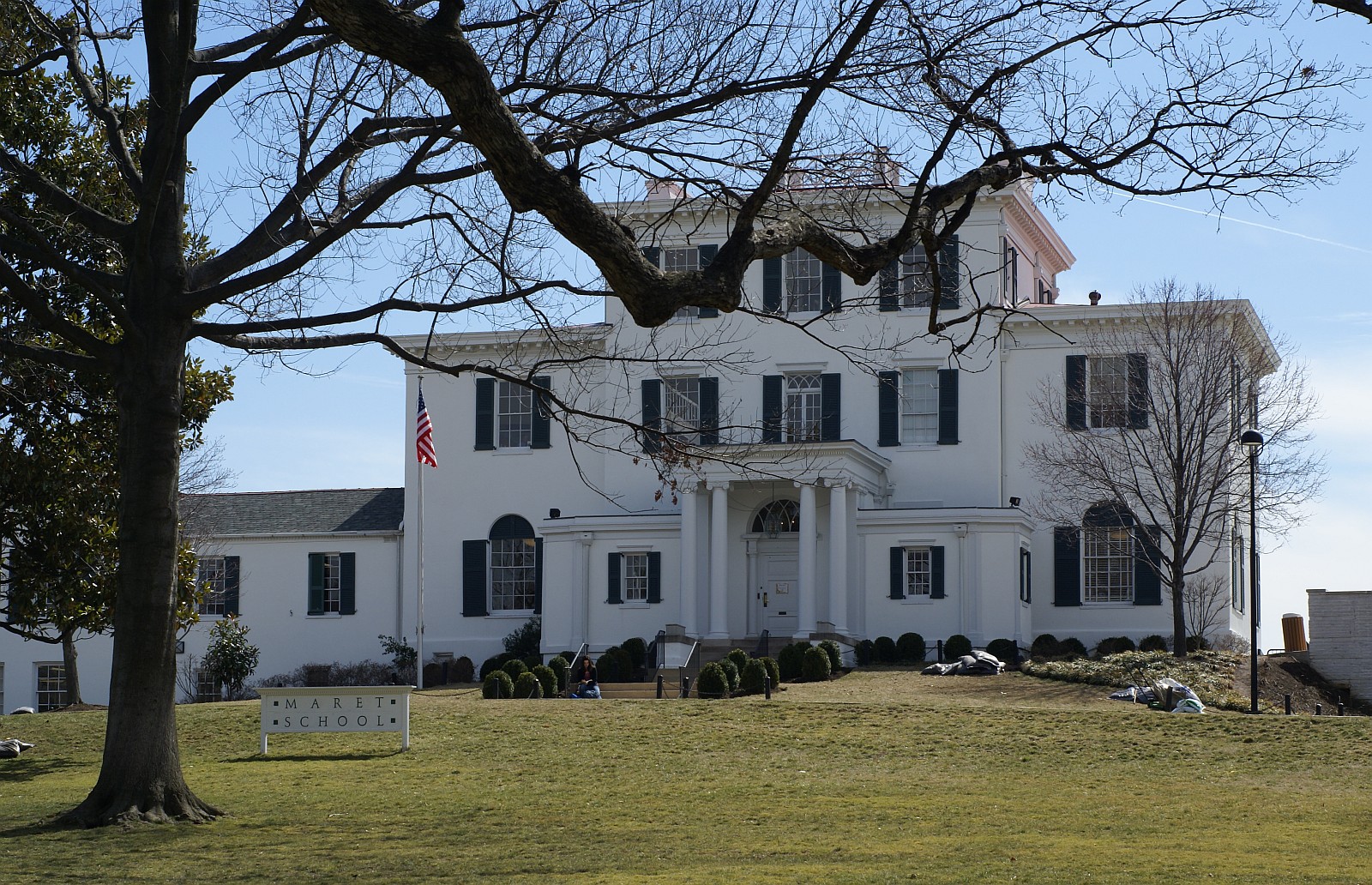
Here is something you would never guess driving past the Maret School today, up at Woodley, the old hilltop estate off Cathedral Avenue where presidents once spent their summers.
The school began in a rented apartment. And the woman who started it had been blind since she was eighteen.
Her name was Marthe Maret. In 1911 she and her two sisters opened a small French school for the children of Washington. They had no building, no endowment, and no famous patrons. What they had was one sister’s teaching salary, a set of rented rooms, and a stubborn idea about how children ought to be taught.
A century later that idea sits on seven wooded acres and is among the most sought-after private schools in the city. This is the story of how it started, and of the first child who ever walked through its door.
Three sisters, three continents
Marthe, Louise, and Jeanne Maret were French, from a village on Lake Geneva near the Swiss border, and by the school’s own telling they scattered across the globe before any of them thought about Washington.
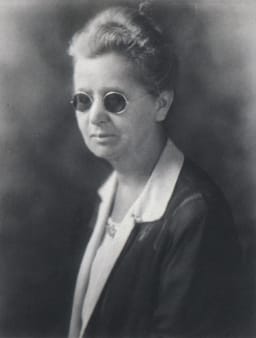
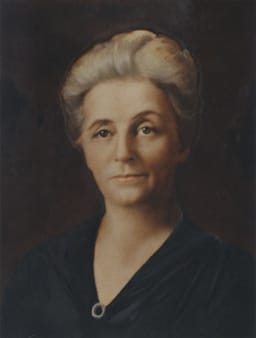
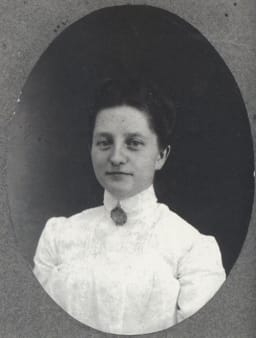
Louise taught in Russia. Jeanne taught in the Philippines. Marthe, who had lost her sight at eighteen, taught in Washington, D.C. By 1911 the three had reunited in the capital with what one person who knew them called a shared dream: to build “a big, beautiful school for girls of many nations.”
They wanted to fold the best of European schooling into the principles of American democracy. It was an ambitious thing to want with almost no money. So they started where they could.
According to the school’s history, “relying on Jeanne Maret’s high school salary as ballast, Marthe became the pioneer,” opening the school in the sisters’ own apartment. The first classes were small. The first pupil, as we will see, was a little girl whose family would stay close to the school for decades.
The apartment we went looking for
The Maret School’s history says the sisters started out in an apartment on Rhode Island Avenue. We went looking for it, and we have to be honest: we could not find them on Rhode Island Avenue in the old city directories.
What the directories do show is close by. In 1911, Boyd’s Directory of the District of Columbia lists Marthe Maret at 1719 13th Street NW, a short walk from where Rhode Island Avenue cuts through Logan Circle. The next year, the 1912 directory lists two sisters together, “Maret, Jeanne, tehr” and “Maret, Martha, tehr,” at 1225 L Street NW, downtown near Franklin Square.
In a school that lived inside the family apartment, the address was simply wherever the sisters happened to be renting.
So maybe those first rooms really were near Rhode Island Avenue, close enough that the avenue settled into family memory as the address itself. Or maybe the detail has softened a little over the past hundred years, the way the best-loved stories do.
We are not closing the book on it. Some directories from the mid-1910s have never been digitized, so there are years we simply could not check. All we can say is this: we could not place the Maret sisters on Rhode Island Avenue, and the records we do have put their first classrooms a few blocks away.
There is a nice footnote to that 1911 address. Today 1719 13th Street NW is home to the Edward C. Mazique Parent Child Center, a day care for infants and young children. More than a century on, the sisters’ first Washington address is still full of small children.
Up Connecticut Avenue
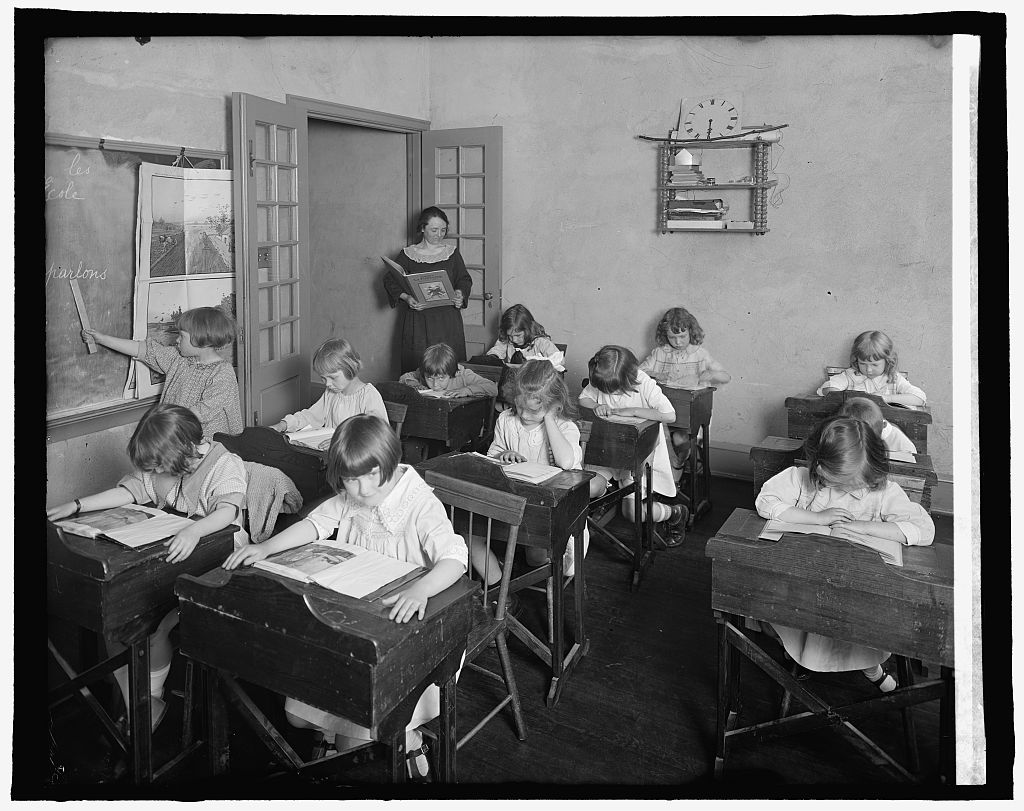
The school grew, and it climbed up Connecticut Avenue. By 1920 the sisters were running what a school photograph of the period simply calls “the Connecticut Avenue school.”
The 1922 and 1923 city directories pin it down. All three sisters, Jennie, Louise, and Marthe, are listed together at 1724 Connecticut Avenue NW, under the school’s formal name of the day, “The Misses Maret French School for Children.” In the classified school listings, it sits right after Madeira’s.
You can feel the school’s French character in the small newspaper notices from those years. In May 1921 the Washington Post announced the school’s end-of-year ceremony, and it was not a “field day.” It was a “distribution des prix.”
The “distribution des prix” of the Misses Maret French school will be held Tuesday afternoon at 3:30 o’clock in the parish hall of St. Margaret’s church, Connecticut avenue and Bancroft place. The pupils will render French songs and plays, and Prof. R. Samson, head of the department of French of the local high schools, will make an address and present the prizes.
French songs, French plays, French prizes, in a borrowed parish hall a few blocks up Connecticut Avenue from the school. That was Maret in the 1920s.
The building still stands on Connecticut Avenue just north of Dupont Circle. Its ground-floor storefront has turned over many times in the century since, and today the space sits between tenants.
A new building on Kalorama Road
Success in Washington came quickly, and in 1923 the school finally got a building of its own: the Tudor Revival pile still standing at 2118 Kalorama Road in Sheridan-Kalorama.
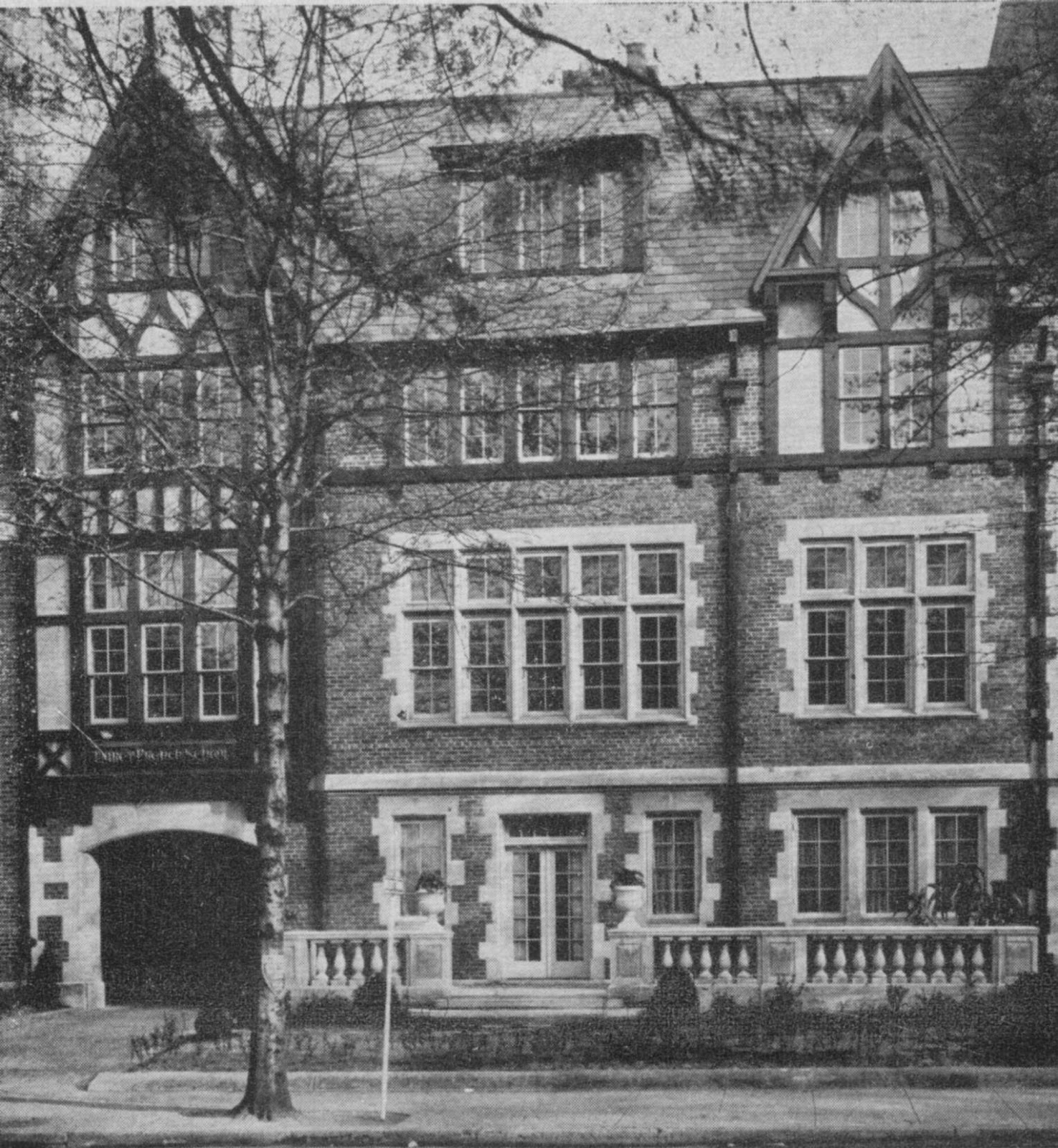
It was built with 25 “sunny and airy” rooms, close enough to Rock Creek Park for the children to play outside. A 1930 school program boasted of “specially designed windows for scientific ventilation,” along with a gymnasium, library, assembly hall, dormitory rooms, and a rooftop garden and playground.
The sisters ran a full life out of it. There was tennis, basketball, skating, riding, football, baseball, and folk dancing for the girls, with swimming held over at the Shoreham Hotel pool. Students staged plays twice a year and published a magazine with the bilingual name “Hand in Hand,” or “La Main dans la Main.” Speaking French was required as soon as a pupil had the basics.
And there was one rule that tells you everything about the place: “no social clubs or secret societies” were permitted.
The school stayed small on purpose. In 1928 it had 112 students and 16 faculty. An admissions brochure put the philosophy bluntly: “The Maret School does not believe in mass production in education.”
The building outlived the school’s time there, and it still stands. Fittingly for a school the sisters built for “girls of many nations,” 2118 Kalorama Road flies a foreign flag today. It is the Embassy of Algeria.
The first pupil: Harryette Zimmele
Every school has a first student. Maret’s was a girl named Harryette Zimmele, and her story is the saddest thread in this whole history.
We know she was the first because the Maret sisters said so. In May 1936, when the school threw a party for its 25th anniversary, the Washington Post reported that the hostesses were assisted by “Mrs. Margaret Zimmele, whose daughter, the late Miss Harriet Zimmele, was the first pupil.”
She was named Harryette, after her father, Harry B. Zimmele, and she was the only daughter of Harry and Margaret Scully Zimmele of 2728 36th Place NW. Her mother was a well-known Washington artist who showed her work around the city for decades through the Arts Club, the League of American Pen Women, and the D.A.R.
Harryette grew up and came out as a Washington debutante around 1926. Three years later, she was gone.
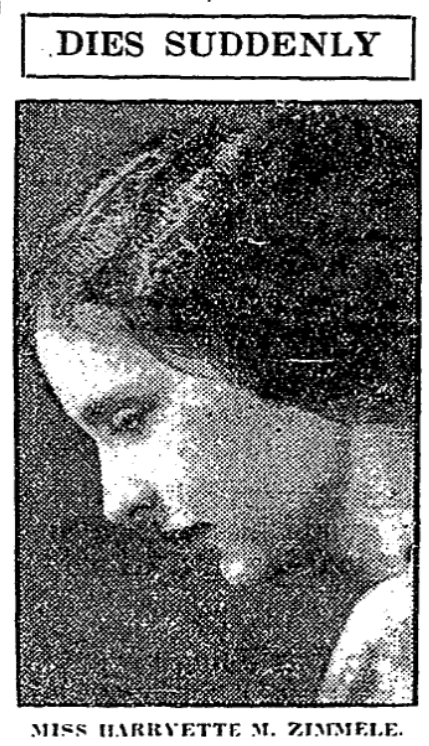
On the night of October 29, 1929, Harryette died suddenly of heart illness at the family home on 36th Place. She was in her early twenties. The Washington Post ran her photograph two days later under a single stark word: “DIES SUDDENLY.”
The detail that lingers is what came after. Seven years on, when the sisters gathered the school to mark a quarter-century, Harryette’s mother was there, helping to host, the parent of the very first pupil, still bound to the little school that had grown up around her lost daughter.
Life at Woodley
The sisters led the school to the end. Both Marthe and Louise Maret died in 1944, after 34 years at it. By the next spring the school had 185 students from 21 nations and a graduating class of 18 young women.
Then came the move that made Maret the school we know. In 1950 ownership of Woodley passed to the Maret School, and in 1952 the school left Kalorama Road for the remaining seven acres of the old estate at 3000 Cathedral Avenue NW.
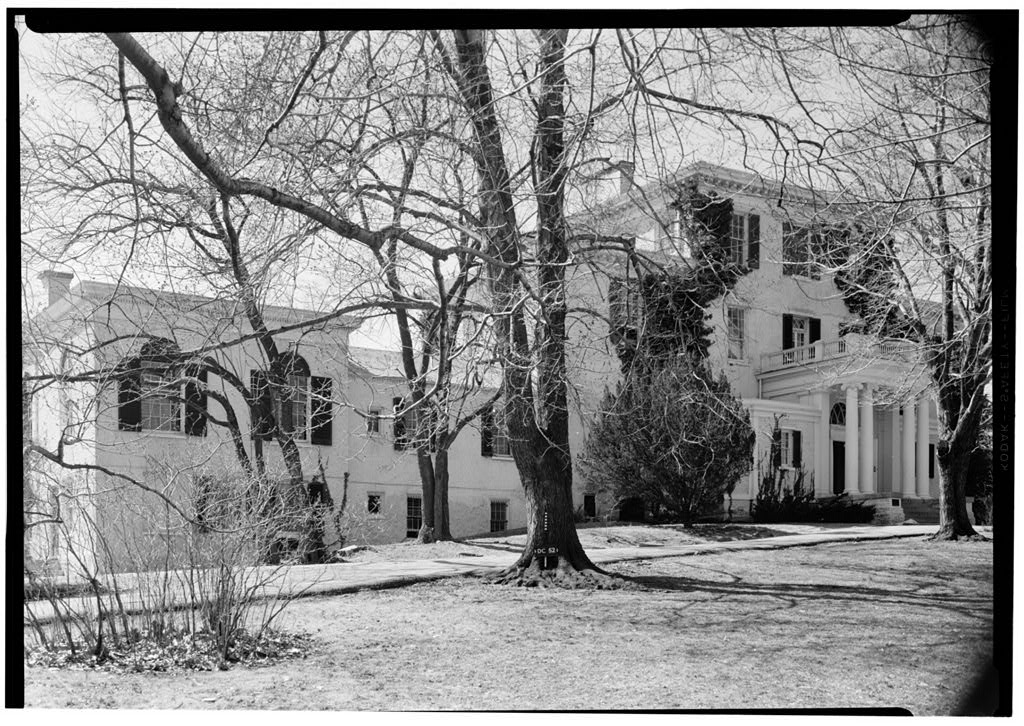
Woodley was a piece of deep Washington history. The land was bought in 1801 by Philip Barton Key, uncle of Francis Scott Key, and the house on the hill went on to shelter eminent men.
Among them were President Martin Van Buren and President Grover Cleveland, who used it as a summer retreat, General George Patton, and finally Secretary of War Henry Stimson, who directed much of the American war effort from the study that is now part of the school.
It was also, like so much of old Washington, a place built on slavery. From the Key family’s purchase until Emancipation, enslaved people lived and worked at Woodley, among them a woman named Lucy Berry and her family. Maret students have since researched their lives, which is its own kind of fitting: the school the sisters built turning to face the full history of the ground it stands on.
By 1954 Maret had admitted boys to the upper school and graduated its first coeducational senior class, five girls and one boy. The French girls’ school from a rented apartment had become a Washington institution.
The sisters never got to see Woodley. But the next time you pass that hilltop, it is worth remembering that the whole thing started somewhere near Logan Circle, with three immigrants, one of them blind, a borrowed apartment, and a girl named Harryette.