
Every so often the best stories simply find us.
This one came from Martha, a reader and supporter, who replied to one of our emails with a request. She had spent years wondering about her own grandparents and a divorce in Washington, around 1930, that her family could never quite explain.
She had heard two versions of it and could not reconcile them. Her mother had lived through it as a small child, barely knew her own father, and never gave her a straight answer.
Her grandfather, it turned out, was no ordinary Washingtonian. He was Robert LeGendre, one of the finest Georgetown athletes of his generation and an Olympic medalist. So we went looking, to see what the record could give her.

The jump that beat a gold medal
Start with the thing he is remembered for, because it is worth remembering.
At the 1924 Paris Olympics, LeGendre left the ground in the long jump pit and came down 25 feet 5 5/8 inches away, about 7.76 meters. It was a world record. Georgetown’s archives and the papers of the day rounded it to 25 feet 6 inches.
It was the longest jump of those Games, longer even than the leap that won the individual long jump gold that year.
And it won him a bronze.
LeGendre had not qualified for the individual long jump at the United States Olympic trials. He was in Paris for the pentathlon, a five event all around contest, and the jump counted only toward that total, where he finished third. The best jump in Paris belonged to a man who had not even entered the event.
From Lewiston to the Hilltop

Robert “Bob” Lucien LeGendre was born in Lewiston, Maine, on January 7, 1898, to French Canadian parents. By his Wikipedia biography, his father died when Bob was about a year old, his mother raised ten children alone, and she died when he was 19. He spent a year at Hebron Academy before enrolling at Georgetown.
At Georgetown he was, in the words of the university’s own archives, “one of the greatest all around athletes to represent the University.” He played football and baseball, ran track, and finished his degree with the class of 1922.
Those multi event contests were his specialty. The Baltimore Sun covered him winning the pentathlon at the Penn Relays on April 29, 1922, under the headline “Legendre, Of Georgetown, Repeats All Round Ability.” His Wikipedia entry credits him with the pentathlon title at the 1919 Inter-Allied Games in Paris, the military games held just after the First World War.
His first Olympics nearly slipped away. Georgetown’s archives note that he broke his foot in March 1920, an injury the Washington Post reported on March 31, 1920 under the headline “G.U. Track Athlete Breaks Ankle Bone.” He qualified for the Antwerp Games anyway and competed on a foot that, by Georgetown’s account, “was not fully healed,” placing fourth in the pentathlon.
He almost became a movie actor, too. The Baltimore Sun ran “Legendre Would Become A Motion Picture Star” on May 31, 1922. Instead he came back to Georgetown for a Doctor of Dental Surgery degree, which the university dates to 1927, and became a lieutenant in the United States Naval Dental Corps.
A young marriage, and a daughter
This is where the family story really begins.
On July 13, 1921, LeGendre married Helen M. Lake at Cumberland, Maryland. The papers called the marriage sudden, and the Evening Star later noted it came just as he was preparing to leave for Hollywood to try his hand at a film acting career.
Helen was very young. The 1930 census lists her as 26 and gives her age at first marriage as 17. LeGendre, born in January 1898, was 23 when they wed.
Their only child arrived the next summer. Jeanne Collette LeGendre was born on July 21, 1922, in Wilkinsburg, Pennsylvania, a little over a year after the wedding.
The reader who asked us to look into this is Jeanne’s daughter. She recalls being told that Helen was visiting relatives in Pennsylvania and that Jeanne, in the family’s phrase, “decided to arrive on their trip.” We pass that along as family memory. The date and place themselves are confirmed.
The house on Newton Street

By the spring of 1930 the marriage had come apart, and the census quietly shows it.
Enumerated that April, the 1930 census lists Helen and seven year old Jeanne living in a rented house at 1629 Newton Street NW, near the eastern edge of Mount Pleasant. The home belonged to Helen’s father, Vivian Elmore Lake, 62 and born in Virginia, and her mother, Lillian Dietz Lake, 55 and born in Maryland. Helen’s brother Thomas, an aunt, and a lodger filled out the household.
Robert is not on the page. The picture is a small one, and a familiar one. A young mother and her daughter, back home with her parents.
The two stories the family carried
Here is the knot the reader could never untie. One version she grew up with said her grandfather sued her grandmother for desertion. The other said her grandmother divorced him for going with other women. The papers from 1930 show why both versions survived in the family. Each one was true.
Helen filed first. In January 1930 she brought a suit for absolute divorce in the Supreme Court of the District of Columbia, the city’s trial court at the time. The Washington Daily News reported it on January 10, 1930.
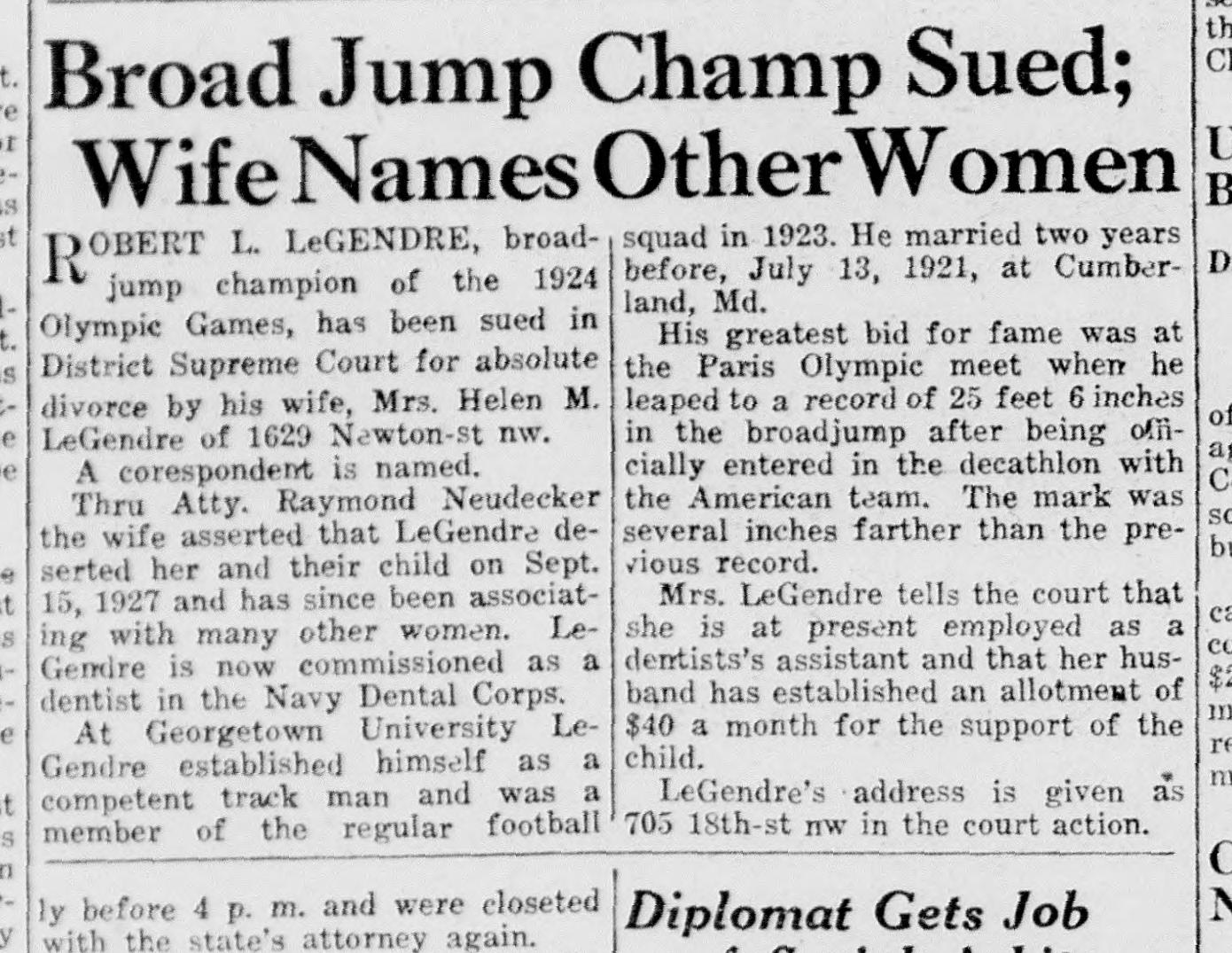
Robert L. LeGendre, broad jump champion of the 1924 Olympic Games, has been sued in District Supreme Court for absolute divorce by his wife, Mrs. Helen M. LeGendre of 1629 Newton-st nw. A corespondent is named. Thru Atty. Raymond Neudecker the wife asserted that LeGendre deserted her and their child on Sept. 15, 1927 and has since been associating with many other women.
Washington Daily News, January 10, 1930
Nearly a year later, LeGendre brought his own suit, in his home state of Maine, on the opposite ground. The Washington Times reported on December 27, 1930 that he had been granted permission to proceed, and noted her case was still open.
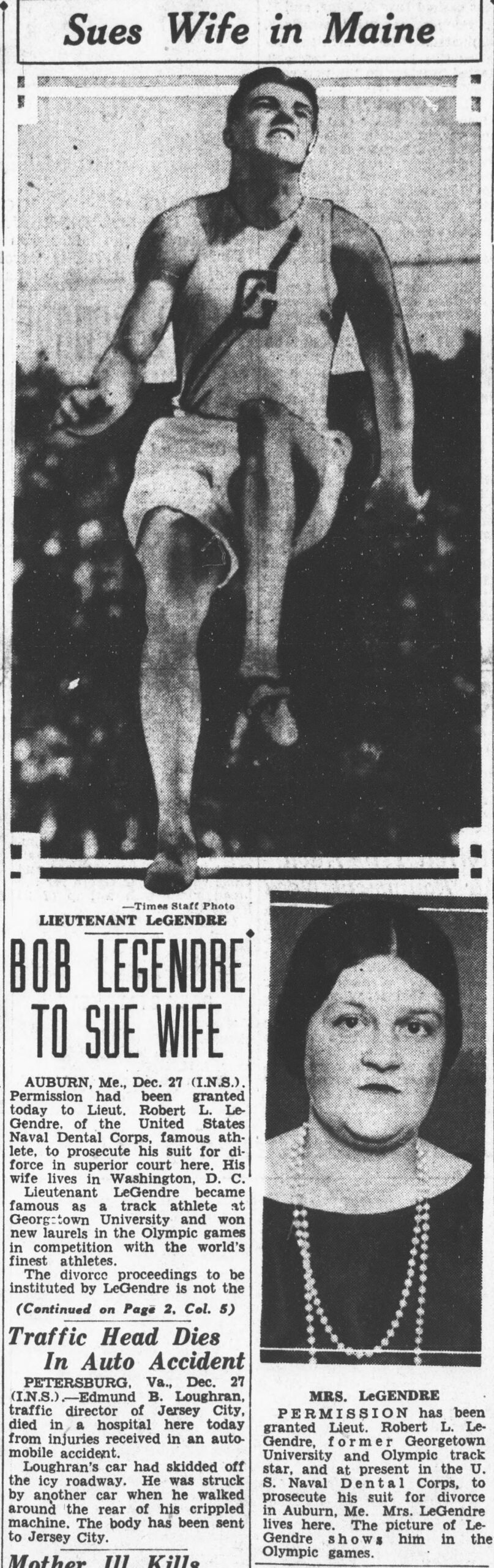
Last January, Mrs. LeGendre instituted absolute divorce proceedings against her husband, naming a corespondent … This suit is still pending in District of Columbia Supreme Court. The parties were married in Cumberland, Md., on July 13, 1921 … The couple have one child.
Washington Times, December 27, 1930
The Evening Star reported the outcome on December 31, 1930.
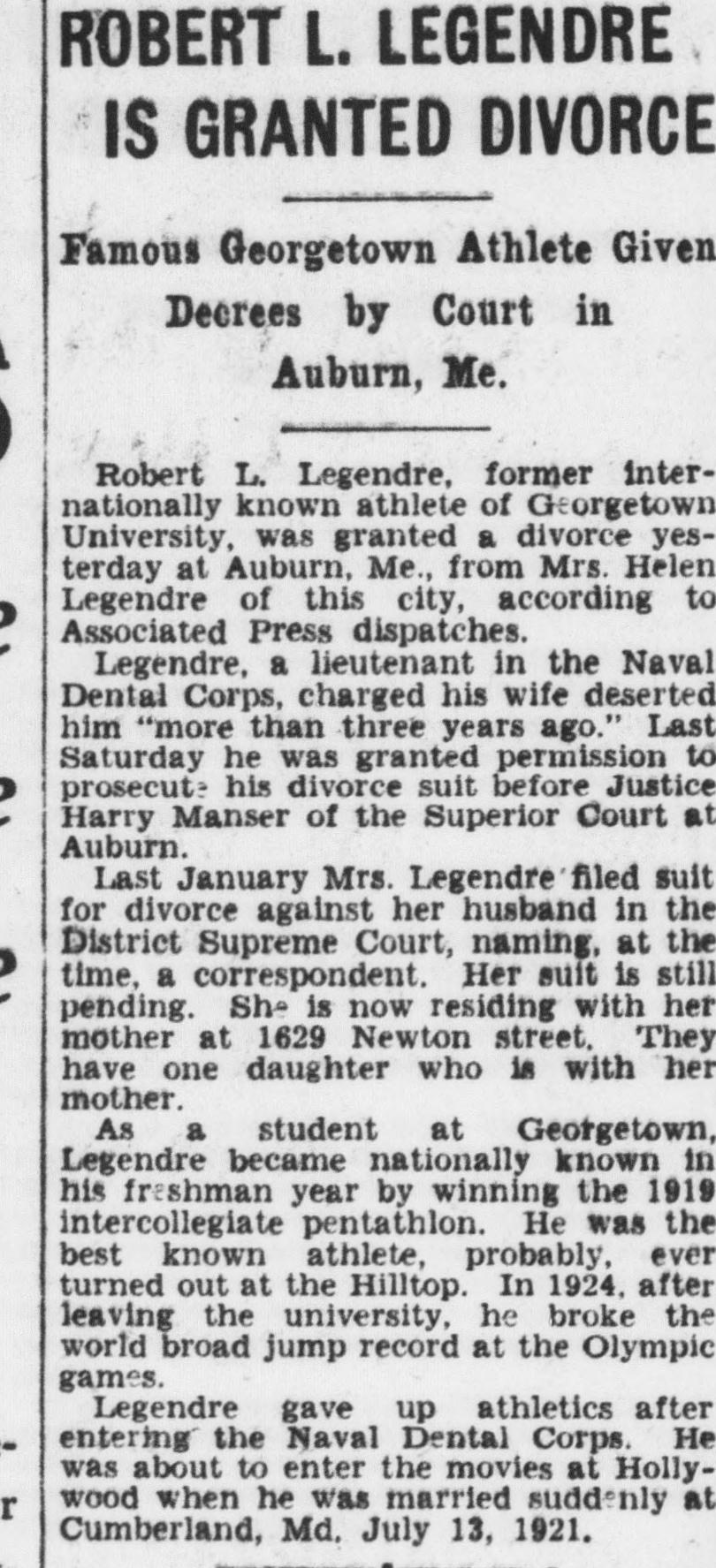
Robert L. Legendre … was granted a divorce yesterday at Auburn, Me., from Mrs. Helen Legendre of this city … Legendre, a lieutenant in the Naval Dental Corps, charged his wife deserted him ‘more than three years.’ … Last January Mrs. Legendre filed suit for divorce against her husband in the District Supreme Court, naming, at the time, a corespondent. Her suit is still pending. She is now residing with her mother at 1629 Newton street. They have one daughter who is with her mother.
Evening Star, December 31, 1930
So the family’s two stories were never really rivals. He did sue her for desertion, in Maine, and won a decree. She did accuse him of adultery, in Washington.
For all the two suits disagree, they agree on when it ended. Helen’s filing dated the desertion to September 15, 1927. Robert’s, brought in Maine almost a year later, put it “more than three years” earlier, the same autumn. Each blamed the other, but both fixed the break at 1927, about six years into the marriage.
Who left whom, and whether there were other women, the record does not say. Those were claims each of them swore in order to win a divorce, not facts a court weighed and confirmed. We do not know the full story of this marriage. We know what was printed, and what was printed is two sworn accounts and one decree.
A hundred years on, that may be as close as anyone gets, and it may not be the thing that matters most. What the digging could give this family was an outline, with names and dates, where before there had been only two half remembered stories.
A death three weeks later
The end came fast.
On January 21, 1931, three weeks after the Maine decree, LeGendre died of bronchial pneumonia at the Naval Hospital in Brooklyn. The Evening Star carried the Associated Press notice that day.
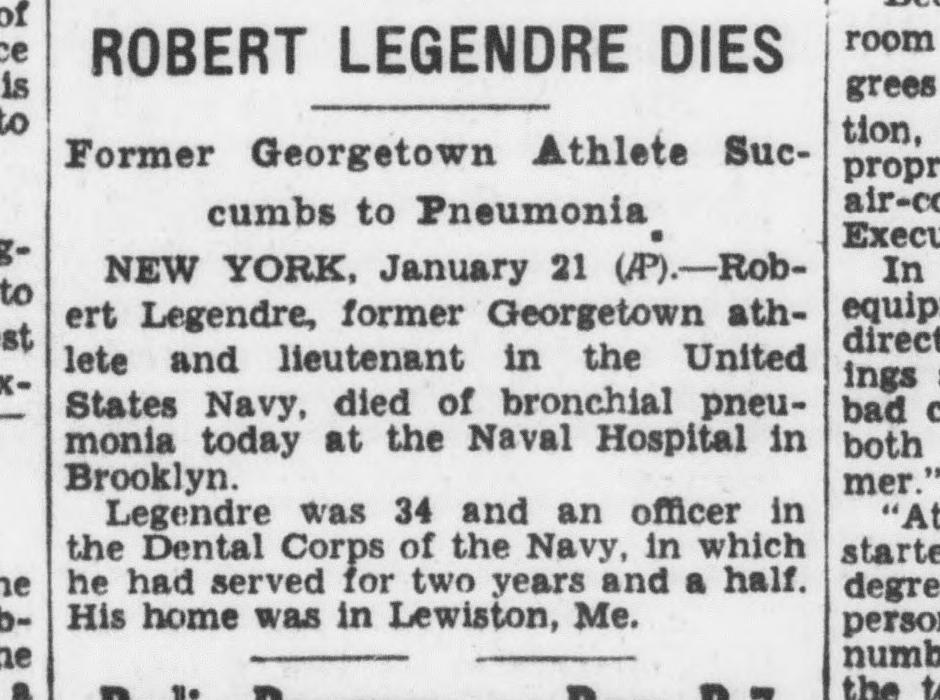
Robert Legendre, former Georgetown athlete and lieutenant in the United States Navy, died of bronchial pneumonia today at the Naval Hospital in Brooklyn.
Evening Star, January 21, 1931
He was 33, though the wire notice said 34. It made no mention of the divorce.
Helen outlived him by ten years. She died on April 30, 1941, at about thirty-seven. Jeanne was eighteen. Her father had been gone since she was eight, and now her mother was gone too, both of her parents lost before she turned nineteen.
Jeanne, the seven year old on that census page, was Bob LeGendre’s only child. She had been too young to really know her father, and she never did give her own daughter a clear account of what had come between her parents.
She grew up, married, became Jeanne Payne, and raised eight children of her own. She lived until 2000.
That daughter is the reader who wrote to us. She never met her grandfather, the champion who broke a world record the summer her own mother turned two. After all these years she has the shape of it now: the young bride, the house on Newton Street, the little girl who grew up without her father, and the two true stories that had always seemed to contradict each other.
This one’s for you and your family Martha.
Your story might be next
This post exists because someone hit reply.
A reader and supporter had spent years piecing her family history together on her own, but one chapter stayed blank. She wondered, she asked us to dig, and the answer turned out to be a Washington story worth telling for everyone. That is how a lot of our best work starts.
If you support Ghosts of DC and there is a person, a place, or a moment in this city’s past you have always wondered about, write to us. We cannot chase every thread, but we read all of them, and the next one we pull might be yours.
We dug this one up with help from AI and checked it against the original records below. Here’s how we use AI.