
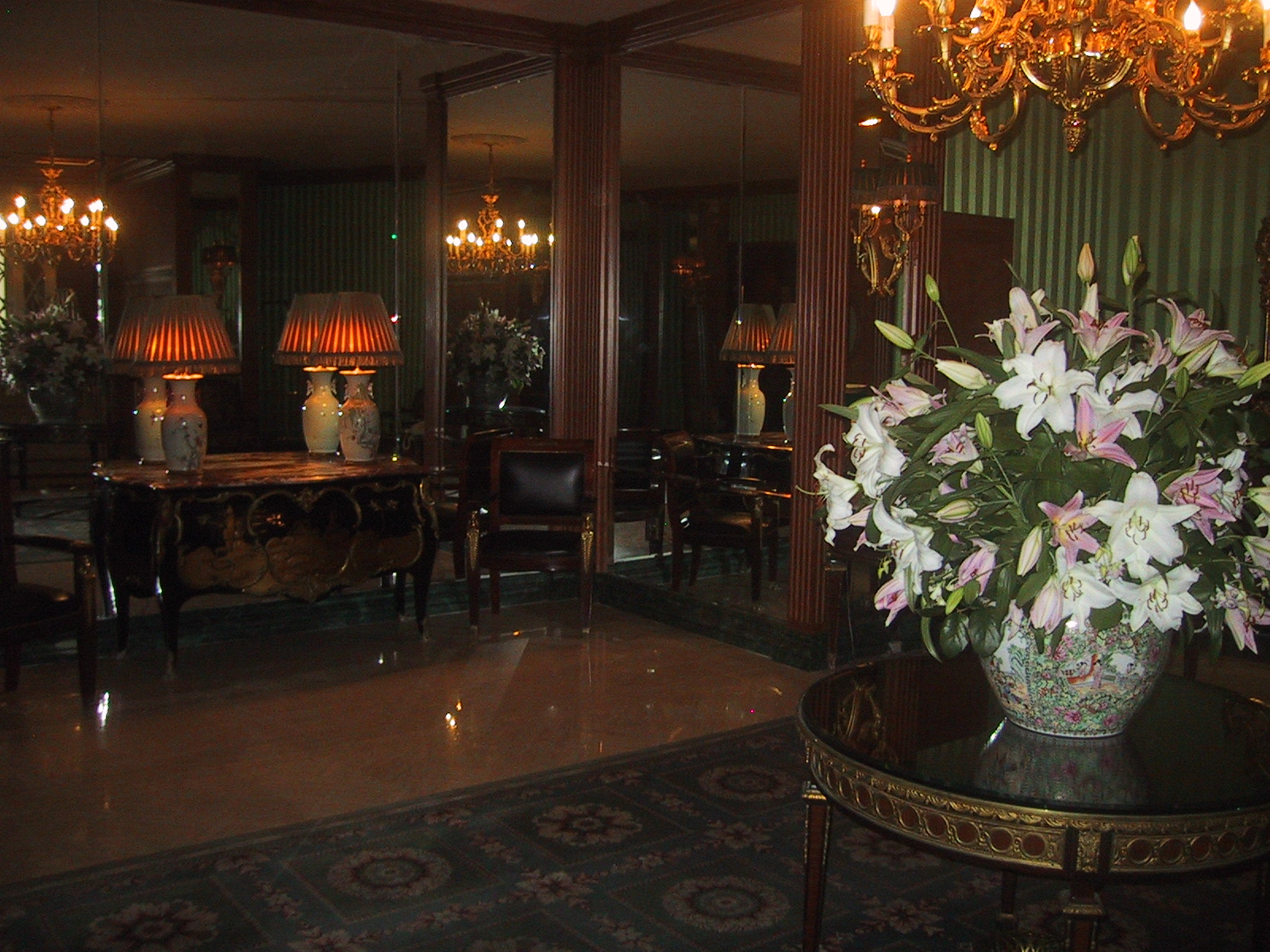
Walk into Hotel Lombardy on a weekday afternoon and the first thing you notice is that nothing feels 2026. The lobby is small and low-lit. Chinoiserie panels curl up the walls, oriental rugs cover the tile, gilt chandeliers reflect back off mirrored walls, and painted porcelain vases sit on lacquered French tables.
Off to one side is the Venetian Room bar. It glows the amber color of a hotel bar in a black-and-white movie. It sits at 2019 Pennsylvania Avenue NW, three blocks from the White House, wedged into the corner where Foggy Bottom starts to give way to the K Street office grid.
It looks Italian at a glance, and the Asian touches are strong enough that you wonder if the story is about East meets West. It is not. The real story is older, more European, and much more Foggy Bottom.
Not always a hotel
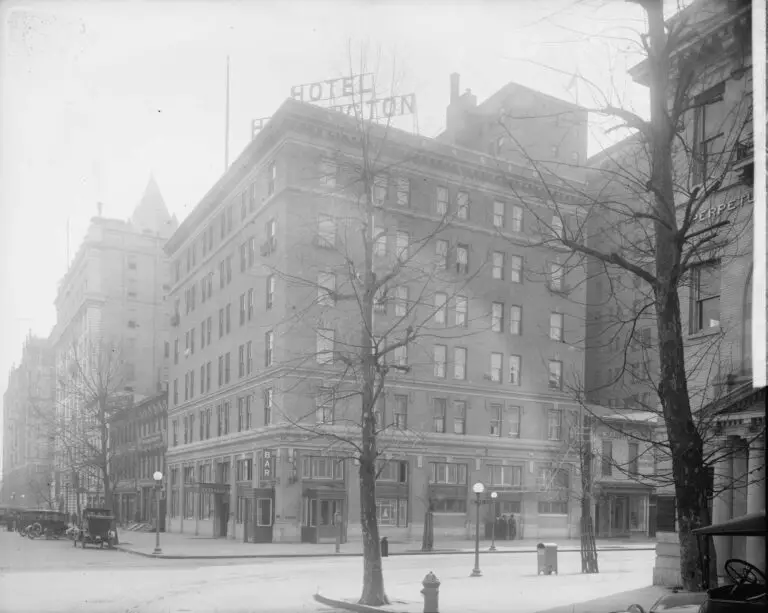
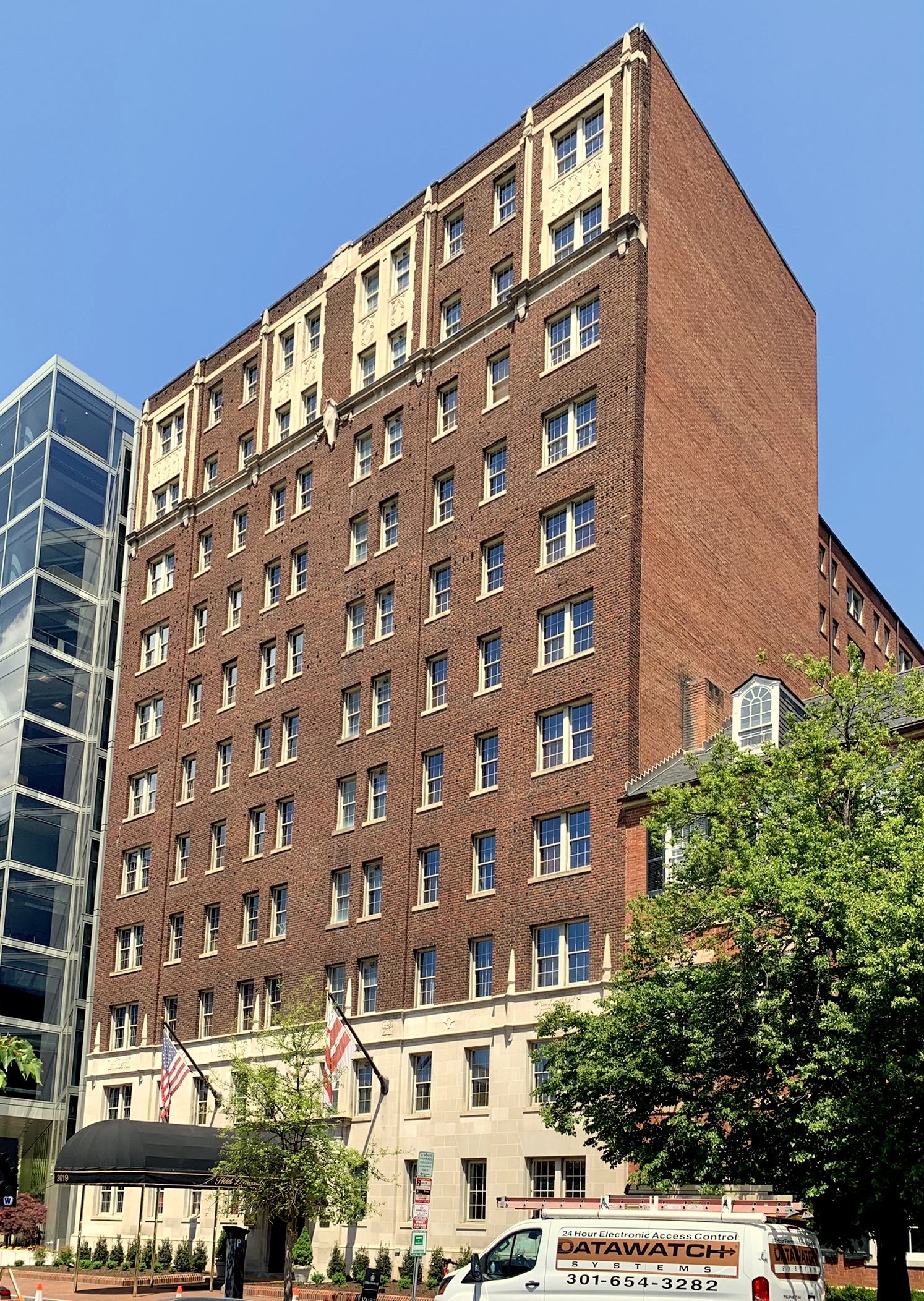
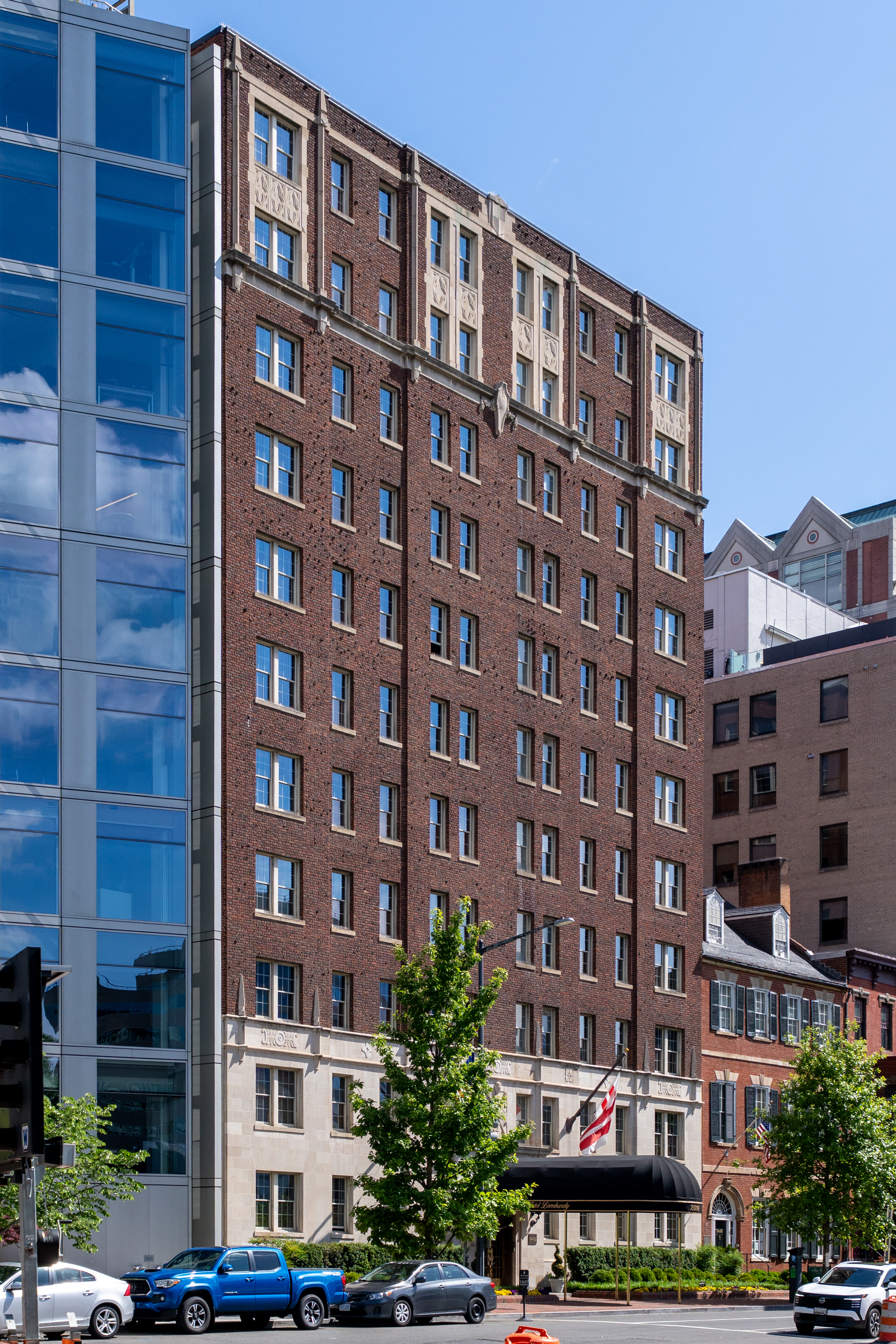
The building at 2019 Pennsylvania Avenue was not built to be a hotel. It opened in 1929 as an upscale private residence, an apartment house for the professional class, right at the moment the Roaring Twenties were about to stop roaring. The Historic Hotels of America timeline is specific about the year, and Wikipedia lands on the same 1929 completion date. The Hotel Lombardy’s own history points to 1926 as the year construction began, which lines up cleanly with a three-year build.
The building carries two street addresses. 2019 Pennsylvania Avenue NW is the one on the awning. It is also 2019 I Street NW. The corner sits at the elbow where I Street runs into the diagonal of Penn Ave, and the mail comes in on both sides.
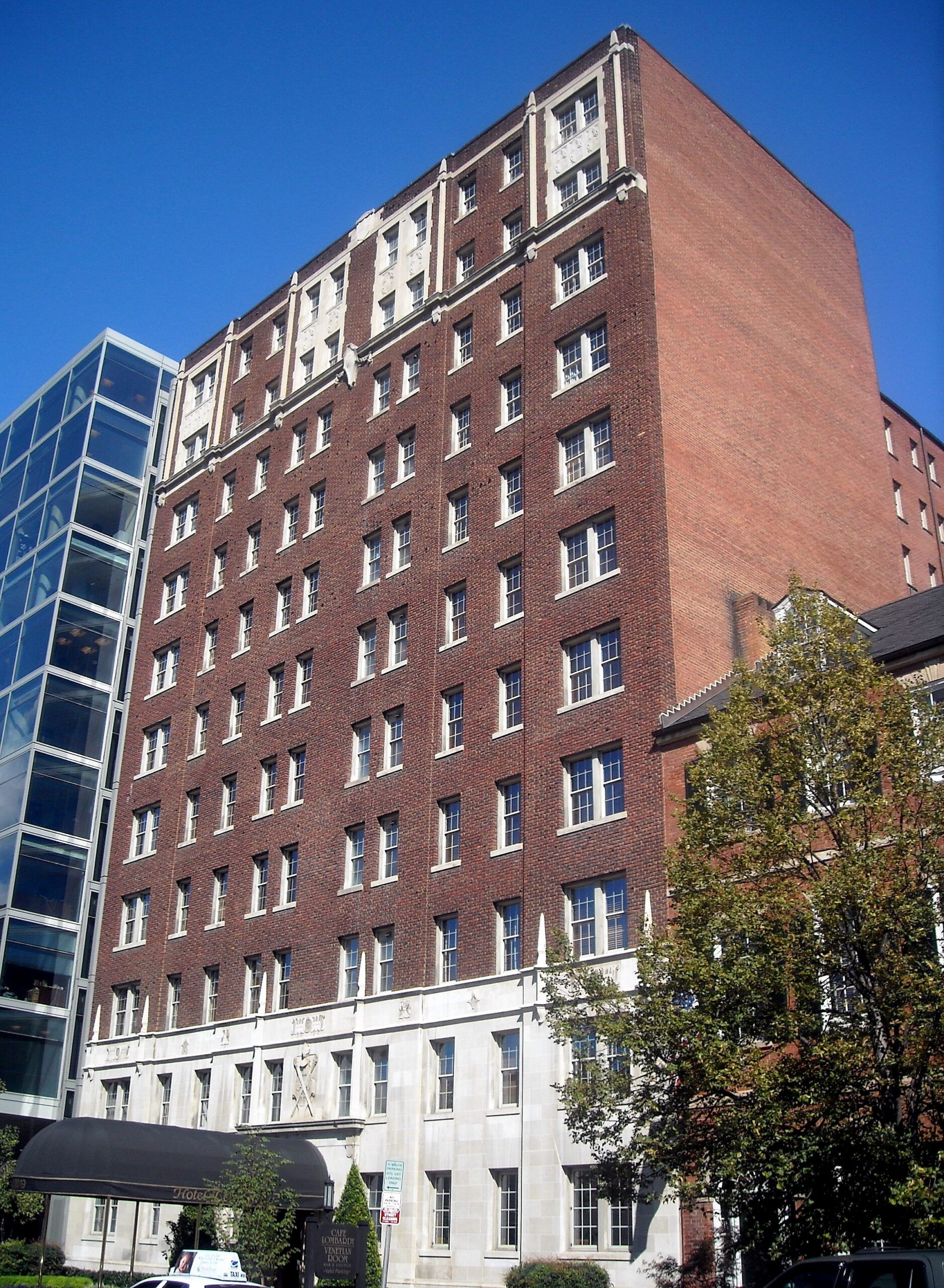
The facade is red brick above a limestone base, with the kind of restrained Beaux-Arts detailing you find on a hundred other 1920s DC apartment buildings, the ones designed for people who wanted a doorman and a small living room, not a Kalorama mansion.
A Depression-era apartment house
Foggy Bottom in the late 1920s was in the middle of a strange, ugly transition. The Chesapeake and Ohio Canal had died. The breweries were dying with Prohibition. The gasworks was still choking the neighborhood with the smoke that (per one story of the name) gave Foggy Bottom its nickname. Working-class families who had staffed the factories were moving out.
The Historic Hotels of America account describes a neighborhood where “a few enterprising individuals decided to capitalize on the slumping real estate prices and began building their own luxurious residences.” 2019 Pennsylvania Avenue is one of those. A speculative bet on the block, right at the corner where the diagonal of Pennsylvania Avenue crosses 20th Street and the grid hands the street back to the numbered avenues.
The block itself had been all row houses and small commercial before the hotel went up. You can see it on the 1919 Baist real estate atlas, the block a decade before construction started. Foggy Bottom’s old rowhouse pattern still survives in pockets a few blocks west, most famously at Snow’s Court, an alley dwelling row between 24th and 25th that dodged the twentieth-century clearance.
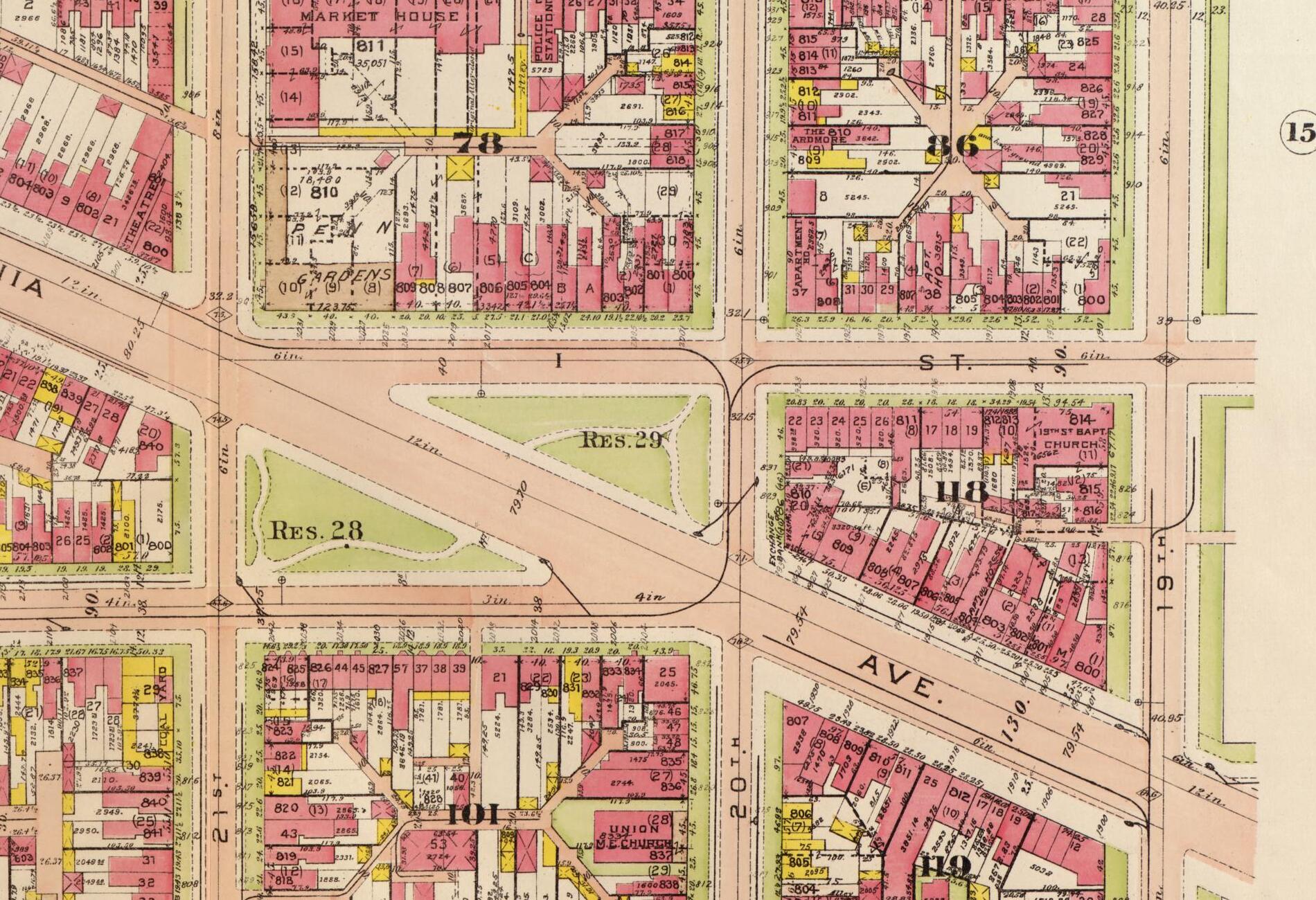
The Baist plate shows what the block looked like in 1919. Pennsylvania Avenue runs diagonally across, cutting off two small triangular reservations (Res. 28 and Res. 29) that are still small parks today. The two small pockets of green at 20th and Penn. The rest of the block is filled in with the tightly packed rowhouse pattern the neighborhood had by 1919.
The apartments opened in the fall of 1929. Within weeks the market crashed. Within a year Foggy Bottom’s remaining industrial base was collapsing. The building stayed occupied through the Depression by the people you would expect: mid-career federal workers, junior diplomats, professionals attached to the growing wartime bureaucracy.
The McPherson case, 1929
The Lombardy Apartments’ first appearance in the DC press is not a society column. It is a grand-jury inquest into the death of a young nurse in the apartment next door.
Mrs. Virginia McPherson was found dead in her apartment at the Park Lane on the night of September 12, 1929. She had been garroted, the Washington Post reported three days later. The husband, Robert A. McPherson Jr., was a youthful bank clerk. Policeman R. J. Allen took the case single-handed and pushed the homicide theory. Detective Lt. Edward J. Kelly, head of the homicide squad, was equally sure it was suicide.
The Lombardy’s people got pulled into the grand-jury inquest as material witnesses. Two names come out of the coverage: the building’s janitor and a woman on an upper floor who claimed she saw a man on the roof.
One of Allen’s star witnesses, James Mills, colored janitor of the Lombardy Apartments, next door to the Park Lane, who is reported to have heard screams and cries on the night Mrs. McPherson met her death, was next quizzed. According to Mills, he was asleep late that night when he was awakened by cries and hastily donned his clothes and made a vain search for their source.
Evening Star, September 26, 1929
Three days later the Washington Post ran the second Lombardy witness on its front page under the headline “Woman in an Apartment Nearby Is Subpenaed for Examination: SHE SAW MAN ESCAPE AUTHORITIES BELIEVE.” Senator Lee Overman of North Carolina, Mrs. McPherson’s home state, was pushing the summons personally.
Authorities last night subpoenaed Miss E. Chatwick, of the Lombardy Apartments, as [a witness in] the investigation into the death of Mrs. Virginia McPherson.
Washington Post, September 29, 1929, p. M1
Chatwick had told police she saw a man crawl off the roof adjoining the McPherson apartment the night of September 12. She had later refused to confirm the statement. The grand jury wanted a second try.
The case ran in the DC papers for months. The Washington Post chased a narcotic-ring theory on October 16 (“NARCOTIC RING HINTED BEHIND NURSE’S DEATH”). Citizens of Mrs. McPherson’s hometown of China Grove, North Carolina, raised a reward fund for the arrest of a killer if murder was ever established. The coroner ultimately ruled suicide. The husband was cleared. The building’s brand-new residents had spent their first weeks in the press.
The Depression, the war, and the State Department
The residence “continued to be inhabited by numerous families over the next several decades,” per the Historic Hotels of America account, “especially as the rest of Foggy Bottom reemerged all around it.”
The reemergence had one specific driver. In 1947 the State Department moved into the block-long building at 21st and Virginia, four blocks south of 2019 Pennsylvania. The department stayed. The Truman Building went up next door. By 1961 the entire foreign-policy apparatus of the United States was working within a five-minute walk of the front door at 2019.
Foggy Bottom became a diplomat’s neighborhood in a way it had never been before, and the building at 2019 Pennsylvania sat inside that new gravity field.
What we can say for certain is what the neighborhood became. GWU expanded east and swallowed the surrounding blocks. The IMF opened its headquarters in 1958 across the street. The World Bank campus took shape three blocks away. If you rented an apartment at 2019 Pennsylvania Avenue in 1970, your neighbors were the professional-diplomatic class working every one of those buildings.
Documenting who those specific residents were is the piece of this story that still deserves a research pass through the ProQuest Washington Post archive and the Evening Star runs on LOC Chronicling America. The hotel’s own history is coy about names. The address is coy about itself.
1994: the rebrand
The conversion to a hotel is where the record gets slippery. Wikipedia and Historic Hotels of America both fix the date at 1994. The Washington Post, however, has “Hotel Lombardy” running as an active hotel by April 8, 1985, when the paper’s first mention of the phrase turns up in a Business Calendar listing. The likely explanation is that the building shifted from all-apartments to mixed hotel-and-residential use somewhere in the late 1970s or early 1980s, and the 1994 date marks the current operator’s rebrand and reinvestment, not the original conversion.
The name itself is not new. The building has been the Lombardy since it opened. The Washington Post called the address “the Lombardy Apartments” on September 29, 1929. The Evening Star called it the same thing on September 26 of that year. Whoever picked “Lombardy” for a red-brick apartment house at 20th and Penn did it in 1928 or 1929 during construction, not in 1994 during a rebrand.
Lombardy is the region in northern Italy anchored by Milan, Como, Bergamo, and Cremona. Picking that name for a 1929 red-brick apartment building at 20th and Penn was not obvious. The building has no Italian architectural heritage, no Milanese owner in its early history, no Cremona-adjacent past to draw on. The name is a promise. This is not going to be a business hotel of the marble-and-chrome variety. It is going to be a small European place that happens to be in Washington. The old-world feeling is the product, and the Italian name does the work of promising it.
Everything in the building from that point on flows from that decision. The lobby renovation. The heavy drapes. The oriental rugs. The Cafe Lombardy restaurant. And, front and center, the Venetian Room bar.
About that “Asian flare”
If you walk into the Venetian Room today, the first read on the room is not Italian. It is chinoiserie. The wallpaper. The lacquer panels. The oriental rugs underfoot. The color palette of red, gold, and lacquered black.
The hotel’s own marketing copy calls the bar’s interior “European and Oriental décor,” which is a fair description. The Oyster hotel-review pool put it more vividly. Their site-inspector team came out of a stay a few years back with a one-line summary of the whole place that lands better than anything the hotel has tried to say about itself.
A fusion of oriental and classic European decor makes Hotel Lombardy feel a bit like a British manor in colonial Shanghai.
Oyster.com hotel review
British manor in colonial Shanghai is the exactly right pin for it. Because chinoiserie is a French word. It describes the European decorative style of the 17th, 18th, and 19th centuries in which European craftsmen imitated (and reimagined, and often invented) Chinese and East Asian motifs. It flourished in French and Italian palace interiors. It went into wallpapers, lacquer cabinets, porcelain, silk.
It is the reason a Venetian palazzo can have a room that looks Chinese and still be an entirely Venetian room. When the Hotel Lombardy calls its bar the Venetian Room and fills it with lacquer panels and rugs that read Asian, that is not a fusion. That is one continuous European tradition of importing East Asian imagery into old-world interiors, and it has been doing that since roughly 1660.
So the “Asian flare” is real. The room does look partly Asian. But the room is an Italian room that is looking Asian in the specific way an Italian room in Como would have looked Asian in 1780. The identity is European. The chinoiserie is a decorative language European interiors have used to be worldly and expensive for three hundred years.
The Venetian Room’s own copy leans into a Victorian angle too, describing itself as “inviting as a fashionable 1920’s-era living room, with rich decor, sumptuous seating and the glow of the fireplace.” The Victorian glow, the chinoiserie panels, the Italian name. It is a bar built to feel like it should not exist in a city where every other hotel bar is trying to look like the lobby of a tech company.
The elevator that hung on until 2011
The single detail people who have stayed at the Lombardy remember most is the elevator. It was hand-operated. Manual. An attendant sat inside and drove it up and down with a lever.
Time Out’s Washington DC 2014 review made the elevator its lede detail, along with the crystal doorknobs.
Formerly a grand apartment building, this 134-unit boutique hotel has managed to retain some of that charm, with old-fashioned touches such as brass fixtures and crystal doorknobs, and a Middle Eastern-style bar. There’s another old-fashioned touch in the shape of an attendant-operated elevator, when was the last time you saw that in a hotel?
Time Out Washington DC, March 12, 2014
Oyster’s site-inspector team pinned down the year the manual elevator went away. Not 2004. Not 1994. It survived deep into the modern era.
A manually operated elevator was in use as recently as 2011, but the owner discontinued it after guests complained it was too slow.
Oyster.com hotel review
The wooden apartment doors, “vented to keep the units cool before the days of air-conditioning” per the Oyster inspectors, are still there outside every guestroom. So are rows of antique mailboxes in the downstairs hallway. The building keeps quietly reminding you it was an apartment house first.
The bar and the neighborhood it serves
The question of who has actually made this bar theirs over the decades, the regulars and the bartenders who defined the room, is the part of the story that lives in ProQuest Washington Post archives and in the memories of the neighborhood. It deserves a longer research pass than any single blog post can do justice.
What the public record does support: the Venetian Room has been a steady, low-key destination for diplomatic staff, GWU academics, IMF and World Bank travelers, and the reporters who cover them. It sits close enough to the State Department that a walk over for a drink after a briefing is a real thing people do.
The kitchen next door is Cafe Lombardy, an unfussy bistro menu that has stayed remarkably consistent for a DC restaurant. The Oyster review calls out the crab cakes and the French toast. The bar menu is small plates. Neither is chasing the current trend.
The AMLO stay, July 2022
Because the hotel commonly hosts foreign delegations, the bar has picked up its share of moments. The one on the public record is the visit of Mexican President Andrés Manuel López Obrador in July 2022. La Jornada’s Emir Olivares Alonso filed from Washington on July 11.
El presidente Andrés Manuel López Obrador llegó a esta ciudad. Lo acompaña su esposa Beatriz Gutiérrez Müller y funcionarios de su gobierno… El presidente se hospedará en el hotel Lombardy, a unas cuadras de la Casa Blanca.
La Jornada, Emir Olivares Alonso, July 11, 2022
López Obrador and his wife Beatriz Gutiérrez Müller flew in from Mexico City on United, landed at Dulles, and rolled into Foggy Bottom in a Suburban convoy. The president was booked at Hotel Lombardy for the run-up to his meeting with President Biden.
Word got out. Mexican supporters and press pooled on the Pennsylvania Avenue sidewalk. Infobae reported that AMLO came to a hotel window and addressed them directly with three words that scanned as pure López Obrador.
Me da mucho gusto verles.
Andrés Manuel López Obrador, from the window of his Hotel Lombardy room to supporters on the sidewalk, July 12, 2022
That is the modern version of what the block has been doing since 1947. Foreign officials come to Washington, they find a hotel with 134 rooms and a lobby small enough to feel private, and the sidewalk out front becomes a stage.
Historic Hotels of America, and how the identity got locked in
In 2004, ten years after the rebrand, Hotel Lombardy was inducted into Historic Hotels of America, the National Trust for Historic Preservation’s program that recognizes older US hotels. It shares that roster locally with the Willard and a handful of others.
The induction is a big deal for a boutique hotel because it locks in a specific brand promise. Once you are a Historic Hotel, ripping out the old elevator or gutting the Venetian Room to install a stainless-steel-and-Edison-bulb cocktail lounge stops being an option. The whole point of the brand is the thing that was already there.
That is why the 2019 Pennsylvania Avenue you walk into in 2026 feels frozen in a way most DC hotels do not. Its own owner has a commercial reason to keep it that way. The chinoiserie stays. The rugs stay. The hand-operated elevator, when it was finally retired in 2011, was retired reluctantly and mourned in the marketing copy.
Who owns it now
The Hotel Lombardy is owned and operated by RB Properties, a Georgetown-based commercial real estate group founded in 1979 and led by Richard Bernstein. RB Properties runs five DC hotels: Hotel Lombardy, the Henley Park Hotel on Massachusetts Avenue, the Morrison-Clark Historic Inn on L Street, the State Plaza Hotel on E Street in Foggy Bottom, and the Washington Plaza Hotel at Thomas Circle.
The through-line across the portfolio is that each hotel occupies a specific era’s architecture and leans into it rather than fighting it. Morrison-Clark is Victorian mansion. Henley Park is Tudor Revival. Washington Plaza is Morris Lapidus 1962 modernism. Hotel Lombardy is 1929 apartment house dressed in chinoiserie.
RB Properties has held Hotel Lombardy long enough that the character of the property is a management decision, not an accident. The owner could have flipped the Venetian Room into something sleeker at any point in the last two decades. They chose not to. The choice is why the place still looks the way it looks.
Foggy Bottom, still
The neighborhood around 2019 Pennsylvania Avenue is not what it was in 1929, and it is not what it was in 1970 either. GWU is now the largest presence on the block. The IMF is across the street. The State Department is four blocks south. The Watergate is another mile west.
The old brewery is gone. The gasworks is gone. Even the Chesapeake and Ohio Canal that started the whole neighborhood is a picnic spot in Georgetown now. What is left is the diplomatic gravity, the university, a few pre-Civil-War oddities like Braddock’s Rock, and a handful of buildings that survived the mid-century clearance.
Hotel Lombardy is one of those survivors. The Cavalier apartments a few blocks north are another. The Cairo on Q Street, twenty blocks away, is a related story. Meridian Mansions at 2400 16th, opened a decade earlier for senators and diplomats, is the same story on a bigger scale.
Each is a 1900s or 1920s apartment building that made it through the highway-era demolition wave and out the other side as something usable. Hotel Lombardy is the one that got the boutique-hotel conversion. If any one of those had been on a different block, it would have been a Marriott by 1985.
My wife stayed at Hotel Lombardy on a recent trip, and her single strongest impression, which she has now told me at least four times, is that the pillows are the best she has slept on at any hotel anywhere. I do not know what pillows they are buying.
I do know that a hotel operated by the same group for two decades has had time to figure out which pillow works, and that somebody made the deliberate call to spend the money on the sleep experience over the lobby chandeliers. It reads to me as the same quiet-money instinct that keeps the Venetian Room chinoiserie in place. Get the important stuff right, keep it right, do not chase the trend.
Standing on the sidewalk
Cross 20th Street to the north side of Pennsylvania Avenue and look back at the building. It is not showy. The limestone base is exactly as tall as the limestone base on the apartment building next door. The red brick is the same red brick that appears on twenty other 1920s DC buildings. The awning over the front door is discreet enough that you can walk past it if you are not paying attention.
That is the point. It was built as an apartment house for people who did not want to advertise where they lived. In 2026 it is a hotel for people who mostly do not want to advertise where they are staying either. Except when the president of Mexico waves from a window.
We dug this one up with help from AI and checked it against the original records below. Here’s how we use AI.