
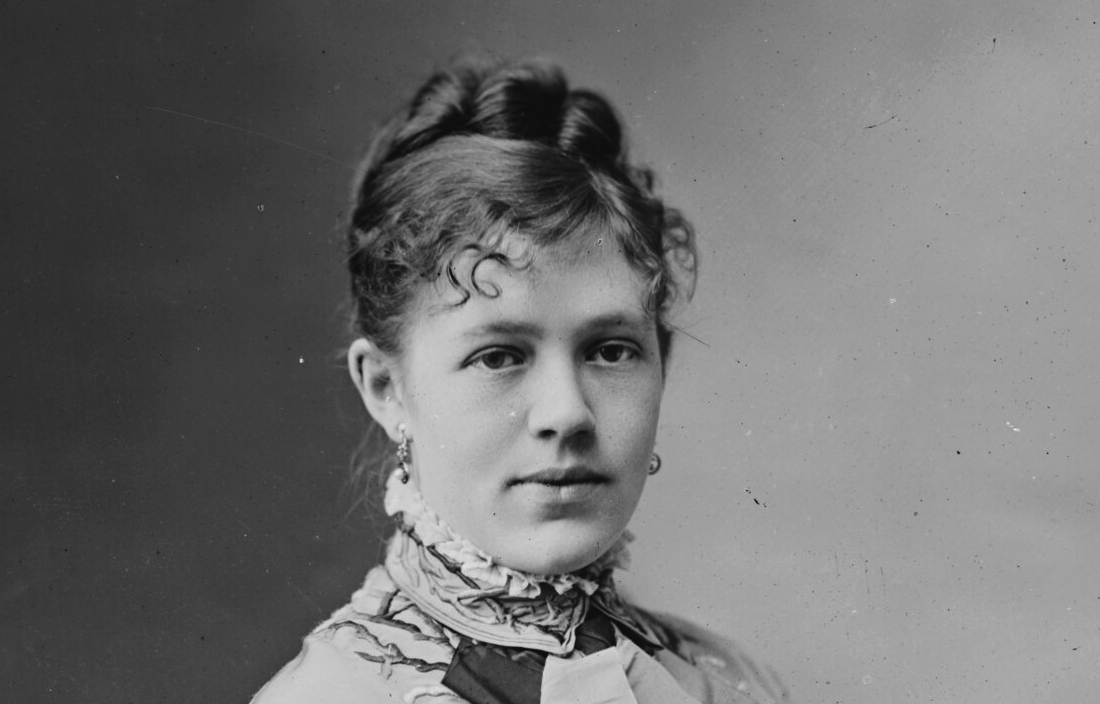
The cake is being cut downstairs and the President of the United States is upstairs in his daughter’s empty bedroom, sobbing.
It is the morning of May 21, 1874. The most lavish wedding in the history of the White House has just ended. Two hundred and fifty guests are eating breakfast in the State Dining Room. The Marine Band is playing. Eight bridesmaids in white silk are accepting compliments. Eighteen-year-old Ellen “Nellie” Grant, the only daughter of President Ulysses S. Grant, has just married a young Englishman named Algernon Charles Frederick Sartoris in the East Room.
Her father has slipped away from the party, walked up the Grand Staircase, gone into her bedroom, and wept.
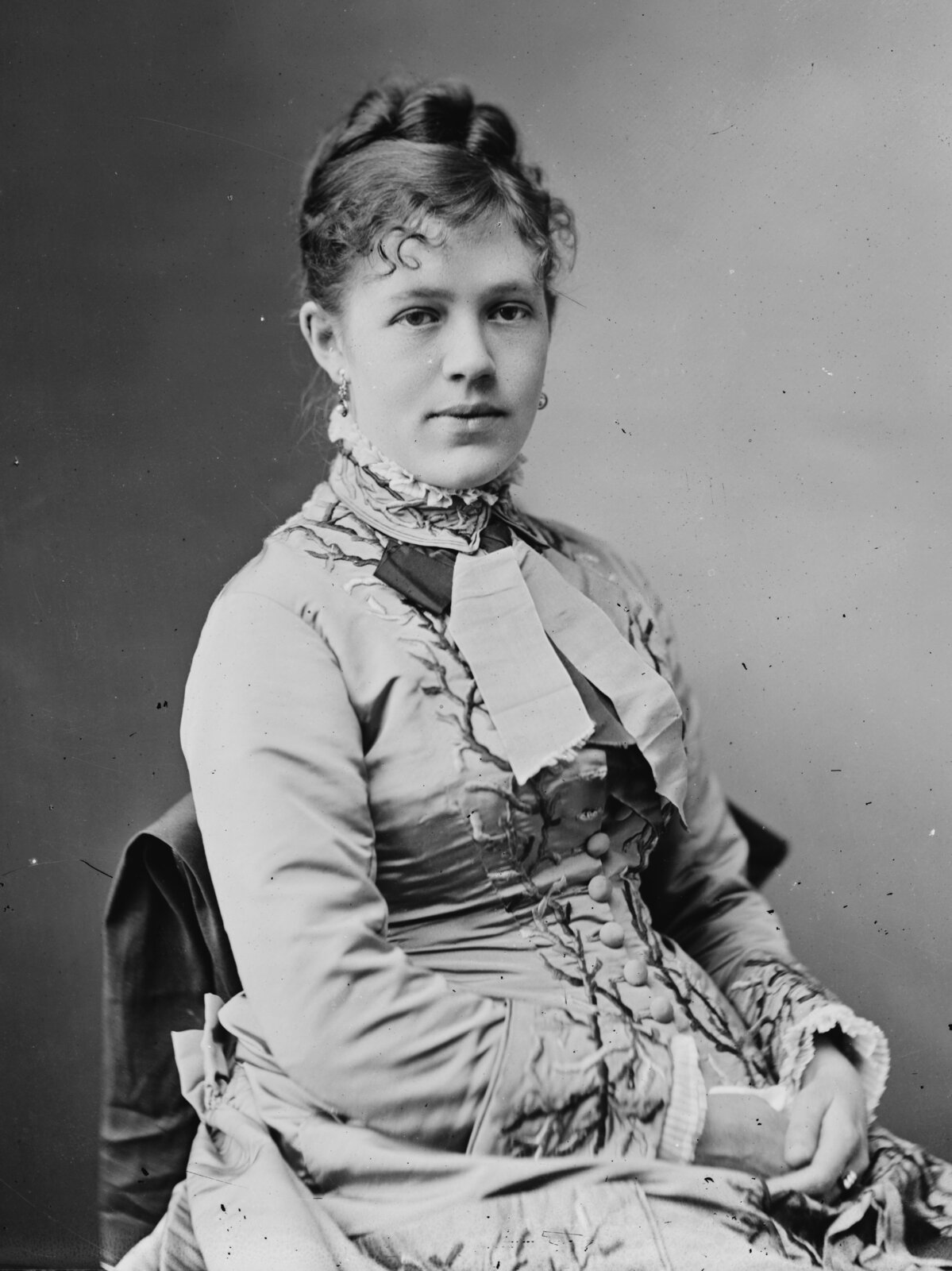
Grant knew. He knew before he gave his blessing. He knew Sartoris was a drinker. He knew the family would take Nellie to England and he might never see her again. He gave his blessing anyway because Nellie was eighteen and headstrong and he loved her too much to refuse.
Twelve years later she would be separated from a publicly unfaithful alcoholic. Twenty years later she would be back in Washington, divorced, living quietly to be near her mother. Grant himself would already be in the ground.
Every reader who has ever toured the White House has stood in the room he built for her wedding. He just never stood in it again the same way.
How Nellie Grant Met Algernon Sartoris
Nellie was sent abroad in 1872 because she was sixteen and pretty and surrounded by suitors, and her parents wanted her out of Washington. She crossed the Atlantic chaperoned by Mrs. A. E. Borie, the wife of Grant’s former Secretary of the Navy. She was received by Queen Victoria at a private audience at Buckingham Palace. Victoria, in her journal, called Nellie “rather stiff and off hand in her manner and spoke with a great twang.”
The trip did exactly the opposite of what it was supposed to do.
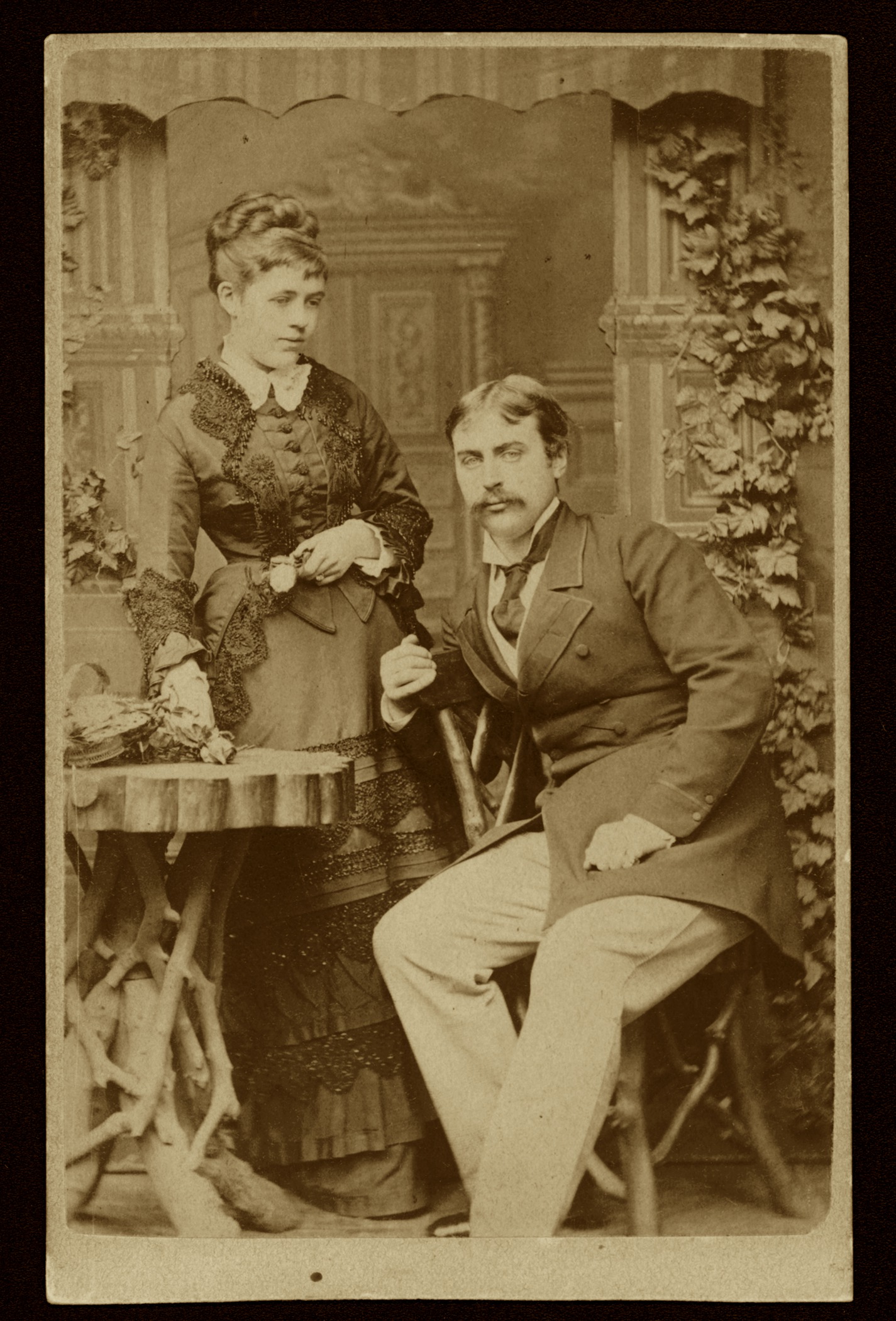
On the boat home, while Mr. and Mrs. Borie were both seasick in their staterooms, Nellie stayed up on deck. She fell in with a young Englishman named Algernon Sartoris. By the time they reached America she was engaged to him. Adam Badeau, Grant’s longtime military secretary, put it bluntly in his memoir Grant in Peace: “before they reached America the mischief had been done that she was sent to Europe to avoid.”
Sartoris was the son of Adelaide Kemble, the famous English opera singer, and the nephew of the actress Fanny Kemble. His father Edward Sartoris was a member of Parliament. The pedigree was real. The young man himself was something else.
“Mr. President, I Want to Marry Your Daughter”
Sartoris went to Grant the way Englishmen of a certain class went to American presidents in the 1870s: with terror.
Badeau got the story straight from Sartoris and recorded it in his memoir. Sartoris was invited to dinner at the White House. Afterward, Grant led him into the billiard room and offered him a cigar.
“Then,” said Sartoris, “I knew my time had come. I waited and hoped the President would help me, but not a word did he say. He sat silent, looking at me. I hesitated, and fidgetted, and coughed, and thought I should sink through the floor. Finally, I exclaimed in desperation: ‘Mr. President, I want to marry your daughter.'”
Grant said yes. He probably said it the way he said most things, which is to say barely at all. Then he wrote to Edward Sartoris on July 7, 1873 and made it conditional. The young couple had to wait at least a year. Sartoris had no permanent employment. Grant did not want to support his son-in-law on a President’s salary.
He also already knew. Sartoris had a reputation for drinking. Grant himself had spent his adult life fighting rumors of his own drinking, and he knew exactly what that looked like in another man. He gave his blessing anyway.
The East Room Was Redecorated for Nellie’s Wedding
This is the part that tends to get lost. Before the wedding, the Grants had the entire East Room redone.
The historian Margaret Huddy, writing for the White House Historical Association, lays it out:
“For this President and Mrs. Ulysses S. Grant had the East Room redecorated entirely, adding to James Hoban’s original architectural detailing matching columns and extending the cornice into beams, all gleaming white, with accents in gold leaf. Andrew Jackson’s three chandeliers were replaced by much grander ‘French’ models, boasting thousands of glass pieces showered over a nickel-plated framework, with gas flames shaded by cut and frosted glass shades.”
Read that again. The columns, the extended cornice, the gold leaf, the new French chandeliers with thousands of glass pieces: that is not the wedding. That is the room itself. Grant restructured the East Room so his daughter could be married in it. The architectural bones of the room you walk through on the public White House tour today were laid down by Grant in 1873 and 1874 as the staging for one wedding. We’ve written before about how the rest of the White House has shifted around it over the next century and a half, and about a separate never-built renovation Benjamin Harrison pushed for in 1892, but Grant’s East Room is the part that survived.
He even had a logistical headache to clear first. Former president Millard Fillmore died on March 8, 1874, which triggered thirty days of official mourning. The White House chandeliers and mirrors had to be draped in black crape. So did the front door and the windows. The decorating crews had to wait for the crape to come down before they could start putting up flowers.
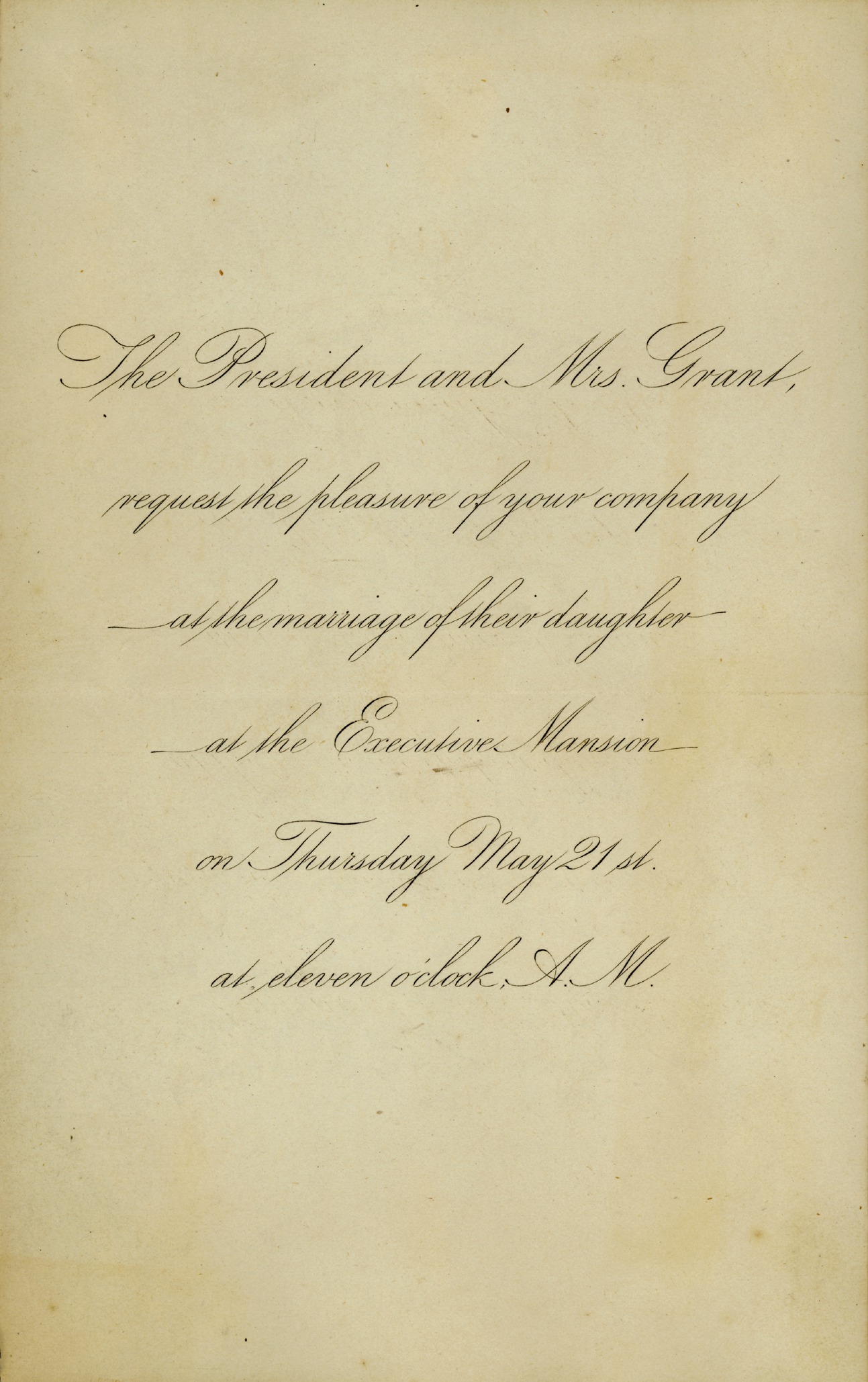
The Wedding of May 21, 1874
By the morning of May 21, the place was unrecognizable.
Pink and white roses and azaleas covered the State Dining Room table for the seated breakfast. The state parlors were laid out for a buffet. The presents had been arranged upstairs in a separate room, organized by which Washington department store they came from, so guests could go look at them.
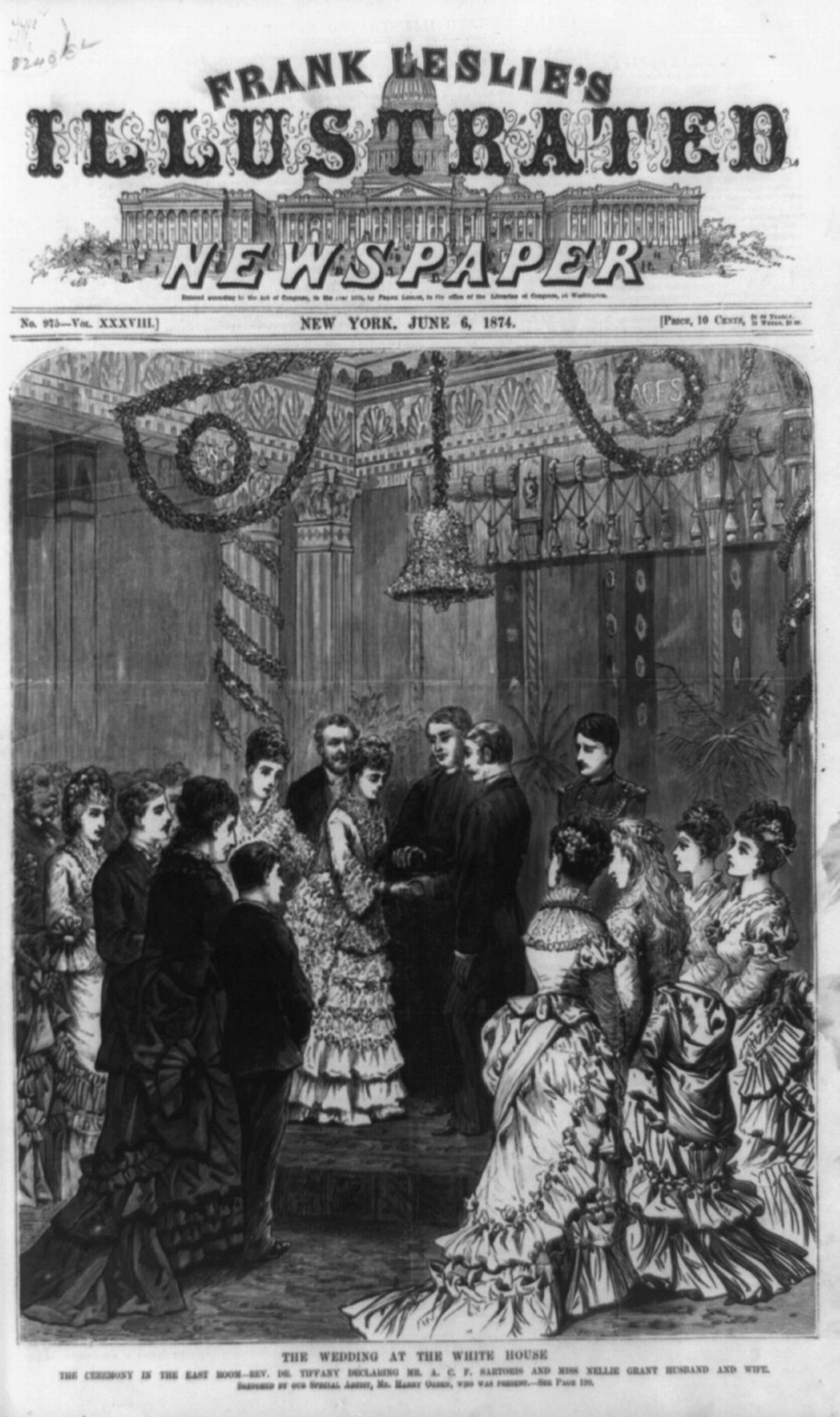
In the East Room a platform had been built before the broad east window. The window curtains were closed. A bell made of pink roses was suspended above the platform. Palms and arrangements of roses lined the walls. Orange blossoms had been crated up in Florida and shipped north for the occasion. Lilies, tuberoses, and spirea covered the staircases.
Tommy Pendel, the longtime White House doorman, captured the scene in his 1902 memoir Thirty-six Years in the White House:
“There was a beautiful marriage bell suspended over her [the bride’s] head. The four large columns supporting the girders were all entwined with the beautiful national colors. Palms and other plants were artistically placed about the room, the windows were closed and the room brilliantly lighted. The effect was beautiful in the extreme.”
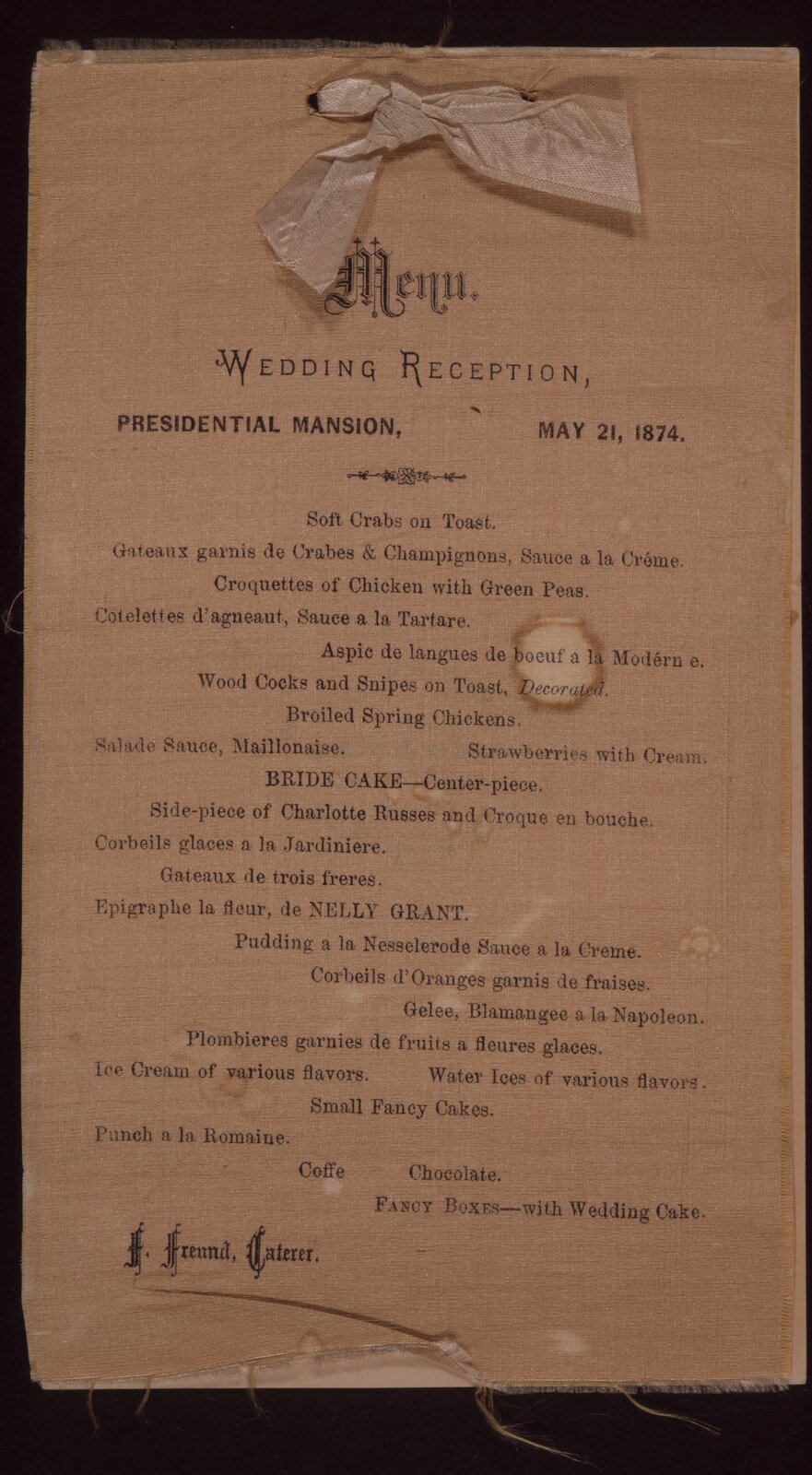
Two hundred and fifty guests were inside. Army and navy officers in dress uniforms stood in a double row down the Cross Hall to the East Room altar. The Marine Band played Mendelssohn’s Wedding March. Nellie and her eight bridesmaids descended the Grand Staircase, all in white. Four of the bridesmaids carried blue flowers, four carried rose-pink.
Nellie’s gown was the finest white satin and Brussels point lace, with a six-foot train. Grant had requested that the lace from Brussels be “the most superb the manufactury could produce.” She wore a tulle veil held in place by a crown of white orchids and orange blossoms from the White House conservatory. She carried a bouquet of roses fixed to a pearl fan, a gift from her parents.
Reverend Dr. Otis Tiffany of the Metropolitan Methodist Church performed the ceremony.
The father of the bride looked at the floor.
Several witnesses noted that Grant kept his eyes down through the entire ceremony. He escorted Nellie to the East Room and gave her away and could not look up.
Walt Whitman Wrote a Wedding Poem for Nellie
The country could not get enough of the story. Nellie’s wedding was already being called the wedding of the century before the cake was cut.
Walt Whitman wrote a poem to mark the day. It ran in the New York Daily Graphic on May 21, 1874, the morning of the wedding itself, under the title “A Kiss to the Bride.” The lines that everyone quoted then and still quote now:
“O youth and health! O sweet Missouri rose! O bonny bride!”
John Greenleaf Whittier, the Quaker poet, wrote to his friend Gail Hamilton: “of course thee saw the great wedding at the White House. Sometime thee shall tell me all about it, especially about the ladies’ dresses, in which thee knows I have a particular interest.”
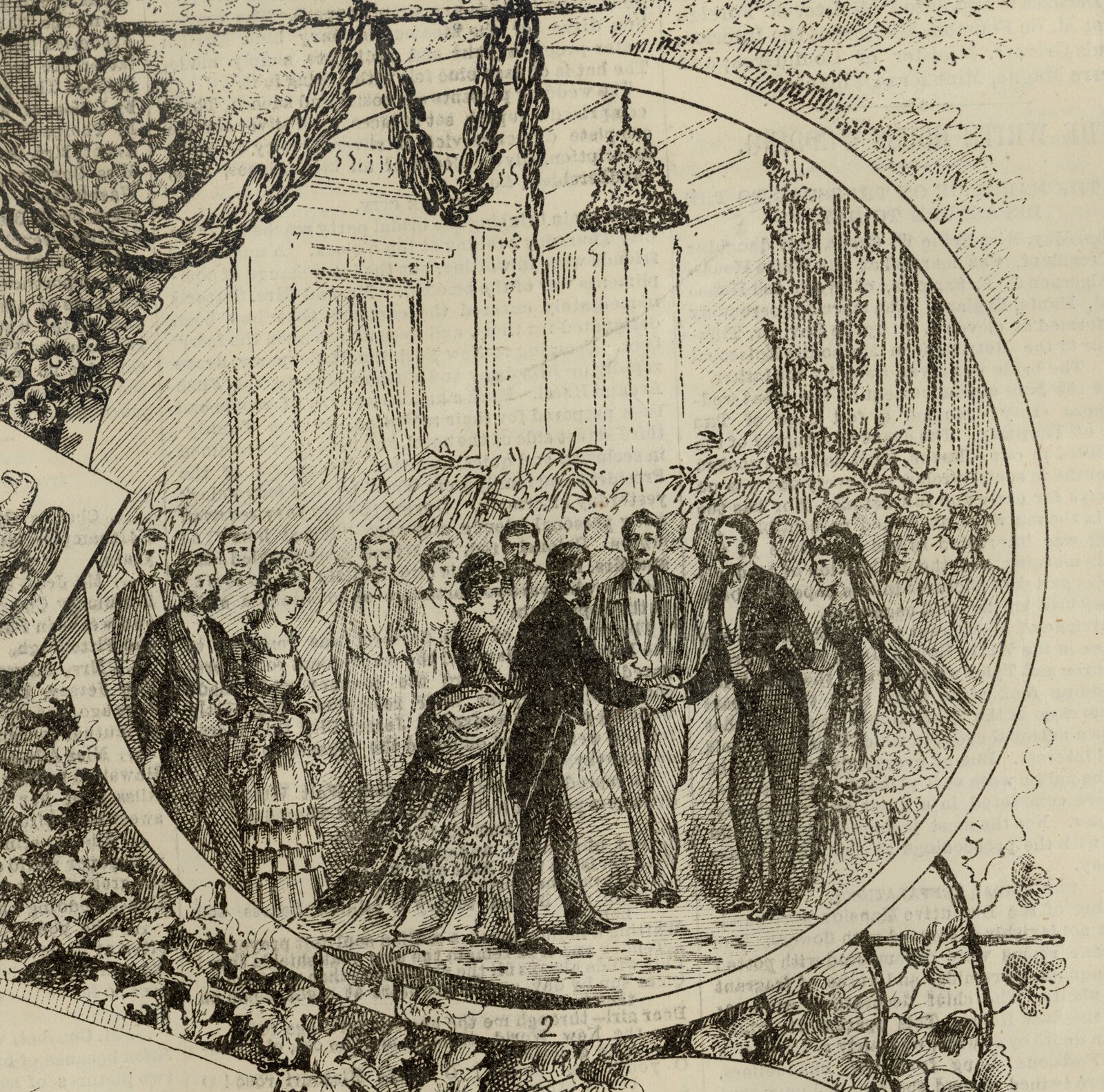
The Daily Graphic special edition on May 23 went into the dresses, the bridesmaids, the trousseau, and the wedding gifts in such detail that the White House Historical Association still cites it as the canonical source. The trousseau alone was reported to contain about one hundred dresses, all of the finest fabrics and embellishments, supposedly so Nellie would not have to ask her new husband to buy her clothes for years.
After the breakfast, the bridal party boarded a Pullman palace car at the Washington station. The car had originally been built for the 1873 World’s Fair in Vienna and had been refurbished for the trip to New York at a reported cost of about $22,000. Nellie traveled in an olive-brown skirt, a light brown long cutaway coat with embroidery, a dark straw hat, and matching brown gloves. The next day she sailed for England.
After the Wedding, Grant Went Upstairs and Wept
Grant did not say anything to anyone. He left the breakfast and walked up the Grand Staircase and went into his daughter’s now-empty bedroom and broke down.
The story is recorded by multiple Grant biographers, including Doug Wead in All the Presidents’ Children and Ron Chernow in his 2017 biography Grant. The detail is consistent across the sources: not in public, not at the ceremony, not at the breakfast, but afterwards, alone, in her room.
He had every reason to be right about Sartoris. Within a year, the marriage was already showing strain.
Henry James on “Poor Little Nellie Grant”
Henry James was a close friend of Adelaide Kemble Sartoris, Algernon’s mother, and visited the family at her home in Southampton on the south coast of England, where Nellie and Algernon were living. James was not gentle about what he saw.
In a letter written soon after Nellie’s marriage, James described her like this:
“poor little Nellie Grant sits speechless on the sofa, understanding neither head nor tail of such high discourse and exciting one’s compassion for her incongruous lot in life. She is as sweet and amiable (and almost as pretty) as she is uncultivated.”
Read that as cruelly as you want. James’s point was not that Nellie was stupid. His point was that Nellie was nineteen years old, an American girl from the White House, dropped into the middle of one of the most literary families in England, and she was completely out of her depth.
By 1888, James was angrier:
“She is illiterate, lovely, painted, pathetic, and separated from a drunken idiot of a husband. The Sartorises don’t like her much, but they like her more, I suppose, than they do their disreputable ‘Algie.’ Whenever I see her there is something rather touching and tragic to me […] in a strange land, quite without friends, ignorant, helpless, vulgar, untidy, unhappy, perfectly harmless and smeared over with fifteen colours.”
Touching and tragic. That is Henry James, who did not throw words like “tragic” around lightly, on the daughter of an American president.
The Sartorises, James added, did not blame Nellie. They blamed their own son. Family tradition held that Algernon was both a drunk and a womanizer. By 1883 he was making headlines in the New York Times under the headline “The Bewitching Mrs. Bush: A Comedy in Which Algernon Sartoris and Some Tradesmen Take Parts.” He had bought a farm in Wisconsin. He was spending most of his time in America while Nellie stayed in England. They were essentially separated.
She had four children with him in those years. The first, Grant Grenville Edward, died in infancy in 1876.
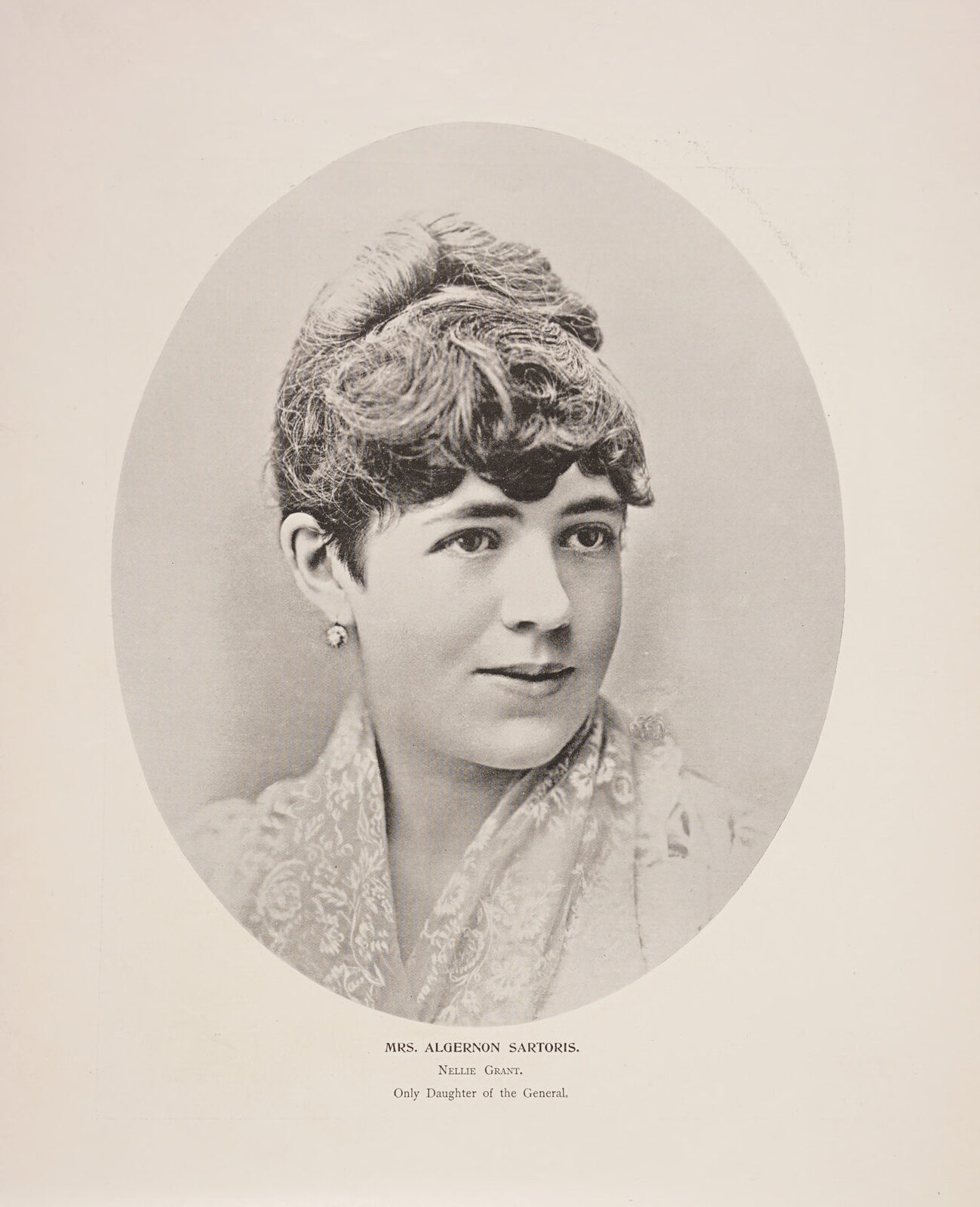
Coming Home to Washington
By 1889 the marriage had collapsed. Nellie was given a large annual income and allowed to take her surviving children back to the United States. Congress eventually passed a special act in 1898 restoring her American citizenship, which she had forfeited under the law of the time when she married a foreign national.
Algernon died in Capri on February 3, 1893 at the age of forty-one. The drinking had broken him.
Nellie came home to Washington in 1894. She settled in the Dupont Circle neighborhood. According to historian Stephen Hansen, she returned the year before her mother did, leasing a house in the area and trying to live quietly. We’ve mapped the city she came home to in this 1894 view of Washington, and the city she had left in these 1874 maps.
Her father had been dead since July 23, 1885, of throat cancer. He had spent his last months at Mount McGregor in upstate New York, racing to finish his memoirs so Julia would not be left destitute.
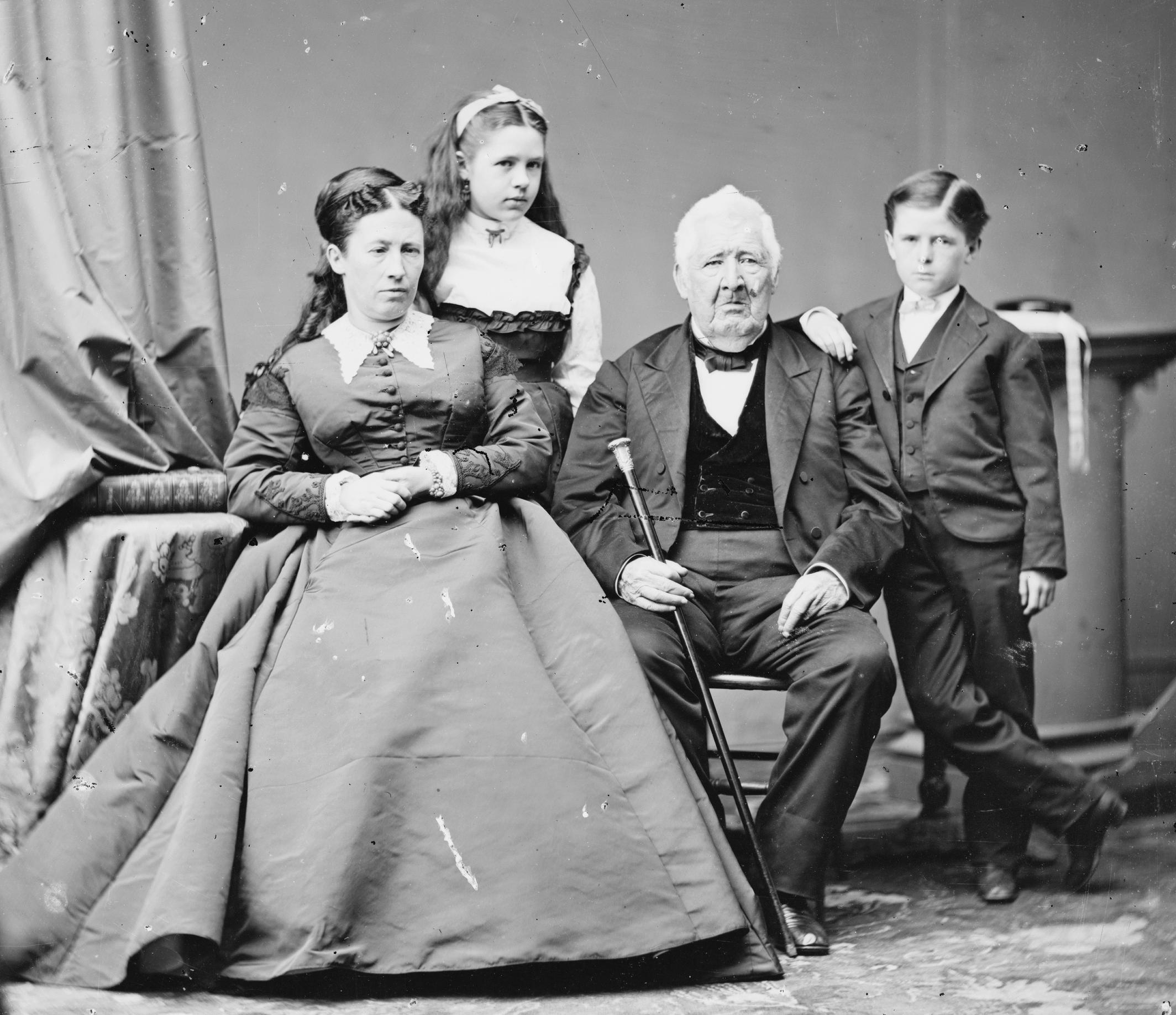
Julia followed Nellie to Washington in 1895. Mother and daughter eventually settled into a marble-faced mansion at 2111 Massachusetts Avenue NW that had once belonged to Vermont Senator George F. Edmunds. Julia hosted open Tuesday afternoon receptions there during the social season, much like the ones Emily Edson Briggs described as the “Olivia Letters” from the 1870s. Many of her oldest Washington friends from the White House years came back. It was a quieter version of the social life she had loved as First Lady.
Julia died at 2111 Massachusetts Avenue NW on December 14, 1902, of heart and kidney complications. She was 76. Nellie was at her bedside. President Theodore Roosevelt attended the funeral.
Then Nellie left Washington for good.
The Room She Was Married In
The East Room is the largest room in the White House. It is the room that hosts state dinners, treaty signings, the lying in state of presidents, and most of the public ceremonies a White House visitor sees on television. It is the room where Lincoln’s body lay in 1865 and where Kennedy’s body lay in 1963.
The columns, the extended cornice, the gold leaf accents, the architectural framework that you can see in any photograph of the room today: those bones were laid by Grant for Nellie’s wedding. The chandeliers have changed. The walls have been refinished. The room has been renovated again under the Roosevelts and again under the Trumans. But the spatial logic of the modern East Room, the way it reads to a visitor walking in from the Cross Hall, was set in place in 1873 and 1874 by a father trying to give his only daughter the most beautiful wedding the country had ever seen. He had taken his second oath of office in a freezing March 1873 inauguration just over a year earlier.
He spent a fortune. He built her a room. He gave her away to a man he knew would be a disaster. He went upstairs and cried.
She came home twenty years later anyway.
She buried her mother and left.