
Francis Scott Key wrote the words to “The Star-Spangled Banner” while living in a comfortable brick house in Georgetown. You cannot visit it today. It did not burn, and it did not fall down on its own.
Washington took it apart on purpose. Workers numbered the bricks so the house could be rebuilt, stacked the pieces near the river, and then lost track of the whole thing. The home of the man who gave the country its national anthem simply vanished.
Here is the story of Francis Scott Key’s house in Georgetown, where it stood at 3516-18 M Street NW, and how the nation’s capital managed to misplace it.
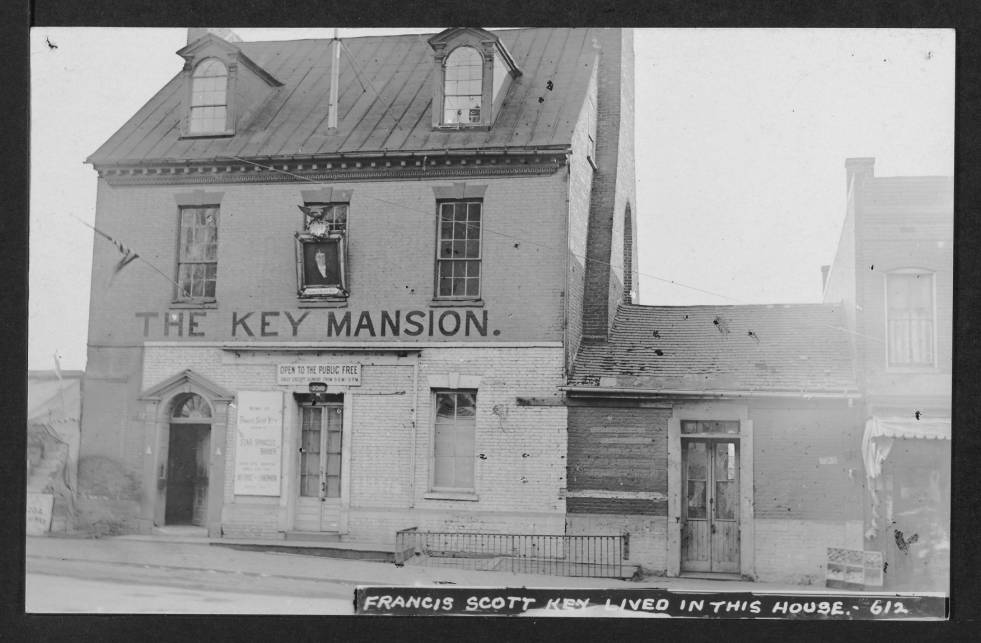
The house where the anthem was born
A merchant named Thomas Clarke built the brick house around 1795, back when M Street was still called Bridge Street. Terraced gardens sloped down behind it to the Potomac River, well before any bridge or canal cluttered the view.
Francis Scott Key leased the place in late 1805. He had come to Georgetown to practice law alongside his uncle, Philip Barton Key, and he and his wife, Mary Taylor Lloyd, would raise eleven children in the house.
Key was living here in September 1814 when he sailed to Baltimore to win the release of a captured doctor. Detained on a British ship, he watched the bombardment of Fort McHenry and the flag that still flew at dawn, and he started scribbling the lines that became the anthem.
The Keys left Georgetown around 1830, after the new Chesapeake and Ohio Canal opened directly behind the house and filled the old garden slope with boat traffic. They moved closer to the courts near Judiciary Square, though Key kept an office in a wing of the house until close to his death in 1843. Like much of his Georgetown world, his household included people he enslaved.
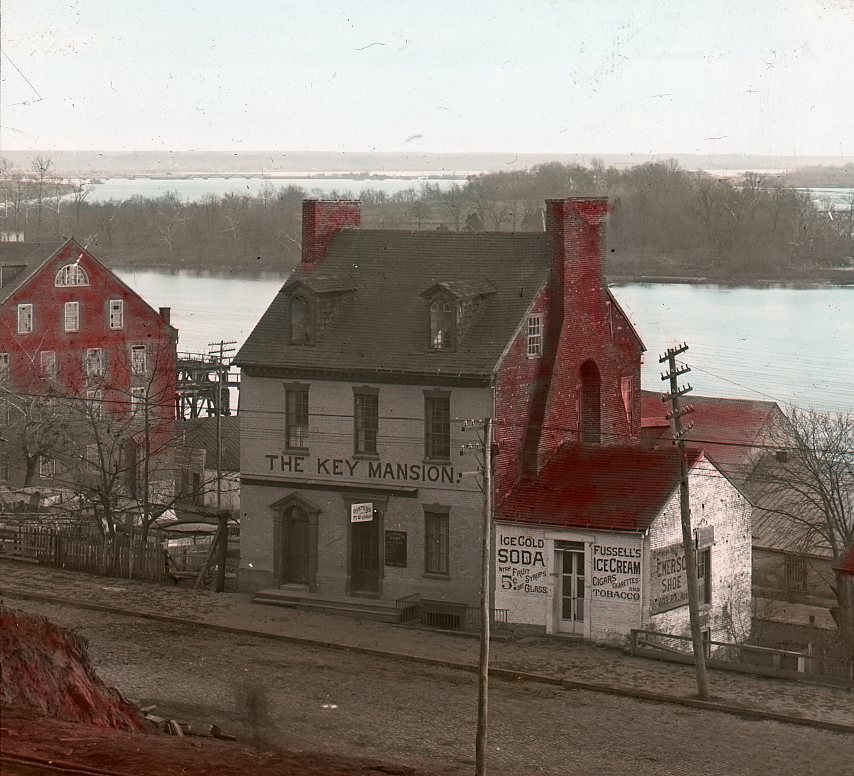
From mansion to dry-goods store
After Key, the neighborhood went industrial and the house went commercial. Over the decades it served as a hotel and restaurant, a blacksmith shop, and a dry-goods store, while grimy mills and factories crowded the old tobacco port around it.
In 1896 an owner floated a plan to turn it into a hotel. The Washington Post reported he was “anxious to preserve the historical house,” but the same scheme called for stacking two more stories on top and tearing the old chimney down. The renovation never happened.
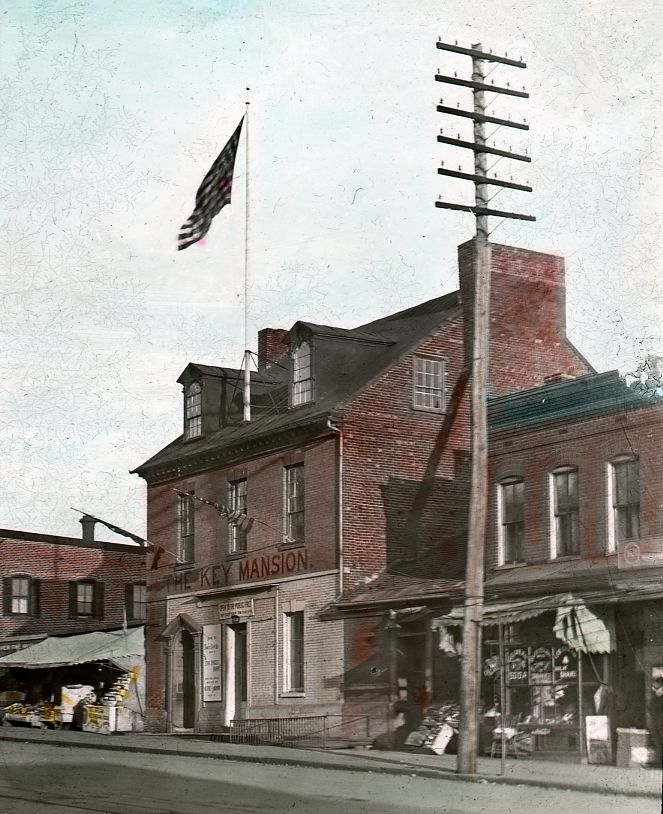
Someone eventually painted “THE KEY MANSION” in big black letters across the front to pull in shoppers. Across the street rose the massive Georgetown Car Barn, and the residential block Key had known was gone for good.
The first attempt to save it
In 1907 a group of prominent Washingtonians formed the Francis Scott Key Memorial Association to rescue the house. The roster was heavy with stars: Admiral George Dewey, Rear Admiral Winfield Scott Schley, the District commissioner Henry MacFarland, and Key’s own great-grandson, Francis Scott Key Smith.
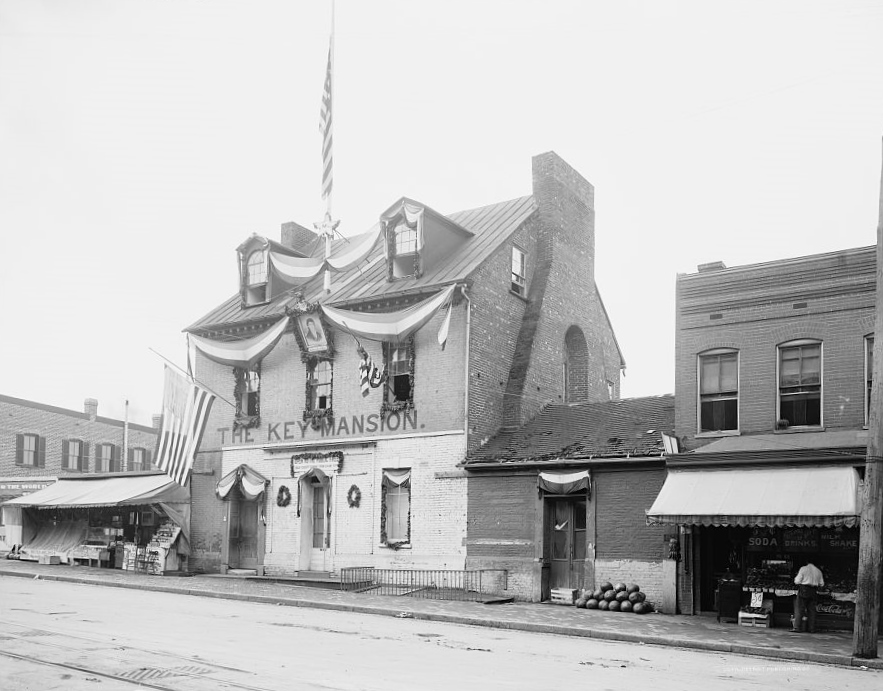
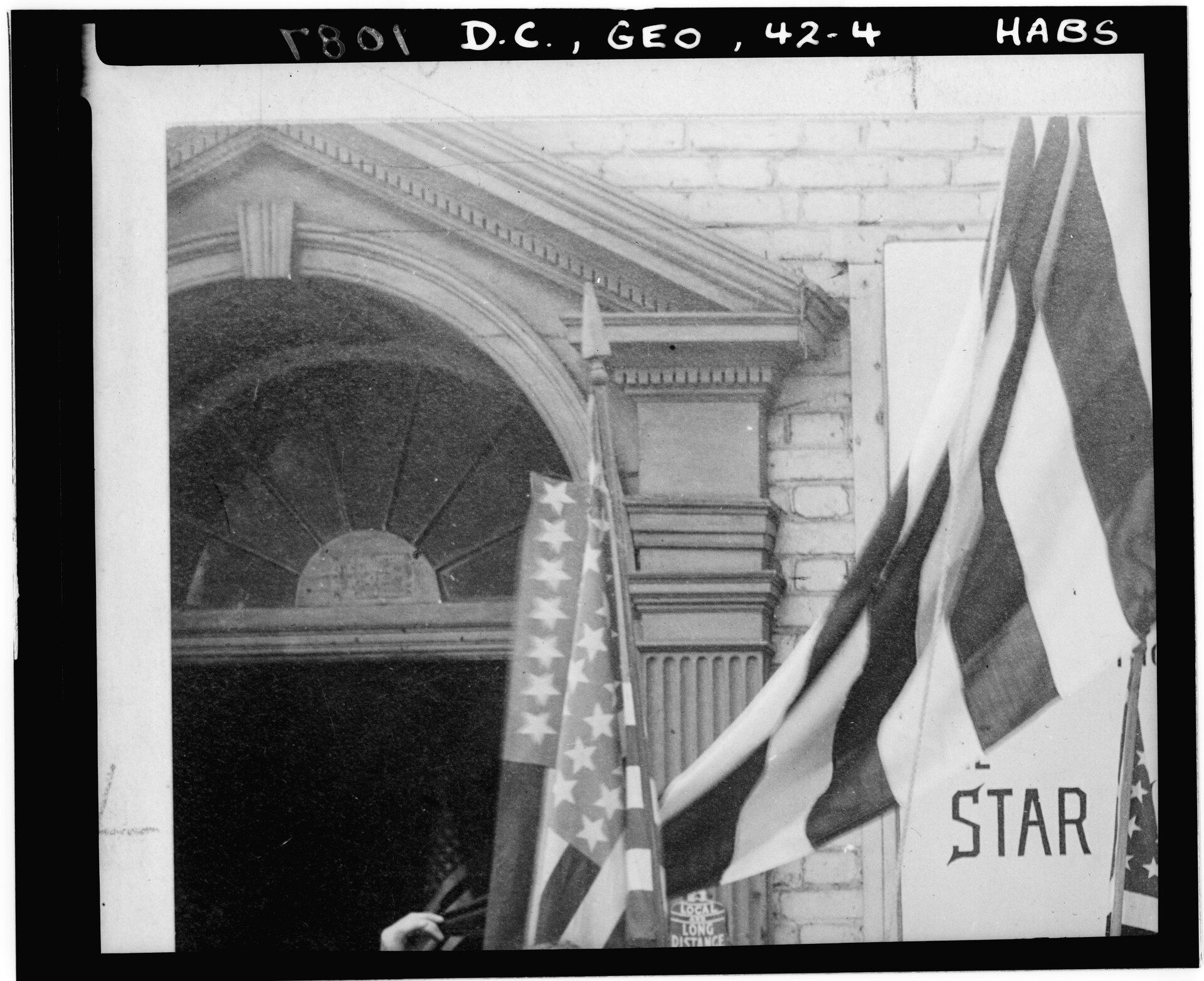
They wanted to repeat what Philadelphia had just done with the Betsy Ross House. The lawyer Hugh T. Taggart bought the building after Dewey talked him into it, and the association dressed the exterior in flags and hung a portrait of Key.
The house opened to the public after a dedication on February 23, 1908, and a Flag Day ceremony that summer brought speeches and a 21-gun salute. Then almost nobody came. The block was shabby, there was no original furniture, and there was nothing much to see. The little museum closed within a few years.
Stripped beyond recognition
When Taggart died in 1912, his heirs remodeled the place into something unrecognizable. They pulled off the gabled roof, ripped out the facade for plate-glass commercial windows, knocked down Key’s one-story law office, and removed the big chimneys.
The result looked like any other storefront on the strip. Plenty of Washingtonians assumed the real Key house had already been demolished and replaced. During World War I, the building even did a stint as a factory turning out American flags.
Promises, plans, and the Depression
The Key Bridge opened beside the house in 1923. In 1931 the National Park Service bought the block to clear it for a riverside park, and when locals protested, officials promised the Key house would be spared and restored.
Then the money never came. A Depression-era fundraising drive led by Ulysses S. Grant III fell short of its $25,000 goal. By 1935 the Park Service floated a restoration estimated at $55,000, even as Key’s great-grandson argued the house was too far gone to truly restore.
A Park Service architect named Stuart Barnette put the doubts in writing, and his verdict was brutal.
Only two things would justify the restoration of any ancient structure reduced to the present physical state of the Key House: historical significance and architectural importance. It is my opinion that neither the ruins are of great architectural importance, nor was the man great whose name is associated with the structure.
Taken apart for a freeway ramp
World War II sealed the decision. Planners approved a ramp linking the Key Bridge to the new Whitehurst Freeway, giving drivers a fast way out of the city and a quicker route toward the Pentagon. The Key house stood squarely in the path.
Preservationists, including the Columbia Historical Society, fought through the 1940s to move the road or relocate the house. As a compromise, Congress voted in 1948 to spend about $65,000 dismantling the building and rebuilding it nearby.
The contractor Alexander and Repass took the house down, numbered the bricks and foundation stones, and trucked them to a storage spot under the Arlington Memorial Bridge. Everything was ready for the rebuild.
Then President Harry Truman pocket-vetoed the funding, after the Bureau of the Budget warned that a replica would cost too much to build and maintain. The Post summed it up on June 29, 1948, with the headline “President Kills Rebuilding Of Francis Scott Key House.”
The bricks that walked away
Once the rebuild was dead, the numbered pile by the river had no purpose and no real guardian. NPS historian Barry Mackintosh later put it plainly.
After the reconstruction prospects died, so did much incentive for the Park Service to zealously guard the brick pile.
Over the years the stack shrank until nothing was left. Some of the material probably went into other restorations around Georgetown, including the nearby Old Stone House, and a Georgetown mansion called Quality Hill is said to wear the Key house doorway.
In 1981 the Post caught up with the absurdity in a story titled “The Case of the Lost Landmark,” reporting that the Park Service could no longer find the house it had carefully taken apart.
What stands there now
The site did finally get its memorial. In the 1980s a group of Georgetown citizens raised the money for a small park, and on September 14, 1993, the 179th anniversary of the anthem, the Francis Scott Key Park and its Star-Spangled Banner Monument were dedicated at 34th and M Streets NW.
The park holds a bronze bust of Key sculpted by Betty Mailhouse Dunston and flies a 15-star, 15-stripe flag, the same design Key saw over Fort McHenry. The National Park Service maintains it as part of Rock Creek Park. The house itself is gone, but the little park marks roughly where Key’s Georgetown stood.
Key once turned a flag that survived a night of cannon fire into a song the whole country sings. His house, fittingly enough, could not survive peacetime, a budget office, and a highway ramp.
I recall hearing, or maybe reading in the Post, that the Key house was dismantled for the construction of the Key Bridge and the parts of the house were stored in a Parks Service warehouse somewhere. People lost track of what that pile of brick and wood was and people used the materials for other things over the years. Not sure if that’s the correct story, though.
There were some other great pictures at the Library of Congress if you type in Key mansion.
I got interested in articles:
http://chroniclingamerica.loc.gov/lccn/sn86090383/1907-03-20/ed-1/seq-2/
http://chroniclingamerica.loc.gov/lccn/sn84020558/1908-06-05/ed-1/seq-7/
http://chroniclingamerica.loc.gov/lccn/sn86063381/1908-07-03/ed-1/seq-1/
http://chroniclingamerica.loc.gov/lccn/sn89066129/1910-07-01/ed-1/seq-7/
This 1920 article has a picture of the construction (which started in 1918) and indicates the mansion was at about the location of the bridge on the DC side. The 1922 mentions previous efforts to save it that were unsuccessful but says nothing about the materials when it was destroyed.
http://chroniclingamerica.loc.gov/lccn/sn85042303/1920-11-28/ed-1/seq-7/
http://chroniclingamerica.loc.gov/lccn/sn83045433/1922-11-26/ed-1/seq-40/
It is widely accepted the Francis Scott Key Bridge between Georgetown, Washington, District of Columbia and Rosslyn, Virginia was named in recognition of Mr. Key’s authorship of our national anthem, The Star Spangled Banner, and justly so.
But there may be more to the story. A nonagenarian Washingtonian related this story to me in the 1990s.
The home of Francis Scott Key, at 3518 M Street, NW, lay in the path of the proposed project, and the occupants at that time understandably objected to having their home destroyed to make way for a new bridge. But knowing that eminent domain would eventually prevail, they decided to make the best deal that they could.
Their negotiations were fruitful. In addition to memorializing their antecedent with one of Washington’s most magnificent structures, they were also successful in requiring that the existing home be disassembled brick by brick, crated, and stored until it could be rebuilt on an adjacent site subsequent to the completion of the new bridge.
We know, of course, that the bridge exists, but what became of the bricks from the original Francis Scott Key house?
Sadly, no one knows. Quite possibly the crates of bricks now rest in the same warehouse that the crate from Raiders of the Lost Ark rests.
I have no idea whether this story is in any way factual, but like I always say, “If you haven’t heard a rumor by ten o’clock, start one.”