
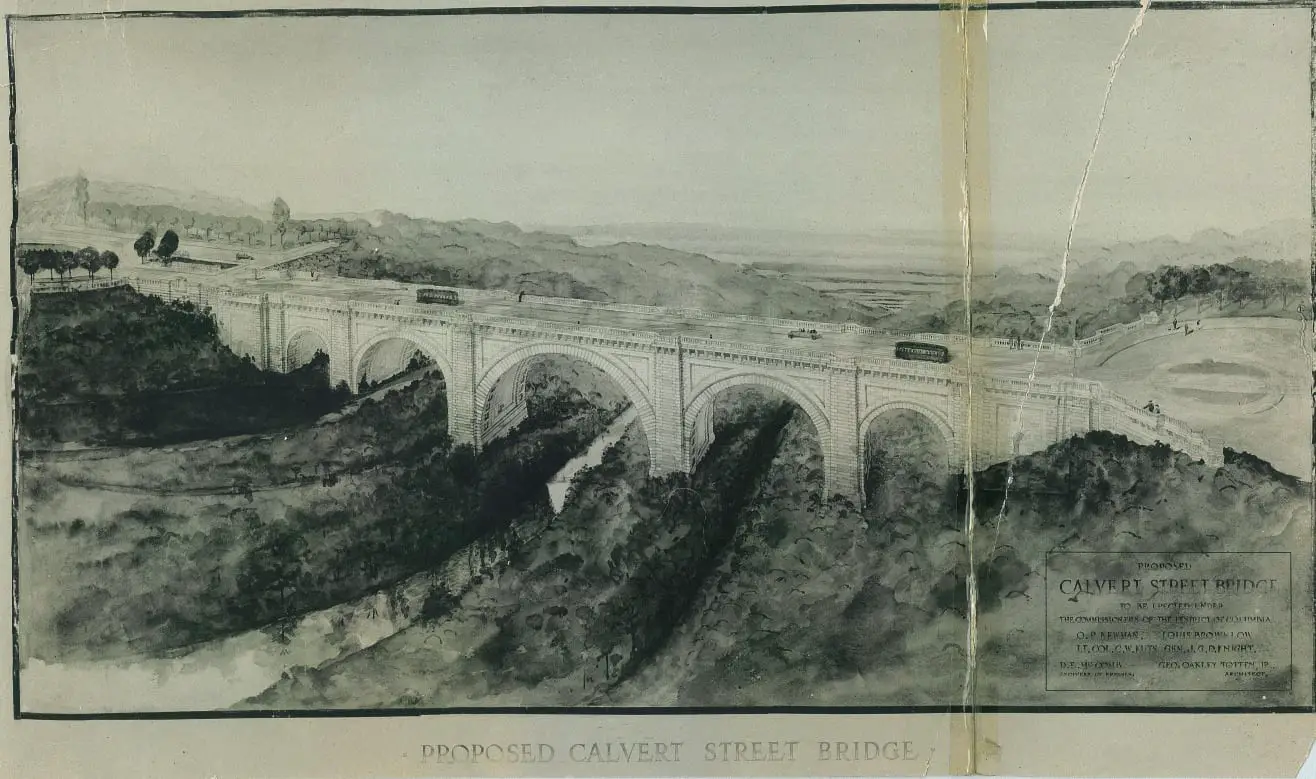
That drawing you see above? It was supposed to replace a failing bridge. It never did.
George Oakley Totten Jr. spent sixteen years fighting to see his design for the Calvert Street Bridge turn into concrete and stone. He had the commission. He had preliminary approval. He sent blueprints. He showed up to a meeting carrying a plaster model. On the Fourth of July, 1931, he wrote an angry letter to the Washington Post.
None of it worked.
The Bridge That Needed Replacing
The first structure at Calvert Street wasn’t much to look at.
Built by the Edgemore Bridge Company in 1891 at a cost of $70,000, it was an iron truss bridge put up for the Rock Creek Railway Company, which needed to carry its streetcar line across the Rock Creek gorge and into the new suburbs being developed to the northwest. Six wrought-iron trusses, sitting on iron trestles 125 feet high, carried a 40-foot roadway plus two five-foot footpaths. It weighed 1,226 tons and stretched 755 feet across the valley. Once finished, the railway handed it over to the District government.
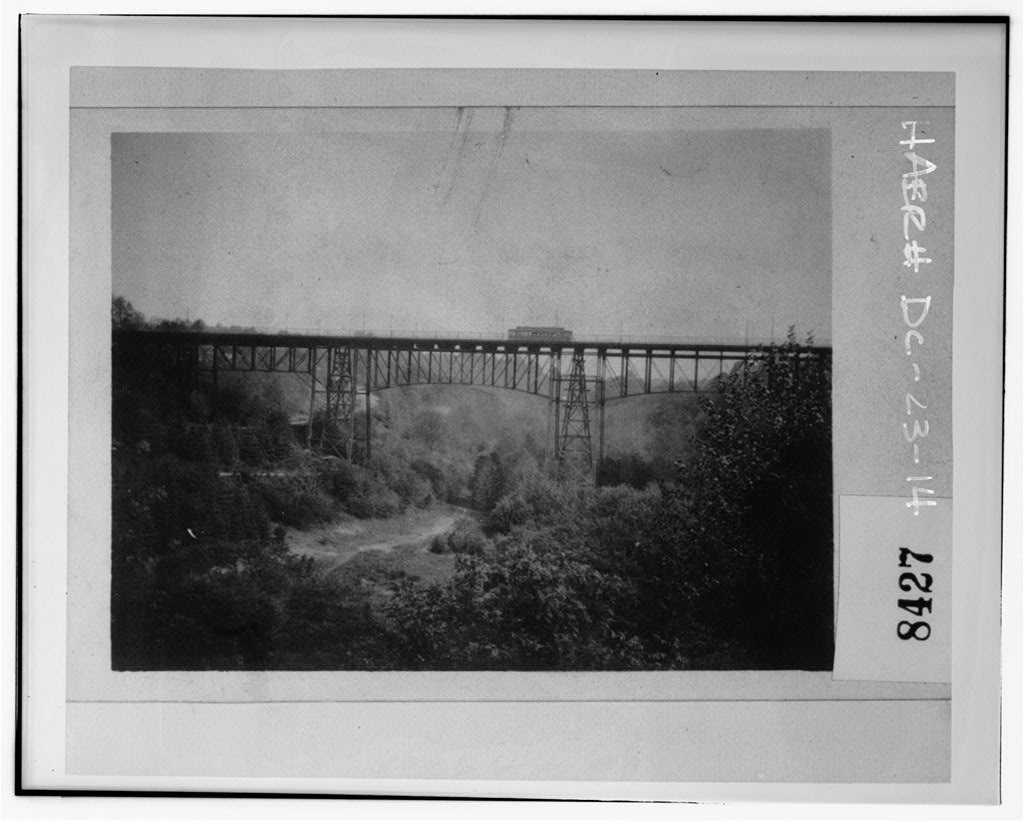
Twenty years in, the bridge was already failing. In 1911, engineers reinforced it by trimming its width, cutting the roadway down to just 26 feet. Timber cribbing went inside each tower for stability.
By the early 1920s, Washington’s Board of Trade had seen enough. Their 1923 annual report described the iron-truss structure as “so narrow that streetcars and automobiles are required to use the same surface.” They added that it was, “to say the least unsightly, and far from being in keeping with the present surroundings.”
Something had to be done.
Enter George Oakley Totten Jr.
In 1917, District Commissioners hired local architect George Oakley Totten Jr. (1865–1939) to design a replacement. Totten was one of Washington’s prominent architects, responsible for the French Embassy on 16th Street NW, the Spanish Ambassador’s residence, and a handful of other notable buildings around the city. When you needed something grand, Totten was your man.
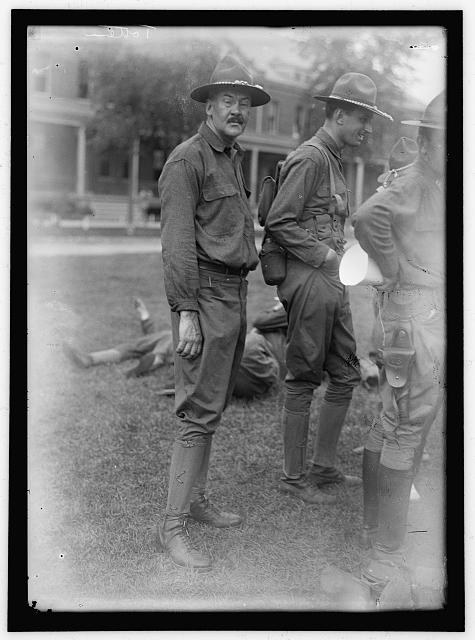
On May 7, 1917, Totten presented six or seven preliminary sketches to the Commission of Fine Arts. The commission selected a design with three large arches and two smaller ones. Totten went to work with Col. Kutz, the engineer commissioner, and D. E. McComb, the District’s engineer of bridges.
He submitted the full project to the commission in July. That’s when the trouble started.
The commission found the design too costly and too ornate. They told Totten to return to a simpler sketch, and made clear that this bridge should be subordinate in design to the nearby Connecticut Avenue Bridge, a more important artery just a short walk to the south. The commission gave its preliminary approval, but with the condition that working drawings would need to come back for final sign-off.
That final sign-off never came.
Sixteen Years in Committee
By November 1921, commission chairman Charles Moore was still writing letters about Totten’s design, now describing it as “elaborately ornamented” and worried it would dominate the larger Connecticut Avenue span. Four years had passed since the commission. Nothing had been built.
The 1923 Board of Trade report urged the city to proceed. By 1927, all that had happened was patching up the old bridge.
Meanwhile, architect Paul Philippe Cret had arrived uninvited. In early 1931, he submitted unsolicited plans for a bridge at Calvert Street. Of ten sketches he sent to an architect member of the commission, one got approved: a steel arch with masonry approaches. They asked for simpler ornamentation and no balconies.
Totten found out. On July 4, 1931, he wrote to the editor of the Washington Post. His working drawings were complete, he said. The District’s structural drawings were ready. The only reason the project had sat idle was that the country had entered World War I. He had been paid for his work. He wanted to see it built.
That was a fair complaint. But it didn’t change anything.
The Last Stand
By August 1933, things were moving fast toward Cret. District Commissioners authorized the engineering firm Modjeski, Masters & Chase to prepare drawings for a masonry bridge with multiple arches.
The very next day, Totten showed up at the Commission of Fine Arts. He brought blueprints of his 1917 design and a plaster model built at one-eighth-inch scale. He asked them to reconsider.
The commission inspected the model. Their verdict: conditions in the valley had changed since 1917. Five arches were too many. The varying heights were a problem. And the model, they said, revealed “unnecessary ornament.”
That was it. Consideration of Totten’s design was abandoned once and for all.
A September 13, 1933 article in the Washington Post reported that the commission had formally approved Cret’s design in collaboration with Modjeski, Masters & Chase. After twenty-five years, someone was finally going to build a new bridge.
How They Built It
Before anything new could go up, the old bridge had to move.
Engineers pulled the 1891 iron truss structure 80 feet downstream on rollers, using four winches with one horse to each winch. The whole move took seven hours and fifteen minutes. The old bridge served as a streetcar and automobile detour while the new one was built, then it was demolished.
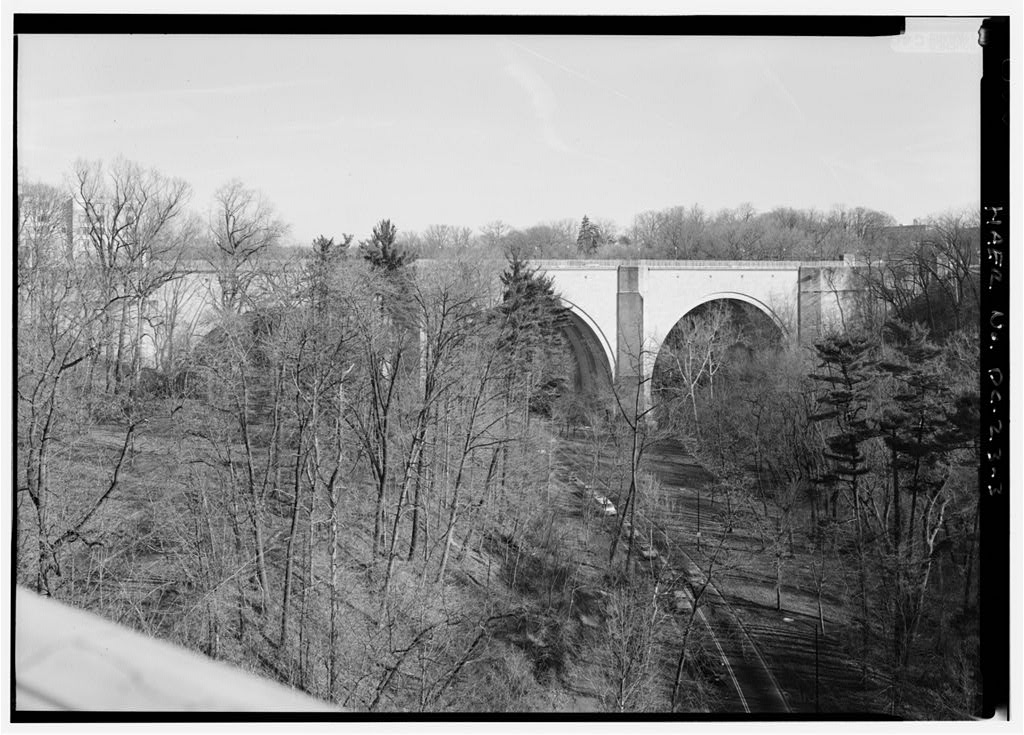
Cret’s bridge was built from 1933 to 1935 by John W. Cowper Co. of Buffalo, New York. It is a concrete structure faced with Indiana limestone, 825 feet long and 128 feet high. Three arches cross the valley: the western one over Cathedral Avenue, the center arch over the Rock Creek and Potomac Parkway, the eastern arch over Rock Creek itself. The roadway is 60 feet wide with 12-foot sidewalks on each side. Total cost: $964,705.35.
Sculptor Leon Hermant designed four allegorical reliefs, one for each abutment. As Paul Cret himself described them: Rail is “a male figure, typical of the powerful modern steam engine, flying over the network of tracks covering the country. He holds the Caduceus emblem of trade.” Water is “a female figure, symbol of the smooth motion of ships over oceans and rivers” with an anchor and sail. Air is “a youth soaring over the clouds, represents the daring and earnestness of this new achievement.” And the automobile: “a woman leaning over a chassis.”
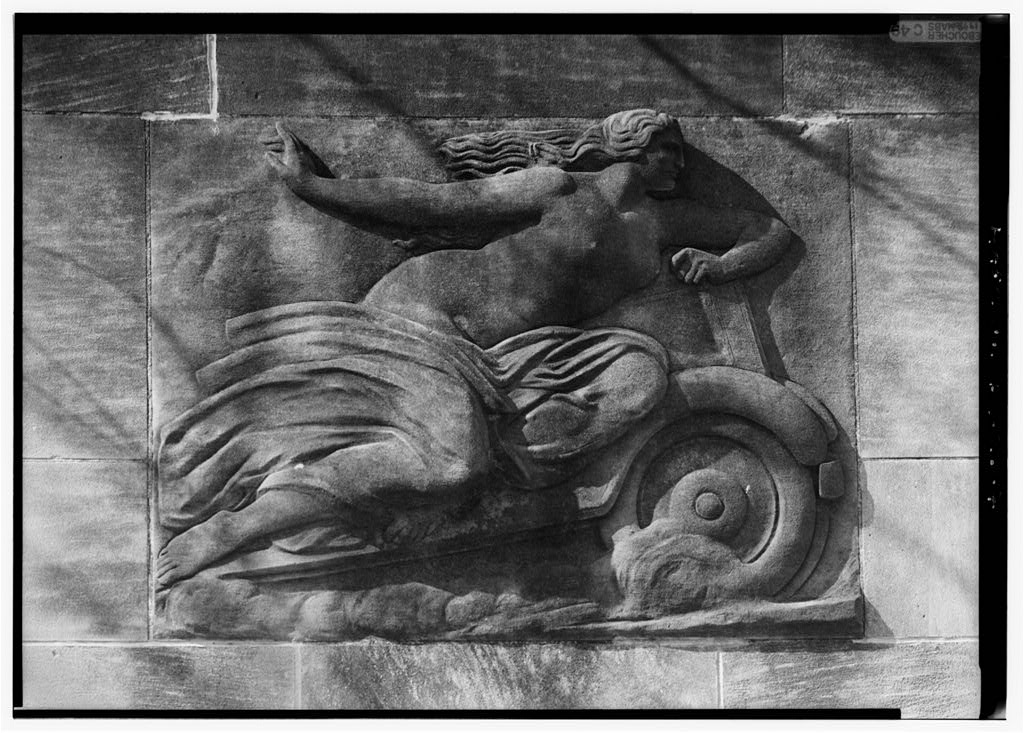
The commission actually tried to kill the reliefs before the bridge was finished, calling them “out of keeping with the architecture.” Cret pushed back. They eventually came around, asking for “simpler modeling.” The first two panels were being carved on site by September 1935. In December, the commission congratulated Cret on the successful completion of his design.
The Bridge Today
In 1974, the bridge was rededicated as the Duke Ellington Bridge, honoring the DC-born jazz legend who had died that year.
If you’ve crossed it recently, you know the suicide-prevention railings that rise above the original parapet. Those went in around 1985, after years in which the Calvert Street and Connecticut Avenue bridges were averaging five deaths a year between them. The installation cost about $160,000, with 80 percent coming from federal funds.
At some point there was a proposal to replace the barriers with Duke Ellington music piped onto the bridge, bronze plaques at each end, and suicide hotline phones. That went the way of Totten’s design.
The bridge you cross today is Cret’s. Totten’s drawing is at the top of this page. We’ve looked at the Connecticut Avenue Bridge in 1911, and if you like the “what almost was” beat, check out Metro’s unbuilt bridge over Rock Creek.
Some of our stories are researched and written with help from AI, and checked by a person before they run. Here’s how we use AI.