
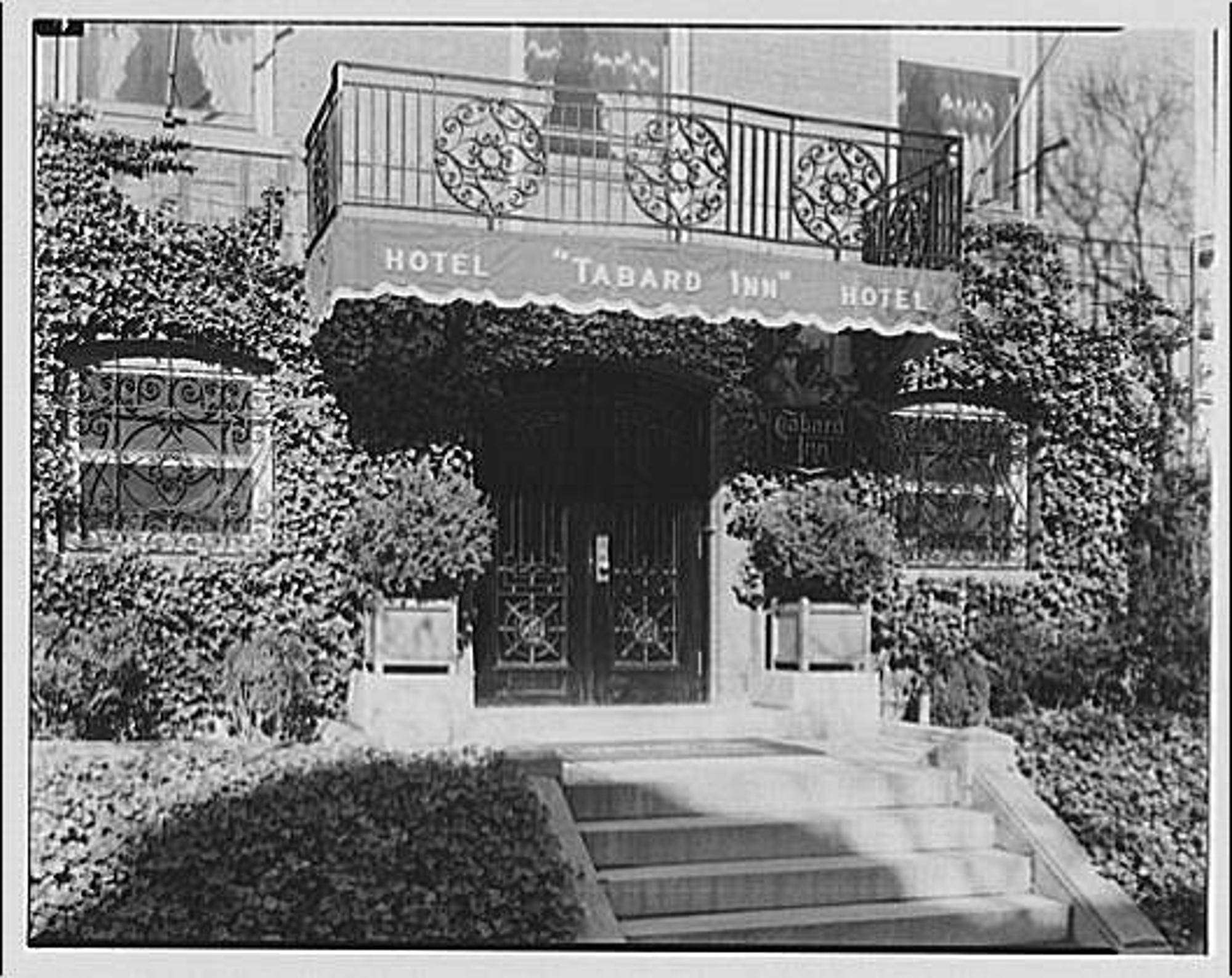
On August 13, 1930, the Tabard Inn was sold at auction. The high bidder was Marie Willoughby Rogers, the woman who had started it. She paid $1,000 for each of its two houses at 1739 and 1741 N Street NW.
Three years earlier, she had sold the whole thing.
The Tabard calls itself the oldest continuously operating inn in Washington, and the story usually told is simple. A recent widow opened it in the 1920s and ran it until she died in 1970. The deeds, plats and census sheets tell a stranger version.
Three Houses on N Street
The Tabard is really three rowhouses on the north side of the 1700 block of N Street, in Square 158, a few blocks from Dupont Circle. They went up over 13 years.
The oldest, 1737, was built in 1887 for Caroline Sherman. Her architect was T. F. Schneider, who would later build the Cairo on Q Street. Sherman married John P. Story, who became the Army’s Chief of Artillery.
Next door, 1741 went up in 1888 for Mary A. Casey, the widow of Joseph Casey, Chief Justice of the U.S. Court of Claims.
The middle lot came last, and the surveyor’s books show exactly how. At 12:50 in the afternoon on April 25, 1900, Col. Frank L. Denny of the Marine Corps recorded this:
I hereby subdivide lot 38 and the East 4.50 feet of lot 39 (of Brainard H. Warner’s subdivision in book 12 page 81) Square 158, into lot 58, as shown above.
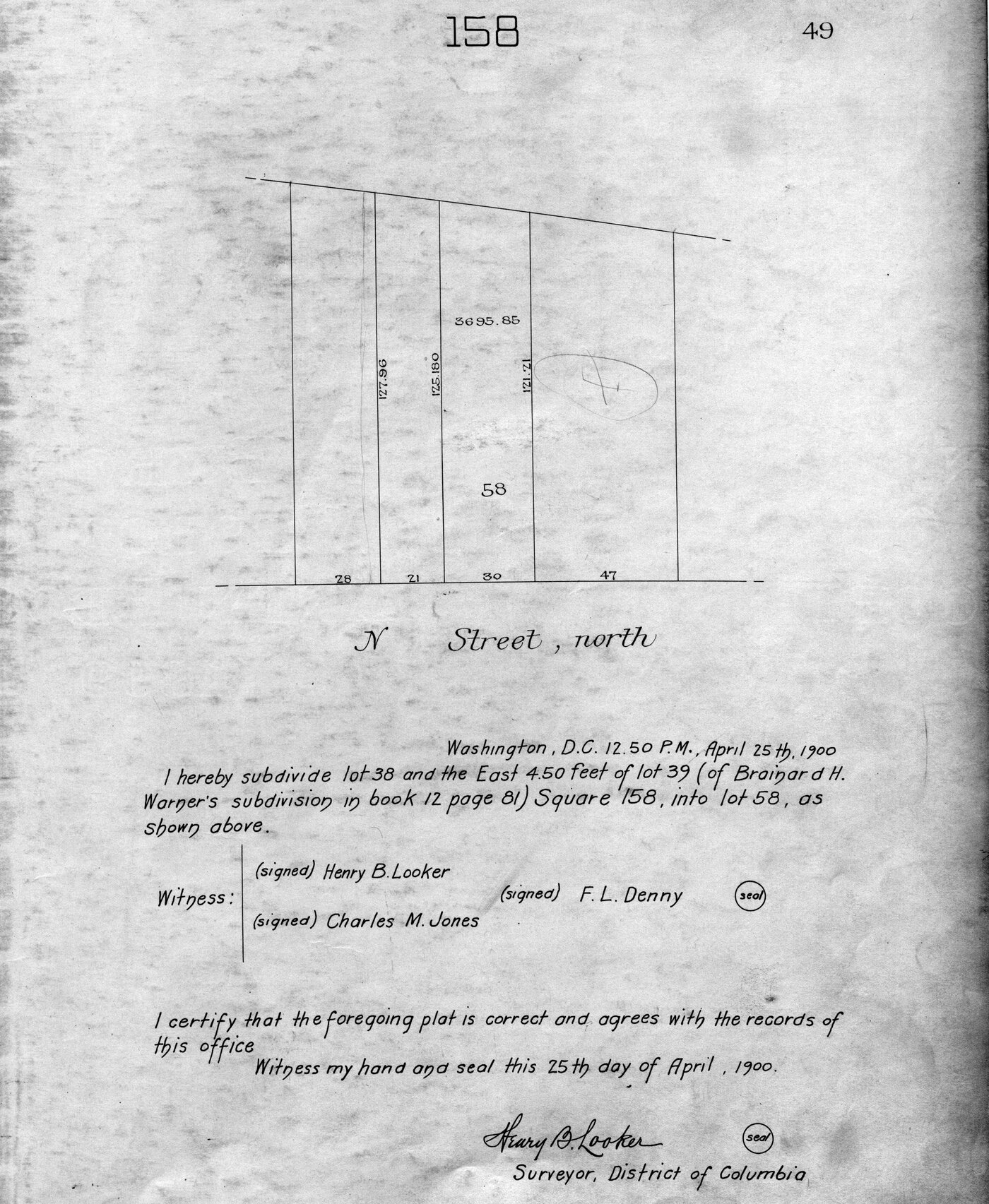
Lot 58 had 30 feet of frontage on N Street and 3,695.85 square feet in all. That is 1739, the heart of the Tabard today.
The next afternoon, at 3:16, Isabella W. Campbell, who owned 1741, recorded her own plat. It turned the west 21 feet of lot 39 and a 3.5-foot strip of original lot 6 into lot 59.
The two plats, filed a day apart, redrew the line between 1739 and 1741. According to the nomination, Denny’s building permit is dated the same day as his plat. His architects, Hornblower & Marshall, designed a four-story brick house.
It passed through an admiral, a congressman and a senator. Rear Adm. John McGowan lived there until 1908, then Rep. Jacob Sloat Fassett of New York. In 1912 it went to Sen. Henry F. Lippitt of Rhode Island, and people called it the Lippitt Mansion.
During World War I, Chester C. Bolton of Cleveland lived there. He served on General Pershing’s war staff.
A Widow From Florence, South Carolina
Marie Willoughby was born in Florence, South Carolina, in 1885. She married Gaillard Sherburne Rogers, a geologist with the U.S. Geological Survey.
On December 19, 1919, the Evening Star ran the news on its front page under the headline “Geological Survey Man Drowns in Colombia.” Rogers had been leading a geological expedition for the Richmond Levering Company:
The accident occurred while in a canoe on the Mulatas river. The canoe was overturned in a swift current. The body has not yet been recovered, according to the latest accounts of the mishap.
He was about 30. His wife, the paper said, was staying in Panama when he died.
According to the building’s National Register nomination, she opened a small restaurant in New York in 1920, the Dixie Cupboard. Two years later she was back in Washington, buying a mansion.
The deed was made on September 25, 1922, and recorded on October 17. Chester C. and Frances P. Bolton sold lot 58 to Marie Willoughby Rogers. The $46.50 in revenue stamps on it points to a price of roughly $46,000 to $46,500.
Frances Bolton, who signed alongside her husband, went on to serve nearly 29 years in Congress.
Open for the Winter of 1923
Rogers named the place for the inn in Chaucer’s Canterbury Tales. The nomination says she spent hours in the Library of Congress looking for the right name.
It also says the inn opened in 1924. The newspapers say otherwise. On January 10, 1923, the Evening Star‘s society page reported:
Mrs. Henry Lloyd Aspinwall, who, with Mr. Aspinwall, is spending the winter at the Tabard Inn, at 1739 N street, entertained at luncheon there yesterday …
The same column reported a second Tabard luncheon, given that very day. By June 1923, when the Shriners came to town for their national convention, the Star’s housing list put the Wa-Wa Temple of Regina, Saskatchewan, at the “Tabard Inn.”
Mrs. Rogers ran it as a society house. In the spring of 1926 she was hostess for a May Day party there for the women’s auxiliary of the American Institute of Mining and Metallurgical Engineers, with dancing in the ballroom and cards in the drawing rooms.
Selling the Tabard in 1927
Then, in March 1927, she sold it.
The buyer was Alice Graham Dennis. On March 3, 1927, Dennis also recorded a deed for 1741 next door, buying it from Isabella Campbell, sole heir of the woman who had drawn lot 59.
Rogers’s deed to Dennis for 1739 was recorded on March 26. Its page image is missing from the city’s online land records, but a deed of trust that Dennis signed that November spells out what Dennis owed her. Dennis was:
justly indebted unto Marie Willoughby Rogers in the full sum of Forty-one thousand, five hundred Dollars ($41,500.00)
The note was dated March 16, 1927, at 6 percent, payable at $425 a month. It covered both houses and “all personal property of every kind” used in and upon the land.
One of the two trustees on it was Marie’s sister, Isla Willoughby.
The inn kept running. In July 1927 the Star carried an ad for “TABARD INN. 1739 N ST.,” with “suites and rooms with private bath for transient or permanent guests.”
That October, a society item noted that Miss Bertha Chinn “is now at the Tabard Inn, where she has spent the Winter for several years.”
The Puseys Take Over
A year later Dennis handed the inn to someone else.
On June 1, 1928, she leased “all that property at 1739 and 1741 N. Street, N.W.” and “all of the furnishings and fixtures” to Lewis B. and Margaret S. Pusey for three years. The Puseys would pay the notes, the taxes and the insurance, which was to run to $85,000.
Net earnings would be split equally. The Puseys owed Dennis a monthly statement “of the exact financial condition of the business,” and they agreed to buy the inn by June 1, 1931. The lease even mentions “the Frigidaire refrigerator.”
Mrs. Pusey was already giving the Tabard as her address that May. A classified ad for a house she had for rent in Bethesda told readers to “communicate Mrs. Lewis Pusey, Tabard Inn.”
And Marie Rogers? On April 15, 1930, a census taker found her living in an apartment on Kalorama Road. She was 45 and widowed. Under occupation, the enumerator wrote “None.”
Bought Back at Auction, 1930
Alice Graham Dennis fell behind. In early August 1930, notices ran in the Evening Star:
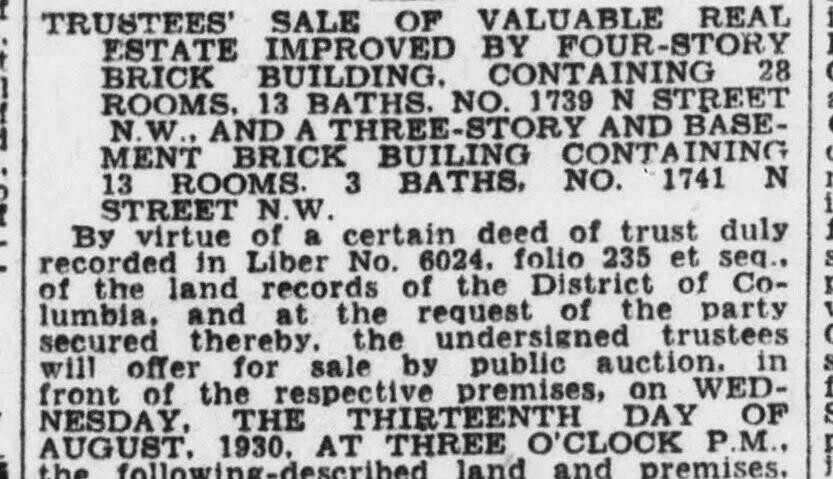
The sale was called “by virtue of a certain deed of trust” recorded in Liber 6024, folio 235, “at the request of the party secured thereby.” That was the $41,500 note. Neither document names the party, but the note was made out to Marie Rogers, and every sign says she still held it.
In all likelihood, she had called the sale herself.
The auction was set for 3 p.m. on Wednesday, August 13, “in front of the respective premises.” The trustees’ deed, made and recorded the next day, records the result. Rogers was the high bidder: $1,000 for 1739 and $1,000 for 1741.
The price was low partly because the debt stayed. She took both houses subject to the mortgages already on them, a $30,000 trust on 1739 and two more on 1741, of $18,000 and what remained on a $6,000 second trust. The furnishings came back with them.
For $2,000 and the mortgages, Marie Rogers had her inn back, now in two houses instead of one.
The Willoughby Sisters
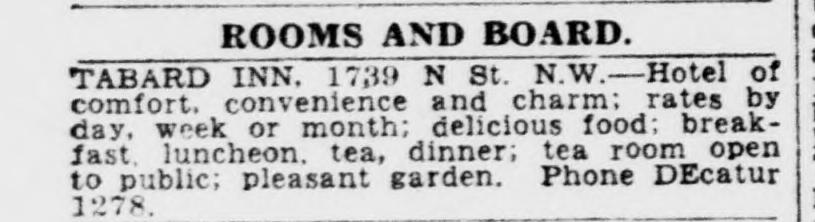
The National Register nomination says the Tabard “rarely advertised.” In fact it ran classified ads in the Star in the 1920s and 1930s. The June 1933 ad promised a “tea room open to public” and a “pleasant garden.”
The third house came in 1935. On May 23, 1935, Grace K. Legare deeded 1737 to Isla Willoughby, not to Marie. The nomination puts the purchase in 1936, and the city’s preservation staff report says 1937.
Isla owned 1737 for the next 40 years.
The 1940 census shows how the family ran it. Marie, 55, lived at the Jefferson Apartments, paying $80 a month. Her occupation was “Manager, Guest house,” 70 hours a week.
At 1737, the enumerator listed Lillian Willoughby as head of household, with her sister Isla, 54, as the manager. Below them came the lodgers.
There was an editor, a government chemist, a personnel officer and a secretary. There was a writer named Helen R. Henry, and Eric and Winifred Nicol of New Zealand. Housekeepers ran the rooms at 1739 and 1741.
The Star’s society columns fill in the guests. In November 1939, Col. Charles Annesley Romeyn and Mrs. Romeyn “will be at the Tabard Inn, 1739 N street, for the winter.” In November 1940, the Nicols gave a wedding reception “at their home at Tabard Inn.”
The WAVES Move In
The war changed the guest list. Washington was jammed, its boardinghouses packed, and the Navy needed rooms for the women officers of the WAVES.
In November 1942 the Tabard was hiring, with a help-wanted line that read “CHAMBERMAID, colored. Tabard Inn, 1739 N st. n.w.”
In the spring of 1943, it appears, two WAVES officers moved in. One of them, Helen Clifford Gunter, wrote in her 1992 memoir that she and a fellow officer, Mary, were the inn’s first WAVE occupants. After “the horror stories we’d heard about the wartime housing shortage,” she was delighted.
By May, she wrote, it held 70 women officers. By July 1943 they had their own mess and officers’ club in the building.
Mrs. Rogers kept an eye on them. Gunter remembered her driving a few of the officers on a charity tour of the embassies, where they chatted with Mrs. Woodrow Wilson.
The Star’s servicemen’s listings for April 15, 1944, included a “WAVE officers’ spring dance, Tabard Inn, 9 o’clock tonight.” In November 1947, the paper listed “Tabard Inn Wave Quarters” among the collections holding a local painter’s watercolors.
That May, the widow of Adm. Marc Mitscher was “residing temporarily at the Tabard Inn.”
Owner, Hotel
On April 19, 1950, the census taker found the three sisters in one household. Marie W. Rogers, who gave her age as 66, listed her occupation as “Owner, Hotel.” So did Isla, 64. Lillian, 54, was the “Room Clerk.”
A decade later the Star ran a feature on the 1700 block of N Street. It noted that the Tabard “has been continuously in business since it opened some 30 years ago.”
That was off by about seven years, and it skipped the part where the owner sold it. But the Star had the important thing right. Through the sale, the lease and the auction, the Tabard appears never to have closed.
One legend the inn picked up along the way doesn’t survive the records at all. Edward Everett Hale is supposed to have written “The Man Without a Country” in the Tabard’s attic. Hale published it in December 1863, 24 years before the oldest of the three houses was built.
After Mrs. Rogers
Marie Rogers died in 1970. The Evening Star‘s obituary called her the “Owner-Manager of Tabard Inn.”
The nomination says a California developer then planned to buy the three houses, knock them down and put up an office building, and that neighbors on the block stopped it in court.
The deeds that followed are dated October 1975, not 1974 as the nomination says. Clair L. Stout and John A. Willoughby, executors of Rogers’s estate, sold 1739 and 1741 on October 15, 1975, to Tabard Associates, a limited partnership. According to the nomination, the buyers behind it were Fritzi and Edward Cohen.
Two days before that, on October 13, 1975, Isla Willoughby, then about 89, sold them 1737. Both deeds were recorded on November 4, 1975.
The Cohens reopened the restaurant in 1977. They had brought in Nora Pouillon and Margee Wright in 1976 to run it. Pouillon went on to open Restaurant Nora in 1979 and became a pioneer of organic dining.
In 1992, according to the nomination, the inn set up an employee stock ownership plan. Since 2018 the inn’s employees have collectively owned a majority of it. The District added the Tabard to its Inventory of Historic Sites on February 27, 2020, and it joined the National Register on June 22, 2020.
The Tabard Inn Today
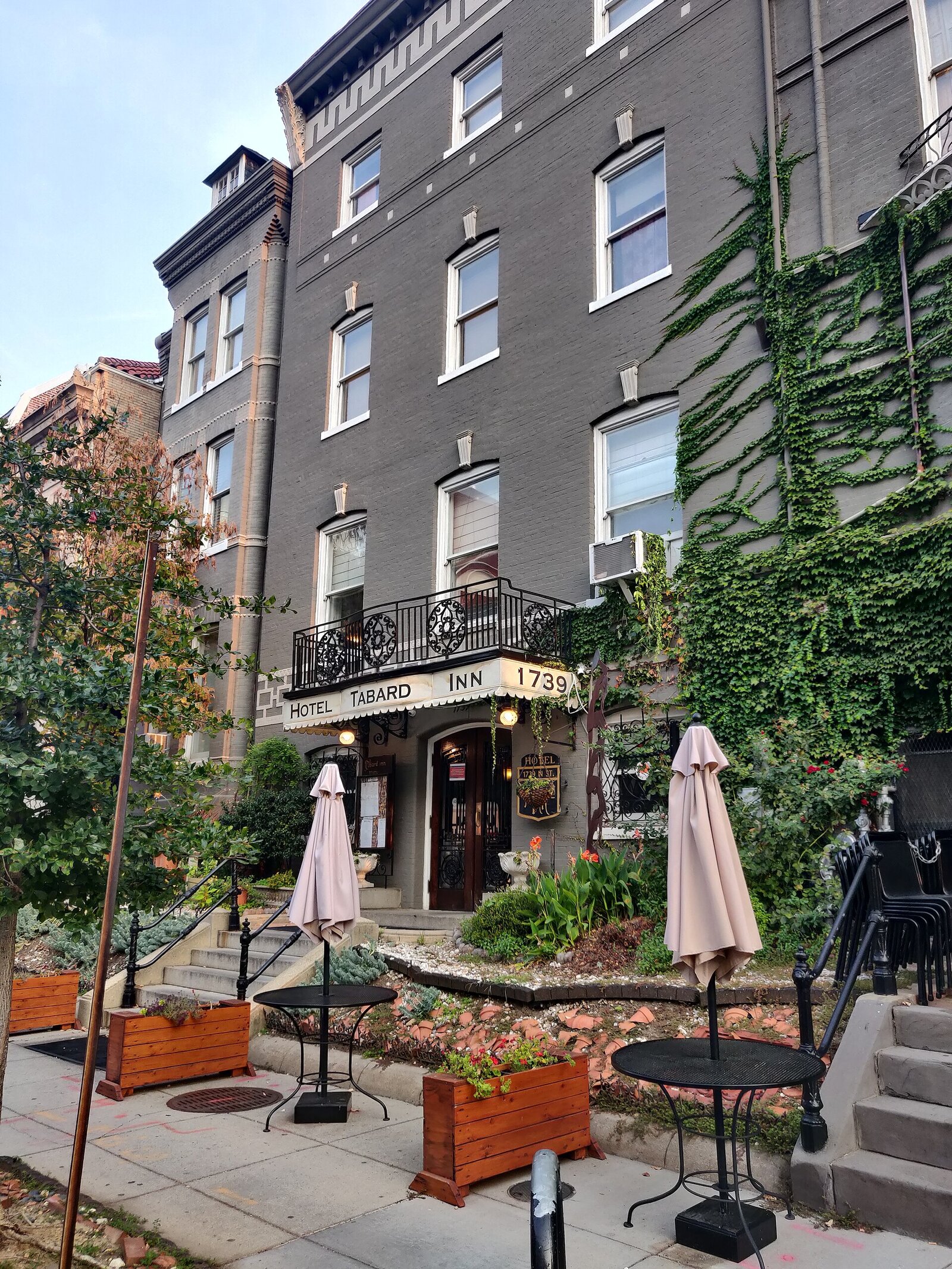
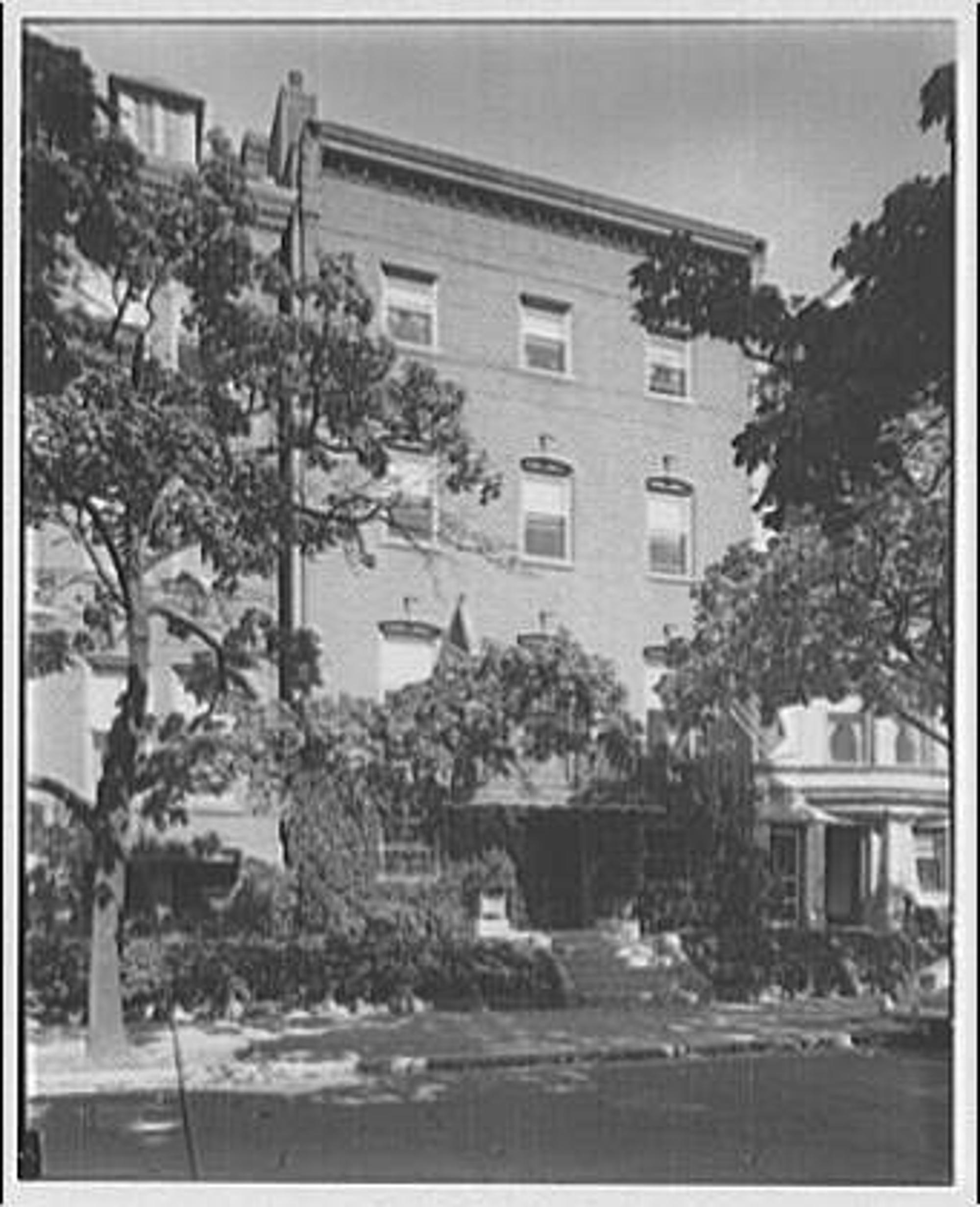
The Tabard is still at 1739 N Street, with more than two dozen guest rooms and a weekend brunch that has been a Washington habit for decades. The iron balcony and the marquee over the door look just as they do in Theodor Horydczak’s photographs.
The inn’s own history calls the Tabard “the oldest continuously operating inn in Washington D.C.” As far as the records show, that holds up, Navy years included. The idea of one continuous owner does not.
I have my own Tabard memories. A job interview in the lounge, by the fire, still one of my favorite rooms in Washington. Dinner there with my dad and my wife.
And one night just after the 2008 election, my wife and I spotted Tucker Carlson at dinner, looking about as glum as a man can look. Very Washington.
All of it happened in the house Marie Rogers bought back at auction in 1930.
Marie Willoughby Rogers sold the Tabard in 1927, watched other people run it, and then, by every sign, called in her own note and bought it back for $2,000. She kept it for the next 40 years.
We dug this one up with help from AI and checked it against the original records below. Here’s how we use AI.