
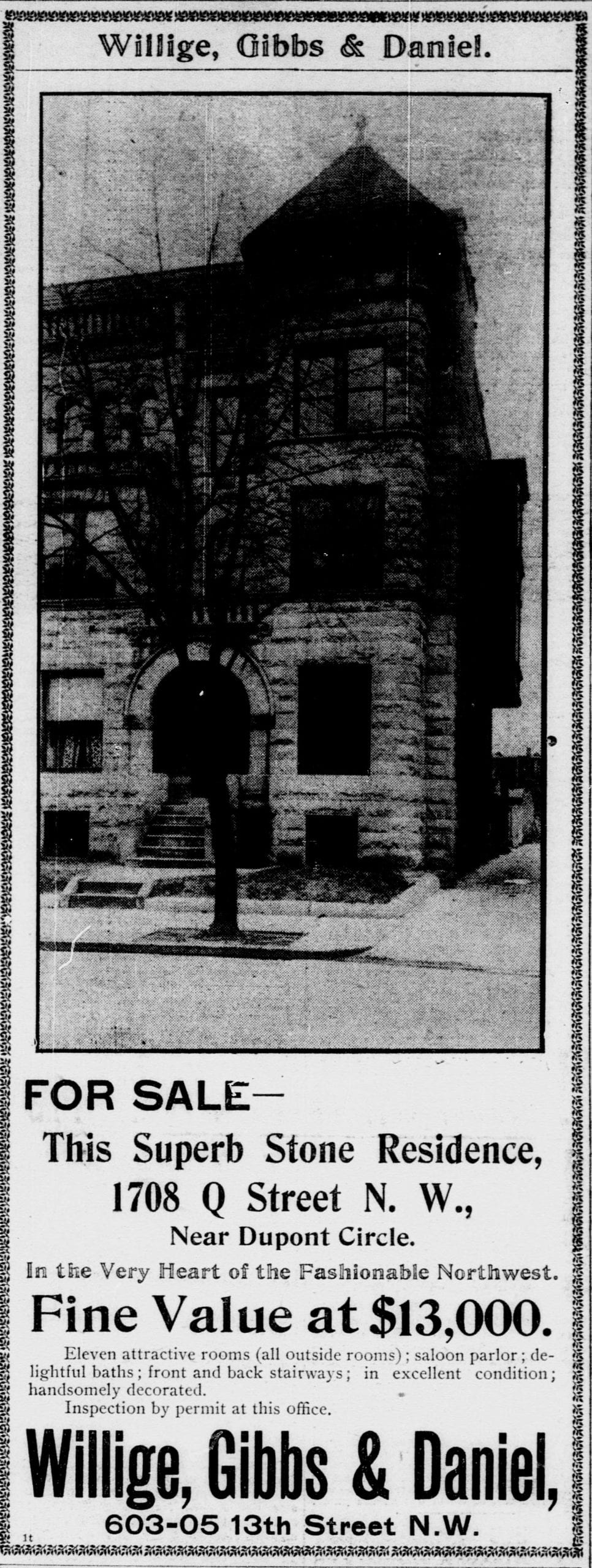
On Friday, May 4, 1906, The Evening Star ran a real estate notice for a “superb stone residence” at 1708 Q Street NW. The asking price was $13,000. Today the same house is a four-unit condo building last sold in June 2026 for $2,050,000, according to the Bright MLS listing.
What the 1906 ad did not mention, because it was already common knowledge in the trade, was who had designed and built the house. It was Thomas Franklin Schneider, the same architect who put up The Cairo one block east on Q Street four years earlier. And in about twenty-five years, the front door of 1708 would be answered by the Haitian minister to the United States.
The 1700 block of Q Street is one man’s block
Between 1889 and 1892, Schneider bought and developed the entire north side of the 1700 block of Q Street NW, and much of the south side, as a single speculative project. He paid $175,000 for the north-side land alone. He was twenty-nine years old.
The National Register of Historic Places calls the result the Schneider Row Houses. They are contributing structures in the Dupont Circle Historic District, added to the register in 1978. Every house on the block reads as part of one composition, but no two are exactly alike. That is a Schneider trademark.
1708 sits mid-block, a four-story stone rowhouse with a heavy arched entry and a stone facade that has weathered into a soft gray. Behind it: 3,739 square feet, a rear parking pad, and a floor plan long since carved into four apartments.
Schneider is best known now for a building he put up one year after finishing the Q Street row: the twelve-story Cairo Hotel at 1615 Q Street, which so alarmed Washingtonians that the District passed the height limit that still shapes the city’s skyline. If you want the full Cairo story, we have that here, plus the terrifying tale of a fatal elevator plunge inside it in 1894.
What $13,000 bought in 1906
The May 4, 1906 ad, buried on the classifieds page of the Star, described the house as a “superb stone residence” and gave the price as $13,000. In 1906 dollars that was serious money, roughly $470,000 in today’s terms, but it bought you a full stone rowhouse in Dupont Circle at the peak of the neighborhood’s Gilded Age.
That valuation put 1708 firmly in the professional-and-diplomatic bracket. It was not a millionaire’s mansion. Those were on the west side of the Circle, at Massachusetts Avenue, and on Sixteenth Street. But it was a substantial house on a stylish block, a few doors from the streetcar line on 18th Street, and close enough to the State Department that a senior diplomat could walk to work.
Dantès Bellegarde answers the door
Skip forward a generation. In the January 1935 issue of the Bulletin of the Pan American Union, the roster of the Union’s Governing Board lists Haiti’s representative:
Haiti. M. Dantès Bellegarde, 1708 Q Street, Washington, D. C.
Louis Dantès Bellegarde (1877 to 1966) was Haiti’s leading intellectual of the early twentieth century. Historian, diplomat, essayist, League of Nations delegate, and one of the earliest Black voices at that body. He served as Haiti’s Minister Plenipotentiary to Paris from 1921, and to Washington beginning February 16, 1931, when he presented his credentials to President Herbert Hoover.
Bellegarde arrived in Washington at a fraught moment. The United States had occupied Haiti militarily since 1915. President Hoover had just appointed a commission to plan the withdrawal. The Haitian minister’s job in Washington was to accelerate that departure and to reset the relationship. That negotiation is why Bellegarde is the man on the Bulletin’s page, and 1708 Q Street NW is the address printed next to his name.
He had form. At the League of Nations in 1922, Bellegarde had publicly denounced the massacre of the Bondelswarts, a small pastoral people in South West Africa, at a moment when almost no one in the League chamber wanted to hear it. In 1924 he became the first Black expert seated on the League’s Temporary Commission on Slavery. He served as Honorary President of the Second Pan-African Congress in 1921, working alongside W.E.B. Du Bois.
All of that history walked in and out of 1708 Q Street NW for close to three years. Bellegarde left the Washington post on December 9, 1933, replaced by Albert Blanchet under a new Roosevelt administration. He returned to Haiti and continued to represent his country at international conferences into the 1950s, dying in Port-au-Prince in 1966 at eighty-nine.
For a house that first came onto the market for $13,000 in a Friday classified, that is a serious footprint. Foreign legations tended to cluster along Sixteenth Street and Massachusetts Avenue; Bellegarde chose the quieter architectural pedigree of a Schneider row. The pattern is familiar in Dupont: diplomats renting the good houses on the good blocks, sometimes for a single posting.
For a comparable “small legation on the wrong side of the diplomatic map” story, see the old Korean Legation at 1500 13th Street, on Logan Circle instead of Dupont, saved by an act of restoration a century after it was sold for five dollars.
From single-family to fourplex
Somewhere in the middle of the twentieth century, 1708 was cut up. The current MLS record has it as four one-bedroom apartments totaling 3,639 square feet of living area, plus 792 square feet in the basement and two rear parking spaces. That is a familiar Dupont trajectory. Many of the Schneider block’s houses ran the same path from single-family to rooming house to condo units.
Recent property records show the building last sold in October 1992 for $350,000 before its 2026 sale. In between, it was held by the same longtime owner, kept fully leased, and treated as an income property rather than restored to a single residence. The stone facade, the arched entry, and the block-long Schneider rhythm all read as they did when Bellegarde climbed the front steps.
The 2026 listing brochure calls it “one of the most recognizable and admired residential architecture in the neighborhood.” That is real estate copy, but it is also true. And the price the market put on it, $2.05 million, is 158 times the 1906 asking price, which is roughly what the whole Dupont neighborhood has done since then.
Somewhere in Washington there is probably a still-open real estate listing that quietly leaves the Bellegarde chapter out. That is what buildings do. They collect owners, forget most of them, and hand the story to the block instead. The block, in this case, is Thomas Franklin Schneider’s.
We dug this one up with help from AI and checked it against the original records below. Here’s how we use AI.